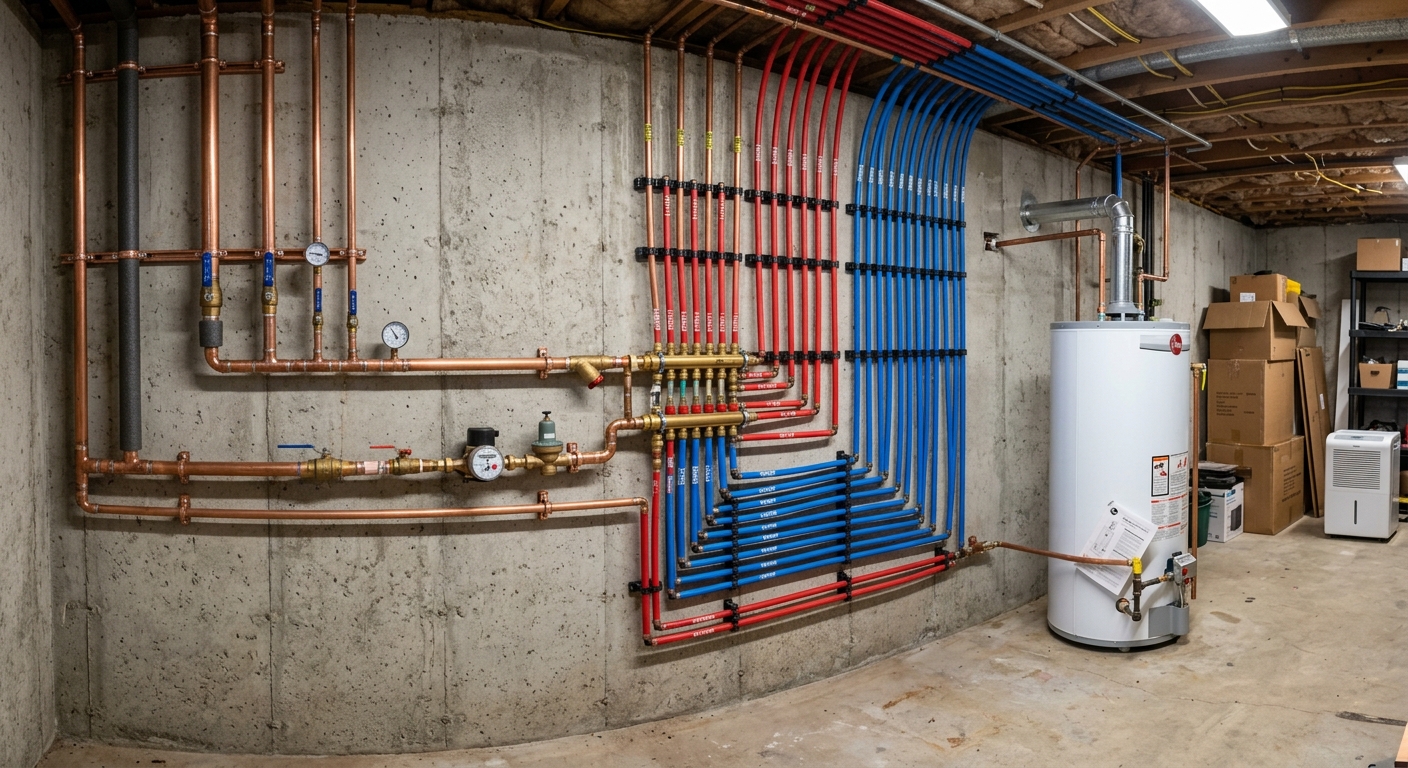
Solebury plumbing prices by job type — 2026
In Solebury, where 90.4% of homes are owned (U.S. Census Bureau, ACS 2024) and nearly half were built before 1980, plumbing repairs and upgrades are a recurring concern. The reality is that what you pay for a plumbing job here depends first on whether it’s an emergency. Emergency calls—like after-hours burst pipes—tend to run at the top end of the range, while work scheduled in advance usually lands near the low to middle mark.
Neighborhoods in Bucks County, especially post-1950 communities like Levittown in Falls Township, are full of aging copper and galvanized pipe. That vintage predicts what fails—old galvanized lines lose pressure and leak slowly, while copper in these neighborhoods is now reaching the end of its reliable lifespan, with pinhole leaks becoming more common.
The most expensive calls remain sewer and water line replacements, but even common jobs like a water heater swap can hit the wallet. Emergency burst pipe repairs in a typical Solebury home, including opening walls, making the repair and restoring service, usually start around $750–$1,500, while a planned swap of a gas water heater runs $1,500–$3,500. Homeowners with older homes—44.3% built before 1980—can expect material and access to move the needle up or down.
| Service |
Scope |
Emergency rate |
Standard rate |
| Emergency repair — burst pipe |
locate, open, repair section, restore service |
$750–$1,500 |
$450–$1,500 |
| Water heater replacement (gas, 40–50 gal) |
remove old, install, test, haul away |
$2,400–$3,500 |
$1,500–$3,500 |
| Drain cleaning — main line |
augering or hydro-jet, camera if needed |
$350–$800 |
$200–$500 |
| Sewer line spot repair |
excavate or reline a failed section |
$2,500–$15,000 |
$2,500–$15,000 |
| Whole-house repipe |
replace supply lines throughout, patch and finish |
— |
$4,400–$10,500 |
| Water service line replacement |
street to house, excavation and restoration |
— |
$7,000–$15,000 |
Estimates for a typical Solebury home. Access difficulty and pipe material move these figures more than anything else.
Galvanized, copper, PEX, cast iron
Many homes in Solebury and throughout Bucks County, especially in Levittown’s mass-built post-1950 housing, still use their original plumbing. Galvanized steel and copper were standard, with supply piping sized for economy, not today’s usage. Knowing your pipe material is worth your time—because it predicts both the next failure and the right repair.
To identify what you have: Look for an exposed pipe (try under a sink or in the basement). Galvanized steel is dark gray, magnetic, and threaded at joints. A scratch test reveals a silver-gray metal. Copper is orange-brown and non-magnetic, usually joined by solder. PEX is flexible, colored red, blue, or white, with crimped rings at joints. Cast iron drain pipes are heavy, dull black or rusty, and ring if tapped. Clay tile is reddish and appears only at the main sewer lateral. Polybutylene is gray or blue, usually with plastic fittings—avoid it, as insurance companies often will not cover it.
Era predicts what’s inside your walls. Galvanized steel in pre-1960 homes loses flow and rusts through after about 40–60 years—many in Solebury are now past due. Copper is more durable, but with Bucks County’s water chemistry, pinholes are seen after 50–70 years. PEX began showing up in the 2000s and should last 40–50 years barring UV exposure. On the drain side, cast iron used before 1975 lasts up to 75 years before cracking or scaling, while clay tile (pre-1980) fails at the joints, admitting roots. Modern PVC or ABS, common since the 1970s, offers the longest trouble-free service for drains if undisturbed.
| Material |
Typical era |
Failure mode |
Service life |
| Galvanized steel supply |
pre-1960 |
internal corrosion, pressure loss |
40–60 yrs |
| Copper supply |
1950s–present |
pinhole leaks, joint failure |
50–70 yrs |
| Polybutylene supply |
late 1970s–1995 |
fitting failure, sudden bursts |
unreliable |
| PEX supply |
2000s–present |
fitting or UV degradation |
40–50 yrs |
| Cast iron drain |
pre-1975 |
corrosion, cracking, scale |
50–75 yrs |
| Clay tile sewer lateral |
pre-1980 |
root intrusion at joints, offset |
50–60 yrs |
| PVC / ABS drain |
1970s–present |
joint separation, crushing |
50+ yrs |
Verifying a Solebury plumber's credentials
In Pennsylvania, plumbing is not licensed at the state level. Instead, plumbers are licensed (if at all) by the municipality they work in. This means a plumber licensed in one township may have zero standing in the next—and not every Bucks County town runs a plumbing licence registry. When hiring in Solebury, always ask: “Are you licensed to pull a permit here?” not just “Are you licensed?”
Because Solebury is within Bucks County, where surrounding boroughs and townships each run their own code offices (the notable example being Bensalem Township), local offices enforce the Pennsylvania Uniform Construction Code (UCC), itself based on the International Residential Code. Most plumbing requiring layout changes or new fixtures will prompt a permit and inspection from your township code office. Typical faucet or showerhead swaps may not trigger permitting in some towns, but anything altering water or sewer lines almost always will.
For contracts over $500, plumbers are required to hold a Home Improvement Contractor (HIC) registration by the Pennsylvania Office of Attorney General—this can be checked at hic.attorneygeneral.gov. Workers’ compensation coverage is mandatory for any business with employees, verifiable at the state’s WCAIS system (wcais.pa.gov). Always ask for a copy of their insurance certificate, and if your home was built before 1978, verify EPA Lead Renovator certification using the federal listing.
Vetting a plumber in Bucks County
When hiring a plumber in Bucks County, where each township controls its own licensing and inspection, start by checking if your plumber legally operates in your township—not just in “Bucks County” or the next town over. For work over $500, use hic.attorneygeneral.gov to confirm a valid Home Improvement Contractor (HIC) registration by legal name and number. Demand a certificate of insurance that names your property as the certificate holder for liability and workers’ comp, which you can cross-check using the WCAIS portal.
Find out: does this company send its own W-2 crew, or farm out work to subcontractors? You want names before the day of the job. Emergency dispatches should always disclose up front what “emergency rates” mean—for instance, main line drain cleaning which runs $350–$800 as an emergency in Solebury.
- Check HIC registration at hic.attorneygeneral.gov
- Verify municipal licensing for Solebury, not just Bucks County
- Confirm workers’ compensation at wcais.pa.gov
- Obtain a certificate of insurance naming your address
- Get written work and price agreement—required by law over $500
- Ask about employee status: in-house crew or subcontractors
- Request jobsite supervisor’s name in advance
- Ask for proof of EPA Lead Renovator certification for pre-1978 homes
- Review warranty terms in writing
- Request a fixed “emergency” vs. “standard” price sheet
- Look for written permit and inspection requirements for your town
- Insist on camera footage and a test before approving major work
Bucks County’s dense contractor market means competition is intense, but also that inexperience is common. Walk away if anyone proposes a full repipe or sewer replacement without first providing camera footage or documenting a failed pressure test—there’s no valid shortcut in this trade.
Sewer line problems in Solebury
In Solebury and throughout most of Bucks County, the homeowner typically owns the sewer lateral from their house all the way to the main—even where that means responsibility extends under a township street. This is the number one cause of arguments after a backup, because digging in the street can match or exceed the repair cost on your own property.
Watch for these signs, in order of severity: one slow drain (often a local clog), multiple slow or gurgling drains (suggests a blockage in the main line), then a backup at the lowest fixture (usually a basement drain or tub spillover). The minimum standard for diagnosis before any excavation or trenchless repair should always be a camera inspection. Clay tile lines (which show up in homes built before 1980) are notorious for root intrusion at the joints. Older cast iron often has “bellies” or sags that trap solids. Open-trench replacement is sometimes the only option, but trenchless relining is available in much of Bucks County if the line is structurally sound.
Some of the northern Bucks townships still rely on individual septic systems. If you’re on septic, slow drains and backups are more often about a full tank or failing drainfield. For these homes, tank pumping every 2–3 years keeps it working—do that before blaming the pipes.
Repeat this: Don’t ever accept a quote to dig or replace your sewer lateral without reviewing the camera video yourself or with a trusted pro. A proper spot repair or full replacement runs $2,500–$15,000 in Solebury and can be justified only after clear visual proof of a break, major offset, or root mass.
Finding a hidden leak in Solebury
If you suspect a hidden leak in your Solebury home, start with the free step: shut off every faucet and appliance, then watch your water meter. If the triangle or dial spins when everything is “off,” you’ve got a supply-side leak somewhere in the house or yard.
Locating the precise spot is where a professional earns his fee. Common technologies include acoustic listening devices (for pinpointing leaks in walls), thermal imaging (which spots cold wet patches behind drywall), and tracer gas (for slab or underground leaks). Slab leak location usually costs about what a burst pipe repair does: expect $450–$1,500 before any opening or fix.
Slab leaks in older homes with embedded copper are rare but not unknown. Wall leaks often show up as bubbling paint, buckled trim, or mold—but don’t let anyone open a wall “just to look.” Any pro should confirm the leak location first using non-invasive tools. Out in the yard, a hidden irrigation leak often leaves a soft patch or spike in your usage—root it out before your next bill surprises you.
Winter pipe failures in southeastern Pennsylvania
Southeastern Pennsylvania, including Solebury, faces moderate freeze-thaw cycles, with a local frost depth of 30 inches and a winter design temperature of 14 °F. Pipes most at risk are those outside the insulated envelope: exterior walls, unheated crawlspaces, garages, attic runs, and—every year—garden hose bibs that weren’t shut off and drained before the first hard freeze.
Frozen pipes usually burst not at the ice plug but just between it and the first closed fixture, as pressure builds up. Prevention is always less hassle and expense than repair. The basics: insulate exposed lines, install electric heat tape if you have a stubborn cold zone, open cabinets on exterior sinks in extreme cold, and leave a trickle running during overnight freezes. Most importantly, shut off, then drain, all outdoor spigots before late fall.
If a pipe does freeze, use a hair dryer, heat gun (on low), or electric heating pad to thaw—never an open flame. If you hear running water or spot moisture from a burst, shut the main and call. In Solebury, opening and repairing a burst pipe averages $750–$1,500 on an emergency call—worth preventing whenever possible.
Frequently asked questions — plumbing in Solebury
Which utility supplies water to Solebury?
The Bucks County Water & Sewer Authority is the water provider across large areas of Bucks County, including Solebury. They handle both public water supply and sewer service in many neighborhoods. If you live in a part of town where water service lines are older—some lines still include segments of lead or undersized galvanized pipe, especially in developments dating to the 1950s–1960s—Bucks County Water & Sewer Authority will be the first call for any utility-side repair or to confirm water quality. If you need to replace your own service line (from the property line or street to the house), homeowners in Solebury can expect excavation, replacement, and restoration costs of $7,000–$15,000, depending on access and length.
How do I tell what my pipes are made of?
For Solebury homeowners, most supply pipes visible in a basement, crawlspace, or under a sink will be either copper, galvanized steel, or PEX for recent updates. Do a quick scratch test: steel is magnetic, with a grayish color under the surface and threaded joints. Copper is orange-brown and non-magnetic, often soldered. PEX is flexible and plastic, typically red, blue, or white with crimp rings. Cast iron drains are thick, dull black, and heavy, while PVC/ABS drain pipes are white or black and plastic. Knowing your material helps plan repairs and predicts expected failures. For example, if your home is due for whole-house repiping, most Solebury projects run $4,400–$10,500 depending on size and access.
Is a water softener worth it in Solebury?
Water hardness varies in Bucks County, but most of Solebury receives moderately hard water—enough to leave some scale but rarely enough to damage fixtures or appliances quickly. For most homeowners, especially in older homes with copper or galvanized pipes, a softener can extend the life of water heaters and reduce spotting. For recent plumbing or all-PEX systems, the benefits may be less significant. Unless you have severe scale buildup (visible on aerators or inside kettles), a water softener is optional, not essential. The more common unscheduled plumbing expense here is not scale, but leaks due to aging pipes and freeze-thaw cycles—such as emergency repairs running from $450–$1,500 if a line bursts.
How much does a plumber cost in Solebury?
In Solebury, routine plumbing rates are driven by job type and urgency. For example, a standard drain cleaning appointment can run $200–$500 if scheduled in advance, or $350–$800 during off-hours when it’s an “emergency.” Emergency burst pipe calls—which include same-day repair, opening and restoring the wall or area—typically cost between $750–$1,500. Major replacements, such as swapping out a gas water heater, will fall in the $1,500–$3,500 range. Always ask your plumber in advance for both regular and emergency rates before scheduling work.
Who inspects plumbing work in Solebury?
Each township in Bucks County, including Solebury, runs its own code office for building and plumbing permits. Projects that alter water or sewer piping layout—or even add fixtures—require permits and inspections under the Pennsylvania Uniform Construction Code (UCC), which is enforced locally. For Solebury residents, the municipal inspector (not a county or state inspector) will visit the property to approve rough-in, pressure, and final work on any permitted job. If your contractor says “no permit is needed” for a major job, call your township code office directly to confirm. Emergency jobs may be opened up and temporarily restored before a next-day inspection.
How deep do water lines need to be buried in Solebury?
In Solebury’s climate, the required minimum burial depth for water lines is governed by frost depth. Southeastern Pennsylvania, including Bucks County, sets this at 30 inches to prevent freezing, based on local winter temperatures that can drop as low as 14 °F. Proper burial is essential both for new installations and for any service line replacements, especially on older homes. If your water service pipe is under-insulated or shallow, it’s more vulnerable to freezing and failure—repairs for a frozen or burst line can cost $750–$1,500 or much more if excavation is required.
How do I shut off the water to my house?
In almost every Solebury home, the main shutoff valve is found just inside where the municipal water service enters—often in a basement or utility closet near the front foundation wall. Turning this clockwise closes it; test to be sure it moves freely before an emergency arises. If you have older galvanized or original copper lines, use gentle pressure—a stuck valve can snap or leak. If you have a municipal meter pit outside, it may have a secondary shutoff requiring a special tool. Closing the main is the first step if a pipe bursts (before calling for an emergency repair that typically starts at $750–$1,500). It’s worth practicing at least once so everyone in the home knows how.
Who owns the sewer lateral, me or the city?
In Solebury and throughout most of Bucks County, the property owner is responsible for the sewer lateral from the house all the way to where it connects to the main—often in the street or right-of-way. The city or township maintains only the public main beneath the road, not the section under your yard or even the street itself. This matters because repairs can be significant: a spot repair, needing excavation and reinstatement, runs $2,500–$15,000 depending where the break occurs. Always demand a clear camera inspection before any repair or replacement contract.
What does repiping a house cost in Solebury?
Repiping a typical Solebury home (removing old copper or galvanized supply lines and replacing with new PEX or copper) usually lands between $4,400–$10,500, with median jobs falling near $7,200. Homes built before 1980, which make up 44.3% of Solebury housing, most need full repipes when internal corrosion or pinhole leaks become common. The final price depends on the number of bathrooms, pipe runs, access (finished versus unfinished basement), and how much wall or floor repair is needed afterward. Urgency also matters—planned repiping is more affordable than emergency cut-ins.