Plumbing costs in Abington — 2026
Abington homes carry plumbing costs shaped by their mid-century construction and suburban layout. With 69.9% of residences as single-family homes and 87.2% built before 1980 (U.S. Census Bureau, ACS 2024), most local plumbing work involves aging pipe materials, original service lines, and water heater replacements. In these houses, what you pay depends on two things: access and whether you’re calling in an emergency. The same repair—take a burst pipe—can run double at 2AM compared to a regular weekday.
The region’s wave of 1950s-1970s builds means copper and galvanized pipes are typical, with clay sewer laterals and, in some, old lead or steel water service lines. That predicts today’s repair bills: repeated slab leaks, low pressure from corroded pipes, or whole-house repipes looming for homes that have put it off. Water heaters here often see their third replacement already. Owners should expect higher costs the worse the access—finished basements, tight wall cavities, or crawlspaces push rates up.
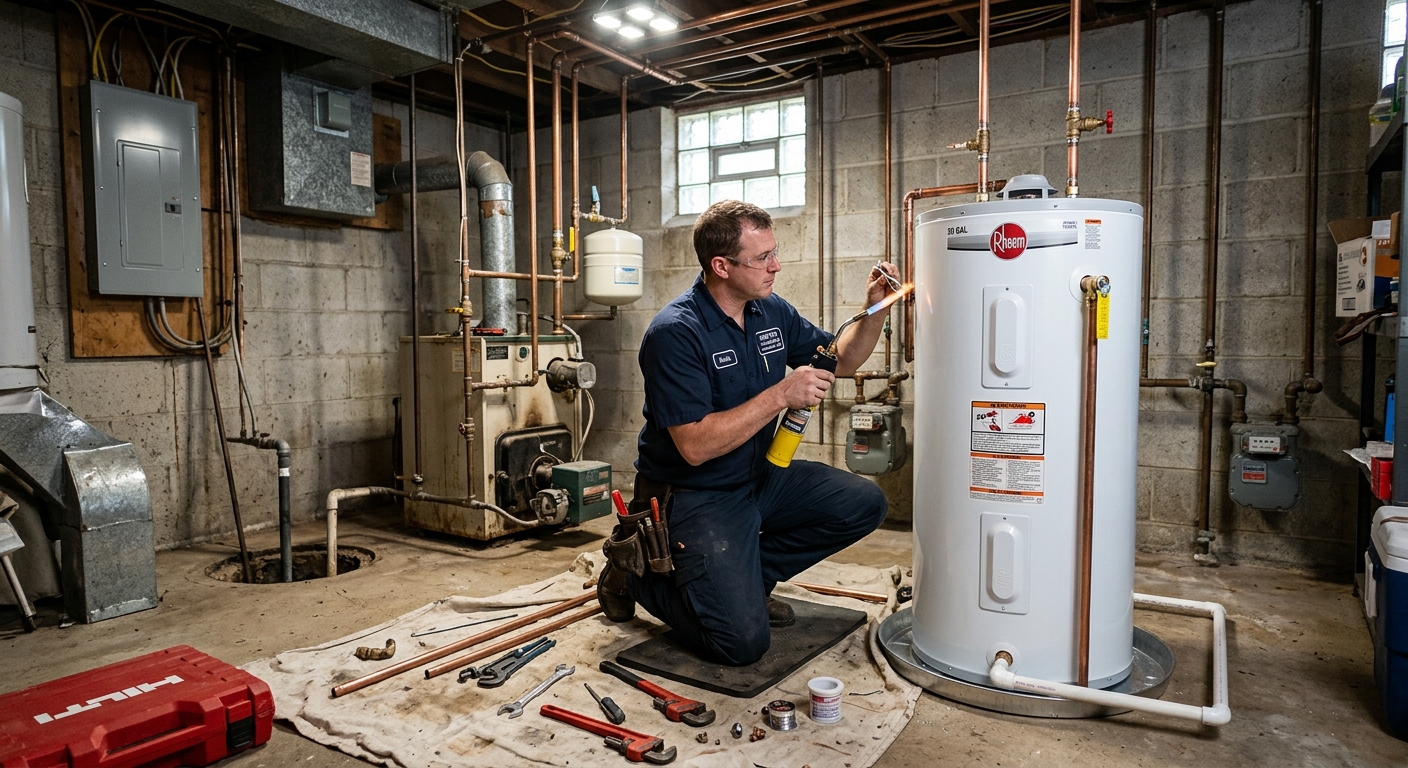
Every job has a standard and an emergency price: emergency repairs add after-hours premiums and the cost of rapid mobilization for local crews. For planned work—water heater swaps, repipes—you avoid the steepest surcharges. Think of diagnostic work, drywall repairs, and hauling away old fixtures as bundled dependencies. Here’s what to expect for typical work in Abington:
| Service |
Scope |
Emergency rate |
Standard rate |
| Emergency repair — burst pipe |
locate, open, repair section, restore service |
$650–$1,300 |
$375–$1,300 |
| Water heater replacement (gas, 40–50 gal) |
remove old, install, test, haul away |
$2,100–$3,000 |
$1,300–$3,000 |
| Drain cleaning — main line |
augering or hydro-jet, camera if needed |
$350–$800 |
$200–$500 |
| Sewer line spot repair |
excavate or reline a failed section |
$2,200–$13,000 |
$2,200–$13,000 |
| Whole-house repipe |
replace supply lines throughout, patch and finish |
|
$3,800–$9,200 |
| Water service line replacement |
street to house, excavation and restoration |
|
$6,000–$13,000 |
Estimates for a typical Abington home. Access difficulty and pipe material move these figures more than anything else.
What construction era means for your pipes
Abington’s neighborhoods are dominated by 1950s to 1970s single-family homes, with nearly nine out of ten built before 1980 (U.S. Census Bureau, ACS 2024). This means most plumbing systems here use copper or galvanized steel supply lines and cast iron or clay for the sewer lateral. Copper ages well, but galvanized builds up corrosion, causing pressure drops and eventual leaks. Clay laterals crack and admit roots, while original water service lines before the '60s may be lead or steel—especially if you haven’t seen yours replaced.
By the time a house hits its third or fourth decade, water heaters have often been swapped two or three times. For many Abington homes, your current tank is not the first, but the second or even third. Sewer lines from this era are mostly clay tile, and that makes main-line backups or root intrusion very likely. Drains may be original cast iron, which rusts out at the bottom where water sits, or transitions to modern PVC if there’s been a prior repair.
Unlike newer developments, these homes rarely face issues like polybutylene supply lines—a material linked with leaks in some 1980s-90s builds—or builder-grade fixtures at end of first life. Instead, expect trouble with aged metal pipes, corroding shutoffs, and water heaters that may not have shut-off or expansion tanks that meet current code. Spotting the materials and their age is crucial, since the cost to replace or repair is driven more by what’s behind the wall than how old the house is overall.
Comparing plumbing estimates in Abington
When you ask for a plumbing quote in Abington, the biggest difference is almost always how the job is billed: flat rate (one price, regardless of time spent) versus time-and-materials (hourly rate plus parts and incidentals). Flat rate gives homeowners price certainty, with the risk shifted to the contractor—expect a higher up-front price for that. Time-and-materials can end up cheaper if access is easy and surprises are few, but it gets expensive fast if a job turns complicated. The issue isn’t one model or the other; it’s not knowing which you agreed to.
Start with the diagnostic fee. Many local plumbers charge one, but better companies let you credit it to the repair if you proceed. A quote should state not just the price, but what work will actually be performed—what gets opened, which materials are installed, and what is or isn’t restored (drywall, tile, paint). Always check if permit fees are included: in Abington, most system changes or water heaters need one, and “not needed” is a red flag. For warranties, look for separate terms on labor and parts, as manufacturer backing is not the same as a craft guarantee.
After-hours and weekend rates should be made obvious before work starts—not buried in fine print. Here’s what to look for in a typical estimate:
| Line item |
What to look for |
Red flag if… |
| Billing model |
flat rate or hourly, stated up front |
unstated |
| Diagnostic fee |
amount, and whether it credits |
vague |
| Scope |
what is opened, repaired and restored |
price with no scope |
| Restoration |
drywall and finish explicitly in or out |
silent |
| Permit |
included and priced |
'not needed' |
| Parts |
brand and model for fixtures |
'standard fixture' |
| Warranty |
labour period stated separately |
parts only |
The point where patching stops making sense
If you’re dealing with plumbing in a classic 1950s-1970s Abington house, drawing the line between patch and replace is a real calculation. One isolated, visible leak—especially if you can see the pipe and it’s modern—may genuinely be fixed for good. But if you’ve had two or more leaks in three years, especially on galvanized or old copper, this is a sign of systemic pipe fatigue, not bad luck.
Here’s how to read the bigger warnings. Pressure dropping across the whole house means a supply problem, not just a lazy faucet. Discolored water when turning on the tap is rust or corrosion, most common with old galvanized or cast iron. Pinholes along exposed copper—particularly in the basement—show the pipe walls have thinned out. Once a pattern appears, full or partial repiping becomes about preventing water damage and surprise bills.
Deciding between copper and PEX supply lines comes down to disruption and cost. PEX is easier to fish through finished walls and cuts labor time, but some homeowners prefer copper for longevity. Whichever you choose, the drywall, plaster, or paint repairs drive up the true total—especially where there’s original plaster (not just drywall). Partial repipes help localize disruption, but if you see leaks or corrosion throughout, it’s cheapest to do it all at once and be done for decades.
| Situation |
Recommendation |
Cost |
Reasoning |
| One leak, accessible, modern pipe |
Spot repair |
$375–$1,300 |
Isolated failure—rest is sound |
| Two or more leaks in 3 years |
Partial repipe |
$3,800–$6,200 |
Repeating leaks = aging system |
| Galvanized supply, pressure loss |
Full repipe |
$3,800–$9,200 |
Corrosion means whole line is at risk |
| Polybutylene anywhere in the house |
Full repipe |
$3,800–$9,200 |
Prone to sudden failure—do not patch |
| Cast iron drain with root intrusion |
Camera, then reline or replace |
$2,200–$13,000 |
Main sewer at end of life and leaking |
| Suspected lead service line |
Test, then replace the lateral |
$6,000–$13,000 |
Lead is a health risk and must go |
Detection methods and what they cost
If you suspect a leak, the first move in an Abington home is free: shut every tap and appliance, then check your water meter. If the dial keeps spinning, you have a supply-side leak somewhere after the meter. That quick test can save a call.
Professionals step in with acoustic devices to listen for leaks inside wall voids and floors. For longer pipe runs—think slab leaks or those under finished basements—thermal imaging can spot cold spots where water escapes. More elusive, hidden leaks (like an irrigation line or a line under concrete) may need tracer gas and sensitive sniffers, while slab leak location may blend several of these to pinpoint the break with minimal cutting. These detection methods typically run from $200–$500 for basic acoustic or thermal, up to $350–$800 when tracer gas or slab work is necessary.
A plumber who wants to tear into walls before doing a proper location step is skipping the basics—always expect at least a meter test or acoustic check first. Use detection to limit the damage and avoid unnecessary patching throughout your house. In most cases, you’ll get a price upfront for both the detection work and the repair, so push for that certainty.
Verifying a Abington plumber's credentials
Plumbing work in Abington is governed by a patchwork of local and state requirements, and it’s easy to see misinformation online. In Pennsylvania, there is no statewide plumbing license. Instead, licensing is handled at the municipal level. This means a plumber registered or licensed in one city might have no standing in Abington or next-door in another township. When you hire, the real question isn’t whether the company has “a license”—it’s whether they’re licensed or registered to operate in your municipality.
For contracts over $500, every company must hold a valid Home Improvement Contractor (HIC) registration from the Pennsylvania Office of Attorney General. You can verify this directly at hic.attorneygeneral.gov. Insurance is also crucial: plumbing companies with employees (including even part-time help) are required to carry workers’ compensation, which you can confirm at WCAIS (wcais.pa.gov). Always ask for a copy of their liability and workers’ comp insurance naming you and your property on the certificate.
In Abington and across Montgomery County, permits are required for plumbing alterations, repipes, water heaters, and any change to a water, sewer, or venting system. Minor like-for-like fixture swaps with no system change don’t require a permit. Inspections are performed by the local municipal code office. For projects in a home built before 1978, the contractor must comply with the federal EPA Lead Renovation, Repair and Painting Rule—check for their certification via certifiedrenovatorsearch.epa.gov.
Vetting a plumber in Montgomery County
With Montgomery County’s crowded contractor market, finding a reputable plumber means looking past the ad and checking actual credentials. Step one: confirm the Home Improvement Contractor (HIC) registration at hic.attorneygeneral.gov, but remember—licensing is municipal, not statewide, so always ask if they are approved to pull permits in your township. Insurance isn’t just a line on the website; require a certificate that names your address as the insured site. Confirm workers’ compensation via the state’s WCAIS system.
Ask if the company uses their own employees or subcontracts the work—this matters for accountability if things go sideways. For urgent repairs, ask for their emergency and after-hours pricing policy in writing before the truck shows up. When a fix involves major work—like a repipe or sewer line replacement—insist on camera footage or a pressure test as proof the work is needed. In a dense market like this, competition is high, but so is the possibility of being oversold.
- Check HIC registration at hic.attorneygeneral.gov
- Ask: Are you licensed to pull permits in this township?
- Request a certificate of insurance naming your property
- Verify workers’ compensation at wcais.pa.gov
- Ask if techs are company employees or subcontractors
- Require written emergency and after-hours rates
- Demand a written, detailed scope with brands and materials listed
- Confirm permit is included for system work or water heaters
- Warranty terms for labor and parts separately stated
- Proof (camera, pressure test) before approving big jobs
- For pre-1978 homes, check EPA Lead RRP certification
- Never sign a contract without the 3-day cancellation notice
Red flags: In such a saturated market, be cautious about any contractor who pushes a full repipe or sewer replacement with no footage, skips the written scope, or claims a permit “isn’t needed.” You have options—don’t be rushed.
Frequently asked questions — plumbing in Abington
How do I shut off the water to my house?
In Abington, almost every single-family home has a main shutoff valve right where the water line enters—typically in the basement. Look for a round gate valve or a lever-handled ball valve near the foundation wall (often close to the water meter). Turn a gate valve clockwise until tight; for a ball valve, move the handle so it’s perpendicular to the pipe. This will stop all water from coming in—a must in an emergency. If you can’t find the main shutoff, it may be hidden behind a finished wall or obscured by old construction (not uncommon in houses built before 1980). If the valve is stuck or leaking at the stem, call for help; replacing just a shutoff valve might cost $375–$1,300, but every second counts if you have an active leak.
What do I do if a pipe is frozen but not burst?
In an Abington winter, pipe freezes are most common in exterior walls and cold, unfinished basements. If a pipe is frozen but hasn’t split, leave the affected tap open, and gently warm the pipe starting near the faucet with a hair dryer. Never use an open flame; hot water pipes usually freeze first since they have less flow. If you have multiple lines frozen, or water is still not coming through, the problem could be in an inaccessible run. Don’t use a space heater unattended, as this is a fire risk in older homes with insulation packed against pipes. If you can’t thaw it out, or suspect a split, call a plumber—repairs for a burst pipe usually run $375–$1,300 in Abington, but quick action can prevent water damage much more expensive than that.
Who owns the sewer lateral, me or the city?
In Abington and the rest of Montgomery County, you—the homeowner—own the sewer lateral from your house all the way to the main line in the street. This includes any portion of the line that runs under your yard, driveway, or sidewalk. The municipal authority maintains only the main line, not the connection. If you experience a sewer back-up or need a repair (especially common in aging clay tile laterals here), it’s your responsibility to fix it. A spot repair on a collapsed or root-intruded lateral typically costs $2,200–$13,000 depending on depth and street restoration. Always get a camera inspection and footage before signing for a dig or reline job.
Can I do my own plumbing work in Abington?
You can tackle minor plumbing repairs in your Abington home—things like replacing a faucet, swapping a toilet, or repairing a shutoff—without a permit if you’re not altering supply, drain, or vent systems. Anything more involved, such as a repipe, new water heater, or moving a fixture, requires a permit from your municipal code office and should be done by someone registered as a Home Improvement Contractor and, where applicable, licensed for your township. For homes built before 1978, the EPA Lead RRP Rule applies, and DIYers can run afoul if disturbing painted surfaces. Saving on labor is appealing, but complex mistakes can mean thousands in repairs: repipe corrections, for instance, can run $3,800–$9,200 when done wrong. Know when to call a pro.
Is a tankless water heater worth it in Abington?
Tankless water heaters are increasingly popular in Abington, but they’re not an automatic win. The retrofit cost is higher—both the unit and the venting work—compared to swapping in a standard 40–50 gallon gas model, which typically runs $1,300–$3,000 here. Tankless units can save on gas for big households, but installation in older homes with smaller gas lines or original venting may mean costly upgrades. Recovery time (how fast you get hot water) is faster, but those savings only add up with high usage. If your home already has compatible gas lines and venting, the math is more appealing; otherwise, a new tankless install may not pay back for years. Weigh total installed cost, not just the sticker price.
How much does a water heater replacement cost in Abington?
Replacing a standard 40–50 gallon gas water heater in Abington usually falls between $1,300–$3,000. This price covers removal and disposal of your old tank, installation of the new one, and all connections and venting to code. If your home’s last water heater lasted 8 to 12 years, you’re in the majority for this area’s 1950s–1970s houses. Expect the higher end of the range if you need upgrades for shutoff valves, expansion tanks, or venting to pass inspection, or if access is tough (tight basements are common). For homes built before 1978, any disturbance of painted surfaces means lead-safe rules may add cost—make sure the installer shows their EPA credentials.
How long should a water heater last in Abington?
Most water heaters in Abington single-family homes—built mainly during the 1950s to 1970s—last between 8 and 12 years, especially with the moderate local water quality. If your heater’s approaching this age (check the label for the install year), replace before you see leaks or rust at the base. Proactive replacement is wise, because a rusted tank can fail dramatically and cause thousands in damage to finished basements and living spaces. Installing a new 40–50 gallon gas model in Abington costs $1,300–$3,000, and that price often includes hauling away the old unit. If you’re upgrading to a larger tank or tankless, check if your gas line and venting need work—older setups may not be compatible without additional cost.
Are tree roots a common sewer problem in Abington?
Yes—Abington’s dominant housing stock with clay tile sewer laterals is especially prone to root intrusion. Mature trees in older suburban lots send roots into the smallest cracks and joints, causing slow drains or full blockages. If you have repeated main line clogs or hear lots of gurgling in floor drains, a camera inspection is warranted. Cleaning a root-invaded line usually runs $200–$800, but once the tile fails or collapses, local spot repairs can cost $2,200–$13,000. Preventive cleaning extends the life, but once there’s a breach, replacement or trenchless relining is your only permanent fix. Always request a recording of the inspection if a plumber recommends major work.
What does emergency plumbing cost in Abington?
Emergency plumbing rates in Abington reflect the need for quick mobilization and after-hours work in a market already busy with calls. For a typical burst pipe or active leak, the emergency response cost is usually $650–$1,300, depending on access and whether significant restoration is involved (like cutting a finished ceiling to reach pipes). Drain clearing or water heater replacement on a weekend can also bring a higher charge—expect $350–$800 for main line cleaning and $2,100–$3,000 for water heater swaps at off hours. To keep costs down, shut off your main as soon as trouble starts and document the situation thoroughly—this also helps if you need to file a homeowner’s insurance claim.