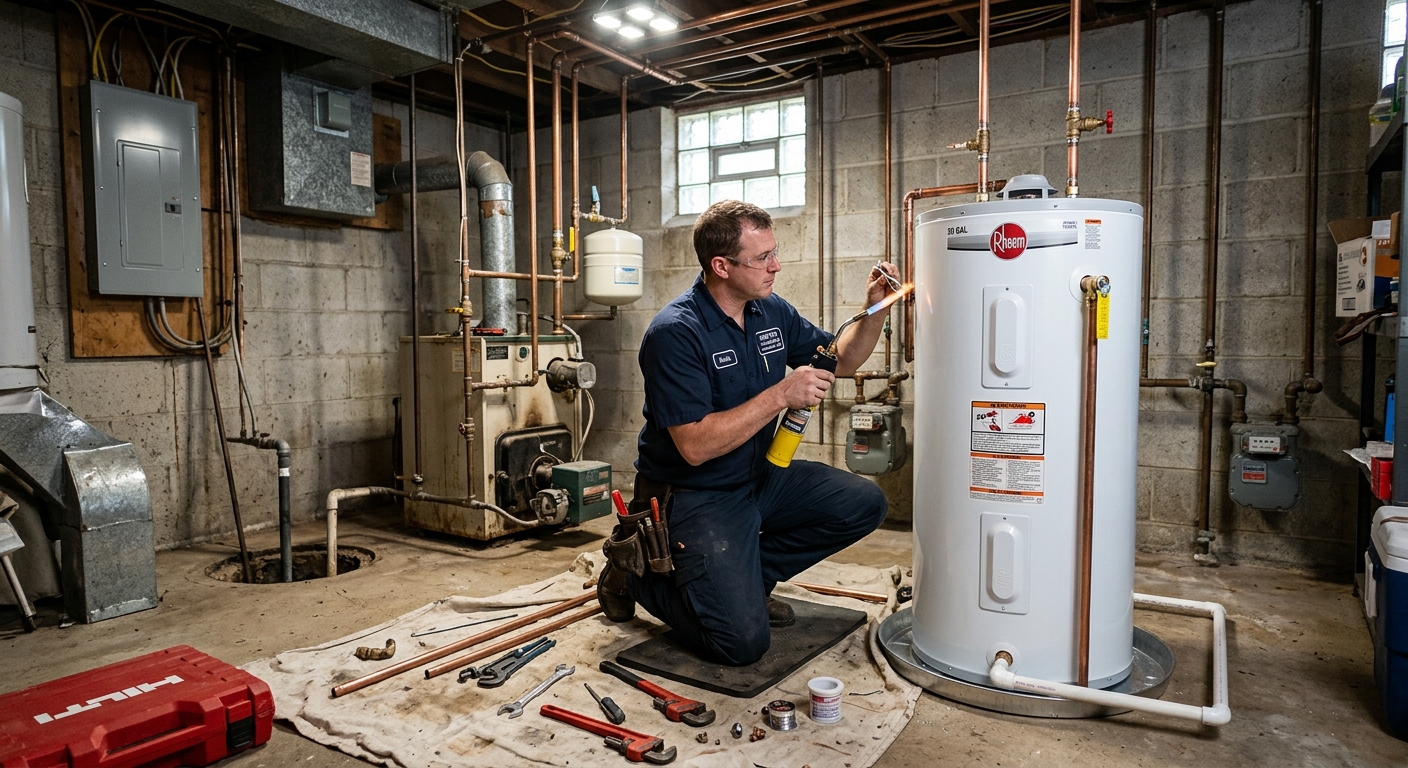
Cranberry plumbing prices by job type — 2026
Cranberry homeowners face a distinctive set of plumbing challenges, with about 68.9% of homes built before 1980 and three out of four being single-family residences (U.S. Census Bureau, ACS 2024). Here, the era a house was built points directly to the plumbing materials inside—galvanized and cast iron are common in late-1800s and early-1900s homes, and both come with their own likely failure points and costs to repair or replace.
One of the biggest drivers in what you’ll pay for plumbing in Cranberry is whether you’re dealing with an emergency. The same service—like fixing a burst pipe—can cost twice as much (sometimes more) if it’s after hours or during severe winter weather. In this rural market, expect travel surcharges, especially for emergency work, due to the limited number of contractors able to serve the area on short notice.
If you’re seeing higher bills in Cranberry compared to other places, it’s not just the rural location. The age and makeup of your pipes (like galvanized steel or cast iron) mean some repairs can be complicated, requiring specialized replacement materials and more invasive work—especially true if sections have already been replaced piecemeal over the decades.
| Service |
Scope |
Emergency rate |
Standard rate |
| Emergency repair — burst pipe |
locate, open, repair section, restore service |
$550–$1,150 |
$325–$1,150 |
| Water heater replacement (gas, 40–50 gal) |
remove old, install, test, haul away |
$1,800–$2,600 |
$1,150–$2,600 |
| Drain cleaning — main line |
augering or hydro-jet, camera if needed |
$350–$800 |
$200–$500 |
| Sewer line spot repair |
excavate or reline a failed section |
$1,900–$11,500 |
$1,900–$11,500 |
| Whole-house repipe |
replace supply lines throughout, patch and finish |
|
$3,300–$8,000 |
| Water service line replacement |
street to house, excavation and restoration |
|
$5,200–$11,500 |
Estimates for a typical Cranberry home. Access difficulty and pipe material move these figures more than anything else.
Sewer line problems in Cranberry
In Cranberry, the responsibility for the sewer lateral—meaning the pipe carrying wastewater from your home to the main—almost always falls on the homeowner, and this includes sections under your yard or even under the public right of way in some cases. Most disputes and surprise costs in sewer repairs come down to this point. If you own your Cranberry house, you likely own that whole run.
Symptoms of a sewer issue escalate quickly: it starts with a single slow drain, then moves on to multiple sluggish fixtures, gurgling toilets, and finally a backup at the lowest drain, such as a basement floor drain or shower. When more than one fixture is acting up, the problem is rarely a clog in a branch—it’s in the main line or even beyond your house’s footprint.
Before anyone digs, a camera inspection is not optional. Any serious plumber in the area will run a camera, show you the footage and explain if roots, a collapsed pipe, or a shifting joint (common with older clay tile lines or cast iron) are to blame. Never accept a quote for excavation work without seeing that footage yourself, as it’s the only way to know what you’re paying for and to avoid unnecessary or overly broad digging.
Clay tile laterals are particularly vulnerable to root intrusion at the joints, and offset pipes (caused by shifting or settling in older soils) cause recurrent blockages. Repairs range from spot replacement of a few feet to relining the entire run. In some municipal areas, relining is an option, but open-cut replacement is still common when the pipe has fully collapsed.
Cranberry Township homes commonly have septic systems. If that’s you, remember: regular tank pumping (every 3–5 years) prevents overflows, but drainfield failure is a separate (and expensive) issue, unrelated to the typical main sewer clog. Know which system you have before you call for help.
Who is allowed to do plumbing work in Pennsylvania
Plumbing work in Pennsylvania isn’t licensed at the state level, but rather by each municipality. In Cranberry’s part of Venango County, only cities such as Oil City are noted for having formal permitting and inspection of plumbing work. That means someone “licensed” in a nearby area may not be recognized to do work on your home. It’s not enough to ask a contractor if they’re licensed—the real question is, “Are you registered and permitted to work here?”
Where formal code enforcement exists, such as in Oil City, permits are required for new work, replacements, and alterations, while minor repairs (like fixing a leaky faucet or clearing a drain without replacing pipes) usually do not need a permit. Inspections are carried out by the Oil City Codes Department, not a county or state plumbing board. For many homes in rural areas or townships, formal permitting is much less common, but you should still ask what is required where your house sits.
All contracts over $500 must be with a Home Improvement Contractor (HIC) registered with the Pennsylvania Office of Attorney General. You can verify this at hic.attorneygeneral.gov. Workers’ compensation is mandatory for any employer, and you can confirm insurance status via WCAIS (wcais.pa.gov). These are your last lines of defense to ensure you aren’t hiring someone unqualified or uninsured to work inside your walls.
Choosing a water heater in Cranberry
When replacing a water heater in Cranberry, most homeowners pick between gas and electric tank models, with tankless and heat pump units becoming more available. A standard gas tank water heater is the least expensive to install, but also has the shortest expected life and higher energy losses. Tankless models provide endless hot water and last longer, but cost more up front, and in older houses they often require upsizing the gas line and installing a new vent—which can surprise you at install. Heat pump water heaters have the lowest running cost, but they cool the room where they’re installed, make some noise, and need plenty of air space—think unfinished basements, not closets or tight laundry rooms.
In Cranberry’s late-1800s and early-1900s homes, gas is usually available, but some outlying areas may only have electric. Where gas isn’t an option, the choice shifts toward electric and heat pump models, despite their quirks. Sizing should be by first-hour rating, not just tank volume—the first-hour rating tells you how much hot water the heater can deliver in a busy period, like multiple showers or laundry cycles.
Always ask for an expansion tank on the cold side and a pan with a floor drain (if possible)—both are sensible cheap insurance, especially on older houses with inconsistent plumbing upgrades. Premature failure is almost always a problem with the tank itself, not the controls, so expect replacement rather than repair once a heater starts leaking.
| Type |
Installed cost |
Service life |
Operating cost |
Best when |
| Gas tank, 40–50 gal |
$1,150–$2,600 |
8–12 yrs |
moderate |
existing gas, unfinished basement |
| Electric tank, 40–50 gal |
$1,150–$1,800 |
10–15 yrs |
high |
no gas, lower upfront |
| Gas tankless |
$1,800–$2,600 |
18–25 yrs |
low-moderate |
high demand, remodel/new |
| Heat pump water heater |
$1,800–$2,600 |
13–15 yrs |
lowest |
ample space, electric-only |
When to call now and when to wait until Monday
Deciding between an emergency plumbing call and waiting for regular hours makes a big difference in both cost and stress. Emergency calls in Cranberry always carry a premium—after-hours dispatch fees, travel surcharges (because contractors are thin on the ground here), and overtime labor all stack up, especially if a real fix has to happen immediately. Add to that the fact that troubleshooting under time pressure can mean more cautious, sometimes more expensive, recommendations.
What’s truly an emergency and what can wait? Active flooding in your home, sewage backing up anywhere, a total loss of water, or any gas odor needs an immediate call. These can cause serious property damage or personal danger fast. On the other hand, isolated slow drains, a running toilet, or a minor drip under a sink can almost always wait for normal business hours, potentially saving you $200–$600 compared with calling at night or on a weekend.
The best way to reduce your own risk is knowing how to shut off water at the main (usually where the service line enters your basement) and at individual fixtures. If you can safely turn off the supply, most minor leaks transform from full-blown emergencies into scheduled work, which means a lower price and less disruption.
If in doubt, a phone call costs little or nothing—let a local plumber talk you through the urgency and how to shut things down. Don’t let panic or a slick ad push you into paying emergency premiums when a little knowledge could wait out the weekend.
Pipe materials in Cranberry homes and how they fail
Cranberry’s housing stock is loaded with late-1800s and early-1900s homes, and that tells you most of what you need to know about the pipes behind your walls. Galvanized steel and cast iron are common from those periods—galvanized supply pipes corrode from the inside out, reducing water pressure long before they ever leak, while cast iron drains scale up and eventually crack or burst. Copper became the go-to from the 1950s on, holding up well unless your water chemistry is aggressive, which can lead to pinhole leaks. Polybutylene supply lines, used around the 1980s and 90s, fail suddenly and are typically uninsurable, while PEX is the present standard—much easier to work with and durable if protected from sunlight.
If you want to know what you’re dealing with, do a quick scratch test on any exposed line. Galvanized steel is gray and sticks to a magnet; copper is bright orange and not magnetic; polybutylene is flexible, usually gray or blue; and PEX is brightly colored (red, blue or white) and slightly flexible. Joints can also help: threaded means steel, soldered means copper, and plastic push-fits or rings mean poly or PEX.
Linking these materials to your home’s era helps estimate remaining life. Most galvanized and cast iron lines are at or beyond their intended lifespan, meaning replacements will likely be needed sooner rather than later. If you’re seeing rusty water or slow drains, start budgeting for a repipe—especially if your home has seen only partial upgrades over the years.
| Material |
Typical era |
Failure mode |
Service life |
| Galvanized steel supply |
pre-1960 |
internal corrosion, pressure loss |
40–60 yrs |
| Copper supply |
1950s–present |
pinhole leaks, joint failure |
50–70 yrs |
| Polybutylene supply |
late 1970s–1995 |
fitting failure, sudden bursts |
unreliable |
| PEX supply |
2000s–present |
fitting or UV degradation |
40–50 yrs |
| Cast iron drain |
pre-1975 |
corrosion, cracking, scale |
50–75 yrs |
| Clay tile sewer lateral |
pre-1980 |
root intrusion at joints, offset |
50–60 yrs |
| PVC / ABS drain |
1970s–present |
joint separation, crushing |
50+ yrs |
What a plumbing quote should contain
When looking at plumbing quotes in Cranberry, you’ll see two main ways work is priced: flat rate or time-and-materials. A flat rate gives you a set price for the job, no matter how long it actually takes, and includes the contractor’s risk if things go sideways. Time-and-materials may come out cheaper on straightforward work but can get expensive on jobs where complications are discovered along the way. The real red flag is not knowing which you’ve agreed to—there should be no confusion before work starts.
Every quote should itemize any diagnostic fee and state if it’s credited toward the repair if you go ahead. Scoping matters: quotes should say exactly what’s being opened, repaired, and restored—avoid any document that gives just a price with no details. Permit costs, if needed, should be listed up front. Restoration (like patching drywall or flooring) is a frequent pain point; make sure the quote states what’s included and what’s not. Warranties should be described in plain language, with labor and parts listed separately—and after-hours or emergency rates spelled out clearly.
| Line item |
What to look for |
Red flag if… |
| Billing model |
flat rate or hourly, stated up front |
unstated |
| Diagnostic fee |
amount, and whether it credits |
vague |
| Scope |
what is opened, repaired and restored |
price with no scope |
| Restoration |
drywall and finish explicitly in or out |
silent |
| Permit |
included and priced |
'not needed' |
| Parts |
brand and model for fixtures |
'standard fixture' |
| Warranty |
labour period stated separately |
parts only |
Frequently asked questions — plumbing in Cranberry
Is Cranberry on combined sewers or septic?
Cranberry Township homes commonly rely on septic systems, while Oil City, which is nearby, operates separated municipal sewers. If your address is within the more rural surrounds of Cranberry, you probably have a septic tank in your yard and a drainfield, both of which you own and maintain. These require regular pumping every 3–5 years to avoid backup and costly drainfield repairs. If you’re within Oil City or Franklin, you’re likely connected to a municipal sanitary sewer with your own private lateral. Seeking sewer repair? A camera inspection can run $200–$500 and will immediately tell you what system you’re on and what problem you’re facing.
What does emergency plumbing cost in Cranberry?
Emergency plumbing in Cranberry costs more than routine, scheduled work. This is due to after-hours trip charges, overtime pay, and travel surcharges—contractors covering this rural region must drop everything and get to you, often from a distance. For a common emergency like a burst pipe or active leak, expect to pay between $550–$1,150, while clearing a main line stoppage on the weekend could hit $350–$800. If you can shut off the water and stop further damage, waiting until normal business hours may save you several hundred dollars.
Should I wait until business hours to call?
In Cranberry, you’ll almost always save money by waiting for business hours if your problem isn’t urgent. For example, a slow drip, a running toilet, or a single slow drain can generally hold off until Monday and will cost closer to $325–$1,150 rather than the higher emergency range. Emergencies, like active flooding, sewage backing up, or a gas odor, should never wait—call immediately. Whenever possible, turn off the supply at the main or fixture shutoff to reduce damage and protect your wallet.
What causes low water pressure in Cranberry homes?
Low water pressure in Cranberry is often caused by aging galvanized steel pipes from the late-1800s and early-1900s. These pipes corrode inside, slowly narrowing until water trickles out. Partial replacements or “band-aid” repairs can worsen this by mixing old and new sections. Replacing everything with copper or PEX is the real fix—a whole-house repipe typically costs $3,300–$8,000. Before you schedule anything, check that your main shutoff is fully open and that pressure regulators or filters aren’t clogged.
How much does a water heater replacement cost in Cranberry?
A standard 40–50 gallon gas water heater replacement in Cranberry ranges from $1,150–$2,600, depending on access, haul-away, and unexpected code upgrades. Rural locations may see the higher end due to travel surcharges. Electric tank models are similar, while tankless or heat pump models start where tanks leave off, and can hit $1,800–$2,600. If you’re looking to upgrade, factor installation realities—venting and gas line sizing raise tankless costs quickly.
Is trenchless sewer repair reliable?
Yes, trenchless repairs like pipe relining are reliable for many Cranberry homes—especially those with clay tile sewer laterals that have root intrusion or offset joints. The method uses a resin liner to form a new pipe inside the old one, often without major digging, which is critical in tight or landscaped yards. The catch: it’s only as good as the host pipe allows, and some severe collapses still need open excavation. The price for a spot repair using trenchless methods in Cranberry usually starts at $1,900–$11,500, depending on access and scope.
Who owns the sewer lateral, me or the city?
In this region, including Cranberry and Oil City, homeowners almost always own the lateral—the entire section from the house to where it meets the main in the street. This is true even if part of the pipe crosses the public right of way. If your lateral clogs, collapses or is invaded by roots, repairs and costs (often $1,900–$11,500 for a spot repair) are entirely your responsibility. Always ask for recorded camera footage before approving any excavation.
What do I do if a pipe is frozen but not burst?
If you suspect a pipe is frozen in your Cranberry home but hasn’t burst, the key is to thaw it gently and as quickly as possible. Open the faucet fed by the line to relieve pressure, and warm the pipe gradually using a hair dryer or electric heating pad—never use an open flame. Focus on areas along exterior walls, crawlspaces, or uninsulated basement sections found in local late-1800s and early-1900s houses. Prevent further damage—if the pipe does burst, emergency repair will run $550–$1,150, plus restoration. Once thawed, insulate and/or add a heat source for the future.
Can I do my own plumbing work in Cranberry?
In Pennsylvania and particularly in rural Venango County, homeowners can legally perform plumbing work on their own homes if they occupy them, but local rules vary. Oil City, for example, requires permits and inspections for anything beyond minor repairs. If your project exceeds $500, state law requires a written contract and a registered Home Improvement Contractor (HIC) for hired work. Unpermitted work or DIY errors can lead to costly repairs and trouble during inspections or resale. Before you start or hire, check with your local codes department to confirm what’s allowed and what needs a permit.