Plumbing costs in West Whiteland — 2026
In West Whiteland, plumbing costs depend heavily on both the age of your home and whether you’re calling for emergency service. With 33.7% of homes in the area built before 1980 (U.S. Census Bureau, ACS 2024), material and system age set the stage for what goes wrong and what you’ll pay to fix it. Large tracts of Chester County housing built from 1960 to 2000 mean copper-to-PEX repipes are common, as are spot repairs where aging PVC or cast iron cause trouble. If you’re among the 67.1% of local homeowners, plan on emergencies costing more—not just from the time of day, but because hidden problems or harder access raise labor costs. For example, the same pipe burst in an easily reached basement is on the low end, while a nighttime call for a pipe behind finished walls pushes you to the top.
Material matters. Copper pinhole leaks and brittle PVC mean older homes see more frequent, sometimes costly repairs. Repipes carry the added expense of repairing drywall and finishes, not just pipes. Always ask if you really need a full repipe, or if spot fixes will hold up.
| Service |
Scope |
Emergency rate |
Standard rate |
| Emergency repair — burst pipe |
locate, open, repair section, restore service |
$700–$1,400 |
$400–$1,400 |
| Water heater replacement (gas, 40–50 gal) |
remove old, install, test, haul away |
$2,200–$3,300 |
$1,400–$3,300 |
| Drain cleaning — main line |
augering or hydro-jet, camera if needed |
$350–$800 |
$200–$500 |
| Sewer line spot repair |
excavate or reline a failed section |
$2,300–$14,000 |
$2,300–$14,000 |
| Whole-house repipe |
replace supply lines throughout, patch and finish |
— |
$4,100–$10,000 |
| Water service line replacement |
street to house, excavation and restoration |
— |
$6,500–$14,000 |
Estimates for a typical West Whiteland home. Access difficulty and pipe material move these figures more than anything else.
Verifying a West Whiteland plumber’s credentials
Pennsylvania does not issue a statewide plumbing license, so in West Whiteland and the rest of Chester County, plumber licensing is strictly municipal. This means that being “licensed” in one nearby city often means nothing in your township. For West Whiteland, always ask if the plumber is registered with the local code office or the township itself. Some Chester County townships—including Westtown and others—issue their own plumbing contractor registrations in addition to any city-specific credential a plumber might hold.
Any plumbing work tied to public water or sewer in places like West Goshen Township requires a township plumbing permit before work begins. The local code office or township inspector will conduct inspections upon completion, following the Pennsylvania Uniform Construction Code (UCC), which is based on the International Residential Code. That’s your assurance work is done to code, not just “to standard.”
If your contract is over $500, the plumber must have Home Improvement Contractor (HIC) registration from the Pennsylvania Office of Attorney General—always confirm this at hic.attorneygeneral.gov. Insurance is required: ask for a certificate showing liability coverage for your property specifically, and verify workers’ compensation via Pennsylvania’s WCAIS at wcais.pa.gov. For jobs in pre-1978 homes, lead-safe certification under the EPA Lead RRP Rule is required and can be checked online.
How to find a good plumber in West Whiteland
Start by verifying your plumber holds the right municipal credential—ask, “Are you registered to work in West Whiteland Township?” and confirm with your township or the Chester County code office. For any contract over $500, the company must have Home Improvement Contractor (HIC) registration with the State Attorney General; verify this at hic.attorneygeneral.gov. Request an insurance certificate showing your address and make sure their workers are covered by workers’ compensation, which you can check at wcais.pa.gov. For pre-1978 homes, confirm lead renovation training status through the EPA database if work disturbs paint. Ask if crews are employees or subcontractors—local firms with regular crews tend to stand behind their service, and with the density of plumbing contractors in Chester County, you have choices. For emergency calls, make sure after-hours pricing and diagnostic fees are clearly spelled out before any commitment.
- Confirm municipal registration for West Whiteland or your township
- Check state HIC registration at hic.attorneygeneral.gov
- Demand a current insurance certificate listing your property
- Verify workers' compensation at wcais.pa.gov
- Ask for written estimates and contracts above $500
- Require camera footage or pressure tests for big-ticket sewer or repipe work
- Inquire whether work will be completed by employees or subcontractors
- Review online reviews—but give priority to local Work, not out-of-area ratings
- Request clear, written disclosure of diagnostic or emergency rates
- Ask about post-job cleanup and patching, especially on repipes
- Ensure compliant lead-safe practices for pre-1978 homes where needed
- Never waive the 3-day right to cancel a contract under HICPA
Red flags: Quotes for expensive repipe or lateral replacement without any camera evidence or supply pressure testing. In a dense suburban market like West Whiteland, reputable firms document their findings and justify the work.
Spot repairs or whole-house repipe?
In West Whiteland, two or more leaks in the same type of pipe within three years means it’s time to talk about a partial or full repipe—this isn’t just “bad luck.” Falling pressure house-wide, rusty or discolored water at first draw, exposed joints with green or white corrosion, or repeated pinholes point toward entire stretches of pipe failing, not isolated flaws. The housing boom between 1960–2000 in Chester County set the stage for copper pipe pinholing, brittle CPVC, and some homes stuck with polybutylene lines prone to catastrophic leaks.
On a practical level, copper is long-lasting but costs more to repipe, while PEX offers flexibility and lower price. For accessible leaks and newer materials, a spot repair at $400–$1,400 may be all you need. If you’re replacing multiple sections or you have anything polybutylene or deteriorated galvanized, expect a full repipe—supply lines throughout the house—at $4,100–$10,000. Don’t forget: drywall and plaster patching often rivals the plumbing cost, especially in homes with original plaster walls or tricky layouts.
| Situation |
Recommendation |
Cost |
Reasoning |
| One leak, accessible, modern pipe |
Spot repair |
$400–$1,400 |
Modern pipe generally repaired once with confidence; low disruption |
| Two or more leaks in 3 years |
Partial repipe |
$4,100–$6,700 |
Repeating leaks signal larger system failure |
| Galvanized supply, pressure loss |
Full repipe |
$4,100–$10,000 |
Zinc corrosion restricts flow; fix is full replacement |
| Polybutylene anywhere in the house |
Full repipe |
$4,100–$10,000 |
Material fails unpredictably and insurance may deny claims |
| Cast iron drain with root intrusion |
Camera, then reline or replace |
$2,300–$14,000 |
Roots only enter through holes—the whole line needs assessment |
| Suspected lead service line |
Test, then replace the lateral |
$6,500–$14,000 |
Lead cannot be reliably repaired; only full replacement resolves risk |
Winter pipe failures in southeastern Pennsylvania
Southeastern Pennsylvania has a frost depth of 30 inches and a winter design temperature down to 14 °F, with frequent freeze-thaw cycles and some coastal storms. In West Whiteland, burst pipes are most likely in places where pipes weren’t insulated or were run too close to exterior walls or in unheated crawlspaces. The failure almost never happens at the point of freezing—the pipe bursts between the ice plug and a closed fixture, where rising pressure has nowhere to go. That’s why a split may show up in an entirely different room than you expect.
Cold air in garages, attic spaces, or behind kitchen sinks on outside walls leaves pipes vulnerable. Outdoor spigots (hose bibs) freeze without proper seasonal shutoff. To prevent a disaster, start with pipe insulation in accessible areas and affordable heat tape on exposed spans. On the coldest nights, leave a faucet dripping—just a trickle—and open vanity or sink cabinets to get warm air on pipes. Always shut off and drain exterior spigots before the first hard freeze in the fall.
To thaw a frozen pipe, use a hair dryer, heat gun (set on low), or warm towels. Never use an open flame—it’s a leading cause of house fires every winter.
The price of repairing a burst pipe—even in the best scenario—is at least $400–$1,400. Preventing the problem is almost always cheaper and less upsetting than fixing the damage after the fact.
What’s in the water here
In West Whiteland, most residents get water from Aqua Pennsylvania’s southeast division or the West Chester Area Municipal Authority, both of which publish annual water quality reports on request. Public water here is reliably treated, but hardness still varies, leading to scale buildup that shortens the life of water heaters and fixtures. In older homes or those with copper, mildly aggressive water can speed up pinholes.
A typical water softener for a single-family home runs $1,400–$3,300 for installation, but honestly, unless your water leaves spots or builds scale on fixtures, the payback is questionable. More often, a simple whole-house filter or point-of-use drinking filter is all you need—don’t let anyone sell you an overbuilt treatment setup. For most households in West Whiteland, replacing the anode rod in your water heater on schedule gains you as much usable life as any filter could.
If you’re on a private well (more common outside the main townships), no one is monitoring water quality for you. Have your well water professionally tested for minerals and bacteria every 1–2 years—it pays off if problems ever arise or if you ever plan to sell.
The leak you can hear but can’t see
If you suspect a hidden leak in your West Whiteland home, start with the “meter test”: shut off every faucet and appliance, then watch your water meter. If the dial keeps spinning, you have a leak somewhere between the meter and your plumbing fixtures. This test costs nothing and helps you rule out false alarms.
For professional leak detection, plumbers use acoustic listening, which runs $200–$500, and can pinpoint sound through walls or floors. Thermal imaging spots temperature changes from hidden water, while tracer gas is reserved for particularly elusive leaks in slabs or concealed pipes. Slab leak location or advanced diagnostics generally run in the upper cost band, but are necessary where water appears without any visible source.
Leaks under slabs, inside wall cavities, or in hard-to-see irrigation lines should never be approached with demolition as the first step. A reputable plumber will always locate first, open last. If you’re told invasive work is required without evidence, get a second opinion or insist on documentation before agreeing to any major repair.
Frequently asked questions — plumbing in West Whiteland
Who inspects plumbing work in West Whiteland?
The inspection process in West Whiteland follows Pennsylvania’s Uniform Construction Code, but the actual inspection—and the permit itself—are handled by the township or local code office, not the state. For any project connecting to public water or sewer (like a new bathroom or water heater), your township’s inspector comes out to check the rough-in, then a finish inspection before anything is covered up. This is your guarantee the work meets code and protects you if you ever sell or have an insurance claim. Permits and inspections come with a fee, of course, but compared to the cost of undoing work or failing a future sale, it’s well worth it—even more so for bigger jobs like a sewer lateral replacement at $2,300–$14,000.
Am I responsible for the water line under the street?
In West Whiteland and most of Chester County, homeowners are responsible for the water line from the curb all the way to the house—and that often includes any section under the township right-of-way. The water utility (like Aqua Pennsylvania) typically covers only up to the shutoff valve (curb stop). If a leak develops between the street and your basement, you’re looking at excavation and restoration costs that can reach $6,500–$14,000. It’s smart to confirm your property’s boundaries with your water provider and consider a third-party service line policy if your line is older or made of suspect materials.
What causes low water pressure in West Whiteland homes?
Low water pressure in West Whiteland is most often caused by aging pipes—especially galvanized steel that corrodes inside and restricts flow. Homes built from 1960 to 2000 in Chester County have a mix of copper, PVC, and sometimes older materials that slowly reduce pressure over decades. Other causes include pressure regulator failure, debris in a fixture, or a hidden leak, in which case a diagnostic visit (usually under $400–$1,400) pays for itself in proper diagnosis. Sometimes it’s the city supply itself, but most local houses should see pressures in the normal residential range unless there’s a true problem.
What do I do about a burst pipe right now?
First, shut your water off at the main valve—usually found where the supply enters your basement or crawlspace. Open nearby faucets to relieve pressure, then assess whether you’re dealing with water pouring out or only a slow leak. In West Whiteland, an emergency plumber will arrive quickly but expect to pay their emergency rate, often between $700–$1,400, especially after hours. Remove valuables from the area and document any damage for insurance. Finally, don’t rush to replace drywall or flooring until you’re sure everything is fully dried to avoid future mold.
How much does a water heater replacement cost in West Whiteland?
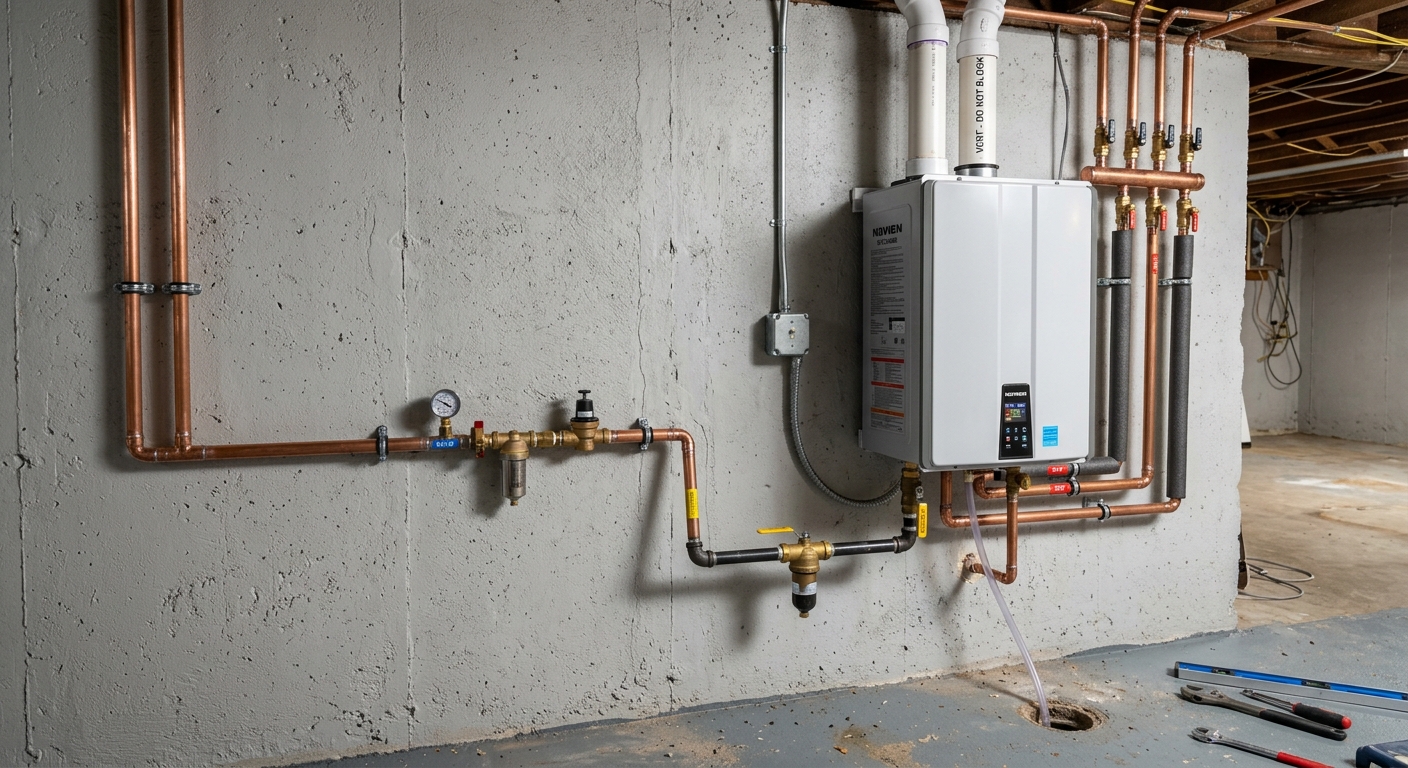
For a standard 40–50 gallon gas water heater, replacement in West Whiteland typically costs $1,400–$3,300. This includes removal of the old unit, installation, testing, and hauling away the old tank. Costs run higher if venting or code upgrades are involved, or if access is difficult, but basic “like-for-like” replacements are right in that range. Always require a written contract and ask if the price includes permit and inspection fees—which are required whenever the installation connects to your home’s gas or water lines under the Pennsylvania Uniform Construction Code.
Why do plumbers charge a diagnostic fee?
In West Whiteland, many plumbers charge a diagnostic fee to cover their time for coming out, evaluating the problem, and formulating a solution. With a dense and competitive local market, this fee (often $200–$500 for the average house call) weeds out no-shows and recovers the real costs of travel and expertise. Most reputable companies apply the diagnostic fee toward the cost of the repair if you approve the work, so you’re not paying twice. If a firm refuses to give credit for this fee, get a second quote—competition is strong here, and you have better options.
Which utility supplies water to West Whiteland?
Most homes in West Whiteland are served by Aqua Pennsylvania’s southeast division, with the West Chester Area Municipal Authority covering some neighborhoods. Both utilities treat water to federal and state standards and provide annual water quality reports you can request directly. If you own a home and aren’t sure which utility you’re on, check your most recent water bill or ask your township office. The water infrastructure here is what you’d expect for Chester County, where private service line replacements can run $6,500–$14,000 if an old pipe fails.
How deep do water lines need to be buried in West Whiteland?
Local code in southeastern Pennsylvania calls for water lines to be buried to a minimum depth of 30 inches—this matches the frost depth for our area, preventing pipes from freezing when winter temperatures hit the design minimum of 14 °F. Shallow lines are a leading cause of freeze bursts that can cost $700–$1,400 to repair in emergency situations. If you’re replacing or repairing a service line, confirm with your township inspector before any digging—failing an inspection for insufficient depth will mean starting over.
Should I reline or replace my sewer line?
The right choice for a failing sewer line in West Whiteland comes down to the type and extent of the damage. Spot repairs via relining are cost-effective for limited sections with root intrusion or minor cracks, running in the ballpark of $2,300–$14,000 depending on access and length. If your pipe has collapsed or sags (a "belly"), full replacement is the only long-term fix—especially true for aging PVC from the 1960–2000 era in Chester County. Always demand a camera inspection report and get a line-by-line quote before approving relining or full excavation.