What plumbers charge in Stowe
Stowe homeowners with older houses are more likely to face plumbing bills on the higher end, and the main reason is era. Most of this part of Allegheny County, including Stowe, is dominated by homes built before 1980—almost 89.8%, according to the U.S. Census Bureau (ACS 2024). That era saw galvanized and cast-iron pipe used almost everywhere in the Pittsburgh area, and today, replacing or repairing old lines is the norm rather than the exception. With nearly half of Stowe’s households owning their homes (49.8%), it’s homeowners, not landlords, who usually make these calls—often with some urgency.
For all the common jobs in Stowe, prices diverge sharply depending on whether you’re calling in an emergency or can schedule ahead. Emergency repairs demand a premium: plumbers have to drop their current work and prioritize your burst pipe or leak. If you can wait, you might save hundreds. On the other hand, sewer work and major line replacements rarely see a discount for scheduling because the crew, permit, and equipment costs are substantial with little room for fast-tracking.
Pipe material and access matter most. Galvanized in hard-to-reach walls, for example, is more of a project than accessible copper under a basement ceiling. In Allegheny County, older homes mean surprises are the norm, not the exception. That’s why even “typical” costs swing so wide.
| Service |
Scope |
Emergency rate |
Standard rate |
| Emergency repair — burst pipe |
locate, open, repair section, restore service |
$550–$1,150 |
$325–$1,150 |
| Water heater replacement (gas, 40–50 gal) |
remove old, install, test, haul away |
$1,800–$2,600 |
$1,150–$2,600 |
| Drain cleaning — main line |
augering or hydro-jet, camera if needed |
$350–$800 |
$200–$500 |
| Sewer line spot repair |
excavate or reline a failed section |
$1,900–$11,500 |
$1,900–$11,500 |
| Whole-house repipe |
replace supply lines throughout, patch and finish |
$3,300–$8,000 |
$3,300–$8,000 |
| Water service line replacement |
street to house, excavation and restoration |
$5,200–$11,500 |
$5,200–$11,500 |
Estimates for a typical Stowe home. Access difficulty and pipe material move these figures more than anything else.
Comparing plumbing estimates in Stowe
In Stowe, you’ll see two main ways plumbers bid out jobs: flat rate (set price for a defined scope) or time-and-materials (your final total is labor hours plus actual parts used). Flat rate gives you certainty—what you see is what you pay—even if your repair takes longer or has difficult access. With time-and-materials, you’re often better off for jobs that are quick and clean, but if the job runs into extra problems inside an old wall or under a slab, your bill rises with every hour. Neither approach is dishonest, but the biggest mistake Stowe homeowners make is not understanding which model their quote actually uses.
A proper estimate will spell out the diagnostic fee up front (and whether it counts toward the job if you go ahead). The written scope should detail what’s being opened, what gets repaired, and what’s restored—especially important with old finishes, since restoration can be a big part of the cost. Permit fees for new lines or alterations in most Allegheny County municipalities must be clear and listed. Don’t settle for “parts included”; insist on brands and models for anything visible. Expect a warranty on both labor and parts, not just parts alone. If you’re dealing with emergency rates, you should know them before anyone’s dispatched. Ambiguity here is a red flag.
| Line item |
What to look for |
Red flag if… |
| Billing model |
flat rate or hourly, stated up front |
unstated |
| Diagnostic fee |
amount, and whether it credits |
vague |
| Scope |
what is opened, repaired and restored |
price with no scope |
| Restoration |
drywall and finish explicitly in or out |
silent |
| Permit |
included and priced |
'not needed' |
| Parts |
brand and model for fixtures |
'standard fixture' |
| Warranty |
labour period stated separately |
parts only |
Verifying a Stowe plumber's credentials
In Pennsylvania, there’s no statewide plumbing license: licensing is set by each municipality. That means a plumber can be fully qualified in one place, yet hold no credential in the next township. For Stowe—within Allegheny County—if the job is inside Pittsburgh or certain neighboring municipalities, the Allegheny County Health Department runs journeyman and master plumber licensing and permitting. Always ask whether your plumber is licensed for work where your property is located, not just “in Allegheny County” in general.
For new or altered plumbing systems, a permit from the Allegheny County Health Department is required in Pittsburgh and many surrounding municipalities. However, if your work is minor—like swapping out a faucet or toilet—a permit usually isn’t needed. The code enforced for residential plumbing is the Pennsylvania Uniform Construction Code (UCC), which is built on the International Residential Code (IRC), but enforced locally or by the PA Department of Labor & Industry if a municipality opts out.
Insurance is your next checkpoint. Homeowners in Stowe should insist on a certificate of insurance with your home named as the insured location, and verify workers’ compensation coverage (you can confirm via WCAIS at wcais.pa.gov). For jobs over $500, check the contractor’s Home Improvement Contractor (HIC) registration through hic.attorneygeneral.gov—this is state-required for residential contracts of $500 or more. It’s an extra layer of consumer protection built into Pennsylvania law.
Galvanized, copper, PEX, cast iron
Most homes in Stowe and the wider Pittsburgh area were built between 1900 and 1950, so you can’t talk plumbing here without talking old galvanized steel and cast iron. These materials mark their era—galvanized steel for water supply, cast iron for drains, and clay tile running underground out to the street. Everything newer is repairs, patch-ins, or an outright replacement.
Galvanized steel pipes, visible as dull silvery gray and attracted by a magnet, were common before 1960. Their inside diameter shrinks with time: water pressure drops off in the home years before you’ll see a real “leak.” Copper followed, with shiny orange color, either soldered or threaded at joints. It lasts, but aggressive water chemistry (not uncommon in local municipal systems) can create pinholes. Polybutylene pipes—gray, flexible, common in late 1970s–1995—failed at fittings and now spell trouble for insurance. PEX, the flexible colored tubing, is standard now. Cast iron drains are black and heavy, joined with lead-packed joints; clay sewer laterals are usually found if your home predates the 1980s, easily shattered or root-infiltrated.
If you have exposed pipe, scratch it with a key—dull gray is galvanized, shines orange is copper, plastic is either PEX (red/blue/white) or older polybutylene (blue/gray). How long you have left? Any original pipe from before 1960 is in the replacement zone now, meaning even if it’s working today, a plan makes sense.
| Material |
Typical era |
Failure mode |
Service life |
| Galvanized steel supply |
pre-1960 |
internal corrosion, pressure loss |
40–60 yrs |
| Copper supply |
1950s–present |
pinhole leaks, joint failure |
50–70 yrs |
| Polybutylene supply |
late 1970s–1995 |
fitting failure, sudden bursts |
unreliable |
| PEX supply |
2000s–present |
fitting or UV degradation |
40–50 yrs |
| Cast iron drain |
pre-1975 |
corrosion, cracking, scale |
50–75 yrs |
| Clay tile sewer lateral |
pre-1980 |
root intrusion at joints, offset |
50–60 yrs |
| PVC / ABS drain |
1970s–present |
joint separation, crushing |
50+ yrs |
Freeze risk and what to do about it
Stowe, like the rest of Allegheny County, sits in a hard freeze-thaw zone with a frost depth of 36 inches and winter design lows around 8 °F. Our clay and shale soils make it tougher for pipes buried near the surface or run through exterior walls—they’re at higher risk of freezing and then bursting. What many folks don’t realize: it’s not always the spot that freezes that bursts. When water freezes and creates a plug, pressure builds between that plug and your closed faucet or valve—and the pipe can split somewhere entirely different, often out of sight.
Vulnerable spots include pipes on exterior walls, unheated crawlspaces and garages, hose bibs, and any supply running through an unconditioned attic. Here’s how to stack your risk reduction, from least to most costly: insulate any exposed or exterior-wall pipes; wrap with heat tape on problem runs (good for winter peace of mind); let faucets trickle when there’s an extreme cold snap to keep water moving; open under-sink cabinet doors on outside walls; and always shut off and drain outdoor spigots in the fall before the first freeze.
Thawing frozen pipes? Stick with a hairdryer or a heat gun on moderate—not an open flame. The fire risk in tightly-packed, old Stowe basements is real. If you need a plumber after a burst, you’re looking at $550–$1,150 for a typical emergency pipe repair. Investing an hour in prevention beats that bill every time.
Water heater replacement decisions
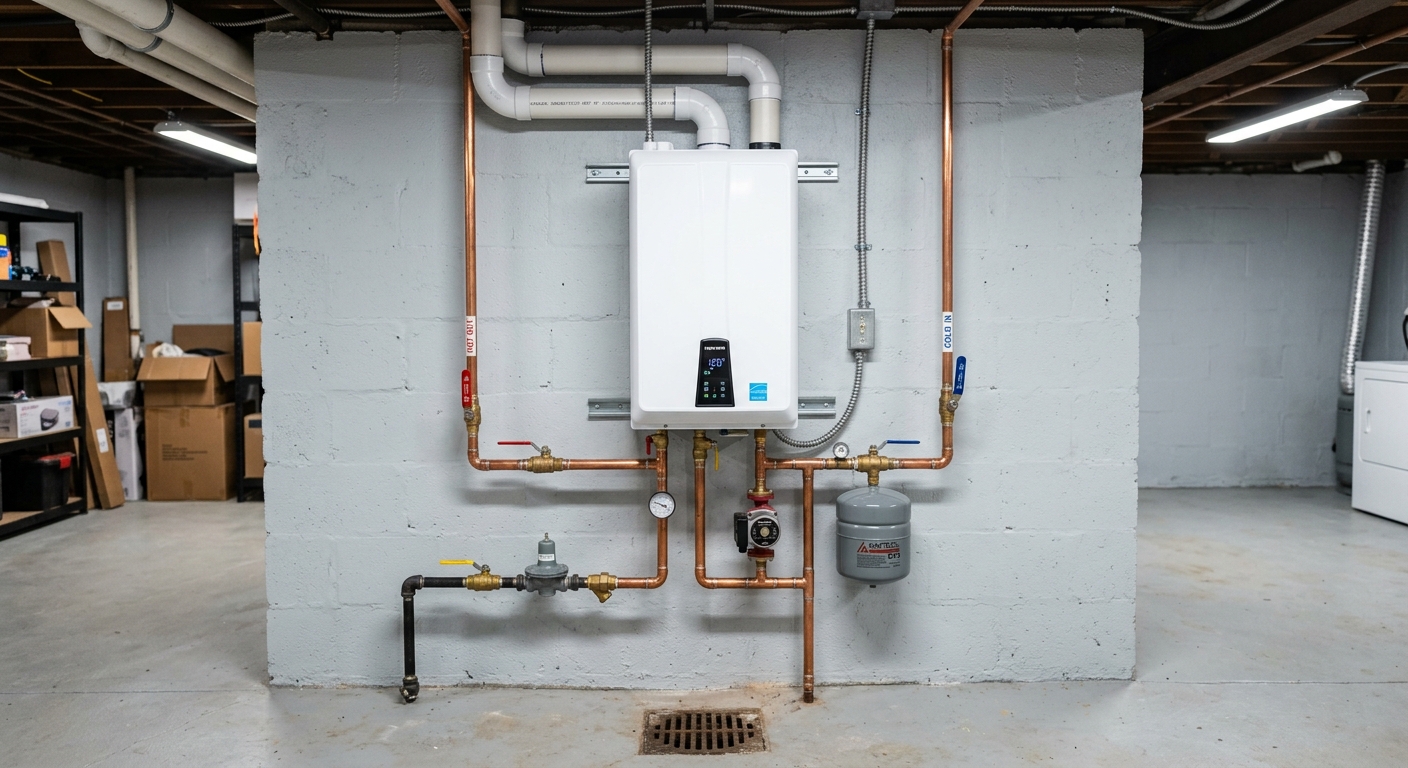
If your Stowe home needs a new water heater, know upfront: most stick with either a traditional tank or, sometimes, a tankless for continuous hot water—heat pump water heaters are newer but worth considering for certain setups.
Standard gas or electric tanks are cheapest—easy install, readily available, but they work on a cycle and always keep water hot, even when you’re not using it (standby heat loss). They’ll typically last 8–15 years in this area. Tankless gas systems mean endless showers and a smaller footprint, but plan on a bigger bill: they often require upsizing the house gas line and adding new venting, which can push the job toward the top of the price band. For heat pump water heaters, figure the lowest running costs in Stowe—provided you have an unfinished basement or utility area big enough. They pull heat from the surrounding air and dump some cool air back, which matters if your water heater sits in your main living area.
Don’t size by gallon—size by first-hour rating (amount of hot water delivered in a busy hour). In Allegheny County, adding an expansion tank is now standard for anything permitted, and every new install should have a pan and drain line for leak control. Most water heater failures here come from the tank itself corroding, not the controls—so age is your best replacement indicator.
| Type |
Installed cost |
Service life |
Operating cost |
Best when |
| Gas tank, 40–50 gal |
$1,150–$2,600 |
8–12 yrs |
moderate |
existing gas hookup, standard replacement |
| Electric tank, 40–50 gal |
$1,150–$1,800 |
10–15 yrs |
high |
no gas, cheapest upfront |
| Gas tankless |
$1,800–$2,600 |
18–25 yrs |
low-moderate |
continuous demand, can vent and upgrade gas line |
| Heat pump water heater |
$1,800–$2,600 |
13–15 yrs |
lowest |
unconditioned space, interested in long-term savings |
Vetting a plumber in Allegheny County
Because licensing for plumbing in Allegheny County is handled by each municipality, you must confirm that your contractor’s license covers Stowe—not just Pittsburgh, and not just Allegheny County generally. Ask for proof. Next, insist on a certificate of liability insurance that names your home specifically, as well as up-to-date workers’ compensation (through the WCAIS system).
Stowe homeowners should verify Home Improvement Contractor (HIC) registration for any work over $500 (hic.attorneygeneral.gov). Confirm if you’re getting the company’s own employees or if they subcontract—to avoid finger-pointing later. If you’re facing a premium for emergency dispatch, they should state that upfront before anyone’s in your driveway.
- Is the plumber licensed for work in your specific municipality?
- Did you verify their HIC registration at hic.attorneygeneral.gov?
- Do you have a certificate of insurance that names your property?
- Did you check workers’ compensation in the WCAIS system?
- Does the estimate specify whether crews are employed or subcontracted?
- Is there a written, detailed scope (not just a price)?
- Are permit fees listed if the work involves new piping?
- Are restoration/patchwork details included?
- Are parts and brands identified, not just “standard”?
- Is the diagnostic fee and billing model disclosed clearly?
- Is the emergency or after-hours rate disclosed before dispatch?
- Do you receive camera footage or test results for repipe/sewer quotes?
In the Pittsburgh metro area’s saturated plumbing market, every major player has competition. Biggest red flags: high-dollar sewer, repipe or service line quotes without any pressure test or camera evidence—they’re counting on the urgency of the problem, not the facts.
Frequently asked questions — plumbing in Stowe
How hard is the water in Stowe?
Stowe’s water is drawn from the Pittsburgh Water and Sewer Authority’s system, which generally delivers moderately hard water. Most supplies in central Allegheny County run between 7 and 10 grains per gallon (gpg), not enough to demand a softener by default, but enough to leave white buildup on fixtures and inside tank water heaters over time. For Stowe homeowners, this means most faucets, showerheads, and especially water heaters accumulate mineral scale each year—reducing efficiency and sometimes shortening equipment lifespan. That can edge up replacement costs. Water heater flushing can help but doesn’t eliminate all buildup. For a 40- to 50-gallon tank replacement, expect $1,150–$2,600 depending on your setup. Most homes do fine without a whole-house softener unless you have specific sensitivity or appliance needs.
What does emergency plumbing cost in Stowe?
Emergency plumbing in Stowe, especially for something like an active leak or a burst pipe, comes at a premium. Typical response for an in-progress leak includes the plumber dropping their current work, traveling to Stowe, opening up finished spaces, fixing the break, and restoring service. The usual cost runs $550–$1,150, but can run lower if you catch a slow drip early. More severe cases—flooded basements or leaks in tough spots—run toward the top of that range. Drain clogs or main line backups in off hours also see higher rates: expect $350–$800 with camera diagnostics included. If you can stem the flow safely and wait for business hours, you may save substantially.
Who pays to replace a lead service line in Stowe?
In Stowe and across Allegheny County, the Pittsburgh Water and Sewer Authority is working to replace thousands of old lead service lines. If the main running from the street to your house is identified as lead, the line on public property is replaced by the utility (paid for by PWSA). However, the portion running from the property line into your home—called the “private side”—is the homeowner’s responsibility. Stowe homeowners are typically on the hook for private-side replacement, which means excavation and new service line from curb to basement. Expect $5,200–$11,500 depending on length, access, and restoration needs. Some utility programs offer partial reimbursement or coordination, but not full payment for private pipe.
Is my water line lead?
Many Stowe homes built before 1950 originally had lead, galvanized, or even iron water service lines. The fastest way to check: find where your water line enters your basement. If the pipe is soft, dull gray, and scratches to shiny silver (but not magnetic), you likely have lead. Galvanized is steel gray and magnetic. Copper is orange and not magnetic. If you suspect lead, the best next step is to call a plumber to confirm. Replacing a lead line from street to house typically costs $5,200–$11,500. Local authorities may also test water samples if you’re unsure. If you’re in a target zone, the Pittsburgh Water and Sewer Authority can confirm material for you.
Do I need a permit for plumbing work in Stowe?
In Stowe and other Allegheny County municipalities, permits are required for new or altered plumbing systems, like moving fixtures or re-piping. The Allegheny County Health Department oversees permits and inspections within Pittsburgh and many townships. Minor work—such as swapping out a faucet or toilet—typically does not require a permit. When a permit is needed, the cost is usually bundled into the estimate, but always ask your contractor. Full repiping jobs ($3,300–$8,000) and water service line replacements are guaranteed to need inspection. Permitting ensures code compliance for safety and resale, which matters in Stowe’s older housing stock.
Repair or replace a leaking water heater?
For Stowe homeowners, when a water heater leaks from the bottom or rust shows on the tank itself, it’s almost always time to replace. Repairs are cost-effective only if the problem is in the controls (like a thermostat or heating element) and your unit’s under 8 years old. Old tanks will almost always develop more leaks soon, and patching isn’t safe or code-approved. Replacement cost for a standard 40- or 50-gallon tank is $1,150–$2,600 including removal and new installation. If your tank’s over 10 years old in Stowe’s moderately hard water, replacement beats repair for both safety and cost certainty.
Why do plumbers charge a diagnostic fee?
Plumbers in Stowe usually charge a diagnostic fee—typically $50–$100, sometimes credited toward the actual repair. The fee covers travel, inspection, and basic troubleshooting. For older homes like those in Stowe (most built before 1980), problems can be buried behind finished walls or under slab—a plumber can’t price a solution until they know the cause. This fee discourages no-shows and covers the pro’s time if you decide not to proceed. It’s usually rolled into the total when you accept the bid—for example, a burst pipe repair might list only $550–$1,150 as the final charge, with no add-on. Make sure the estimate states if the diagnostic cost is credited or not.
Should I wait until business hours to call?
If you have active water pouring out and can’t stem the flow, call a Stowe plumber right away. Emergency rates will run higher—expect $550–$1,150 for a major leak or burst pipe on weekends, nights, or holidays. But if you can safely turn the water off at the main, or if it’s a slow drip and not flooding, you’ll likely save hundreds by waiting for business hours. In Stowe, most reputable plumbers post emergency vs. regular rates online or on their estimate forms. If you’re ever unsure, ask up front—some charge just for the trip outside business hours, others for work performed only. Always prioritize safety and avoid water damage before worrying about bills.
How do I prevent frozen pipes in Stowe?
In Stowe’s climate, where the frost depth is 36 inches and winter lows reach 8 °F, pipes on exterior walls, crawlspaces, and garages freeze frequently. Prevention is cheaper than repair. Insulate exposed pipes—especially in basements or outside walls. For the riskiest spots, use heat tape (electric pipe wrap). During extended cold, let a faucet on each floor trickle to keep water moving, and open under-sink doors for warmth. Always shut off and drain outside spigots before first freeze in the fall. If you follow these steps, you sharply reduce the odds of paying an emergency repair bill of $550–$1,150. Don’t ever thaw pipes with a torch; a hairdryer or gentle heat is safer for old walls and wood.