Plumbing costs in Middletown — 2026
Middletown’s homes, with a 73.6% homeownership rate and over 60% built before 1980 (U.S. Census Bureau, ACS 2024), see plumbing costs shaped by the era of construction and the materials used in both supply and drain lines. Many neighboring tracts in Upper Darby and Lansdowne, filled with mid-century rowhouses and twins, are still transitioning away from failing galvanized pipes and old drains—this area is no exception. What you pay will almost always depend on not just the job, but whether you need someone out right now for an emergency, or can schedule standard service: emergency callouts always run higher, and price bands on this page reflect both situations.
For emergency repairs—like a burst pipe or active leak—you can expect a bill between $700–$1,350, but if it’s not urgent and you can wait, that can drop as low as $400. Major jobs like water heater replacement or a whole-house repipe (copper or PEX) will be at the upper end—motivated mostly by what type of pipe you have and how hard it is to reach, not the style of fixture or finish. Sewer line and water service replacements, when necessary, come from the same combination of excavation, pipe material, and restoration needs.
| Service |
Scope |
Emergency rate |
Standard rate |
| Emergency repair — burst pipe |
locate, open, repair section, restore service |
$700–$1,350 |
$400–$1,350 |
| Water heater replacement (gas, 40–50 gal) |
remove old, install, test, haul away |
$2,100–$3,200 |
$1,350–$3,200 |
| Drain cleaning — main line |
augering or hydro-jet, camera if needed |
$350–$800 |
$200–$500 |
| Sewer line spot repair |
excavate or reline a failed section |
$2,300–$13,500 |
$2,300–$13,500 |
| Whole-house repipe |
replace supply lines throughout, patch and finish |
$4,000–$9,600 |
$4,000–$9,600 |
| Water service line replacement |
street to house, excavation and restoration |
$6,200–$13,500 |
$6,200–$13,500 |
Estimates for a typical Middletown home. Access difficulty and pipe material move these figures more than anything else.
What's in the water here
The majority of Middletown taps are supplied by Aqua Pennsylvania, Inc., which is the dominant public water utility throughout Delaware County. If you’re a customer, you can request their annual water quality report to see everything tested for, from chlorine levels to lead content. Most Middletown tap water is moderately hard, meaning you may notice white scale building up on showerheads, faucets, and water heater elements over the years. This mineral buildup can shorten water heater and fixture lifespan, causing them to fail a couple years sooner than their ratings suggest.
On the other hand, aggressive water—less common in this part of Pennsylvania—can lead to copper pipes forming pinhole leaks. Actual softening equipment is rarely justified in most of Middletown: a water softener typically costs more to run and maintain than you save on plumbing repairs, unless you truly hate scrubbing scale off glass or have a history of rapid heater element failure. Whole-house filtration (installed at the entry) addresses sediment and chlorine, but for most homes here, a simple under-sink (point-of-use) filter for taste and odor suffices. Avoid being sold expensive filtration for problems your water report doesn’t confirm.
If you’re on a private well, typical outside the main public supply area, annual water testing and periodic checks for bacteria, pH, and iron/manganese are a must—nobody monitors these for you, and home test kits are sometimes unreliable.
The leak you can hear but can't see
Before you pay anyone, do the “meter test.” Shut off every faucet and appliance in your house. Then watch your water meter (usually in the basement or at the curb). If the dial is spinning, you’ve got a supply-side leak somewhere after the meter, even if you can’t find visible water. This costs nothing, tells you immediately if you have a problem, and is the same method pros use to start locating hidden leaks in Middletown homes.
Professional detection moves to acoustic listening (for leaks inside walls or under floors), thermal imaging (shows cold damp spots from a leaking pipe), or, less often, tracer gas (for tough-to-find slab leaks, where gas is pumped through the lines and detected by a sniffer device). Expect a professional leak detection to run somewhere between $400–$1,350 in Delaware County, depending on scale and urgency. Each method fits a scenario: slab leaks show up as damp basement floors, wall leaks as painted spots that never dry, and even buried irrigation lines can often be traced acoustically.
Never let a plumber start opening drywall before localizing a leak as closely as possible—anyone proposing to cut first and ask questions later is guessing, not diagnosing. In older homes built before 1980, galvanized or cast iron pipes especially are prone to hidden leaks that can run for months, so act early if your meter says there’s a problem you can’t see.
Comparing plumbing estimates in Middletown
Plumbers in Middletown, like the rest of Delaware County, work mostly on two billing models: flat rate and time-and-materials. Flat rate means the price is fixed up front—the contractor takes the risk if the job runs long. Time-and-materials may be cheaper if everything goes smoothly, but gets expensive if surprises pop up. Neither model is a scam by itself—what matters is knowing which one you’re being offered. Miscommunication on this point is the number one cause of disputes.
Look closely: Is there a diagnostic fee, and does it disappear if you authorize the repair? Does the estimate spell out exactly what’s included—like patching drywall or restoring your lawn—or is it just a dollar amount? Are restoration and permits included, and is the type and brand of parts specified, or just “standard fixture?” For any job over $500, a written contract is required. Warranties should spell out separate coverage for labor and materials. Expect to see an after-hours rate or emergency surcharge when calling outside business hours; this should be transparent before work starts.
| Line item |
What to look for |
Red flag if… |
| Billing model |
flat rate or hourly, stated up front |
unstated |
| Diagnostic fee |
amount, and whether it credits |
vague |
| Scope |
what is opened, repaired and restored |
price with no scope |
| Restoration |
drywall and finish explicitly in or out |
silent |
| Permit |
included and priced |
'not needed' |
| Parts |
brand and model for fixtures |
'standard fixture' |
| Warranty |
labour period stated separately |
parts only |
Sewer laterals: the pipe you own and can't see
Most Middletown homeowners are surprised to learn they own the “lateral”—the pipe from the house all the way to the main sewer in the street. You’re responsible for it, even if the problem is under the sidewalk or curb. In Delaware County’s older neighborhoods, especially where homes predate 1980, these laterals are often original clay tile or cast iron, both of which are prone to root intrusion and joint failure.
Symptoms usually start with one slow drain, then spread to multiple drains gurgling or backing up, and finally a sewage backup at the lowest plumbing fixture (basement tub, floor drain, or laundry). Before anyone digs, always get a camera inspection—this is the gold standard, showing if the problem is a root ball, a dip (“belly”) in the pipe, or a complete collapse. Open-cut trench replacement is still common, but trenchless relining is possible if the defects aren’t too severe. Spot repairs, limited to failed pipe sections, are often the most cost-effective resolution and fall somewhere between $2,300–$13,500 depending on access and the length of pipe replaced.
Chester and Upper Darby use separate sanitary and storm sewers, and septic systems are now mostly limited to outlying townships like Edgmont. If you’re on a septic, issues usually concern tank pumping (every 3–4 years) or drainfield failure—sewer backups are typically unrelated to the house plumbing. No matter the system, always insist on reviewing camera footage yourself before considering excavation or relining work.
Who is allowed to do plumbing work in Pennsylvania
Pennsylvania does not grant plumbers a state-wide license; instead, licensing happens at the municipal level. This means a plumber working in Philadelphia or Pittsburgh holds a local credential that means nothing in Middletown, where municipalities enforce their own standards—or contract it to third-party code offices. Delaware County itself does not issue a county plumber’s license, so always ask, “Are you licensed for this town?” rather than just “Are you licensed?”
Most plumbing work here falls under the Pennsylvania Uniform Construction Code (UCC), enforced by your municipality or, in places that opt out, by the PA Department of Labor & Industry. In Upper Darby, for example, any new or relocated plumbing fixture or piping almost always requires a municipal permit, while simpler jobs—like replacing faucet or toilet internals—in most boroughs (like Media) generally do not. Permit costs and requirements vary, and inspection follows work completion.
If a contractor is doing work over $500, they must be registered as a Home Improvement Contractor (HIC) with the Pennsylvania Office of Attorney General. You can verify this at hic.attorneygeneral.gov. For insurance, all employers must have workers’ compensation and you can check coverage through the state’s WCAIS system at wcais.pa.gov.
Galvanized, copper, PEX, cast iron
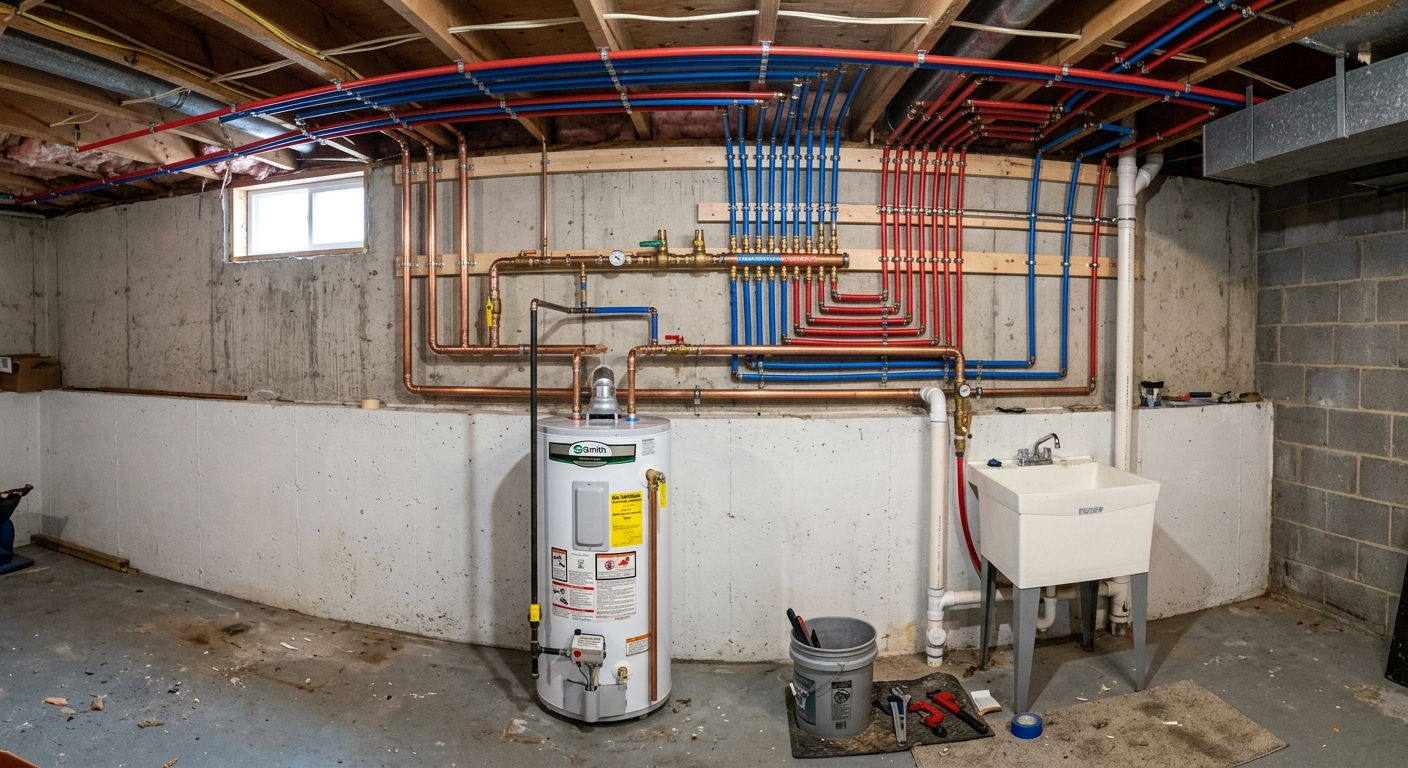
The era your home was built usually predicts your plumbing. Houses in the 1945–1975 range (seen in many Upper Darby and Lansdowne blocks) most often started life with galvanized steel supply lines and cast iron drains—both nearing end of service. Galvanized steel rusts from the inside out, first reducing water pressure then developing leaks, and rarely makes it past 60 years. Copper, popular from the 1950s on, usually lasts but can form pinholes here if the water chemistry is aggressive. Polybutylene was used briefly and is failure-prone; current installations use PEX for supply and either ABS or PVC for drains. In the ground, many older sewer laterals run clay tile—roots find their way into every unsealed joint given enough time.
You can identify your pipe material with a scratch and magnet test: Galvanized is gray, threads at joints, and sticks to a magnet. Copper is reddish and soldered. PEX is flexible and colored (usually red or blue). Cast iron is massive, dull black and magnetic; clay tile is orange-brown and found only underground. PVC and ABS are plastic: white or black and joined with glue.
If your home is approaching 50 years with original pipe, expect repairs soon. Proactive repiping or sewer work isn’t always urgent, but surprises tend to come during sales or active leaks. Owning a pre-1980 Middletown house means budgeting for upgrade work is smart planning.
| Material |
Typical era |
Failure mode |
Service life |
| Galvanized steel supply |
pre-1960 |
internal corrosion, pressure loss |
40–60 yrs |
| Copper supply |
1950s–present |
pinhole leaks, joint failure |
50–70 yrs |
| Polybutylene supply |
late 1970s–1995 |
fitting failure, sudden bursts |
unreliable |
| PEX supply |
2000s–present |
fitting or UV degradation |
40–50 yrs |
| Cast iron drain |
pre-1975 |
corrosion, cracking, scale |
50–75 yrs |
| Clay tile sewer lateral |
pre-1980 |
root intrusion at joints, offset |
50–60 yrs |
| PVC / ABS drain |
1970s–present |
joint separation, crushing |
50+ yrs |
Frequently asked questions — plumbing in Middletown
Is Middletown on combined sewers or septic?
For most Middletown residents, sanitary and storm sewers are separated systems, like those in Chester and Upper Darby. That means household wastewater and storm runoff go to different pipes, helping prevent backups during heavy rain. Septic systems are mostly found in outer Delaware County townships like Edgmont, so unless your property uses a private well and septic field, you’ll be tied into the municipal sewer. If you’re experiencing backups or slow drains, you’re likely dealing with a problem in your own sewer lateral—a repair that typically costs between $2,300–$13,500. If you’re on septic, maintenance (like tank pumping every 3–4 years) is your responsibility.
Should I wait until business hours to call?
Emergency rates apply if you call for service outside standard business hours, weekends, or holidays—expect a charge of $700–$1,350 for urgent burst pipe or leak repairs in Middletown. If water is pouring in or you can’t safely shut off the supply, make the call. But if you can turn off a leaking valve and wait, you’ll save by waiting for normal hours, when rates can drop to $400. The practical answer is: if property is at risk or you’re completely without water or drainage, don’t wait. If it’s a drip you’ve contained or a slow drain, set an appointment during normal business hours.
Why do all my drains drain slowly at once?
When every drain in the house slows—or backs up—it’s almost never individual clogs. In Middletown homes, it’s a sign of a main drain or sewer lateral problem. Aging clay tile or cast iron sewers, common in area homes built before 1980, are prone to root intrusion and collapse. For these cases, expect a camera inspection to confirm, and then likely main line drain cleaning, which typically ranges from $200–$800 depending on method and complexity. Don’t spend money snaking individual sinks or tubs: if every drain is slow, the issue is further downstream.
How do I verify a plumber's licence and insurance?
In Pennsylvania, check two things: Home Improvement Contractor registration (for any job over $500) at the Pennsylvania Attorney General’s site (hic.attorneygeneral.gov), and workers’ compensation insurance through the WCAIS system (wcais.pa.gov). Delaware County does not grant a county plumbing license—each municipality controls its own licensing. Always ask: “Are you licensed to work in Middletown?” Not just “are you licensed?” For insurance, request a current certificate with your address named on it. This protects you if something goes wrong.
What does drain cleaning cost in Middletown?
For a main line cleaning in Middletown, budget between $200–$500 for a scheduled job and $350–$800 for an emergency call. This covers augering or hydro-jetting the main line, and often a basic camera inspection if needed. Secondary line (branch drain) clogs can be less, but when multiple fixtures are slow, pay for cleaning the main, not snaking branch lines. If you’re quoted drastically below these ranges, be wary of add-on sales after arrival.
Do I need to drain outdoor spigots in Middletown?
Yes—every fall, drain and shut off your outdoor hose bibs before freezing temperatures hit. Southeastern Pennsylvania averages a winter design temperature of 14°F and a frost depth of 30 inches. Even “frost-free” sillcocks fail if hoses remain attached. Undrained outdoor fixtures lead to burst pipes, and repairing freeze damage typically runs $400–$1,350 depending on accessibility. Take ten minutes each year: shut off the interior valve (if you have one), open the outside faucet to drain, and you’ll avoid a winter call to a plumber.
How much does a water heater replacement cost in Middletown?
Replacing a standard gas 40–50 gallon water heater in Middletown will typically run between $1,350–$3,200. Most jobs land close to $2,100, including removal, installation, testing, and hauling away the old unit. Prices vary mostly by heater brand, venting requirements, and whether access is straightforward or in a tight basement corner. If your heater is over ten years old and nearing the end of its life (which is common in the area due to hard water buildup), replacing it proactively can prevent expensive emergency calls.
Should I reline or replace my sewer line?
The choice depends on what your camera inspection shows. Full open-cut replacement is often the only option for severe pipe collapse or multiple joint failures, but trenchless relining can be a good fit for root intrusion or moderate joint offsets. In Middletown, spot repairs and trenchless solutions can be far less disruptive and sometimes quicker, generally ranging from $2,300–$13,500. The right answer depends on the pipe’s condition, the number of problem spots, and your budget. Never accept a replacement quote without seeing video proof for yourself.
Am I responsible for the water line under the street?
Yes. In Delaware County, including Middletown, you own and are responsible for the water service line from your house all the way to the connection with the main, often under the street or sidewalk. If the line leaks or fails, replacement costs run $6,200–$13,500 depending on length and excavation required. Aqua Pennsylvania’s inventory has marked many lead or galvanized lines for phased replacement, so check if your address is already on their list—they may coordinate upgrades at reduced cost in coming years. Otherwise, repairs and restoration fall to the homeowner.