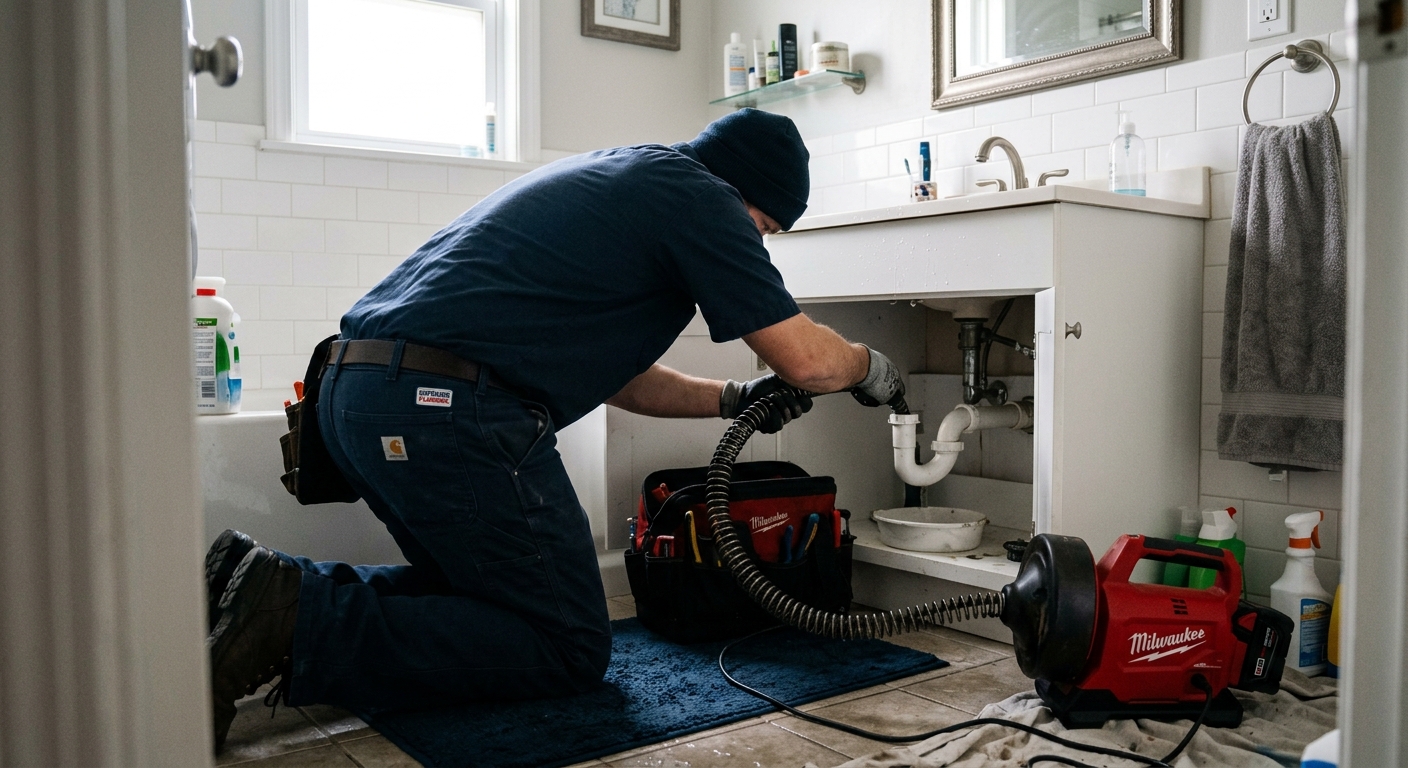
Harrison plumbing prices by job type — 2026
In Harrison and nearby Allegheny County neighborhoods, plumbing costs can jump significantly depending on whether you need emergency work. The most common situation is reactive: a burst pipe, a leaking supply line, or an old water heater that fails without warning. In those cases, both hourly rates and material costs typically rise. This is especially true given Harrison's older housing stock—85.5% built before 1980 (U.S. Census Bureau, ACS 2024)—where a simple job might get complicated by hard-to-access piping or the presence of galvanized steel or cast iron that’s well past its service life.
As with much of the Pittsburgh region, houses built between 1900 and 1950 mean more supply and drain pipes are reaching the end of their reliable life, and emergency scenarios are more likely. For homeowners, it matters whether the job happens after hours or when a leak is caught quickly, as price swings can be meaningful in the typical single-family Harrison home, where 73.9% own their homes (U.S. Census Bureau, ACS 2024).
| Service |
Scope |
Emergency rate |
Standard rate |
| Emergency repair — burst pipe |
locate, open, repair section, restore service |
$550–$1,150 |
$325–$1,150 |
| Water heater replacement (gas, 40–50 gal) |
remove old, install, test, haul away |
$1,800–$2,600 |
$1,150–$2,600 |
| Drain cleaning — main line |
augering or hydro-jet, camera if needed |
$350–$800 |
$200–$500 |
| Sewer line spot repair |
excavate or reline a failed section |
$1,900–$11,500 |
$1,900–$11,500 |
| Whole-house repipe |
replace supply lines throughout, patch and finish |
|
$3,300–$8,000 |
| Water service line replacement |
street to house, excavation and restoration |
|
$5,200–$11,500 |
Estimates for a typical Harrison home. Access difficulty and pipe material move these figures more than anything else.
Licensing and permits for plumbing work in Harrison
Plumbing in Pennsylvania is not licensed at the state level but handled by municipalities. This means a plumber fully licensed to pull permits and work in Pittsburgh may not hold the same credentials in Harrison or elsewhere in Allegheny County. The question to ask isn’t “Are you licensed?” but “Are you licensed to work here?” In Pittsburgh and several surrounding communities, the Allegheny County Health Department runs its own journeyman and master plumber licensing program. Outside of those areas, Harrison and other townships may enforce plumbing code themselves or depend on the Pennsylvania Department of Labor & Industry for oversight if they have opted out of enforcement.
The residential construction standard here is the Pennsylvania Uniform Construction Code (UCC), which follows the IRC. On the permitting side, any significant plumbing job—like replacing or altering water or drain lines—requires a plumbing permit in Pittsburgh and neighboring Allegheny County municipalities. Permit inspections are handled by either the municipal authority or the Allegheny County Health Department. However, minor fixture swaps (like swapping a faucet) usually won’t trigger a permit requirement.
When hiring, confirm your contractor is registered with the Pennsylvania Office of Attorney General for home improvement work above $500, which can be checked at hic.attorneygeneral.gov. Also ask for proof of workers’ compensation through WCAIS (wcais.pa.gov), and always insist on a written contract for work above $500. Insurance is not just a formality; it should list your address as the named location for coverage.
Camera inspection, relining and replacement
In Harrison and across Allegheny County, homeowners are typically responsible for the sewer lateral running from the house all the way to the main, which may reach under your front yard or even out to the street. This is the number one point of confusion in any bigger sewer emergency. The earliest warning signs are a single slow drain, then simultaneous slow drains or bubbling in toilets, and finally backups at the lowest fixtures.
The main diagnostic today for any main line problem is a camera inspection. A reputable plumber will show you the actual footage before quoting a dig-up or lining. Many homes here still have original clay tile or cast iron sewer lines, making them susceptible to root intrusion at joints, “belly” sags, or lengthwise cracking—all visible on a camera.
Sewer line repairs take one of two forms: open-cut excavation (digging a trench to remove and replace bad pipe) or trenchless relining (inserting a liner to create a new pipe inside the old). Clay and iron laterals in Allegheny County homes from the 1900–1950 era tend to need more spot repairs or full replacement after about 50–75 years. Expect costs from $1,900–$11,500, depending on depth, length, and restoration needed.
In the outlying townships of Allegheny County, some homes still use septic systems rather than sewers. If you have septic, tank pumping every 3–5 years and timely drainfield maintenance are essential. If your lowest fixtures back up but the tank is fine, you still need a camera to see if the line has collapsed or filled with roots. Bottom line: never accept a sewer excavation quote in Harrison without first reviewing the camera inspection video yourself.
Hardness, treatment and fixture life in Harrison
Harrison’s water comes primarily from the Pittsburgh Water and Sewer Authority. Like most public systems, PWSA publishes an annual water quality report, which you can and should request for the latest numbers. In this part of Pennsylvania, water isn’t especially hard—scale buildup in water heaters and fixtures is typically less aggressive than in rural limestone areas—but sediment and mild hardness can still cut down the lifespan of faucets, showerheads, and tank-type heaters.
Some older Harrison homes have seen pinhole leaks in copper piping, which may indicate mildly corrosive water or older pipes nearing the end of their service life. Big-box softener systems are widely marketed, but for most Harrison homeowners, the cost of installing and maintaining a softener does not add up unless you’re specifically bothered by spots on fixtures or have a high-efficiency tankless water heater.
Whole-house point-of-entry filters are more about addressing taste or visible sediment than toxicity—public water here generally meets EPA standards. If you want extra protection (for example, if you have infants or immune concerns), a point-of-use filter at the kitchen tap does the job more economically. Unless you have a private well, there’s no need for broad-spectrum testing—public systems are monitored and must publish results.
Galvanized, copper, PEX, cast iron
If you live in a Harrison home built before the 1960s, you’re likely to find galvanized steel supply lines or cast iron drains. These materials were standard when most Pittsburgh-area houses went up between 1900 and 1950. Galvanized steel rusts from the inside, slowly choking off your water pressure before leak points appear. Old cast iron drain stacks, meanwhile, often corrode and develop cracks at 50 to 75 years old—right around the service life for much of the area’s housing.
Copper supply lines came in through the mid-20th century and hold up well, though pinholes happen if your water is slightly acidic or you have excessive velocity at the fixtures. Polybutylene (identifiable by its grayish-blue, flexible look and crimped fittings) was used briefly and rarely lasts here without issues at the joints. Today, PEX (a flexible plastic, usually red or blue, installed with crimp rings) is the material of choice; it’s quicker to run through floor and wall cavities of an old house and isn’t as prone to freeze damage as copper.
To check what you have: scratch an exposed pipe with a coin (copper will show bright orange, galvanized will dull gray, lead will scrape shiny). Magnets won’t stick to copper or lead. Galvanized has threaded joints; copper is soldered. For drains, black cast iron and white or black plastic (PVC/ABS) are easy to spot. Knowing your materials helps estimate remaining useful life—and plan for repairs rather than surprises.
| Material |
Typical era |
Failure mode |
Service life |
| Galvanized steel supply |
pre-1960 |
internal corrosion, pressure loss |
40–60 yrs |
| Copper supply |
1950s–present |
pinhole leaks, joint failure |
50–70 yrs |
| Polybutylene supply |
late 1970s–1995 |
fitting failure, sudden bursts |
unreliable |
| PEX supply |
2000s–present |
fitting or UV degradation |
40–50 yrs |
| Cast iron drain |
pre-1975 |
corrosion, cracking, scale |
50–75 yrs |
| Clay tile sewer lateral |
pre-1980 |
root intrusion at joints, offset |
50–60 yrs |
| PVC / ABS drain |
1970s–present |
joint separation, crushing |
50+ yrs |
Is your water line lead? How to find out
Pittsburgh Water and Sewer Authority has identified and is actively replacing thousands of lead service lines throughout Allegheny County. In Harrison, as in the rest of the area, the water service line is often split into two sections: the city-owned portion out to the main and the homeowner-owned section running from the curb stop or property line into the basement. Replacement projects commonly tackle only the city-owned or only the homeowner-owned part, unless you specifically coordinate both.
To find out what material your line is: look where it enters the basement wall. Lead pipe is dull gray, bends easily by hand, and scratches shiny with a coin (but don’t use a knife—lead is soft and you'll feel it). Touch a magnet—lead will not attract. If you see “bulb” shapes or wiped joints, those are clues too.
Partial replacement (where only part of a lead line is replaced with copper or plastic) can actually cause a temporary spike in lead levels for days or weeks, because removing the old section disturbs decades of scale. Always run the tap for several minutes after work is done, and check the PWSA service line inventory for your property address rather than assume you’re in the clear.
If you do need to replace your private water service line, a typical project for a Harrison home runs $5,200–$11,500; whole-house repiping comes in at $3,300–$8,000. Before starting, call the utility to ask about available cost-share or community programs—don’t just assume you qualify. Not every area has coverage, and the rules can change annually.
Vetting a plumber in Allegheny County
Before hiring a plumber in Harrison or anywhere in Allegheny County, confirm that they’re actually permitted to work in your specific municipality—plumbing licensing is handled locally here, not by the state. For Pittsburgh and several neighboring communities, the Allegheny County Health Department manages licensing. Always check that your contractor is registered as a Home Improvement Contractor (HIC) with the Pennsylvania Office of Attorney General for jobs over $500; you can verify this at hic.attorneygeneral.gov.
Ask for an insurance certificate that names your property for the date of work, and verify workers’ compensation through WCAIS (wcais.pa.gov). Don’t leave it at just paperwork—ask if the company uses its own plumbers or subs out jobs, and make sure emergency fees and rates are disclosed up front. Market saturation here means you have options, but it also means plenty of one-truck outfits working without proper credentials. Never accept a high-dollar repipe or sewer line quote without camera footage and, for water lines, a documented pressure drop test.
- Confirm municipal plumbing licence—don’t rely on just state or out-of-town credentials.
- Verify Home Improvement Contractor registration at hic.attorneygeneral.gov.
- Check for insurance naming your address and dates of work.
- Look up workers' compensation coverage in WCAIS (wcais.pa.gov).
- Ask if employees are directly hired or subcontracted.
- Require a written contract for any work above $500.
- Insist on camera footage for drain or sewer line jobs.
- Get clear emergency and after-hours pricing in writing.
- Require written scope and material list for bigger jobs.
- Get at least one reference from recent Harrison work.
- Check for clean-up and restoration guarantees.
- Never pay the full amount up front—use a deposit only.
Red flags: no verifiable licence or insurance, refusal to provide camera footage for sewer or large drain repairs, quote-only contractors who can't name streets they've worked on in Harrison, and pushy sales for unnecessary repipes or whole-house filtration.
Frequently asked questions — plumbing in Harrison
How much does sewer line repair cost in Harrison?
Sewer line repair costs in Harrison range from $1,900–$11,500 depending on the length, depth, and method—spot repair, trenchless lining, or full excavation. Most jobs for a single-family Harrison home fall near the middle of the range due to the age of local clay and cast iron laterals. An emergency or after-hours repair won’t necessarily cost more for sewer work since the cost is almost all labor and equipment, not materials, but difficult access (such as lines under concrete drives) will move you toward the upper end. Never accept a quote without a camera inspection video of your own sewer run. You own the lateral from the house to the street in Harrison, so you’re responsible even for problems under sidewalks or public greenspace.
Do I need to drain outdoor spigots in Harrison?
Yes, you do. Harrison winters bring freeze-thaw cycles that can crack spigots and burst pipes when left full, especially with a frost depth of 36 inches and occasional single-digit temperatures. Before the first hard freeze, always shut off the inside valve (if you have one), open the outside spigot, and leave it open to drain. If you forget, best case you’re in for an emergency repair, which could run $325–$1,150 if the pipe bursts behind the wall. Many older Harrison homes were not originally plumbed with frost-free sillcocks, so don’t assume your outdoor faucet is freeze-safe unless you’ve seen it replaced.
How hard is the water in Harrison?
Harrison relies on Pittsburgh Water and Sewer Authority, which provides moderately hard water—typically enough to leave faint white scale on fixtures but not so hard as to damage appliances quickly. If you notice buildup inside a kettle or on your showerhead, it’s mild compared to some rural areas. As a result, most Harrison homeowners won’t see enough benefit to justify the cost of a water softener, which with installation could run more than a typical water heater replacement at $1,150–$2,600. If you’re seeing blue-green stains or pinhole leaks in copper, call for a water test to rule out mild acidity.
Should I wait until business hours to call?
If you’re facing an active leak, visible water pooling, or sudden loss of water pressure, do not wait. After-hours rates in Harrison are real, but the cost of water damage is always higher—emergency plumbing repairs run $550–$1,150 and are worth it to prevent structural or mold problems. For a slow drip or non-urgent clogs, you can usually wait for business hours and save. But keep in mind that in many older Harrison homes, what looks small can escalate fast if there’s hidden galvanized pipe or old valves behind a wall.
How do I tell what my pipes are made of?
You can check pipe material in your Harrison home with a simple scratch and magnet test. Galvanized steel scratches dull gray and is magnetic; copper is bright orange and not magnetic; lead is soft, non-magnetic, and scratches shiny. Look at joint styles: threaded for galvanized, soldered for copper, sometimes “bulb” connections on lead. Polybutylene is flexible gray plastic, often with crimped metal rings. Cast iron drains are thick, dull black; newer white or black pipes are PVC or ABS. Knowing your pipe type is useful when you’re considering repairs, since the cost to replace old galvanized or lead supply lines runs $3,300–$8,000 (whole house).
Should I repipe my Harrison home or keep repairing?
In Harrison, where most housing dates before 1980, pipe material often determines your best move. If you have galvanized steel that’s closed off, corroded, or causing rusty water, repairs are usually a stopgap, and almost always cost more in the long run (especially if you’ve needed more than one emergency fix at $325–$1,150 per call). For copper or PEX, isolated repairs are usually fine unless you’re seeing multiple failures a year. When leaks, pressure drops, or water quality issues become routine, a whole-house repipe will likely solve the root problems and stabilize plumbing costs for the next several decades.
What does drain cleaning cost in Harrison?
Main drain cleaning in Harrison typically runs $200–$500 for standard business hours and $350–$800 if you need immediate, after-hours service. These prices include augering and often a camera inspection if the blockage returns or isn’t quickly resolved. For older Harrison homes with cast iron or clay tile drains, repeated clogs may indicate scale buildup or roots, both of which are common here. If a line requires hydro-jet cleaning or tree root removal, expect the high end of the range, but don’t pay extra unless your plumber shows you camera evidence of a deeper problem.
Do I need a permit for plumbing work in Harrison?
For most substantial plumbing work—such as replacing supply or drain lines, running new fixtures, or replacing a water heater—you’ll need a plumbing permit in Harrison, with inspections handled by the local municipal authority or, in some neighboring communities, the Allegheny County Health Department Plumbing Program. Simple replacements (like faucets) usually don’t require a permit. Always ask your contractor, and make sure they’re registered as a Home Improvement Contractor (jobs over $500) with the state and locally licensed for jobs in Harrison. Permits protect you as much as the city; unpermitted work can hurt resale or insurance claims.
Does insurance cover a burst pipe in Harrison?
Homeowner’s insurance in Harrison generally covers sudden and accidental water damage from a burst pipe inside walls or under floors, up to your policy limits, not the cost to repair old pipes themselves. The emergency plumbing repair bill—typically $550–$1,150—is your responsibility, but drying out and necessary restoration after damage is what insurance targets. Most policies do not cover gradual leaks from long-standing corrosion or neglect, so prompt reporting and routine maintenance (especially in older Harrison homes) are your best bet to avoid coverage disputes or expensive out-of-pocket losses.