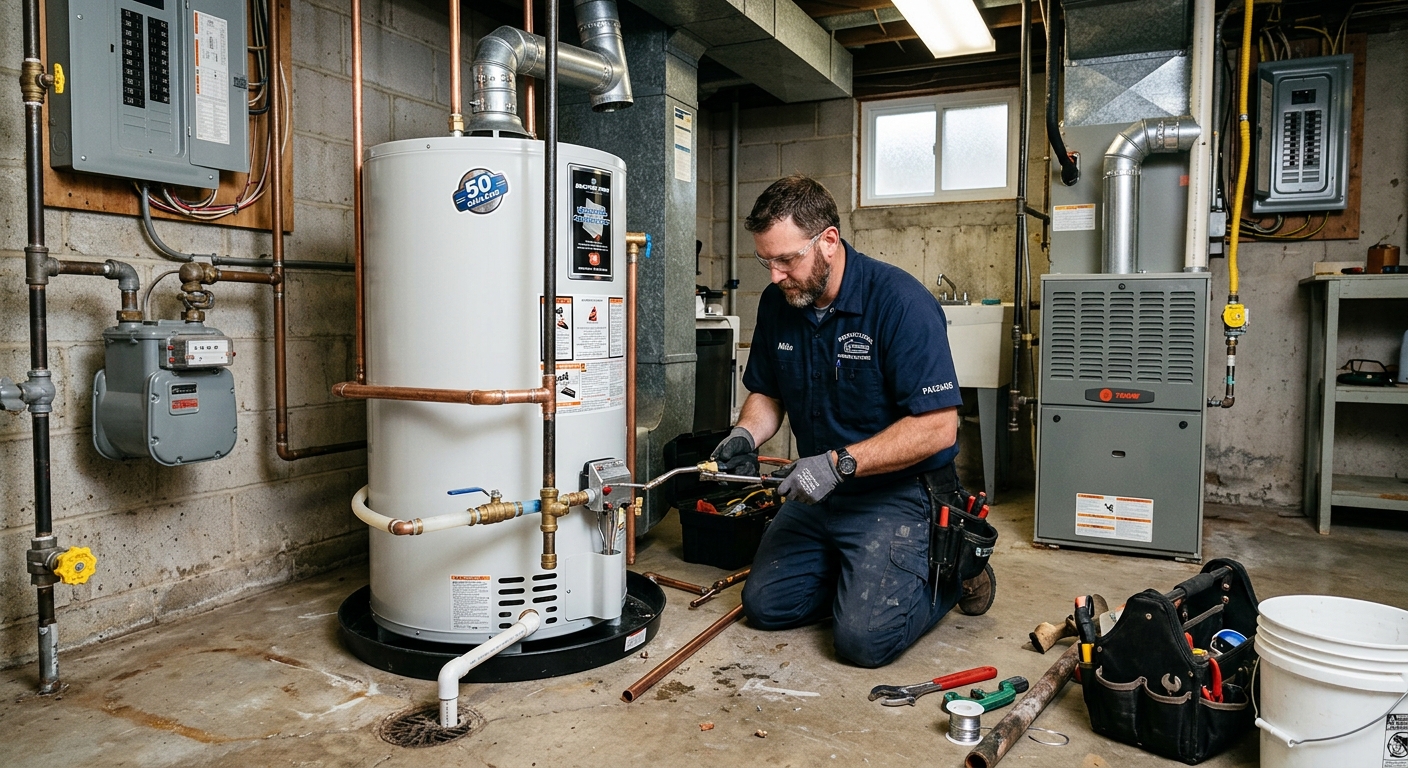
Norristown plumbing prices by job type — 2026
In Norristown, where more than 82% of homes were built before 1980 and owner occupancy is below 40% (U.S. Census Bureau, ACS 2024), plumbing system age and past repairs often drive what it costs to fix or replace something. The bulk of the area’s housing dates from the 1950s–1970s. That vintage means you’re likely to be dealing with older copper or even galvanized steel pipes, which are more prone to pinhole leaks, corrosion, and supply line failures. Construction era almost always predicts what pipes are in your walls, and the pipe material will decide what goes wrong—and how much it costs to make right.
One of the biggest variables in pricing is whether you need emergency help or can schedule out a repair. The exact same repair on a Tuesday morning will run hundreds less than a midnight call with a leak in progress. Norristown’s dense housing and short travel times keep the lower end of service call pricing fairly grounded compared to rural Pennsylvania, but if you call after hours or for major leaks, plan on paying the upper end.
| Service |
Scope |
Emergency rate |
Standard rate |
| Emergency repair — burst pipe |
locate, open, repair section, restore service |
$600–$1,250 |
$375–$1,250 |
| Water heater replacement (gas, 40–50 gal) |
remove old, install, test, haul away |
$2,000–$2,900 |
$1,250–$2,900 |
| Drain cleaning — main line |
augering or hydro-jet, camera if needed |
$350–$800 |
$200–$500 |
| Sewer line spot repair |
excavate or reline a failed section |
$2,100–$12,500 |
$2,100–$12,500 |
| Whole-house repipe |
replace supply lines throughout, patch and finish |
$5,900–$8,800 |
$3,600–$8,800 |
| Water service line replacement |
street to house, excavation and restoration |
$8,000–$12,500 |
$5,700–$12,500 |
Estimates for a typical Norristown home. Access difficulty and pipe material move these figures more than anything else.
Vetting a plumber in Montgomery County
In Montgomery County, the first check is always whether your plumber is actually registered and insured to work in your township or borough. There’s no statewide plumbing license—each municipality handles its own registration. For jobs over $500, the contractor must have Home Improvement Contractor (HIC) registration through the Pennsylvania Office of Attorney General (check at hic.attorneygeneral.gov). Insurance is a must, and the certificate should name your property. Workers’ compensation should be current and verifiable through the WCAIS system (wcais.pa.gov).
Always check that the plumber has an active business presence in the township where your property sits. A company registered in one part of Montgomery County may have zero standing to work in Norristown proper. Emergency pricing should be transparent, and for bigger jobs, ask directly if work is subcontracted. If you can’t get a direct answer or a written quote, keep moving.
- Check HIC registration at hic.attorneygeneral.gov
- Ask if they hold valid business registration in your municipality
- Request a valid insurance certificate naming your address
- Verify workers’ compensation at wcais.pa.gov
- Get a written contract for all work over $500
- Ask if they dispatch their own crews or subcontract
- Require clear emergency and after-hours pricing in writing
- Insist on itemized quotes, especially for large jobs
- For repipes or sewer work, require camera evidence and a pressure test
- Ask who will file for permits and request inspection documentation
- Read contract cancellation rights: you have a 3-day window
- Never allow anyone to waive your insurance deductible—it's prohibited
Red flags: With Montgomery County’s saturated contractor market, volume can make it tempting for companies to oversell. Beware anyone pushing a whole-house repipe or sewer replacement without camera footage, or who can’t provide a pressure test to back up their assessment.
Freeze risk and what to do about it
Norristown’s official frost depth is 30 inches, with a winter design temperature of 14°F—cold enough to burst pipes if they’re unprotected or run through poorly insulated spaces. The real mechanism isn’t just freezing: when water freezes, it forms a plug, and as pressure builds between that plug and a closed faucet or valve, the pipe finally bursts between the freeze and the fixture. That explains why the rupture is rarely right at the visible ice; the split is where pressure finds a weak point.
The most vulnerable plumbing is found in exterior walls, unheated crawlspaces, garages, pipes running along foundation walls, or under kitchen/bathroom cabinets on outside-facing walls. Hose bibs and any supply running through an unconditioned attic are regular culprits.
Prevention, from lowest to highest cost:
- Open sink cabinet doors on cold nights to allow room air circulation
- Let faucets at risk trickle just enough to keep water moving during deep freezes
- Install pipe insulation on any exposed supply line, especially in basements and crawlspaces
- For stubborn spots, add electric heat tape (plug-in style, never open flame)
- Shut off and drain all outdoor spigots before the first hard freeze
If a line does freeze, use a hair dryer, heat gun on low, or a heated pipe wrap to thaw it. Never use an open flame, torch, or welding device—too many fires and split pipes have started with this shortcut.
A burst pipe emergency in Norristown will run anywhere from $375–$1,250 to fix after the fact. Insulating a dozen feet of exposed piping is far cheaper than an after-hours call and drywall repair.
What's in the water here
Norristown homes are served by Aqua Pennsylvania, which provides treated municipal water. Public water systems like this issue an annual water quality report—you can request it if you want to see official test results on chlorine, lead, or byproducts.
The local water here is considered moderately hard, which means you’ll see scale build-up inside water heaters and on fixtures. This shortens the life of both, enough that 8–12 years out of a tank water heater is normal. Copper pinholes, while not rampant, can happen if the water supply is slightly aggressive (low pH). Most Norristown homeowners don’t save money adding a softener unless they have severe build-up, and most units cost more to install and run than you get back in appliance savings.
Whole-house filtration makes sense only if you object to chlorine taste or specific odors, otherwise a sink or fridge filter is enough. Save your money on high-cost “treatment” systems unless a real water quality problem exists.
If you’re in one of the rare outer pockets with a private well, there’s no published report—you’ll need your own lab analysis, especially for lead, nitrates, or bacteria. This is rarely the case in Norristown proper.
Choosing a water heater in Norristown
Your choice of water heater in Norristown boils down to what fits your home, fuel availability, and your tolerance for higher upfront cost. Most homes here already have gas, favoring gas tank-type heaters since they install easily, cost less up front, and work with older plumbing layouts. They do lose energy through standby losses and last about 8–12 years.
Gas tankless heaters provide endless hot water but come with a big installation jump—many Norristown homes need a larger gas line and a new vent, which isn’t factored into most advertised prices. Unless you have a big household, the extra cost may not pay for itself.
Heat pump water heaters use much less electricity but want to live in a basement or garage with at least 700 cubic feet of air volume and temperatures above 50°F. They’ll cool the room they’re in and can be noisy—something to consider if your basement is finished or used regularly.
Whatever type, size your unit by the “first hour” rating—the gallons it can deliver at full demand, not just tank size. Norristown homes with lots of old pipes should have a pan and drain under the heater and consider an expansion tank if water pressure is high. Almost all failures are tank ruptures, not control board problems.
| Type |
Installed cost |
Service life |
Operating cost |
Best when |
| Gas tank, 40–50 gal |
$1,250–$2,900 |
8–12 yrs |
moderate |
Gas line in place, traditional install |
| Electric tank, 40–50 gal |
$1,250–$2,000 |
10–15 yrs |
high |
No gas access, smaller households |
| Gas tankless |
$2,000–$2,900 |
18–25 yrs |
low-moderate |
High demand, space saver, updated gas line |
| Heat pump water heater |
$2,000–$2,900 |
13–15 yrs |
lowest |
Larger, warm unfinished basement |
Licensing and permits for plumbing work in Norristown
In Pennsylvania, plumbing contractors are not licensed by the state; instead, licensing is municipal. This means if you’re hiring for a job in Norristown, you need someone registered with the Borough of Norristown Code Enforcement Department, not just any plumber with a business in Montgomery County. A plumber licensed in Philadelphia, for example, cannot assume they’re legal to work in Norristown or Ardmore.
All contracts over $500 require that the contractor hold active Home Improvement Contractor (HIC) registration, which can be verified through the Pennsylvania Office of Attorney General. Workers’ compensation coverage is mandatory for all employers, and you can double-check active policies through the WCAIS portal.
For plumbing work—alterations, whole-house repiping, water heater installation, or new or changed systems for water, sewer, or venting—you need a permit in Norristown. Routine fixture swaps with no pipe alterations do not require one. The borough or the local code office will inspect permitted work for compliance with the Pennsylvania Uniform Construction Code (UCC), based on the IRC.
When hiring, ask to see both the municipal registration for Norristown and valid insurance, and make sure the contractor will pull all necessary permits before work starts.
Emergency rates versus scheduled work in Norristown
The biggest price swing you’ll see with plumbing in Norristown is between emergency calls and planned work. An emergency rate usually means after-hours dispatch, a trip fee, overtime labor, and less time to diagnose calmly. That extra charge quickly adds up, especially if you call at midnight or on a holiday.
A scheduled pipe repair in Norristown might run $375–$1,250, while calling for the same burst on a Sunday night pushes it to $600–$1,250. For a water heater, a planned replacement can mean a difference of many hundreds.
What really counts as an emergency in Norristown?
- Active flooding or ceiling leaks
- No water at all to your house
- Sewage backing up inside
- Gas smell from a water heater or appliance
What can almost always wait for business hours?
- Slow drips from shutoffs or valves
- One clogged sink or bathtub (if you have backups)
- Running toilet or minor fixture leaks
To avoid an emergency bill, learn how to shut off water at your main (usually where the pipe enters the home from the street) and at individual fixture stops. Cutting water quickly converts an urgent leak into a job you can schedule without the big surcharge.
Frequently asked questions — plumbing in Norristown
Do I need a permit for plumbing work in Norristown?
Yes, permits are required in Norristown for any plumbing alteration, repipe, water heater installation, or work that changes your water, sewer, or venting system. The exception is small, like-for-like fixture swaps—if you’re replacing a faucet or toilet without altering pipes, no permit is needed. All permitted work gets inspected by the Borough of Norristown Code Enforcement Department to meet Pennsylvania’s Uniform Construction Code. If a plumber tries to skip the permit process for a substantial job (such as a water heater replacement, which usually costs $1,250–$2,900), that’s a bad sign. Always ask your contractor who will pull the permit and confirm inspection is included in the price.
Who owns the sewer lateral, me or the city?
In Norristown and the rest of Montgomery County, homeowners generally own and are responsible for the sewer lateral—the pipe running from your house to the main under the street. Aqua Pennsylvania manages the water supply, but the sewer system is municipal, and repair costs on your segment aren’t covered by the city. If a tree root or collapse occurs, all excavation and repairs (which often run $2,100–$12,500) are on the property owner unless you’ve purchased a special insurance rider. Always confirm the line’s condition during any major plumbing job.
Are tree roots a common sewer problem in Norristown?
Yes, tree roots are a common problem in Norristown—especially in neighborhoods with large, mature street trees and homes built before 1980. Old clay or cast iron pipes are vulnerable to root intrusion at joints or cracks, causing slow drains, backups, and sometimes total failures. Sewer spot repairs can cost from $2,100–$12,500, so paying for a sewer camera inspection before buying or major work often pays for itself. Newer plastic pipe is less prone, but many laterals here predate modern materials.
What does drain cleaning cost in Norristown?
Main line drain cleaning in Norristown typically runs from $200–$800, depending on method and urgency. If you need emergency service for a total clog, expect the higher end—hydro-jetting and camera inspection add to cost. For basic augering during business hours, stick to the lower end. Always demand documentation of what was cleared; if you’re quoted a complete replacement without at least a camera video, get a second opinion. Most backups in Norristown’s older homes are fixable with cleaning, not excavation.
What do I do about a burst pipe right now?
If you have a burst pipe in Norristown, immediately shut off your main water valve—typically where the pipe enters your basement from the street. Open a few faucets to relieve pressure and call a registered plumber who works in your municipality. Document any visible damage for insurance. Emergency repairs in Norristown cost between $375–$1,250, with after-hours calls at the top end. Never let anyone talk you into a full repipe unless there’s solid proof (such as a pressure test or multiple leaks). Quick action minimizes water damage and repair costs.
What does discoloured water on first draw mean?
Discoloured water from your tap when you first turn it on, especially in older Norristown homes, usually means flushing of the local water lines or minor rust in your own supply. Aqua Pennsylvania occasionally flushes mains, stirring up harmless mineral sediment. If the problem persists or stains laundry, flushing your own pipes may help. If you see a sudden drop in water pressure or the color lingers beyond a few minutes, it’s worth a call—persistent brown water can signal pipe corrosion, which may mean a repipe ($3,600–$8,800) is in your future, but most cases resolve quickly.
Is a tankless water heater worth it in Norristown?
Tankless water heaters in Norristown offer endless hot water and lower standby energy loss, but installation costs are higher due to venting and possible gas line upgrades. Expect to pay $2,000–$2,900 (and possibly more if retrofitting). In older homes, it only pays off if your hot water demand is especially high—otherwise, a traditional tank is cheaper to install and nearly as reliable. The added complexity of tankless systems means repairs are costlier, and they require more maintenance. For most households here, a tank model is still the default unless space is an issue.
How much does a water heater replacement cost in Norristown?
Replacing a gas water heater (40–50 gallon) in Norristown will cost you between $1,250–$2,900, typical for Montgomery County given older home access and disposal of your old unit. If you switch to a tankless or heat pump model, expect to pay at the higher end. Be sure your quote includes not just the unit itself but all connections, a drip pan, and any necessary venting or expansion tank work. Scheduling replacement before a total failure often saves money, since waiting for a tank to rupture can lead to extra water damage and emergency service premiums.
Do I need to drain outdoor spigots in Norristown?
Yes, in Norristown you should always shut off and drain outdoor spigots before the first real freeze. With a frost depth of 30 inches and winter temperatures dipping to 14°F, any water left in exterior pipes can freeze, expand, and cause splits—even with “frost-free” hydrants. Winterizing outdoor lines takes a few minutes and can save you from costly repairs (emergency burst pipe calls run $375–$1,250). Don’t forget to detach hoses and leave the spigot open after shutting off the interior valve—this lets air in and water out, minimizing risk.