What plumbers charge in Plainfield
In Plainfield, plumbing costs come down to two main factors: whether it’s an emergency and the type of piping in your home. Most single-family homes here were built before 1980 (U.S. Census Bureau, ACS 2024), meaning many residents still have original plumbing—often galvanized steel, copper, or even cast iron drains—especially in the largest post‑1945 tracts that extend from Palmer and Forks Townships. Those older supply lines lead to Plainfield’s steady demand for copper-to-PEX repiping and water line replacements.
The gap between emergency and standard rates is real. Fixing a burst pipe at 2 AM will always cost more than the same job done on a weekday afternoon. Emergency calls demand fast response, higher labor premiums, and often some on-the-spot material sourcing. Most local households (80.3%) own their homes (U.S. Census Bureau, ACS 2024), so the urgency to limit water damage is high—and so is the cost if you wait. If you’re in a typical Plainfield home with older copper or galvanized pipes, expect main line repairs and water heater replacements to follow the town’s construction timeline and plumbing material lifecycle. Below are local costs for common jobs, reflecting that all-important distinction: emergency versus scheduled work.
| Service |
Scope |
Emergency rate |
Standard rate |
| Emergency repair — burst pipe |
locate, open, repair section, restore service |
$600–$1,250 |
$350–$1,250 |
| Water heater replacement (gas, 40–50 gal) |
remove old, install, test, haul away |
$1,950–$2,900 |
$1,250–$2,900 |
| Drain cleaning — main line |
augering or hydro-jet, camera if needed |
$350–$800 |
$200–$500 |
| Sewer line spot repair |
excavate or reline a failed section |
$2,100–$12,500 |
$2,100–$12,500 |
| Whole-house repipe |
replace supply lines throughout, patch and finish |
$3,600–$8,700 |
$3,600–$8,700 |
| Water service line replacement |
street to house, excavation and restoration |
$5,600–$12,500 |
$5,600–$12,500 |
Estimates for a typical Plainfield home. Access difficulty and pipe material move these figures more than anything else.
Galvanized, copper, PEX, cast iron
If you own a Plainfield home or one in the larger developments of Palmer and Forks Townships, your plumbing will tell a story about when your house was built. Post‑1945 tracts in these areas mean many homes with copper supply lines, with some older houses still running on galvanized steel or cast iron drains. The material matters because it predicts not only what can fail, but when.
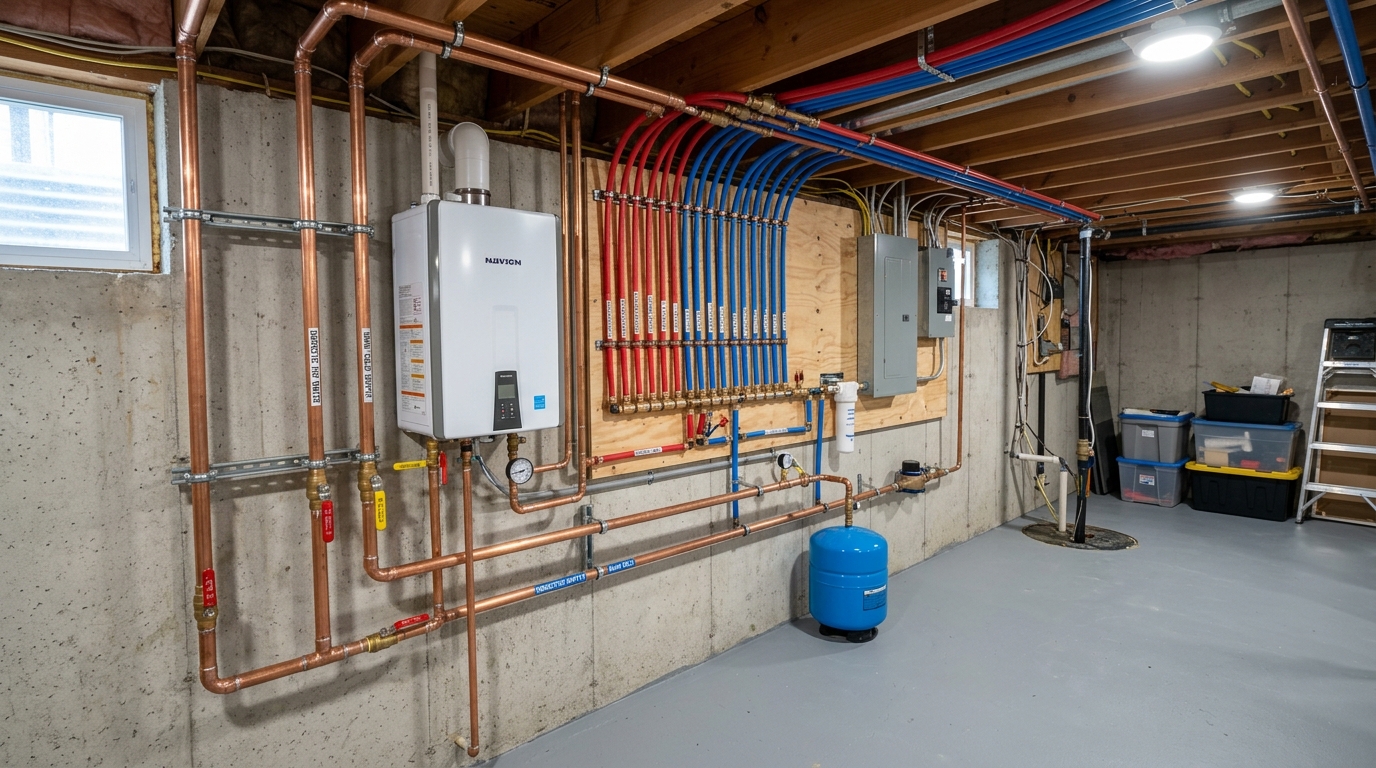
Galvanized steel is dull gray and magnetic. To identify it, gently scratch an exposed pipe (such as in the basement); it’ll reveal shiny silver metal under the paint or corrosion. Copper pipes are the color of a penny—look at your water heater’s inlet for confirmation. PEX is flexible, plastic-looking—red, blue, or white, with crimped brass or plastic fittings. Polybutylene, if you still find it, will be gray, flexible, and often stamped with “PB” markings. Cast iron drains are thick, dull black and heavy, joined with hub-and-spigot or clamp connections. Clay tile sewer lines are usually terracotta brown, visible at a cleanout or from camera inspection.
If your home was built in the 1960s or earlier, galvanized and cast iron are common, and both are near or at the end of their service life. The big maintenance item in Palmer and Forks isn’t fixing leaks—it’s full-house copper-to-PEX repiping, and swapping out drains before a major failure. Polybutylene, largely found in late ‘70s to mid-‘90s homes, is best replaced proactively. If you’re seeing pressure drops, slow drains, or pinhole leaks, your pipes are sending a message.
| Material |
Typical era |
Failure mode |
Service life |
| Galvanized steel supply |
pre-1960 |
internal corrosion, pressure loss |
40–60 yrs |
| Copper supply |
1950s–present |
pinhole leaks, joint failure |
50–70 yrs |
| Polybutylene supply |
late 1970s–1995 |
fitting failure, sudden bursts |
unreliable |
| PEX supply |
2000s–present |
fitting or UV degradation |
40–50 yrs |
| Cast iron drain |
pre-1975 |
corrosion, cracking, scale |
50–75 yrs |
| Clay tile sewer lateral |
pre-1980 |
root intrusion at joints, offset |
50–60 yrs |
| PVC / ABS drain |
1970s–present |
joint separation, crushing |
50+ yrs |
The leak you can hear but can't see
Start with the meter test: turn off every faucet and appliance, check your water meter (often found in the basement or outside near the curb), and watch for any movement on the low-flow indicator. If it spins with all fixtures off, you have a leak somewhere on the supply side. This costs nothing and tells you whether a hidden leak is active.
When it comes to finding a hidden leak, plumbers use several methods. Acoustic listening devices “hear” water escaping from pressurized pipes, allowing pinpoint location behind walls or slabs—expect this service in the $350–$800 range, usually part of an emergency repair call. Thermal imaging can spot temperature changes caused by water leaks, especially useful inside walls or under floors. Tracer gas, less common in Plainfield homes but effective for slab leaks, involves sending a harmless gas through the pipes and detecting where it escapes. Dedicated slab leak detection, when needed, is usually closer to the upper end of the emergency repair range.
Suspect a leak? The pro will use listening devices or a camera before ever opening walls—a plumber offering quick demolition is doing it backwards. Special cases include leaks beneath concrete slabs or in buried irrigation lines—the right tools find the source without needless repair bills.
Who is allowed to do plumbing work in Pennsylvania
Pennsylvania does not issue plumbing licenses at the state level. Instead, every municipality sets its own rules: a plumber licensed in Bethlehem, for example, may hold no credential at all in Forks Township or Hanover Township, Northampton County. Always ask: “Are you licensed to do plumbing here?” In Hanover Township, there’s a Master Plumber License system—entirely separate from Bethlehem or Easton.
For any plumbing job over $500 in Plainfield, your contractor must be registered as a Home Improvement Contractor (HIC) with the Pennsylvania Office of Attorney General. You can verify this registration at hic.attorneygeneral.gov. In single-family homes in Bethlehem, replacing a faucet or toilet doesn’t typically require a city plumbing permit, but new or replacement interior piping and fixtures usually do. For most Plainfield homes—especially those in the more densely enforced jurisdictions around Bethlehem—permits may be needed for significant changes or repairs.
Workers' compensation insurance is mandatory for any employer. Verify coverage via the state’s WCAIS system (wcais.pa.gov) to ensure a claim won’t fall back on you. Written contracts are required by law for all work over $500. You also have a three-business-day right of cancellation thanks to the Home Improvement Consumer Protection Act. If your house was built before 1978, make sure your contractor follows the EPA’s lead paint rules—verify certification at certifiedrenovatorsearch.epa.gov.
Choosing a water heater in Plainfield
Most Plainfield homes use either gas or electric tank water heaters, as they're the lowest up-front cost and fit nearly any mechanical room or basement. Tank heaters have a service life of 8 to 15 years and tend to fail suddenly from tank corrosion—not the controls—with little warning. Heat pump water heaters are showing up more, especially in basements where they can grab warm air, but you’ll notice the noise and the cooling effect in winter. They’re the thriftiest to operate, but don’t install one in a finished tight space unless you’re fine with the hum and chill.
Tankless—while endlessly hyped—demands a higher install cost and, with gas models, might require a new, larger gas line and advanced venting. In Plainfield, those extra costs are common and can surprise you. Unless your hot water use is high or you need the space savings, a quality tank model will repay you faster. Sizing should be done by first-hour hot water rating, not just gallons—critical during Plainfield’s winter months when demands spike. Don’t skip the thermal expansion tank or a drip pan with a floor drain, especially in older basements.
| Type |
Installed cost |
Service life |
Operating cost |
Best when |
| Gas tank, 40–50 gal |
$1,250–$2,900 |
8–12 yrs |
moderate |
standard replacement, reliable hot water |
| Electric tank, 40–50 gal |
$1,250–$1,950 |
10–15 yrs |
high |
no gas available, low install cost |
| Gas tankless |
$1,950–$2,900 |
18–25 yrs |
low-moderate |
endless hot water, high efficiency |
| Heat pump water heater |
$1,950–$2,900 |
13–15 yrs |
lowest |
basements with space and warm temps |
Camera inspection, relining and replacement
In Plainfield and surrounding Northampton County, the homeowner nearly always owns the sewer lateral from house to the street main, sometimes including the section under the public sidewalk or roadway. That means if roots get into your clay tile or cast iron cracks, the repair bill stops with you—not the township.
Issues start with a single slow drain, progress to backups at the lowest fixture, or become obvious when gurgling and sewage indicate a total blockage. In this market, camera inspection is the standard step before any excavation or relining quote—don’t accept any bid without seeing the footage. It finds roots growing into old clay lines at joints, offsets from settling, and bellies (sags) that hold waste and water.
For sewer lines made from pre-1980 clay tile, roots are the most common problem. Relining (trenchless repair) can fix many issues without digging up your yard, but it’s not suited for pipes that have completely collapsed or have major sags. Where septic is still common in rural townships, tank pumping and a healthy drainfield are the focus—if your system backs up, start by locating and pumping your tank before committing to full drainfield replacement.
Sewer excavation is serious money: always insist on seeing that camera video, both before and after the repair.
Winter pipe failures in northeastern Pennsylvania
With a winter design temperature of 4 °F and a frost depth of 36 inches, Plainfield sits squarely within northeastern Pennsylvania's freeze belt. Heavy snows and ice-dam formation are constant threats, particularly in homes with pipes in exterior walls, crawlspaces, garages, and unconditioned attics. Unlike warmer climates, the freeze here runs deep and long—if you have an unheated basement or garage, those pipes are especially vulnerable.
Pipes burst not because of the ice itself, but due to the pressure buildup between the frozen section and a closed fixture. The actual break often happens away from the frozen point, catching homeowners off guard. Hose bibs and any outdoor spigots should be shut off and drained before the first real freeze, as these are top failure points year after year. In older Plainfield homes, it’s common to see original lines run through the coldest spaces—bad news when the temperature drops.
Preventing a winter disaster starts with proper insulation and using heat tape (UL-listed only), opening cabinet doors to let warm air circulate, and letting a faucet slowly drip during cold snaps. Never use an open flame to thaw a pipe—stick to hair dryers, heating pads, or space heaters. Emergency burst pipe repairs run $600–$1,250 —a lot more than prevention costs.
Frequently asked questions — plumbing in Plainfield
Does Pennsylvania license plumbers at the state level?
Pennsylvania does not license plumbers statewide. Instead, every municipality and township creates its own requirements. That means a plumber authorized to work in Bethlehem, for example, might not be permitted in Plainfield or other parts of Northampton County. Hanover Township in Northampton issues its own Master Plumber License, completely separate from neighboring municipalities. Always ask if your plumber is qualified to work “here”—not just in the general region. Regardless of licensing, any plumbing project over $500 requires the contractor to hold a Home Improvement Contractor (HIC) registration with the Pennsylvania Office of Attorney General. You can look this up directly at hic.attorneygeneral.gov. For jobs involving employees, workers’ compensation coverage is mandatory and verifiable at wcais.pa.gov. Emergency repairs, such as a burst pipe, often cost $600–$1,250 and it’s worth confirming credentials before the job starts.
What do I do if a pipe is frozen but not burst?
If you discover a frozen pipe in your Plainfield home—perhaps a faucet isn’t running or a section of exposed pipe feels unusually cold—shut off the water supply to that pipe if you can. Open the affected faucet fully to relieve pressure. Then, thaw the pipe gently using a hair dryer, heat lamp, or heating pad—focus on the area closest to the faucet. Never use an open flame, as this is extremely dangerous and can cause a fire. If you cannot locate or access the frozen section, or if you’re not seeing improvement, it’s wise to call a professional before it bursts. The cost of thawing is far less than the $600–$1,250 you’ll pay if it breaks and floods your home in the middle of a Pennsylvania winter. Don’t ignore the problem: prevention trumps repair every time in our climate.
Is a sewer line replacement covered by homeowner's insurance?
Generally, most homeowner’s insurance policies in Plainfield and across Pennsylvania exclude coverage for repairs to your sewer lateral unless damage is sudden and accidental—such as from a vehicle driving over the line or a sudden collapse. Issues common to our area, like root intrusion in clay tile pipes or gradual deterioration, are almost never covered because they’re classified as wear and tear. It’s possible to add a special rider for “service line” protection, but this is not standard and typically comes with restrictions. If you’re facing a sewer line spot repair or full line replacement—costing anywhere from $2,100–$12,500—don’t assume insurance will step in. Always check your policy details and talk to your agent directly. The footage from a camera inspection is typically required before any insurer will even consider a claim.
Do older Plainfield homes have galvanized pipes?
Yes—many Plainfield homes, especially those built before 1960, are likely to have at least some original galvanized steel supply piping. These pipes were common in the era when much of Northampton County (including the post-war suburban boom in Palmer and Forks Townships) was first developed, and Plainfield is no exception. Galvanized pipes can last 40 to 60 years, but they inevitably corrode from the inside, leading to reduced water pressure and eventual leaks. If your house is over 60 years old and you’re experiencing low flow or visible rust at fixtures, it’s worth investigating. Aging galvanized is one major reason full repipes in the area run $3,600–$8,700—a common upgrade for Plainfield homeowners.
How do I tell what my pipes are made of?
To identify pipe material in your Plainfield home, start at exposed runs in the basement or near the water heater. Galvanized steel is gray and magnetic, and scratching it gently with a screwdriver reveals shiny silver metal beneath. Copper is reddish-brown like a penny, with soldered joints. PEX is plastic, flexible, and color-coded (red for hot, blue for cold), joined with crimp rings. Polybutylene is gray and flexible—with “PB” printed on it. Cast iron drain pipes are heavy and dark, often joined with clamps or hubbed connectors. Correct identification helps estimate remaining service life—important around here, as pipes installed in the 1940s–1960s are nearly always past their best years. Whole-house repipes in Plainfield regularly run $3,600–$8,700, but replacements are often phased.
Should I repipe my Plainfield home or keep repairing?
If you have original galvanized or early copper pipes in your Plainfield home—common in houses built before the 1970s—it’s often more cost-effective in the long run to do a full repipe. As corrosion accelerates, persistent leaks, pressure drops, or repeated repairs become more common. Spot repairs may seem cheaper in the short term, but multiple emergencies (each at $600–$1,250) add up—and damage from leaks can far exceed the repair bill. Full repiping, usually with PEX or copper, eliminates future surprises and improves home value and water quality. The upfront expense of $3,600–$8,700 is higher, but it avoids warranty issues with piecemeal fixes. In Palmer and Forks Townships, many homeowners are choosing to repipe before selling, given how buyers are now checking plumbing material and ages as closely as roofs and furnaces.
What do I do if sewage is backing up?
If you notice sewage backing up into basement floor drains or the lowest fixture in your Plainfield home, stop using all water immediately—no flushing, washing, or draining. This symptom means your main sewer line is blocked or failing. Contact a plumber who can perform a camera inspection before quoting repairs; seeing the problem on video is standard here and avoids unnecessary excavation. The culprit is often roots in older clay or cast iron pipes, or a collapsed lateral. Clearing the line can cost $200–$500 if it’s a simple augering job, while major repairs run much higher. In rural townships, verify that the septic tank isn’t full (which needs pumping every 3–5 years), as this can also cause backups. Don’t delay—sewage exposure brings health risks and increases cleanup costs.
How much does sewer line repair cost in Plainfield?
Sewer line repairs in Plainfield and greater Northampton County range from $2,100–$12,500, depending mostly on the extent of damage, the material involved, and how accessible the problem is. Spot repairs (fixing a single break or root intrusion) sit on the lower end, especially when caught early with a camera inspection. Full replacements, needed if your clay tile or cast iron has collapsed or if multiple joints have failed, run close to the high end of the band. Always insist on seeing the camera footage before any digging—this is standard practice locally. Trenchless relining options may save your yard but aren’t possible if the pipe is severely offset or bellied. Sizable parts of Plainfield still have pre-1980 sewer lines, so it’s worth budgeting for inspection if you’re buying or planning a remodel.
What does drain cleaning cost in Plainfield?
In Plainfield, main line drain cleaning usually falls between $200–$500 for standard calls, or $350–$800 during emergencies or after-hours service. This work includes augering, hydro-jetting, and a preliminary camera look if blockages recur or if roots are suspected. Routine clogs are often cleared within an hour or two, but older homes with cast iron or clay pipes may see frequent blockages from roots or internal buildup. While chemical drain cleaners are cheap, they can damage pipes—especially PVC, older cast iron, or those with questionable joints common to pre-1980 houses. Regular annual cleaning can prevent bigger, more expensive issues from developing. If you’re facing consistent backups, a camera inspection (sometimes included) will tell you if the time has come for a bigger repair.