Jackson plumbing prices by job type — 2026
Jackson, in south-central Butler County, has an owner-occupied housing rate of 84.2% and a housing stock where just over 40% of homes were built before 1980 (U.S. Census Bureau, ACS 2024). This blend means you see both post-1990s subdivision homes—common in neighboring Cranberry Township, where modern PVC and PEX supply lines are the rule—as well as older homes with a wider spread of materials. With plumbing jobs, when your home was built decides your pipe material, and the pipe material is the main driver for what breaks and how much a fix will cost.
In Jackson, the same repair—say, for a burst pipe—will have two very different prices depending on whether it is an emergency with water pouring out, or a planned repair scheduled during standard hours. Emergency calls carry premiums for after-hours response, mobilization, and the urgency to restore basic service, even before parts or additional complications factor in.
For water heater replacements, drain cleaning, or sewer repairs, you’ll find that newer homes with open basements and accessible pipe runs are generally less expensive than homes with finished walls, slab foundations, or quirky early piping layouts. Multi-bath layouts, now common thanks to the 1990s–2010s building boom just south in Cranberry Township, mean longer pipe runs and more fixtures to account for.
| Service |
Scope |
Emergency rate |
Standard rate |
| Emergency repair — burst pipe |
locate, open, repair section, restore service |
$650–$1,300 |
$375–$1,300 |
| Water heater replacement (gas, 40–50 gal) |
remove old, install, test, haul away |
$2,000–$3,000 |
$1,300–$3,000 |
| Drain cleaning — main line |
augering or hydro-jet, camera if needed |
$350–$800 |
$200–$500 |
| Sewer line spot repair |
excavate or reline a failed section |
$2,200–$13,000 |
$2,200–$13,000 |
| Whole-house repipe |
replace supply lines throughout, patch and finish |
— |
$3,800–$9,100 |
| Water service line replacement |
street to house, excavation and restoration |
— |
$5,900–$13,000 |
Estimates for a typical Jackson home. Access difficulty and pipe material move these figures more than anything else.
Pipe materials in Jackson homes and how they fail
What your plumbing is made of depends heavily on when your house was built—a rule that holds in Jackson as it does in neighboring Cranberry Township, where the 1990s–2010s subdivision boom brought modern PVC and PEX to nearly every new home. In older Jackson houses, you’re likely to find galvanized steel (dull gray, magnetic, and threaded) or copper (reddish color, non-magnetic, soldered joints) for supply pipes. Galvanized pipes corrode from the inside, gradually closing up and dropping water pressure before leaking. Copper is more durable but may form pinholes if the water’s chemistry is aggressive.
Polybutylene—a flexible gray or blue plastic—shows up in some homes from the late 1970s through the mid-1990s, especially where tract builders aimed to cut costs, but is now notorious for catastrophic failures at the fittings, and insurers seldom want anything to do with it. If you have it, replacement is your only real option. PEX piping, in red, blue, or white, is now the norm and holds up well except where direct ultraviolet exposure or cheap fittings are a problem.
On the drain side, pre-1975 homes may have cast iron soils stacks and branch drains (heavy, black, magnetic, hub-and-spigot joints). These rust from inside, gradually scale up or crack, and 50–75 years is usually their limit. Clay tile sewer laterals were the norm before 1980; they’re tough but root-prone at every joint. Modern homes run ABS or PVC for everything below the fixtures, usually white or black plastic with glued joints—reliable barring poor installation or mechanical damage.
| Material |
Typical era |
Failure mode |
Service life |
| Galvanized steel supply |
pre-1960 |
internal corrosion, pressure loss |
40–60 yrs |
| Copper supply |
1950s–present |
pinhole leaks, joint failure |
50–70 yrs |
| Polybutylene supply |
late 1970s–1995 |
fitting failure, sudden bursts |
unreliable |
| PEX supply |
2000s–present |
fitting or UV degradation |
40–50 yrs |
| Cast iron drain |
pre-1975 |
corrosion, cracking, scale |
50–75 yrs |
| Clay tile sewer lateral |
pre-1980 |
root intrusion at joints, offset |
50–60 yrs |
| PVC / ABS drain |
1970s–present |
joint separation, crushing |
50+ yrs |
Verifying a Jackson plumber's credentials
In Pennsylvania, there is no statewide plumbing license; licensing is handled by municipalities. This means that a plumber qualified to work in one city may not be authorized to work in Jackson or elsewhere in Butler County. In the City of Butler, plumbers must meet city contractor registration requirements, but the surrounding municipalities, including Jackson and Cranberry Township, set their own rules. Always ask if the company holds registration or credentials for your specific municipality, not just the county or state.
Permitting rules change block by block: in Cranberry Township, a plumbing permit is required for any new system installation or for adding to the supply or drain piping. If you’re simply swapping in an above-ground fixture—say, a faucet or toilet—Butler City often allows that without a permit, as long as piping isn’t touched. Permit inspections are run by each municipal code or zoning office, not a central authority.
With any job over $500, Pennsylvania law requires a written contract under the Home Improvement Consumer Protection Act. That contract gives you the right to cancel up to three business days after signing. Plumbers must also maintain workers’ compensation coverage, and you can independently verify this using the state’s WCAIS system (wcais.pa.gov). For contracts, only work with plumbers holding active Home Improvement Contractor (HIC) registration, which you can check at hic.attorneygeneral.gov.
How to find a good plumber in Jackson
Start by confirming the plumber’s Home Improvement Contractor (HIC) registration using the Attorney General’s public registry. But don’t stop there—since there is no statewide plumbing license in Pennsylvania, check if the crew is approved for Jackson specifically, and be extra careful if you’re in Butler City, which keeps its own contractor registry for plumbing work. Always ask for an insurance certificate that names your property directly (not just the business). For workers’ compensation, use the WCAIS system to confirm the coverage is still active and tied to the hiring company.
Ask if the company uses its own employees or brings in subcontractors. For emergency repairs, always get the dispatch fee and the after-hours rate in writing before anyone rolls a truck—and know that true emergencies (burst pipes or active leaks) may cost more but should get a price range upfront.
- Check HIC registration at hic.attorneygeneral.gov
- If in Butler City, confirm municipal contractor registry status
- Ask if licensed/registered in Jackson’s municipality, not just the county
- Request an insurance certificate naming your address
- Independently confirm workers’ comp at wcais.pa.gov
- Get a written contract for any job over $500
- Ask if work is done by company crew or subcontracted
- Demand after-hours and emergency rates in writing
- Require explanation and proof (camera footage or pressure test) for high-dollar work
- If told you need a main line replacement or repipe, request video/camera proof
- Get a second opinion for any proposal over $3,800
- Be wary if the estimate bundles large, unrelated work “before it breaks”
In Butler County’s mixed suburban and rural market, it’s a red flag if a plumber skips proof on big-ticket jobs (no camera or pressure test for a sewer or whole-house repiping proposal) or pressures you for an immediate deposit. Take your time with any decision north of $3,800.
What construction era means for your pipes
Jackson’s housing mirrors much of Butler County: newer suburban construction dominates, thanks in part to the 1990s–2010s boom seen in Cranberry Township. If your home was built in those years, you’re generally looking at modern PVC or PEX supply lines and builder-grade fixtures throughout, often with several bathrooms and long pipe runs. Few lead service lines are found in this stock. The drawback? These homes can start to see PEX or copper failures where fittings weren’t installed perfectly, or issues with early builder-grade water heaters—most nearing end of their first life if they’ve never been replaced.
Older Jackson homes—especially anything built before 1980, which is about 40.7% of the local stock—may feature galvanized steel (gray, magnetic, threaded) or early copper plumbing, plus cast iron or clay tile for drains and sewer lateral. If you have a water heater in this vintage, it’s likely been replaced one or more times; three replacements would not be unusual by now.
Don’t assume “newer” translates to low risk. Subdivision-era homes, especially from the 1990s, can have polybutylene supply lines—a hidden issue if not already upgraded. Older homes, meanwhile, may have scale-clogged galvanized pipes that should be considered for replacement once pressure falls or a leak appears.
Detection methods and what they cost
The simplest leak test is free and you can do it yourself: turn off every faucet and appliance, then check your water meter. If the dial moves when nothing is running, you have a supply-side leak somewhere between the meter and your furthest fixture.
Professionals in Jackson use acoustic listening, thermal imaging, and—when a leak is stubborn to trace—pressurize the line with tracer gas and use sensitive sniffers to pinpoint the escape. For a slab leak (where pipe runs under the basement floor), this is often essential before tearing up any concrete. Acoustic and thermal methods usually cost between $200–$500 for typical jobs; tracer gas or more involved slab location may reach $650–$1,300 depending on the time and tools required.
Leaks inside wall cavities (especially in multi-bath homes built after the Cranberry subdivision boom) demand caution—there’s no good reason for a plumber to cut walls without at least narrowing down the leak using non-invasive means. Similar logic applies to irrigation line leaks outside the foundation: these are usually tracked by isolating valves and segment tests. Any plumber willing to open up drywall “to see” before confirming the leak’s location is jumping the gun; the technology exists to save you that cost.
When to repipe a Jackson home
If you’ve had two or more leaks in the same system within three years, it’s time to see the pattern—this isn’t bad luck, it’s failing material. Chronic low pressure throughout the house, rust-tinted or brown water coming from the tap after standing, visible corrosion on exposed sections, and repeated pinhole leaks in copper are all clear signs.
A full repipe makes sense if you still have galvanized steel or any polybutylene piping in the supply system—these will not get better with age, and the market for home insurance on polybutylene has all but disappeared. On the other hand, a single leak in a modern PEX or copper line, as found in most Jackson homes built after the 1990s, is fixable as a spot repair, especially if located in an open basement. What homeowners in older houses sometimes forget is that the drywall and plaster repair after plumbing matters—plaster ceilings and walls on 1960s and earlier homes are costly to restore, sometimes rivaling the plumbing work itself.
In newer multi-bath homes from the Cranberry Township construction wave, the repipe job can be larger simply because there’s more pipe and more fixtures per house, so realistic budgets rise accordingly.
| Situation |
Recommendation |
Cost |
Reasoning |
| One leak, accessible, modern pipe |
Spot repair |
$375–$1,300 |
Isolated failure; modern material likely to last after repair |
| Two or more leaks in 3 years |
Partial repipe |
$3,800–$6,100 |
Pattern of failure; preventative replacement of problem runs |
| Galvanized supply, pressure loss |
Full repipe |
$3,800–$9,100 |
Bore closing and leaks likely; inevitable replacement |
| Polybutylene anywhere in the house |
Full repipe |
$3,800–$9,100 |
Uninsurable, unreliable material; total replacement advised |
| Cast iron drain with root intrusion |
Camera, then reline or replace |
$2,200–$13,000 |
Roots signal cracks or joints opened; camera locates extent |
| Suspected lead service line |
Test, then replace the lateral |
$5,900–$13,000 |
Potential health risk; full excavation and pipe swap needed |
Frequently asked questions — plumbing in Jackson
Does insurance cover a burst pipe in Jackson?
Most homeowners’ insurance policies in Jackson will cover water damage from a burst pipe, provided it’s sudden and accidental—meaning the break wasn’t due to years of neglected maintenance or freezing from turned-off heat. However, the policy usually covers damage to the home and contents, not the actual cost to repair the failed section of plumbing. For example, if a supply pipe bursts in a finished basement, insurance typically pays to restore drywall and flooring but not the plumber’s bill for the pipe repair itself, which is often in the $375–$1,300 range for a typical emergency fix. Always check your policy’s fine print—and be aware that insurers may not cover polybutylene failures at all, since this pipe is considered too high-risk by most companies.
Does Pennsylvania license plumbers at the state level?
No—Pennsylvania does not have a statewide plumbing license. Licensing for plumbers is handled at the municipal level. For Jackson and most other Butler County communities, you need to confirm that your plumber is registered or licensed with your specific township or city, as the requirements change from place to place. For larger projects, always request a copy of the company’s Home Improvement Contractor (HIC) registration—which is statewide and required for any work over $500—but remember, this is different from a plumbing license. In Butler City, plumbers must meet additional municipal contractor registration requirements. If a plumber claims statewide licensure, be wary and ask them to prove their status locally.
Do I need to drain outdoor spigots in Jackson?
Absolutely. Jackson, like the rest of Butler County, gets winter temperatures well below freezing (design temp as low as 8 °F), and leaving water in hose bibs or exterior lines is a recipe for a split pipe. Always shut off the inside supply valve to exterior spigots in the fall, then open the outside faucet and drain any remaining water. If you don’t already have “frost-proof” sillcocks, consider upgrading—the one-time cost (usually within the $375–$1,300 window when combined with other minor work) can save you from a major burst or flooded basement come spring. No one in Pennsylvania should skip this step, given the climate.
Should I wait until business hours to call?
If you have an active burst, water pouring into a room, or a backed-up sewer, don’t wait. Emergency plumbing calls in Jackson carry a premium—expect charges in the $650–$1,300 range for after-hours work—but waiting can mean catastrophic damage. On the other hand, dripping faucets, slow drains, or no-heat water heater issues that aren’t urgent can almost always wait until morning when prices drop and more crews are available. Don’t let anyone rush you with “fear of damage” unless water is actively flowing into a living space.
What does drain cleaning cost in Jackson?
For main line snaking or hydro-jetting, prices in Jackson run $200–$500 during regular business hours, moving up to $350–$800 if you need an emergency call on a weekend or holiday. These rates include a basic auger job; camera inspections—sometimes used to verify the cause—may be extra, but many local companies roll that into the job if they think there’s a break or root intrusion. If multiple attempts are needed, or the blockage is especially deep or due to grease and wipes (all too common in newer multi-bath homes), the rate pushes to the top end.
Is a tankless water heater worth it in Jackson?
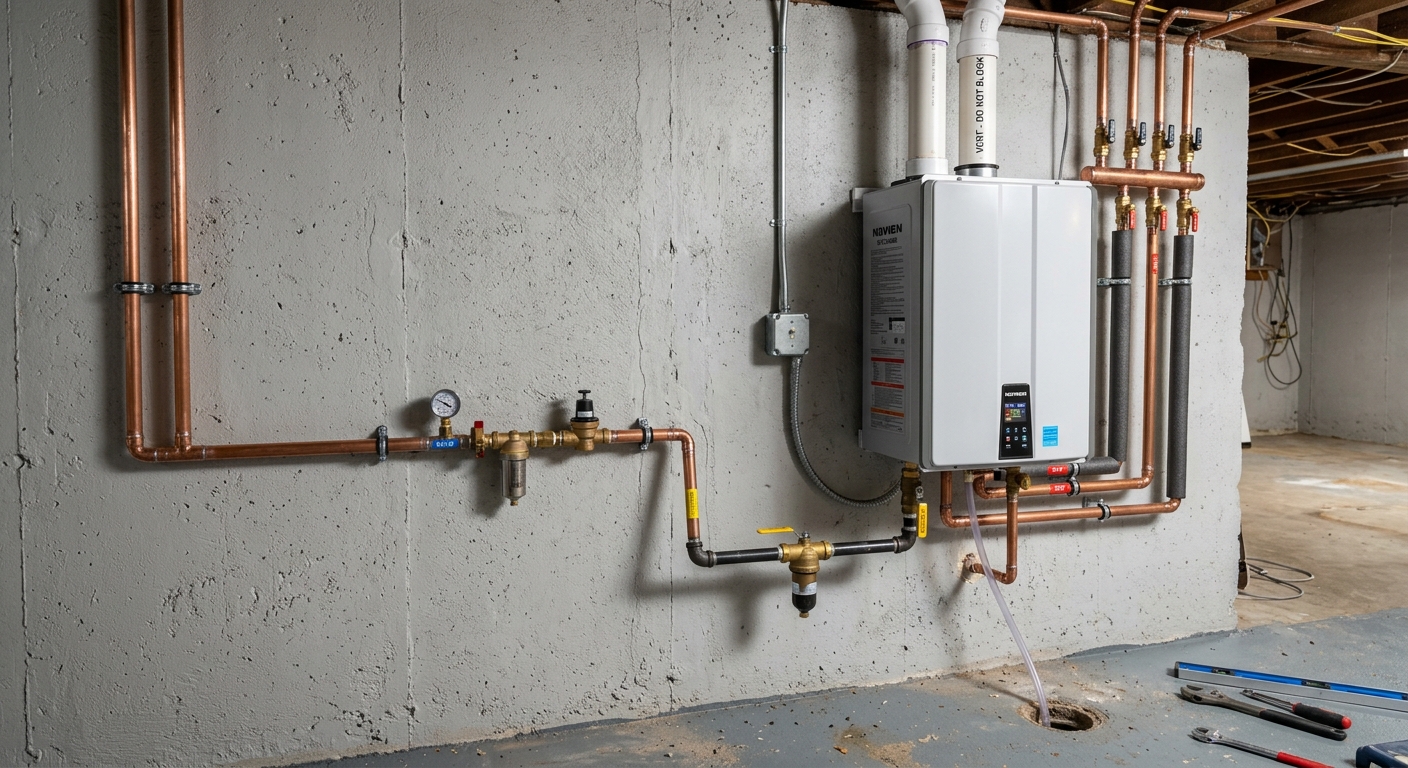
Tankless water heaters are gaining ground in Jackson, but installation is a bigger project than a simple tank swap—think $2,000–$3,000 or higher, especially if upgrades to your gas supply or venting are needed. While they provide endless hot water and can lower long-term energy costs, the upfront investment puts you in the higher range compared to traditional tank-style units. In newer subdivision homes with accessible pipe layouts, the retrofits are easier, but be cautious: hard water and high usage can add maintenance costs, and not every home’s gas line is sized to handle a tankless unit without further work. Weigh your actual usage before making the leap.
Do older Jackson homes have galvanized pipes?
Yes—about 40.7% of Jackson’s housing stock was built before 1980, and many of those homes have either original or replaced galvanized steel water lines. This is the dull silver-gray pipe that’s heavy and magnetic, usually joined with threads. Over time, galvanized pipes corrode internally, restricting water flow and eventually leaking. If your shower pressure steadily drops, or you see rusty water after standing, it’s a likely culprit. Spot repairs rarely solve the root issue—once a leak forms, a repipe in the $3,800–$9,100 range is often the best long-term solution.
Why do plumbers charge a diagnostic fee?
Diagnostic or service fees compensate for the time, fuel, and tools required simply to show up and properly assess a job in Jackson. Most local companies, especially given the spread from suburban Cranberry to rural northern townships, can’t afford to roll a truck “just to look” for free—labor and mileage both matter. The fee—commonly in the $200–$500 range—often gets credited toward the repair if you hire them, but is sometimes a flat charge on smaller or more complex jobs. A fair diagnostic fee signals a company values their time and yours; someone advertising “free estimates” may cut corners elsewhere, or may pad their repair price to make up for the upfront savings.
What causes low water pressure in Jackson homes?
Low pressure in Jackson homes can have several causes. In older homes, the top culprit is usually galvanized steel supply pipes—the interior bores fill with rust, causing whole-house drops, especially when multiple fixtures run. In newer homes built since the 1990s, poor crimped PEX fittings or builder-grade pressure regulators go bad and cause similar symptoms, but are usually cheaper to fix. Municipal supply issues (rare in the Pennsylvania American Water district) can affect whole neighborhoods, but a single home’s low pressure is almost always inside piping. A plumber charging more than $1,300 just to “find the cause” without confirming it’s not just a clogged aerator or faulty regulator isn’t doing you a service—most testing is simple and inexpensive.