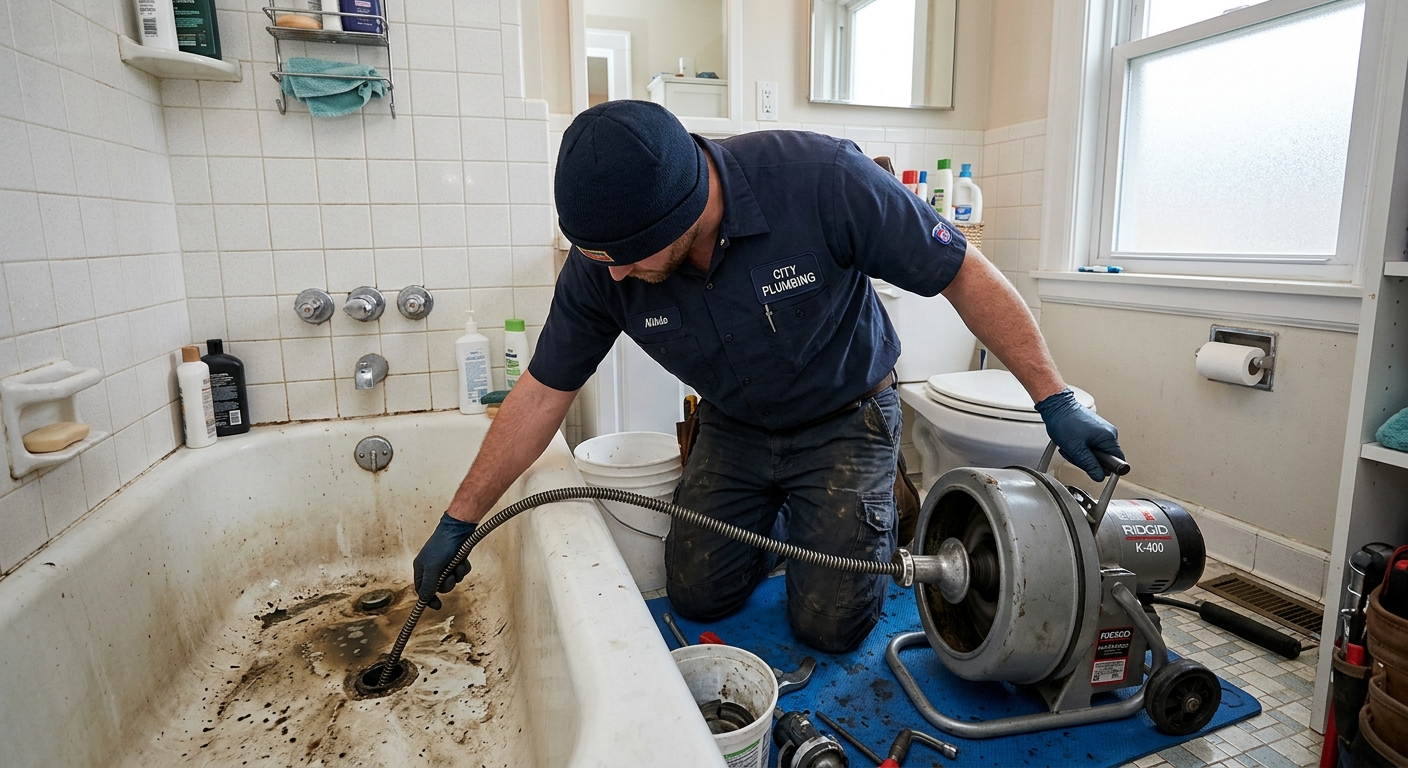
Plumbing costs in Penn Hills — 2026
Penn Hills is part of Allegheny County’s older, single-family housing corridor, with over 80% of homes detached and a typical build date well before 1980 (U.S. Census Bureau, ACS 2024). What you pay for plumbing here traces back, in large part, to which decade your pipes were put in. Much of Pittsburgh’s housing stock dates 1900–1950, so that’s decades of galvanized supply and cast-iron drains now reaching the end of their reliable life. If you own in Penn Hills and hit the right (or wrong) year, your first repair or replacement is rarely your last.
The first thing to know: emergency and standard job pricing are two different animals. An emergency repair—think a pipe leaks Sunday night—will always out-cost the same job scheduled next Wednesday. That premium covers after-hours dispatch, the tech’s overtime rate, and sometimes the fact that rushed diagnosis means more labor or parts billed. In this region, where cold snaps push older pipes to failure, emergency calls are routine from November through March.
Material and access decide price from there. Plumbing tucked behind thick plaster or buried under additions means more labor, especially true in the 90.8% of older homes around Penn Hills. If your pipes are galvanized, today’s repair is rarely the last—the next leak doesn’t respect your calendar or budget.
| Service |
Scope |
Emergency rate |
Standard rate |
| Emergency repair — burst pipe |
locate, open, repair section, restore service |
$550–$1,150 |
$325–$1,150 |
| Water heater replacement (gas, 40–50 gal) |
remove old, install, test, haul away |
$1,800–$2,600 |
$1,150–$2,600 |
| Drain cleaning — main line |
augering or hydro-jet, camera if needed |
$350–$800 |
$200–$500 |
| Sewer line spot repair |
excavate or reline a failed section |
$1,900–$11,500 |
$1,900–$11,500 |
| Whole-house repipe |
replace supply lines throughout, patch and finish |
|
$3,300–$8,000 |
| Water service line replacement |
street to house, excavation and restoration |
|
$5,200–$11,500 |
Estimates for a typical Penn Hills home. Access difficulty and pipe material move these figures more than anything else.
The point where patching stops making sense
If you’ve had two or more leaks on the same supply pipe in three years, that’s not bad luck—it’s the warning that the whole run is ready to go. Many Penn Hills homes use pipework dating all the way back to the 1900–1950 building wave. That usually means galvanized steel or, sometimes, aging copper. This is where it helps to pay attention to patterns: falling water pressure everywhere, versus just at one faucet, is a strong indicator your supply lines are filling with buildup or corroding from the inside. Water that comes out rusty or brown for the first few seconds after you turn on a tap—especially after sitting—suggests the same.
Visible corrosion or green/white mineral crust at exposed joints never reverses. Repeated pinhole leaks in copper mean the pipe wall is about worn through. At some point, repeated patching is throwing good money after bad; a full or partial repipe saves in the long run, especially with multiple failures or known problem materials like polybutylene or lead.
When deciding between copper and PEX, consider both material cost and access. PEX usually goes in faster and curves around framing, which keeps labor down, but copper remains the gold standard for longevity. Remember: in older Penn Hills homes, fixing the pipes is only half the job—the plaster and lath repair after a whole-house repipe can rival the plumbing cost itself if you want a seamless finish.
| Situation |
Recommendation |
Cost |
Reasoning |
| One leak, accessible, modern pipe |
Spot repair |
$325–$1,150 |
Problem is isolated; repairs hold |
| Two or more leaks in 3 years |
Partial repipe |
$3,300–$5,400 |
Recurring failures; saves on future repairs |
| Galvanized supply, pressure loss |
Full repipe |
$3,300–$8,000 |
Lines filling with rust; efficiency gone |
| Polybutylene anywhere in the house |
Full repipe |
$3,300–$8,000 |
Known to fail unpredictably |
| Cast iron drain with root intrusion |
Camera, then reline or replace |
$1,900–$11,500 |
Roots or collapse can’t be patched |
| Suspected lead service line |
Test, then replace the lateral |
$5,200–$11,500 |
Lead must be removed, not patched |
What urgency costs you
The biggest variable in what you’ll pay for plumbing in Penn Hills is whether you’re calling in an emergency or can wait for a standard repair slot. Emergency pricing includes extra charges: higher after-hours rates, sometimes double-time or overtime for labor, and often a specific trip or dispatch fee. The work is still billed by a scope or rate, but acting under time pressure (especially with water off and damage underway) typically pushes the high end of the band. For example, a burst pipe emergency might run $550–$1,150, while the same scope scheduled standard hours might be closer to $325–$1,150.
What truly counts as an emergency? Active flooding anywhere in the house, a main water line leak, sewage backing up (especially in homes with combined sewers), loss of all water service, or a gas smell—these are “drop everything” cases. The following can almost always wait until business hours to save money: a dripping pipe or faucet, a single slow drain, a toilet that won’t stop running (as long as it shuts off at the supply valve), or a water heater that’s not leaking but won’t heat.
Knowing how to turn your water off—both at individual fixtures and at the main valve for the whole house—is the most valuable skill. This stops water damage and often allows you to wait for standard scheduling. The main shutoff is usually where the water service enters, typically in the basement along the front wall in a Penn Hills home. Quarter-turn ball valves are quickest; older homes may have gate valves, which you’ll need to turn clockwise until fully closed.
What's in the water here
Pittsburgh Water and Sewer Authority serves Penn Hills and central Allegheny County. Every public water system here has to publish an annual water quality report (Consumer Confidence Report), which you can request directly from the utility. This details tested contaminants and general mineral profile, including hardness.
Hard water is common, which causes scale to build up inside water heaters, showerheads, and valves—shortening their lifespan and efficiency. Some homes with copper supply lines will see pinhole leaks from “aggressive” water (low pH, high dissolved oxygen). If you’re burning through water heaters faster than expected—say less than 8–10 years—a softener could slow down new scale, but for most Penn Hills homeowners, the economics are not favorable. A softener is only rarely cheaper than an extra heater over decades, unless you have extremely hard water confirmed by testing.
Whole-house filtration is only needed for specific water quality problems, not as a one-size-fits-all solution, and most public supplies don’t require it. Point-of-use filters (for drinking water or specific taps) often deliver the same result at lower cost. If you’re offered elaborate “treatment equipment” packages, demand a water quality report before considering.
If your property is on a private well (rare in Penn Hills), you will need to test annually for bacteria, nitrates, and heavy metals—no official agency manages or reports on your water quality.
Licensing and permits for plumbing work in Penn Hills
Pennsylvania does not issue a statewide plumbing license. Instead, plumbing is licensed at the municipal level, which means a plumber licensed in Pittsburgh is not automatically licensed to work in Penn Hills or other Allegheny County municipalities. In our area, the Allegheny County Health Department runs its own journeyman and master plumber licensing for Pittsburgh and nearby communities. If you want to check your plumber’s credentials, always ask, “Are you licensed for work in this municipality?”—not just “Are you licensed?”
For any new or altered plumbing systems, a permit from the Allegheny County Health Department is required. This covers work like repiping, installing a new water heater, sewer repairs, or adding and relocating fixtures—anything beyond a simple faucet swap. Minor fixture replacements, such as faucets, are routinely completed without pulling a plumbing permit in the county. Permit inspections are handled at the county level for jobs requiring a permit.
Before hiring, check that the contractor is registered as a Home Improvement Contractor with the Pennsylvania Office of Attorney General (verify at hic.attorneygeneral.gov), and confirm that their workers’ compensation insurance is valid and current through WCAIS (wcais.pa.gov). All employers are required to carry active workers’ compensation insurance to protect both workers and homeowners.
Comparing plumbing estimates in Penn Hills
There are two main ways plumbers bill: flat rate or time-and-materials. Flat rate means you’re quoted a single price for the job, and the contractor takes on the risk if something takes longer or costs more. Time-and-materials charges for actual hours worked and parts used, which can come out cheaper if the job is truly simple, but can climb if complications pop up. Neither approach is sneaky, but you need to know which you’re signing on for—an estimate that doesn’t state the billing method is a red flag.
Legitimate estimates should disclose whether there’s a diagnostic fee, and if that fee is credited toward the final bill if you hire them. The scope—the specific work, access, and restoration included—should be spelled out in plain terms. It’s also critical to clarify if drywall, plaster, or floor repairs after plumbing are included or you’re expected to arrange that. Permits are required for many jobs in Penn Hills; your estimate should address whether the contractor will pull and pay for it, or if you’ll have to handle it. Watch for vague warranty language: labor and parts should be distinct. If you’re looking at emergency work, demand that off-hours surcharges are disclosed before any work starts.
| Line item |
What to look for |
Red flag if… |
| Billing model |
flat rate or hourly, stated up front |
unstated |
| Diagnostic fee |
amount, and whether it credits |
vague |
| Scope |
what is opened, repaired and restored |
price with no scope |
| Restoration |
drywall and finish explicitly in or out |
silent |
| Permit |
included and priced |
'not needed' |
| Parts |
brand and model for fixtures |
'standard fixture' |
| Warranty |
labour period stated separately |
parts only |
Freeze risk and what to do about it
Penn Hills, like the rest of southwestern Pennsylvania, has a winter design temperature of 8 °F and a frost depth of 36 inches. The local climate swings drastically—freeze-thaw cycles, hilly lots, and clay subsoil all make pipes vulnerable to bursts. The science is this: when water in a pipe freezes, it expands into an ice plug. As water pressure rises between this plug and a closed valve or fixture, the pipe bursts—often not at the frozen spot, but somewhere the pressure buildup escapes. This explains why breaks can pop up behind a wall or ceiling nowhere near the cold draft that started it.
The most at-risk spots are pipes running through exterior walls, unheated crawlspaces or garages, hose bibs, and any line running above the insulation layer (think: attic). For Penn Hills homes built before 1980, many plumbing runs never anticipated today’s insulation standards.
Prevention comes in ranges: pipe insulation is cheap and effective. Heat tape (installed carefully) adds another layer of protection for stubbornly cold runs. Opening cabinet doors under sinks lets warm air in, and a pencil-width trickle from a faucet during single-digit nights keeps water moving—making freezing far less likely. Always drain and shut off exterior spigots before the first hard freeze.
If a pipe does freeze, use a hair dryer or heating pad to thaw—never use an open flame. The aftermath of a burst can run $550–$1,150 or much more once plaster and flooring need repair. Preventive steps almost always pay for themselves.
Frequently asked questions — plumbing in Penn Hills
What do I do if a pipe is frozen but not burst?
If you suspect a pipe is frozen—no water or just a trickle at a faucet—but you don’t see any active leaking yet, turn off the main water supply if you can do it safely. Open the closest faucet to relieve pressure and gently warm the affected section using a hair dryer, heat lamp, or a heating pad. Never use an open flame, as that’s a serious fire risk, especially in Penn Hills homes with older framing and insulation. Work from the faucet back toward the frozen section to encourage flow. If you get water restored and see no leaks, monitor for any new dripping or water damage. If you do find a crack or split, expect a professional repair bill between $550–$1,150 if it turns into an emergency. When in doubt, call a plumber before a small problem becomes a major flood.
What do I do about a burst pipe right now?
First, shut off the main water valve to stop water flow—most Penn Hills homes have the main shutoff in the basement along the front wall. Open a faucet on the lowest level to drain any remaining water and reduce pressure. Move valuables or electrical items away from the wet area. If you can identify the break and it’s accessible, wrap it with a towel to direct water into a bucket until the plumber arrives. Call a licensed professional right away and let them know if you need after-hours service, since emergency repairs usually cost between $550–$1,150 in this market. The sooner you get water stopped and service scheduled, the lower the damage and repair bill.
Is a tankless water heater worth it in Penn Hills?
Tankless (on-demand) water heaters are growing in popularity, but in Penn Hills, where the water is fairly hard and the winters are cold, there are tradeoffs. Tankless units cost more to install—often 2–3 times the price of a conventional unit. If you use less hot water or don’t want to pay for retrofitting the gas and venting, a standard replacement (costing $1,150–$2,600) might be the smarter call. Tankless models deliver efficiency and endless hot water, but require annual maintenance to prevent scaling with local water. They make most sense for larger households or those looking to free up space, but don’t expect them to slam-dunk your utility bills in Penn Hills.
Does insurance cover a burst pipe in Penn Hills?
Most homeowners’ policies in the Penn Hills area do cover sudden and accidental water damage from a burst pipe, including cleanup and drying—but not every scenario is covered. If a pipe froze because heat was off for days or you didn’t maintain the property, the claim could be denied. Insurance typically covers the damage, not the plumbing repair itself, so you’ll pay for the fix out of pocket (normally $550–$1,150 for emergency pipe repair). Always document damage with photos and call your insurer right away. Do not let a contractor offer to “waive your deductible”—that is specifically prohibited by Pennsylvania law.
How do I verify a plumber's licence and insurance?
In Penn Hills, plumbing is licensed at the municipal level, not statewide. You should always ask your plumber if they are licensed by the Allegheny County Health Department to work in your township. For larger jobs over $500, verify their Home Improvement Contractor registration at hic.attorneygeneral.gov. To ensure the contractor’s workers’ compensation insurance is current (which is mandatory for employers in Pennsylvania), use WCAIS at wcais.pa.gov. This protects you as the homeowner in case a worker is hurt on your job. Licensed, insured pros will not balk at showing you proof—trust those who are transparent, especially with repair costs running $325–$1,150 for common jobs here.
Why do plumbers charge a diagnostic fee?
Diagnostic fees are common in Penn Hills and beyond. This fee covers the plumber’s time and travel to professionally diagnose the problem, not just guess at it. If you hire them to do the repair, many will put that fee toward your final bill—but always confirm first. With emergency work costing in the $550–$1,150 range, a diagnostic fee buys you a clear scope and estimate rather than an unpleasant surprise at the end. It helps you compare estimates apples-to-apples and discourages unnecessary “fishing expeditions” for free advice.
How much does a plumber cost in Penn Hills?
The price depends on the job, materials, and whether it’s an emergency visit. A scheduled repair on a leaky pipe might range from $325–$1,150; water heater replacement usually falls between $1,150–$2,600. Emergency repairs, like fixing a burst pipe at midnight, always cost more—think $550–$1,150 and up. Sewer line work and repiping older homes can climb much higher. Compared to many markets, Penn Hills’ costs reflect both older housing stock and the challenges of accessing pipes hidden behind plaster or in crawlspaces.
Why do all my drains drain slowly at once?
If every drain in your Penn Hills home is backing up or running slow, it’s almost never a problem with just one fixture; it’s a sign that your main sewer line has a clog—often roots or debris in older clay or cast iron lines common in Allegheny County. Don’t waste money on bottles of drain cleaner if it’s the whole house. A pro can use an auger or hydro-jet to clear the line for $200–$800; more severe blockages may require camera inspection or even line repair, which is a bigger ticket. Single slow drains are usually local clogs, but when it’s everything, call for help.
Do older Penn Hills homes have galvanized pipes?
Yes, many Penn Hills homes—particularly those built between 1900 and 1950—have galvanized steel supply pipes. These pipes corrode and fill with rust over decades, leading to lower water pressure, brown or rusty water, and eventual leaks. The cost of repeated spot repairs adds up fast, and a full or partial repipe (typically $3,300–$8,000) is sometimes more cost-effective over time. If you notice widespread pressure loss or discolored water on first draw, it’s a strong sign your home still has galvanized lines.