Plumbing costs in Clearfield — 2026
Clearfield’s housing is overwhelmingly pre-1980, with 89.1% of homes built before that year (U.S. Census Bureau, ACS 2024), and this shapes what plumbing work costs here. Around DuBois and Clearfield, that means you’re often dealing with copper supply and galvanized drain pipes. These materials tend to corrode, clog, and leak with age—which translates to more frequent repairs or full repiping jobs down the line. The typical homeowner here earns a median $50,485 a year, so plumbing repairs are not a minor expense.
What you’ll pay depends on whether you’re calling for an emergency. After-hours or urgent calls—like a burst pipe—add a clear premium: for instance, the same repair that’s $300–$1,050 in normal hours jumps to $550–$1,050 late at night. That pattern holds for water heater replacements and main drain clogs. Costs are also influenced by how difficult it is to access the work: basements with old, low ceilings and patchy access panels are common here, and they push labor higher.
Clearfield’s market is small and rural compared to bigger metros, which means travel surcharges are routine. Replacement jobs—like a whole-house repipe—are predictable and can be scheduled, while emergencies always cost more. Here’s what to expect:
| Service |
Scope |
Emergency rate |
Standard rate |
| Emergency repair — burst pipe |
locate, open, repair section, restore service |
$550–$1,050 |
$300–$1,050 |
| Water heater replacement (gas, 40–50 gal) |
remove old, install, test, haul away |
$1,700–$2,500 |
$1,050–$2,500 |
| Drain cleaning — main line |
augering or hydro-jet, camera if needed |
$350–$800 |
$200–$500 |
| Sewer line spot repair |
excavate or reline a failed section |
$1,800–$10,500 |
$1,800–$10,500 |
| Whole-house repipe |
replace supply lines throughout, patch and finish |
|
$3,100–$7,600 |
| Water service line replacement |
street to house, excavation and restoration |
|
$4,900–$10,500 |
Estimates for a typical Clearfield home. Access difficulty and pipe material move these figures more than anything else.
Clearfield's housing stock and its plumbing
Most homes in Clearfield and DuBois were built before 1980—89.1% to be exact (U.S. Census Bureau, ACS 2024)—which means you’re probably living with plumbing systems installed near the post-war housing wave. If your house dates from that era, your supply lines are likely copper and your drains are often old galvanized steel. Over the decades, galvanized pipe rusts internally, choking off flow and eventually splitting. Sewer laterals from that period were usually clay tile, which can crack, settle, or get invaded by tree roots. These factors make both leaks and backups far more common as homes age.
If your home was closer to new at the end of the 20th century—in one of the smaller pockets of newer suburban construction—you might find builder-grade fixtures, copper or early PEX, or, if unlucky, some remaining polybutylene (which always merits preemptive replacement). Water heaters in Clearfield are rarely original; for most homes, you’re likely on your third or even fourth tank. These tanks fail with rust at the connections or with sediment clogging the bottom—both common thanks to the area’s water chemistry.
Overall, an older Clearfield home will need attention at the supply lines, drain pipes, and possibly a full sewer lateral inspection, while areas with newer homes face fewer crises but should still watch for past-repair polybutylene and the lifespan of early 2000s fixtures. Whatever your era, expect upcoming costs based largely on the age and type of materials behind your walls and under your lawn.
Emergency rates versus scheduled work in Clearfield
Plumbing bills in Clearfield split sharply between emergencies and planned work. If you call for a burst pipe or a sewage backup at midnight, you pay for an after-hours dispatch, a trip charge to get a plumber from outside your township, and overtime labor. On top of that, diagnosis happens under time pressure—there’s little chance to shop around when your basement is flooding. That’s why an urgent leak repair can run as high as $1,050 while the same job might be handled for $300 during normal hours.
The right move is to know what qualifies as a true emergency. Flooding from a burst pipe, any active sewage backup, no water to the whole house, or a gas smell all demand immediate action and justify emergency rates. But a slow drip under a sink, one stubbornly slow drain, or a running toilet can safely wait until business hours—the difference is real money, and the savings can be several hundred dollars.
If you face a leak, know how to shut off the water at the main valve (usually just inside where the water line enters your basement) or at the local fixture shutoff (small oval valve under sinks or behind toilets). That one bit of knowledge can turn what feels like an emergency—spraying water—into a scheduled repair and save you a full emergency premium.
Spot repairs or whole-house repipe?
In Clearfield and nearby DuBois, post‑1945 homes are likely to have copper supply pipes and galvanized steel or even cast iron drains. If you’ve had two or more leaks on the same supply material in three years, it isn’t bad luck—it’s the start of systemic failure, and you should consider a partial or full repipe. Typical signs include low flow through the whole house, brown or rust-stained water on first draw, green-blue corrosion at exposed joints, and recurring pinhole leaks in copper piping.
Spot repairs make sense with one leak in modern material, but when the problems multiply, whole-house repiping usually saves money and stress. PEX piping is now a viable and reliable alternative to copper, often at a lower installed cost; most plumbers serving Clearfield can replace supply piping throughout for $3,100–$7,600 depending on layout and materials. Don’t overlook the cost to patch plaster or drywall after—the finish work in these older homes can rival the plumbing bill, especially where thick plaster or painted paneling covers the walls.
For drains, repeated rooting from tree roots, or visible cast iron that’s flaking and rusty, means you’re due for camera inspection at a minimum. And any sign of lead on a water service line should be tested and replaced outright.
| Situation |
Recommendation |
Cost |
Reasoning |
| One leak, accessible, modern pipe |
Spot repair |
$300–$1,050 |
Isolated problem, no pattern. |
| Two or more leaks in 3 years |
Partial repipe |
$3,100–$5,100 |
Pattern of failure in aging material. |
| Galvanized supply, pressure loss |
Full repipe |
$3,100–$7,600 |
Internal rust restricts flow. |
| Polybutylene anywhere in the house |
Full repipe |
$3,100–$7,600 |
Known failure risk—replace proactively. |
| Cast iron drain with root intrusion |
Camera, then reline or replace |
$1,800–$10,500 |
Roots signal a cracked or leaking line. |
| Suspected lead service line |
Test, then replace the lateral |
$4,900–$10,500 |
Health risk—removal is the only fix. |
What's in the water here
Most Clearfield Borough homes get water from the Clearfield Municipal Authority, a public system that publishes an annual water quality report, which you can request for free. Like much of north-central Pennsylvania, the water here tends toward moderate hardness—meaning you’ll see scale building up in water heaters, dishwashers, and around faucets. That scale shortens the life of tanks and fixtures and means more frequent flushes or replacements.
We also see “aggressive” water in some pockets—slightly low pH that can accelerate pinhole leaks in older copper plumbing. A softener might help with scale, but unless you have very hard private well water, a whole-house unit rarely pays for itself. Most homes are better off with a simple sediment filter or a point-of-use filter at sinks where taste or color is an issue. Don’t overspend for fancy multi-stage systems unless you have a specific water test showing a problem.
Out in the rural townships, where private wells are common, nobody is testing your water but you. In that case, batch test for bacteria, lead, nitrates, and hardness before you decide on any treatment system—the odds of buying an unnecessary unit are otherwise high.
Licensing and permits for plumbing work in Clearfield
In Pennsylvania, there is no statewide plumbing licence outside of major cities—licensing is handled at the municipal level. That means a plumber might be qualified and experienced in one town, but might not be registered or permitted to pull a plumbing permit in the next township over. In Clearfield County, DuBois has its own city code enforcement office that inspects and permits water and sewer service connection work, while surrounding townships each have their own process. The county seat, Clearfield Borough, often allows simple repairs inside single-family homes without a permit.
Always ask not just “are you licensed?” but “are you registered and permitted to work here?” For any job over $500, Pennsylvania contractors must hold a Home Improvement Contractor (HIC) registration, which you can verify at hic.attorneygeneral.gov. All employers must have workers’ compensation insurance; you can check the status via the WCAIS database at wcais.pa.gov.
For lead safety, if your home was built before 1978, federal lead paint rules apply for any work that disturbs painted surfaces—confirm your contractor is EPA-certified at certifiedrenovatorsearch.epa.gov. Finally, never hand over more than a third down for a project, and always require a written contract, both of which are standard under Pennsylvania’s Home Improvement Consumer Protection Act.
Flat rate versus time and materials
In Clearfield, you’ll see both flat-rate (set price) and time-and-materials (hourly plus parts) models for plumbing work. Flat rate means a fixed price for the whole job, regardless of what it actually takes—giving you certainty and covering the contractor's risk if things are more complicated than they look. Time and materials can be fairer on simple or clearly defined jobs, but they are open-ended and can surprise you if something’s hidden in the walls.
Pay attention to the quote details: is there a diagnostic fee, and does it credit toward the repair? Does the quote specify exactly what’s included—what will be opened up, what gets restored, and what’s omitted? Does it break out costs for permits or restoration? Are both parts and labor under warranty, or just the fixture? Most importantly, after-hours or emergency rates should be stated up front.
| Line item |
What to look for |
Red flag if… |
| Billing model |
flat rate or hourly, stated up front |
unstated |
| Diagnostic fee |
amount, and whether it credits |
vague |
| Scope |
what is opened, repaired and restored |
price with no scope |
| Restoration |
drywall and finish explicitly in or out |
silent |
| Permit |
included and priced |
'not needed' |
| Parts |
brand and model for fixtures |
'standard fixture' |
| Warranty |
labour period stated separately |
parts only |
Frequently asked questions — plumbing in Clearfield
What does repiping a house cost in Clearfield?
Repiping a typical home in Clearfield, with the area’s prevalence of copper supply and galvanized drain pipes, usually falls in the $3,100–$7,600 range. This covers replacing all supply lines—either with new copper or PEX—and patching walls and finishes. Older homes, which make up nearly 90% of the local stock, often have challenging layouts with plaster rather than drywall, which can push costs up due to labor-intensive restoration. Small, single-story homes at the lower end of the band may see costs close to $3,100, while multi-story or large ranches needing extensive patching may approach $7,600. Always ask contractors if wall restoration is included in their estimate, as this can rival the plumbing cost itself.
What do I do if a pipe is frozen but not burst?
In Clearfield’s long, cold winters, freezing pipes happen far more often than actual bursts. If you notice no water or just a trickle from a fixture, start by closing the supply valve to that area if one is present, or use the main shutoff as a last resort. Don’t use an open flame—apply gentle heat from a hair dryer or the warm air from a space heater (never unsupervised). Don’t panic or rush to call after-hours service unless there is water leaking; most frozen pipes handled before they split can be repaired at regular rates, not emergency, which can save you up to $700. Once thawed, watch the area closely—the real trouble often comes hours later when a cracked pipe finally lets go.
How much does a water heater replacement cost in Clearfield?
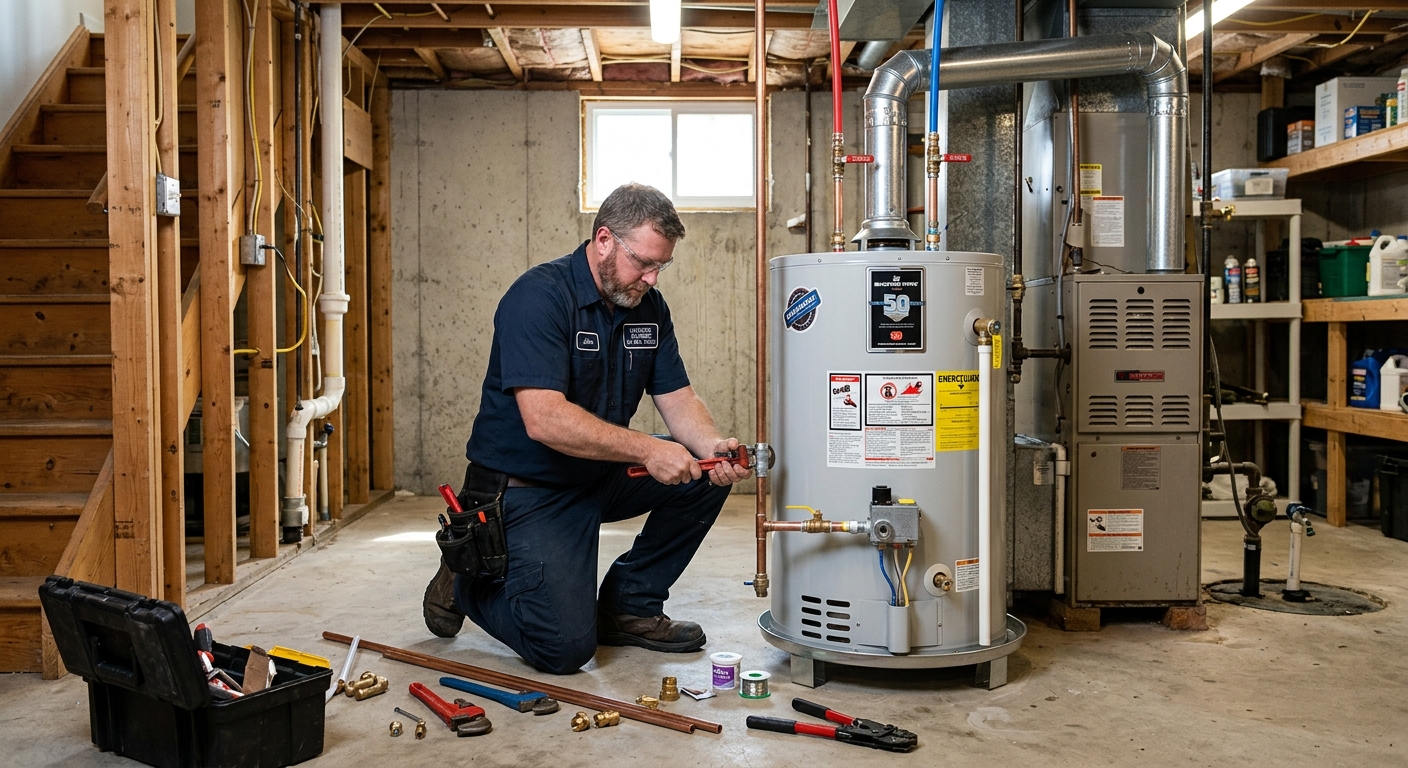
In Clearfield, replacing a gas water heater (40–50 gallons) costs $1,050–$2,500 for a complete job—removing the old tank, setting the new one, reconnecting the vent and water lines, and carting away the old unit. Tank life tends to be shorter here if your home is running without a softener, as the moderate water hardness leads to scale buildup inside. Emergency or off-hour replacements cost more; it’s often worth arranging for a scheduled swap unless you’re truly out of hot water.
Am I responsible for the water line under the street?
Most Clearfield Borough homeowners are responsible for the water service line from their house to the curb stop or main, not under the entire street, but the exact boundary depends on utility and municipal rules. Replacement of a failed service line—due to leaks, lead, or age—can cost $4,900–$10,500. Always confirm the exact limits of your responsibility with Clearfield Municipal Authority before authorizing work. For homes on private wells, the buried line from well casing to inside the home is entirely the owner’s responsibility.
How do I shut off the water to my house?
In most Clearfield homes, the main shutoff valve is located in the basement, right where the water service enters the house—often just a few feet from the wall. Turn the valve clockwise (right) to shut off. For sinks and toilets, look for small oval valves under the fixture or behind the toilet; these control only one outlet. Practicing this before an emergency is worth ten minutes: being able to shut off water yourself can allow you to wait for a standard-service plumber, turning a $1,050 emergency bill into a routine $300 job.
Is trenchless sewer repair reliable?
Trenchless sewer repairs—relining or pipe bursting—are a proven method and see plenty of use in Clearfield County when access is tight or when digging up yards or driveways would be costly. Expect to pay anywhere from $1,800–$10,500 depending on the length and depth of work. Done by skilled contractors following Pennsylvania Uniform Construction Code, modern methods can last as long as a new pipe. Always ask for a camera inspection and a warranty on the liner from your contractor.
What does discoloured water on first draw mean?
In Clearfield’s older homes with aging copper or galvanized pipes, brown or rust-colored water that appears briefly after the tap hasn’t been used is common. It’s usually rust or mineral buildup flushing out and is more a sign of internal pipe deterioration than of an issue with the water supply. If this is persistent, it can signal it’s time for at least a partial repipe—a project that may cost in the $3,100–$5,100 range. Get a plumber to examine exposed pipes before replacing fixtures or running long flushes.
How hard is the water in Clearfield?
The water in Clearfield is typically moderately hard, leading to scale buildup that shortens the life of water heaters and fixtures. If you frequently notice white crust or scale at your faucets, or if a plumber finds significant sediment in your tank, it may be time for occasional flushing or considering a softener. For most homes on the public system, though, a softener is not strictly needed and can take decades to pay for itself. Any related repairs, such as replacing a scale-clogged water heater, tend to cost between $1,050–$2,500.
Who inspects plumbing work in Clearfield?
Plumbing inspections in Clearfield County are performed by municipal code offices. In DuBois, the City of DuBois Code Enforcement Office handles permits and inspections for any new or replacement building water or sewer service connections. In Clearfield Borough, minor repairs inside a single-family home often don’t require a permit or inspection. For major work—like a new water heater install or piping replacement—ask your chosen contractor which local office will inspect, and always confirm they have a Home Improvement Contractor (HIC) registration, as required for any contract over $500 in Pennsylvania. Verification protects you as the homeowner.