Plumbing costs in Shrewsbury — 2026
Shrewsbury's homeowner landscape is defined by high ownership—82.9% of households own their homes—and much of the local housing stock was built before 1980 (U.S. Census Bureau, ACS 2024). That means plumbing work often revolves around the quirks and risks of older materials. If your home has pipes dating back to the early–mid 1900s, chances are you're dealing with galvanized or even cast iron. These materials tend to need replacement, not just repairs, driving up costs compared to a newer build. In this area, plumbing costs swing widely based in part on whether work is done after hours as an emergency call or during regular scheduling. For the homeowner, the same repair can cost twice as much if it can’t wait.
York City’s housing trends influence Shrewsbury too: frequent transitions from galvanized to copper or PEX keep labor in demand, and drive costs higher for jobs involving whole-home repiping. Pipe material and access issues are the biggest cost variables here, so an easy job in a utility room is a different price than the same repair behind historic plaster. Below are typical price bands for 2026 in this part of York County:
| Service |
Scope |
Emergency rate |
Standard rate |
| Emergency repair — burst pipe |
locate, open, repair section, restore service |
$650–$1,300 |
$375–$1,300 |
| Water heater replacement (gas, 40–50 gal) |
remove old, install, test, haul away |
$2,100–$3,000 |
$1,300–$3,000 |
| Drain cleaning — main line |
augering or hydro-jet, camera if needed |
$350–$800 |
$200–$500 |
| Sewer line spot repair |
excavate or reline a failed section |
$2,200–$13,000 |
$2,200–$13,000 |
| Whole-house repipe |
replace supply lines throughout, patch and finish |
|
$3,800–$9,200 |
| Water service line replacement |
street to house, excavation and restoration |
|
$5,900–$13,000 |
Estimates for a typical Shrewsbury home. Access difficulty and pipe material move these figures more than anything else.
Who is allowed to do plumbing work in Pennsylvania
Pennsylvania does not issue a statewide plumbing license. Instead, plumbing is licensed and inspected at the municipal level. What this means for a Shrewsbury homeowner is simple: the plumber who is licensed in one York County township may have no standing in another—Spring Garden Township, for example, runs its own plumbing license registration separate from state-level requirements. The practical result is you must always ask your plumber directly: “Are you registered and permitted to work here?” That’s more important than any general claim of being “licensed in Pennsylvania.”
Permits for plumbing work are enforced by towns or municipalities. For example, in York City, any new or altered plumbing system (beyond just swapping out a fixture in the same spot) generally requires a permit and municipal inspection. However, replacing an existing faucet, toilet, or similar in the same location usually does not. Each township—including those around Shrewsbury—sets its own rules and office hours, making it important to check with your local permit office before hiring out major work.
Every plumbing contract over $500 requires a Pennsylvania Home Improvement Contractor registration, which you can verify with the Office of Attorney General at hic.attorneygeneral.gov. Plumbers must also carry workers’ compensation insurance, and you can check coverage status via WCAIS (wcais.pa.gov). There is no statewide plumbing board. For any home built before 1978, federal lead regulations may apply—verify lead-safe certification at certifiedrenovatorsearch.epa.gov.
Sewer line problems in Shrewsbury
In Shrewsbury and surrounding York County townships, homeowners usually own the sewer lateral from their house all the way to the main—sometimes including the section under the street. That ownership means you’re on the hook for repairs, even outside your property line. The first signs of trouble often appear inside: a single slow drain may just be a local blockage, but when you notice multiple slow drains, gurgling from unused fixtures, or backups at your lowest-level tub or toilet, it’s time to get a professional in.
York City runs separated sanitary and storm sewers. If you’re in the city, you’re likely tied in for both waste and storm water. In the outlying townships, though, many homes are still on septic. If that’s you, problems could be as simple as a full tank (usually pumped every 3–5 years), or as severe as a drainfield failure, which is a different animal and more expensive.
A proper sewer job starts with running a camera—not with a shovel. Clay tile drains from the early 1900s tend to allow root intrusion, creating blockages. Other risks are “bellies” (sagging pipes collecting waste) or joints shifting out of alignment, both common in older York County homes. Most repairs are either open-cut (dig-and-replace) or trenchless, where a liner is installed without excavation. Both methods have their place, but never accept an excavation quote unless you’ve seen the camera footage yourself—it’s the only way to verify exactly where the problem lies and avoid unnecessary yard destruction.
Detection methods and what they cost
Before calling in a plumber, every Shrewsbury homeowner should try the water meter test. Shut off every faucet and appliance, then check your water meter. If the dial still moves, you’ve got a supply-side leak—costs nothing to check, just your time.
Professional leak detection starts at $375–$1,300 for an emergency call-out, depending on complexity and timing. Acoustic listening is the go-to method for leaks inside walls or floors; the technician uses sensitive microphones to pinpoint the sound of escaping water. For leaks under slab or in tight spots, thermal cameras can show temperature differences from wet spots in otherwise dry materials. In rare cases, tracer gas—an inert, safe chemical—is introduced into the line and detected with specialized equipment. Slab leaks are the most involved and typically cost toward the higher end of the range due to the difficulty in isolating and repairing the section.
Sometimes leaks show up in places you can’t see, like buried irrigation lines or long runs feeding outdoor spigots. Opening up drywall or floors should only come after these detection tools have narrowed it down. If your plumber suggests opening walls or ripping up flooring without a clear location, pause the work—it’s backwards and could cost you more for unnecessary repairs later on.
When to repipe a Shrewsbury home
The tipping point for repiping in Shrewsbury isn’t about hope, but about patterns. If you’ve had two or more leaks in a three-year window on the same kind of pipe—especially galvanized, which is common in local houses built between 1900 and 1950—it’s more than bad luck. It’s time to consider a partial or full repipe.
Key warning signs are whole-house pressure drop (not just one shower), rust-colored water on first draw, visible corrosion at pipe joints, and repeated pinhole leaks. With York City’s older homes, converting from galvanized to copper or PEX is a common job. Copper lasts longer and is time-tested, but costs more and requires more wall opening. PEX is quicker, slightly cheaper, and often easier to route in older walls. What’s often forgotten in the estimate is drywall or plaster repair; in prewar homes with lath and plaster, those restoration costs can be almost as high as the piping labor itself.
| Situation |
Recommendation |
Cost |
Reasoning |
| One leak, accessible, modern pipe |
Spot repair |
$375–$1,300 |
No pattern; a localized failure |
| Two or more leaks in 3 years |
Partial repipe |
$3,800–$6,200 |
Recurring failure on same material |
| Galvanized supply, pressure loss |
Full repipe |
$3,800–$9,200 |
Corrosion and buildup common in pre-1950s houses |
| Polybutylene anywhere in the house |
Full repipe |
$3,800–$9,200 |
Material defect makes repair unreliable |
| Cast iron drain with root intrusion |
Camera, then reline or replace |
$2,200–$13,000 |
Frequent in older York County housing; needs visual confirmation |
| Suspected lead service line |
Test, then replace the lateral |
$5,900–$13,000 |
Testing required; full replacement protects health |
Water heater replacement decisions
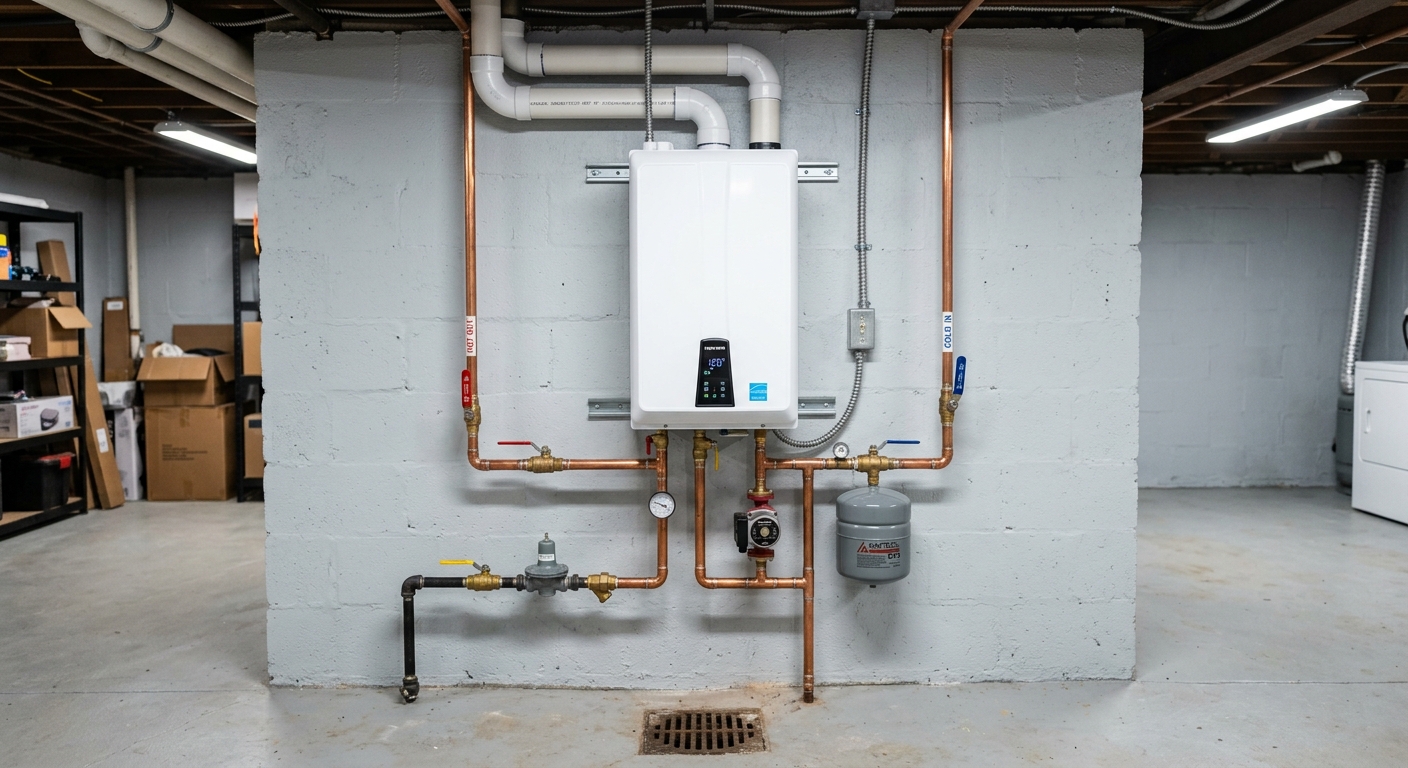
When it’s time to replace a water heater in Shrewsbury, cost and longevity are only part of the story. The classic tank-type—whether gas or electric—is cheapest to install and fits easily where the last one sat. But tank units have the shortest life, and all lose heat constantly (standby loss). A tankless gas water heater promises endless hot water and better efficiency, but brings higher up-front costs; often, an upgrade to a larger gas line and a new vent is required, which can surprise homeowners at install.
The third option, heat pump water heaters, offers the lowest operating cost but with tradeoffs. They cool the air around them—something to consider in a finished Shrewsbury basement—and are louder than a standard tank. They also require a certain volume of air around the unit, so small closets or utility rooms may not work.
Always size your replacement by first-hour rating—how much hot water it delivers at peak use—rather than just the tank’s gallon size. Consider installing an expansion tank if your system doesn’t have one, as it’s required in many townships and protects both plumbing and the new heater.
| Type |
Installed cost |
Service life |
Operating cost |
Best when |
| Gas tank, 40–50 gal |
$1,300–$3,000 |
8–12 yrs |
moderate |
Gas line present and price is the main factor |
| Electric tank, 40–50 gal |
$1,300–$2,100 |
10–15 yrs |
high |
No gas available; simple replacement |
| Gas tankless |
$2,100–$3,000 |
18–25 yrs |
low-moderate |
Endless hot water and long-term energy savings |
| Heat pump water heater |
$2,100–$3,000 |
13–15 yrs |
lowest |
Basement or warm area with room to vent air |
What's in the water here
Most Shrewsbury homes draw from the York Water Company, the primary water utility for York City and surrounding areas. This means you can—and should—request their annual water quality report to get an honest look at what comes out of your tap. Hardness is a persistent issue in this part of York County, adding scale inside water heaters and shortening their life span. Scale buildup also means fixture cartridges and valves wear out faster, and sometimes a ten-year heater fails in six due to ongoing mineral accumulation.
On the other hand, overly “aggressive” water can lead to pitting in copper pipes—a leading cause of pinhole leaks, especially in the kind of older homes common throughout York County. Water softeners do help extend heater and fixture life, but won’t pay for themselves on the utility savings alone in most cases. If you go for treatment, a basic softener or filter at the main line; don’t over-invest in elaborate “whole house” cocktails unless you’ve got a specific contaminant you need to treat. If you rely on a private well—more common in rural townships—regular testing is your responsibility; there’s no utility report for your well, and nobody will look out for heavy metals, bacteria or nitrates except you.
Frequently asked questions — plumbing in Shrewsbury
Is a sewer line replacement covered by homeowner's insurance?
In most cases for Shrewsbury and broader Pennsylvania, standard homeowner's insurance does not cover wear-and-tear or root-damage sewer line replacement, even if the line runs under sidewalks or streets. Insurance may only cover direct damage from abrupt events, like a sudden collapse caused by an external force, and even then, coverage often stops at the property line. The homeowner typically owns the lateral all the way to the main, so you’re usually responsible for everything from foundation to street, as is common throughout York County. To avoid surprise bills, some local homeowners add sewer line endorsements or purchase third-party service line coverage, but these usually have strict exclusions. The typical spot repair or replacement can run from $2,200–$13,000, an amount most policies will not pay unless specific coverage is purchased ahead of time.
How much does a plumber cost in Shrewsbury?
Plumbing rates in Shrewsbury are right in line with what you’ll see in York County, with emergency repairs like a burst pipe running $375–$1,300, and routine jobs during regular business hours at the lower end of that range. For bigger projects like water heater swaps or main-line repairs, expect total bills between $1,300–$3,000 or even higher depending on complexity. The two biggest drivers of cost here are whether it’s an emergency or planned work, and what material you’re working with—older galvanized or cast-iron jobs in historic Shrewsbury homes almost always cost more. Quotes should include patching, permit, haul-away, and clean-up—if a plumber’s proposal doesn’t list these, ask before you sign.
How much does sewer line repair cost in Shrewsbury?
The price of sewer line repair in Shrewsbury depends greatly on access and extent of damage, particularly in older neighborhoods where original clay or cast-iron laterals are common. A small spot repair, such as relining a short section, starts at $2,200, while full replacement with excavation can quickly approach $13,000. Roots, bellies (pipe sags), and joint offsets drive up cost, especially in houses built during the early–mid 20th century. Septic issues in outlying York County areas are a different ballgame: failure of a drainfield or tank can result in a bill similar to sewer replacement. Always insist on a camera inspection before getting a repair quote—it prevents surprises and ensures you’re only fixing what’s truly broken.
Should I wait until business hours to call?
If you have a leaking pipe that’s causing active water damage or a total loss of function (such as a sewer backup or burst supply line), waiting until business hours can make a small problem much worse, especially given the risk of water traveling through old plaster and hardwood in Shrewsbury’s older homes. For emergencies, plumbers in this area do charge more—expect an after-hours rate in the $650–$1,300 range for urgent repairs—but that expense may save you thousands in property damage. For slow drips, clogged drains that aren’t backing up, or planned upgrades, it’s smart to wait and schedule work during normal hours for a better price.
Is my water line lead?
Most of York Water Company’s system, including York City, has now completed full lead service line replacement, so in Shrewsbury or nearby municipalities served by the utility, it’s unlikely but not impossible you have a lead line. For older homes, especially those built before 1950 and supplied before these modernizations, a visual inspection where the line enters your basement or crawl space is the best starting point. Lead lines are usually a dull gray, easily scratched, and often lack visible joints. If in doubt, a plumber can test for you, usually for under $375–$1,300. If confirmed, a full replacement runs $5,900–$13,000 depending how far you need to dig.
Should I reline or replace my sewer line?
In Shrewsbury’s mix of older and newer homes, trenchless relining is a tempting option—it saves your yard from excavation and often costs less up front. If your main issue is limited to a section (roots through a joint, or a localized offset), camera-confirmed relining can be effective, usually at $2,200–$13,000. However, if your line is collapsed, has multiple "bellies," or is made of vintage clay with repeated failures, open-cut replacement might be required to solve the underlying problem for good. The most important step is getting a camera inspection—don’t reline or dig without knowing exactly what you’re dealing with, and don’t let any contractor skip that diagnosis first.
Should I leave a faucet dripping in cold weather?
In Shrewsbury and York County, where frost depth is officially 30 inches, exposed fixtures or pipes in unheated crawl spaces are at risk during cold snaps (12 °F is the winter design temperature). Letting a faucet drip does keep a small trickle running and can prevent the dangerous build-up of pressure that leads to a burst pipe. However, it’s not a cure-all. Insulation and closing up drafty crawl spaces should be your first lines of defense. If a pipe does freeze and burst, emergency repair will run $375–$1,300, and the water damage could be worse. Use the drip method only for those pipes you truly can’t insulate—don’t waste water everywhere.
Is Shrewsbury on combined sewers or septic?
Most Shrewsbury homes are connected to separated sanitary and storm sewers, like York City, but if you are out in one of the neighboring rural townships, individual septic systems are still very common. This affects maintenance schedules and cost: public sewer users mostly deal with clogged laterals and occasional main blockages, while septic owners are responsible for pumping tanks every 3–5 years and facing larger bills if a drainfield fails. Septic repairs can compete with city sewer spot repairs, often reaching $2,200–$13,000. If you’re not sure which you have, your utility bill or property deed will usually say.
How do I verify a plumber's licence and insurance?
For Shrewsbury, always confirm that your plumber holds a valid Pennsylvania Home Improvement Contractor (HIC) registration for jobs over $500. You can look up any contractor at hic.attorneygeneral.gov. For insurance, particularly workers’ compensation (which is mandatory for all employers by state law), verify coverage through WCAIS at wcais.pa.gov. Remember: Pennsylvania has no state plumbing license. Each municipality may have its own licensing, so always ask if your plumber is registered to work in your town or township—Spring Garden has its own requirements, for example. This due diligence ensures you’re hiring a compliant contractor, protecting yourself from liability if anything goes wrong, and ensures any contract over $500 includes consumer rights like a 3-day cancellation window.