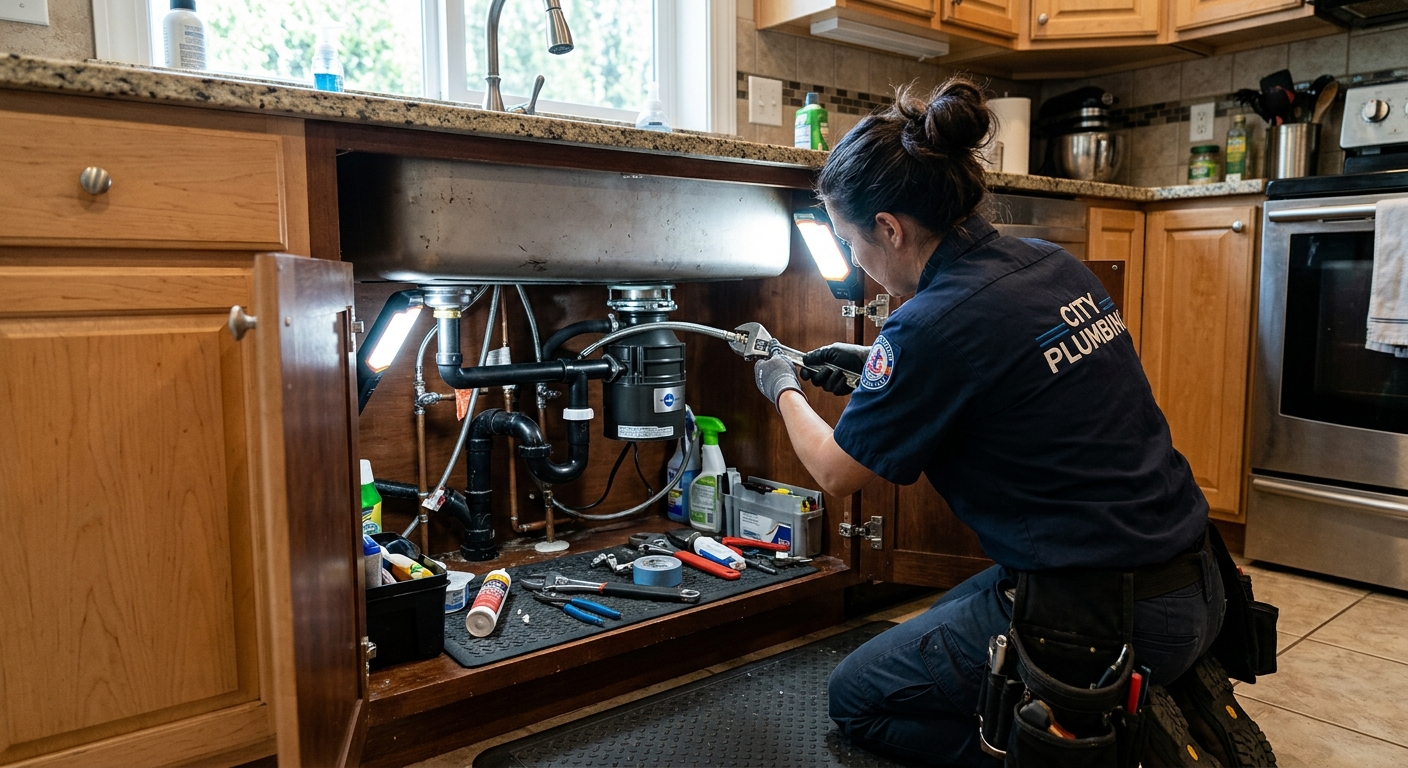
Quincy plumbing prices by job type — 2026
In Quincy, where about 75.8% of households own their homes and most single-family houses along I-81 date to the 1970s and later (U.S. Census Bureau, ACS 2024), what you pay for a plumber tracks directly to your house vintage, the pipe material, and whether the job is an emergency. Franklin County’s post-1970 suburban spread means many homes have already swapped older copper for PEX piping or have copper lines nearing the end of their life. Those past plumbing choices now dictate what goes wrong—pinholes, pressure drops, or outright breaks—plus the price for fixing or replacing them.
In Quincy, every plumbing job divides into two main price lanes: emergency rates and standard rates. True emergencies—like a burst pipe spraying across a basement—cost more because you’re paying for immediate response, after-hours labor, and the extra cost of finding a fix fast. Non-urgent repairs, like a slow leak or a water heater that’s limping along, stay at the lower end of the price scale if you can wait and schedule during normal hours.
| Service |
Scope |
Emergency rate |
Standard rate |
| Emergency repair — burst pipe |
locate, open, repair section, restore service |
$550–$1,100 |
$325–$1,100 |
| Water heater replacement (gas, 40–50 gal) |
remove old, install, test, haul away |
$1,750–$2,600 |
$1,100–$2,600 |
| Drain cleaning — main line |
augering or hydro-jet, camera if needed |
$350–$800 |
$200–$500 |
| Sewer line spot repair |
excavate or reline a failed section |
$1,850–$11,000 |
$1,850–$11,000 |
| Whole-house repipe |
replace supply lines throughout, patch and finish |
|
$3,200–$7,900 |
| Water service line replacement |
street to house, excavation and restoration |
|
$5,100–$11,000 |
Estimates for a typical Quincy home. Access difficulty and pipe material move these figures more than anything else.
Who is allowed to do plumbing work in Pennsylvania
Pennsylvania licenses plumbing at the municipal level—not statewide. This means that in Franklin County, and especially within the Borough of Chambersburg near Quincy, plumbing contractors must be licensed locally to pull permits. For example, Chambersburg requires plumbers to pass their own license exam to work within borough limits. In contrast, a plumber licensed in one municipality might have no official status in the next township.
The Pennsylvania Uniform Construction Code (UCC), enforced by either local municipal authorities or the PA Department of Labor & Industry (if a municipality has opted out), governs residential plumbing work. In Chambersburg, permits are generally required for any new or replacement water, sewer, or gas service piping. In rural Franklin County townships, routine fixture swaps such as a new toilet or faucet are commonly done without a permit, but any major piping work still needs local approval and inspection.
Before hiring, for contracts over $500, you can and should verify a contractor’s PA Home Improvement Contractor (HIC) registration at hic.attorneygeneral.gov, as required by law. Also check their workers’ compensation coverage via WCAIS (wcais.pa.gov), since Pennsylvania mandates this insurance for all employers. Both the HIC registration and proof of insurance protect you if something goes wrong.
In summary: The credential to ask about in Quincy is, “Are you licensed and permitted to work here, for this job?”—not just “are you licensed in PA.”
Tank, tankless or heat pump water heater?
Choosing the right water heater in Quincy depends on your household's needs, utility access, and where the unit will sit. Gas tank models are the bread and butter here—they cost less upfront and fit most replacement scenarios, but have higher standby energy losses and typically last 8–12 years. Tankless gas heaters promise endless hot water and lower energy bills per use, but their installation usually requires larger gas piping and upgraded venting. Those hidden costs can come as a surprise, often nudging the total up by hundreds. Going tankless makes the most sense if you have high hot water demand or multiple showers running at once.
Heat pump water heaters are gaining popularity for their low operating cost. They use electricity but run about three times more efficiently than a standard electric tank. That said, they need a good volume of warm air, so they make sense only in larger mechanical rooms or unfinished basements—plus, they put out noticeable noise and actually cool the room a few degrees, so they're a poor fit in a finished space. While installation costs almost equal a tankless or high-end gas model, their operational savings only add up if electricity rates are favorable and the location is right.
No matter which type you choose, size by "first-hour rating” rather than just tank volume—this matches your peak demand and avoids cold showers. Make sure to add a thermal expansion tank where required, and always opt for a pan with a drain if the heater sits above finished space. Most heater failures are tank ruptures, not control failure.
| Type |
Installed cost |
Service life |
Operating cost |
Best when |
| Gas tank, 40–50 gal |
$1,100–$2,600 |
8–12 yrs |
moderate |
Replacement in most Quincys basements with gas service |
| Electric tank, 40–50 gal |
$1,100–$1,750 |
10–15 yrs |
high |
No gas line, modest household demand |
| Gas tankless |
$1,750–$2,600 |
18–25 yrs |
low-moderate |
High usage, space saver, $ to upgrade gas line |
| Heat pump water heater |
$1,750–$2,600 |
13–15 yrs |
lowest |
Large unfinished spaces, no gas, low operating cost priority |
When to repipe a Quincy home
If you’ve had two or more leaks in the same supply piping within three years, that’s not just unlucky—that’s the pipe telling you it’s time. In Quincy and the rest of Franklin County, most post-1970 homes were built with copper supply lines, with PEX gaining ground in later decades. If your copper pipe is producing frequent leaks, or you notice persistent pressure drops across all fixtures or rusty water out of taps after the home sits, those are clear signals the lines are near end of life. Galvanized pipe and polybutylene—still present in some older or early-1980s houses—are at even higher risk for corrosion, pinholes, or sudden failure.
Spot repairs are cost effective for a single, accessible leak, but repeated problems escalate quickly. Partial repiping makes sense if you’re only seeing issues in a certain area or on a particular run. A whole-house repipe, typically swapping copper or risky materials for modern PEX, is the honest answer when you have pressure loss throughout or ongoing leaks. Don’t forget: the big hidden cost is restoring drywall and plaster. In the oldest Quincy houses with plaster walls, finishing costs can rival the plumbing labor itself.
| Situation |
Recommendation |
Cost |
Reasoning |
| One leak, accessible, modern pipe |
Spot repair |
$325–$1,100 |
Cheapest, fixes most isolated issues quickly |
| Two or more leaks in 3 years |
Partial repipe |
$3,200–$5,300 |
Pattern of failure—patches no longer reliable |
| Galvanized supply, pressure loss |
Full repipe |
$3,200–$7,900 |
Galvanized pipe is at end of life here |
| Polybutylene anywhere in the house |
Full repipe |
$3,200–$7,900 |
Material recall, unpredictable failure |
| Cast iron drain with root intrusion |
Camera, then reline or replace |
$1,850–$11,000 |
Must confirm extent, spot repairs rarely last |
| Suspected lead service line |
Test, then replace the lateral |
$5,100–$11,000 |
Health risk, utility replacement programs may apply |
What urgency costs you
The emergency premium in Quincy plumbing isn’t random—it’s the reality of overtime labor, after-hours trips, and the pressure of diagnosing and fixing a leak on the spot. When you call at night, on a weekend, or during a holiday, the dispatch cost goes up, and hourly rates rise because the plumber is running extra staff or diverting from scheduled work. Immediate jobs also mean less time to shop parts or to schedule specialist support, which can add subtly to the bill even if the time on site seems short.
A typical emergency repair for a burst pipe in Quincy jumps from the standard $325–$1,100 to $550–$1,100 when you add after-hours and priority fees. Water heater replacements and even drain cleaning come at a similar premium if you need them right away.
Here’s the honest triage list:
- True emergencies: active flooding from a burst pipe, no water to the house, sewage backing up into living space, or the smell of gas (leave and call 911).
- Can wait for business hours: a slow drip under a sink, one slow drain out of several, a toilet that runs but is still flushing.
Knowing where your main shutoff is—typically found where the water line enters the basement—turns many “emergencies” into planned jobs. Shut off at the main for supply-side leaks or at individual fixture valves for sinks and toilets. That step alone can save hundreds by putting you back in standard pricing territory.
Hardness, treatment and fixture life in Quincy
Quincy homes mostly get water from the Borough of Chambersburg Water Department, which means water quality is tested and published in an annual report you can request any time. The local water, like much of south-central Pennsylvania, tends toward the moderately hard side, building scale inside water heaters and on plumbing fixtures over time. This shortens the lifespan of tanks, especially standard electric or gas models, and leaves stains on faucets and glassware.
One honest verdict: While water softeners can extend fixture life, the cost of salt and maintenance in Quincy’s water profile does not always pay back unless you have very expensive fixtures or appliances. For most owners, the better move is to set your heater’s temperature right and flush the tank yearly. Whole-house filters generally are not needed unless you have taste or odor complaints; point-of-use units on the kitchen tap usually cover most needs.
If you’re on a private well, which many rural Quincy properties are, you must test your own water for bacteria, hardness, iron, and other contaminants. Nobody is publishing a report for you. Any treatment system for a well should be based on a real lab result, not sales talk. Skip costly “one-size-fits-all” filtration equipment unless a test says you need it.
Detection methods and what they cost
In Quincy, your first leak test is free: shut off every faucet and appliance, then check your water meter. A spinning dial means you have a supply-side leak somewhere between the meter and your fixtures. This simple step rules out or identifies hidden problems without calling anyone.
Professional leak detection adds precision when you can’t pin down the source. Acoustic listening devices, which cost about $325–$1,100 as part of a typical leak call, pick up pipe vibrations through floor or wall materials. Thermal imaging cameras reveal recently wetted areas by seeing temperature differences but are less effective for slow or deep leaks. Tracer gas tests—pumping a safe gas into the pipes and sniffing for its escape—can find leaks hidden behind thick plaster, tile, or concrete, but usually show up only on jobs costing beyond $1,100. Slab leak location (common in late-70s and early-80s homes on slab foundations) is pricier, since it often means using multiple detection methods in tandem.
Good plumbers in Quincy aim to locate before opening walls or floors. Anyone suggesting demolition first is working backwards—you want them to point to an exact spot, not “somewhere in here.” This approach keeps drywall restoration costs in check and prevents unnecessary damage.
Frequently asked questions — plumbing in Quincy
Should I leave a faucet dripping in cold weather?
Freezing pipes are a real concern in Quincy homes, given the pronounced freeze-thaw cycles and 12°F winter design temperature here. Leaving a faucet dripping overnight can sometimes prevent a supply pipe in an uninsulated crawlspace from freezing, but it's not a full solution—especially in homes with post-1970 PEX or well-insulated copper lines, which perform much better in the cold than the older stuff. If you suspect any line is at risk, open the cabinet to let warm air in and keep indoor temps steady. A slow drip does add a bit to your water bill, but that’s trivial compared to a burst pipe, which runs $550–$1,100 to patch up on emergency terms. Point a space heater at trouble spots for a safer, more effective solution, and if you get repeated freezes, you really need to fix insulation or heat tracing, not just drip the faucet.
What does emergency plumbing cost in Quincy?
If you call for emergency plumbing in Quincy, expect prices at the higher end of the band. For a burst pipe or major active leak, a typical callout falls in the $550–$1,100 range. Emergency water heater replacement (if, say, a tank fails and is actively leaking) can climb to $1,750–$2,600. After-hours rates reflect overtime labor and dispatch costs—you're paying extra for prompt service outside regular business hours. If you can safely wait and shut the water off at the main, most jobs will drop to standard rates in the daylight, which can mean a $250–$400 savings right away. Knowing where your shutoff is located might be the single biggest money-saver for homeowners here in Franklin County.
What counts as a plumbing emergency?
In Quincy, a true emergency is anything causing active property damage or immediate health risk: a burst pipe flooding your basement, raw sewage backing up into drains or toilets, total water outage, or a possible gas leak (which does not just warrant a plumber, but a call to 911). These situations demand immediate action and raise your repair into the $550–$1,100 emergency band. Issues like a slow drip under a kitchen sink, a single slow drain, or a toilet that won’t stop running are definitely annoying, but can usually wait for business hours—moving you back into the lower standard price range. If in doubt, shut off water at the main or fixture and call for advice, but don’t pay emergency rates for a fix that won’t prevent new damage overnight.
Can I do my own plumbing work in Quincy?
Pennsylvania law doesn’t set a state plumbing license—you need to check locally. In and around Quincy, most minor fixture swaps (like a faucet or toilet) are commonly DIY jobs in rural Franklin County townships, without a permit. But if your repair involves replacing pipes, dealing with water or sewer service lines, or any work that crosses into structural or code territory, you’ll need a permit and, inside Chambersburg, a locally licensed plumber. Homeowners can do their own work, but for anything beyond the basics, inspection and code compliance matter, both for your safety and for passing resale prep. If you need to hire out, always use a PA HIC-registered contractor (verifiable at hic.attorneygeneral.gov) for jobs over $500.
Who owns the sewer lateral, me or the city?
In Quincy and the wider Franklin County area, the property owner is usually responsible for the sewer lateral—the pipe running from your house to the municipal main or septic tank. The public utility maintains its mains up to your property line; beyond that, all maintenance, repairs, and replacements fall on the homeowner. So, if a tree root punctures your lateral and a spot repair is needed, the out-of-pocket band is $1,850–$11,000 depending on depth and access. It pays to know where your lateral runs and to camera-inspect older lines before buying a property, especially in homes built before the 1980s with aging pipes or mature trees nearby.
How hard is the water in Quincy?
Public water in Quincy, supplied by the Borough of Chambersburg Water Department, is generally considered moderately hard. That means minerals like calcium and magnesium build up in water heaters, shortening their lifespan (and sometimes putting you on the lower end of the $1,100–$2,600 replacement scale for a gas tank) and leaving white scale on fixtures and glassware. Some homeowners opt for a water softener, but unless your appliances are high-end or you have major staining problems, the annual salt and maintenance cost may outweigh the benefits. For rural homes on wells, hardness varies widely—regular well testing is your best guide to deciding whether a softener is worth the investment.
Is a tankless water heater worth it in Quincy?
Tankless water heaters promise endless hot water and some energy savings, but in Quincy, the payoff depends on your setup. They cost more upfront—figure $1,750–$2,600 installed—and often require bigger gas piping and venting, which can drive up installation cost further. For large households with high peak demand, the benefits of never running out and the space savings in a mechanical room are real. But if you're replacing a standard tank and your hot water use is typical, a gas tank model is simpler and usually more cost effective. If you have only electric service or a small family, tankless doesn't pay back the price premium fast enough to recommend for most homes in this part of Pennsylvania.
What does drain cleaning cost in Quincy?
Main line drain cleaning in Quincy generally costs $200–$500 for routine clogs handled during business hours. If you call after hours, emergency rates go up to $350–$800—and that only includes augering. More severe clogs, root intrusion, or blockages that need hydro-jetting or a video camera inspection are at the higher end of both bands. Regular maintenance on older cast iron or clay lines, which are common in the region's pre-1980 homes, keeps surprises to a minimum and can save you from a sudden backup or the much higher cost of a spot repair—which in Quincy, starts at $1,850 and rises sharply with excavation needs.
What does discoloured water on first draw mean?
In Quincy, rusty or brown water when you first open the tap in the morning usually points to corrosion in old galvanized pipes—a material common in parts of Franklin County’s housing stock before copper and PEX took over. It’s a classic sign that pipe walls are thinning and may soon leak, especially if you also notice pressure loss. This kind of issue is a warning that spot repair (typically $325–$1,100) will only buy you time, and a full or partial repipe (ranging from $3,200–$7,900) is likely in your near future. If your pipes are newer, brief discoloration can come from municipal water main flushing or hydrant use—call the Borough of Chambersburg Water Department to check before assuming your plumbing is the cause.