South Fayette plumbing prices by job type — 2026
In South Fayette, plumbing costs reflect both the age of much of the area’s housing and the realities of Allegheny County’s code and permitting requirements. With a homeownership rate of 84.0% and many homes built well before 1980 (U.S. Census Bureau, ACS 2024), there is a higher chance your house still uses galvanized or cast iron pipes. When these systems fail, repairs are more intrusive and expensive to correct than in newer builds with PEX or PVC. Construction era matters: older homes tend to have legacy materials that drive up both the complexity and price of repairs, especially when you’re facing an emergency.
One of the biggest factors in price is whether your job is routine or requires an emergency dispatch. Emergency calls—such as a burst pipe or severe leak—always carry a premium, both for the urgent response and the disruption it causes. Standard rates, by contrast, apply to jobs with more planning, easier scheduling, and minimal property damage to fix.
The table below lists 2026 typical total project costs for South Fayette, with both emergency and standard rates where relevant.
| Service |
Scope |
Emergency rate |
Standard rate |
| Emergency repair — burst pipe |
locate, open, repair section, restore service |
$650–$1,300 |
$375–$1,300 |
| Water heater replacement (gas, 40–50 gal) |
remove old, install, test, haul away |
$2,100–$3,100 |
$1,300–$3,100 |
| Drain cleaning — main line |
augering or hydro-jet, camera if needed |
$350–$800 |
$200–$500 |
| Sewer line spot repair |
excavate or reline a failed section |
$2,200–$13,000 |
$2,200–$13,000 |
| Whole-house repipe |
replace supply lines throughout, patch and finish |
|
$3,900–$9,400 |
| Water service line replacement |
street to house, excavation and restoration |
|
$6,100–$13,000 |
Estimates for a typical South Fayette home. Access difficulty and pipe material move these figures more than anything else.
Galvanized, copper, PEX, cast iron
If your South Fayette home was built before 1980—a real possibility here, given nearly 39% of homes fall into that category (U.S. Census Bureau, ACS 2024)—the material of your pipes has a big say in both problems and costs. Much of Pittsburgh’s housing stock dates from 1900–1950, and that’s when galvanized steel and cast iron were the norm. These materials are robust, but their failure is a matter of “when,” not “if,” as decades of water and minerals do their slow work.
To identify what you’re working with, start with a quick scratch and magnet test:
- Galvanized steel: Dull gray, magnetic, threaded joints. Scratching reveals silvery steel under old paint.
- Copper: Reddish-brown, not magnetic, smooth pipe, soldered joints.
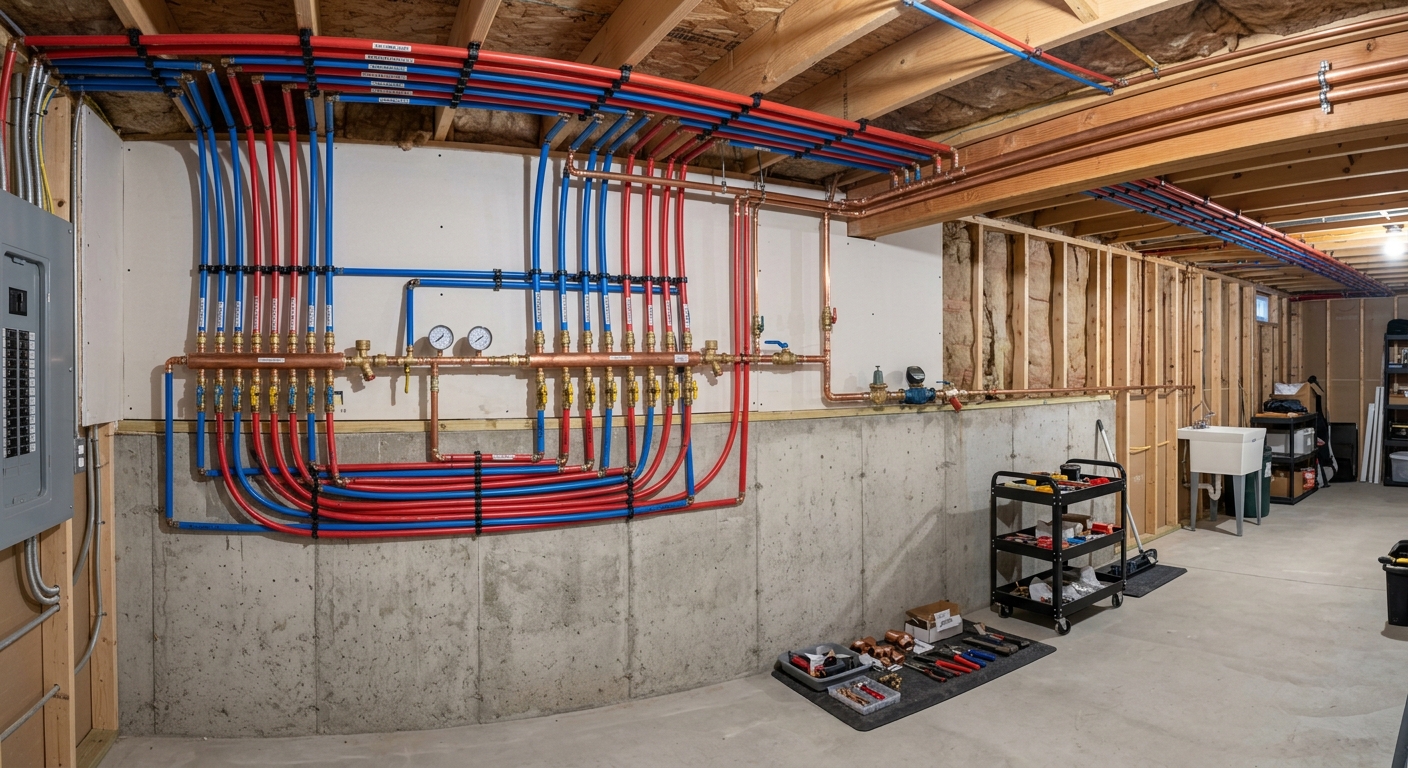
- PEX: Flexible, typically blue (cold) or red (hot), plastic with crimped brass or plastic fittings.
- Cast iron: Dark and heavy, thick-walled, often painted black. Tapping sounds dull, and the surface can show rust patches.
- Clay tile: Typically visible as orange-brown pipe in older basements, especially at the main sewer exit point.
Here is how era, failure mode, and life expectancy look for the pipes you’ll see in South Fayette and across Allegheny County:
| Material |
Typical era |
Failure mode |
Service life |
| Galvanized steel supply |
pre-1960 |
internal corrosion, pressure loss |
40–60 yrs |
| Copper supply |
1950s–present |
pinhole leaks, joint failure |
50–70 yrs |
| Polybutylene supply |
late 1970s–1995 |
fitting failure, sudden bursts |
unreliable |
| PEX supply |
2000s–present |
fitting or UV degradation |
40–50 yrs |
| Cast iron drain |
pre-1975 |
corrosion, cracking, scale |
50–75 yrs |
| Clay tile sewer lateral |
pre-1980 |
root intrusion at joints, offset |
50–60 yrs |
| PVC / ABS drain |
1970s–present |
joint separation, crushing |
50+ yrs |
How to find a good plumber in South Fayette
Vetting a plumber in South Fayette isn’t complicated, but it is critical—especially since Allegheny County municipalities may have their own licensing requirements distinct from surrounding towns. First, any contractor you hire for a job over $500 must have current Pennsylvania Home Improvement Contractor (HIC) registration. You can verify registration at hic.attorneygeneral.gov. For plumbing, make sure the company is credentialed by the municipality or, where required, holds an Allegheny County Health Department license—since licenses do not automatically transfer between townships or boroughs.
Always ask for a certificate of insurance naming your property address and proof of workers' compensation coverage, verified directly via WCAIS (wcais.pa.gov). Ask whether the crew doing the work are employees or subcontractors—insurance and skill can differ. Get clarity up front about how emergency rates are triggered and structured.
- Check HIC registration at hic.attorneygeneral.gov
- Confirm Allegheny County Health Department or municipal license where required
- Insurance certificate must list your address
- Workers’ compensation verified at wcais.pa.gov
- Ask if work is done by direct crews or subcontractors
- Is the quote flat-rate or hourly?
- Does the quote include a camera inspection for sewer or repipe jobs?
- Are all emergency and after-hours surcharges explained up front?
- Is restoration (walls/floors) included or excluded?
- Written contract for all work over $500, as required by law
- Labour and parts warranty periods separated in the proposal
- Pay schedule aligns with contract milestones, not just time
Be cautious in Allegheny County’s saturated plumber market: the biggest red flags are high-price sewer, water line, or repipe proposals without camera footage or a pressure test to justify the expense, vague insurance documentation, or a “too good to be true” timeline for major work.
Verifying a South Fayette plumber's credentials
In Pennsylvania, there is no statewide plumbing license. Instead, plumbing is licensed and permitted at the municipal or county level. That means a plumber licensed in one Allegheny County municipality may have zero standing in the next. The bottom line for South Fayette: always confirm the plumber is licensed to work in your specific township or, if relevant, by the Allegheny County Health Department for plumbing work in Pittsburgh and nearby municipalities.
Permits are required for new or altered plumbing systems across Pittsburgh and surrounding municipalities. In South Fayette, check with township authorities or the Allegheny County Health Department to determine which body is enforcing code for your project. Do not be satisfied by a generic “licensed and insured” claim—ask directly if they hold a license for this municipality.
Insurance must be current and specifically list your address for this job. Workers’ compensation is mandatory by state law for all employers; you should verify it via WCAIS (wcais.pa.gov) and not just take a certificate at face value.
For jobs over $500, Pennsylvania’s Home Improvement Contractor Act applies—requiring a written contract, a three-day right to cancel, and explicitly forbidding any offer to waive your insurance deductible.
Water heater replacement decisions
If your South Fayette water heater is failing, replacement cost and long-run savings depend heavily on type and site conditions. The most common option is the standard gas tank: it’s the cheapest to install ($1,300–$3,100), but its life is only about 8–12 years, and you’ll pay in standby heat losses over time. Electric tanks cost about the same up front but have higher energy bills long-term. Tankless gas heaters deliver endless hot water and last longer (18–25 years), but require higher installation costs ($2,100–$3,100) and often a bigger gas line and new vent, particularly in homes built before 1980.
Heat pump water heaters are the most efficient ($2,100–$3,100), but in South Fayette’s climate, you’ll need a large, unfinished, and relatively warm basement. These units cool the surrounding air. If you keep your hot water heater in a tight, finished space, the sound and cooling side effects are real drawbacks.
Always size your new water heater based on first-hour rating—how much hot water it can deliver in peak use—rather than just storage volume. Expansion tanks, drip pans, and floor drains are a must on any new install in an older Allegheny County home. Most tank failures are leaks through the shell; controls rarely go bad first.
| Type |
Installed cost |
Service life |
Operating cost |
Best when |
| Gas tank, 40–50 gal |
$1,300–$3,100 |
8–12 yrs |
moderate |
Existing gas, replace-in-place, modest usage |
| Electric tank, 40–50 gal |
$1,300–$2,100 |
10–15 yrs |
high |
No gas access, compact install, short-term planning |
| Gas tankless |
$2,100–$3,100 |
18–25 yrs |
low-moderate |
Continuous hot water, high initial budget, wall space |
| Heat pump water heater |
$2,100–$3,100 |
13–15 yrs |
lowest |
Large unfinished basement, all-electric home |
What a plumbing quote should contain
In South Fayette, plumbing estimates follow two models: flat rate or time-and-materials. Flat rate gives you a fixed cost up front, protecting you from surprises but pricing in the risk for the contractor. Time-and-materials often costs less for straightforward jobs but will run open-ended if the job uncovers more work.
Every bid should spell out whether there’s a diagnostic fee and, if so, whether it’s credited to the work. The scope—not just a price—should specify what’s being opened, replaced, and restored. Does the price include wall and floor repairs? Is the permit fee included? Are you getting a separate labor warranty (not just a manufacturer’s part warranty)? Finally, make sure after-hours rates are disclosed up front.
| Line item |
What to look for |
Red flag if… |
| Billing model |
flat rate or hourly, stated up front |
unstated |
| Diagnostic fee |
amount, and whether it credits |
vague |
| Scope |
what is opened, repaired and restored |
price with no scope |
| Restoration |
drywall and finish explicitly in or out |
silent |
| Permit |
included and priced |
'not needed' |
| Parts |
brand and model for fixtures |
'standard fixture' |
| Warranty |
labour period stated separately |
parts only |
Sewer line problems in South Fayette
If you’re a South Fayette homeowner, you are responsible for the sewer lateral from your house all the way to the main in the street—not the township or the county. That means any blockage, collapse, or root intrusion is your bill to pay. Most problems start as a single slow drain, but if you have gurgling, multiple slow fixtures, or backup at the lowest drain in the house, the blockage is probably in the main lateral and not just one branch.
With the age of many homes built before 1980, clay tile pipes are common in older South Fayette properties—these fail at the joints, letting roots in. Cast iron laterals crack and flake apart after 50–75 years. The right first step is a camera inspection, not an immediate dig: this gives you and the contractor a record of exactly what and where the problem is. Never sign a sewer excavation contract without seeing that video footage.
In the Pittsburgh area, including South Fayette, townships have a mix of separated sewer and septic. If you’re on septic, backups could also be a sign your tank needs pumping, or the drainfield is failing—which is an entirely different (and often less dramatic) fix.
As for repairs, you’ll hear about open-cut replacement (digging up the yard) or trenchless lining. Both have their place, but without a camera, no one can say which you need.
Frequently asked questions — plumbing in South Fayette
Can I do my own plumbing work in South Fayette?
Homeowners in South Fayette can perform some basic plumbing work themselves, such as replacing faucets or showerheads, without pulling a permit. However, for most projects involving new or altered plumbing systems—like replacing supply lines, moving fixtures, or installing new drains—a permit is required and inspections are handled either by the township or the Allegheny County Health Department (depending on municipal jurisdiction). Not following this process can lead to denied insurance claims or trouble during resale. If your project cost exceeds $500, Pennsylvania law also requires a written contract if you hire someone else, and you’ll face the same pricing as a pro—expect costs starting around $375–$1,300 for emergency repairs. When in doubt about permit needs, check with your local township office before starting any significant plumbing work.
Should I repipe my South Fayette home or keep repairing?
If you own an older South Fayette home built before 1960, odds are it has galvanized or aging copper pipes. Galvanized lines lose pressure and eventually develop leaks due to internal corrosion, while old copper can develop pinholes. If you're facing repeated repairs, or notice visible rust, discolored water, or a noticeable drop in pressure despite clearing faucet aerators, a full repipe may be the most cost-effective solution. A whole-house repipe in South Fayette typically runs $3,900–$9,400. If isolated leaks are rare and you don’t mind the risk of another eventual repair, spot-fixes are fine, but over time, repair bills add up and you might spend nearly as much as a full replacement. Always get a second opinion (and proof via camera or pressure test) before greenlighting a repipe project.
How hard is the water in South Fayette?
South Fayette’s water hardness is representative of what you see throughout Allegheny County, with moderate to moderately-hard water sourced primarily from the local utility noted in Pittsburgh. While it does not usually cause immediate problems, over decades hardness does contribute to scale buildup—especially in older galvanized and even copper supply systems. Scale reduces water flow and can shorten the life of tank water heaters (replacement typically costs $1,300–$3,100). If you notice white mineral residue on fixtures or inside your kettle, you might want to install a water softener, particularly if you have appliances with heating elements or recently replaced your water heater. Not every home in South Fayette needs softening, but new fixtures and pipes will last longer with it.
Who pays to replace a lead service line in South Fayette?
In most of South Fayette and wider Allegheny County, including areas served by the Pittsburgh Water and Sewer Authority, ownership of the water service line from the street into your house rests with the homeowner. If your house is flagged for lead service line replacement during emergency repairs or as part of a utility-led program, the responsibility (and cost) will depend on the location of the line and whether replacement is scheduled or emergent. Utility-driven programs sometimes cover public sections, but any private side replacement is typically at your expense—expect a ballpark of $6,100–$13,000 for a full water service line replacement. Always request documentation and check if the work qualifies for local assistance programs.
How much does a water heater replacement cost in South Fayette?
For a typical South Fayette homeowner, replacing a gas water heater (40–50 gallons) in 2026 costs between $1,300–$3,100. Electric water heaters are usually a bit less, while tankless and heat pump models cost more up front but may save on energy long-term. Remember that installation prices include not just the heater itself, but removal of the old unit, haul-away, setting up any new code-required pans and expansion tanks, and sometimes electrical or venting modifications. Homes built before 1980 may need additional updates if your heater location or connections are not up to modern code, which can add to the bill.
Do I need to drain outdoor spigots in South Fayette?
Absolutely. South Fayette’s winters bring regular freeze-thaw cycles and lows that easily reach 8°F, matching the winter design temperature for southwestern Pennsylvania homes. If you do not drain and shut off outdoor spigots in the fall, any water left inside can freeze, split pipes, and lead to hidden leaks that show only in spring. Repairs for a burst exterior line start around $375–$1,300, depending on where the freeze occurs and how much wall or ceiling needs to be opened. Always turn off the interior shutoff, drain the line at the spigot, and leave the exterior valve open over winter—especially important for the many older homes with non-frostproof fixtures.
How do I tell what my pipes are made of?
Start with a look under the kitchen sink, laundry, or at your main shutoff. Galvanized steel appears gray and is magnetic; copper is reddish-brown and non-magnetic; PEX is flexible plastic (blue or red) with crimped fittings; cast iron is dark, heavy, and usually larger-diameter for drains. Clay tile or PVC/ABS are typically visible where your main drain exits through the basement wall. For buried or inaccessible lines, a plumber can identify materials via a small inspection opening or with a camera. Knowing your pipe type helps with planning and with cost estimates—full galvanized repipe jobs in South Fayette typically fall between $3,900–$9,400 for a 3-bedroom, 2-bath home.
How much does a plumber cost in South Fayette?
The cost to hire a plumber in South Fayette depends on the type of work, urgency, and complexity. Emergency repairs, such as a burst pipe after hours, typically cost between $650–$1,300, while the same repair scheduled during regular business hours can cost as little as $375. More extensive jobs like a sewer spot repair or full repipe quickly add up, with prices based on access, material, and restoration. Always get a written scope and confirm what’s included. South Fayette is part of a saturated Pittsburgh metro plumbing market, so pricing can be competitive as long as you verify credentials and insurance.
What counts as a plumbing emergency?
In South Fayette, a plumbing emergency is any situation where there’s active leaking, flooding, or loss of essential service—like no water, sewage backup, or a burst pipe spraying water. During winter, frozen and burst pipes are the biggest emergencies, with ground frost reaching 36 inches down. Sewer backups affecting all fixtures or any leak causing visible property damage should be treated as urgent. Emergency callouts generally start around $650 and can go higher. For anything that cannot wait until the next business day due to health, safety, or major property damage, call a pro immediately—these always cost more than planned jobs, but inaction is riskier.