East Lampeter plumbing prices by job type — 2026
In East Lampeter Township, plumbing prices can differ sharply depending on whether you're dealing with a sudden emergency, like a burst pipe, or planning a standard replacement or upgrade. With 45.0% of homes built before 1980 and a homeownership rate of 61.7% (U.S. Census Bureau, ACS 2024), the age and maintenance history of your house matter as much as the job itself. Older homes in nearby Lancaster city—filled with pre-1940 row and twin houses—frequently need full repiping, especially to swap out failing galvanized pipes for copper or PEX. That construction era not only shapes your system but also what goes wrong and what it costs to fix.
When a pipe bursts under pressure on a cold Sunday night, the price is different than if you call on a Tuesday for a planned repair. Emergency rates reflect the need to get someone skilled through traffic and after hours, often wrestling with hard-to-access systems in basements and crawl spaces. For water heater replacements, the standard rate covers a scheduled job, but sudden leaks command the higher end. Sewer and water service repairs especially trend toward the upper range in tightly packed neighborhoods where digging and restoration are tricky.
| Service |
Scope |
Emergency rate |
Standard rate |
| Emergency repair — burst pipe |
locate, open, repair section, restore service |
$600–$1,200 |
$350–$1,200 |
| Water heater replacement (gas, 40–50 gal) |
remove old, install, test, haul away |
$1,900–$2,800 |
$1,200–$2,800 |
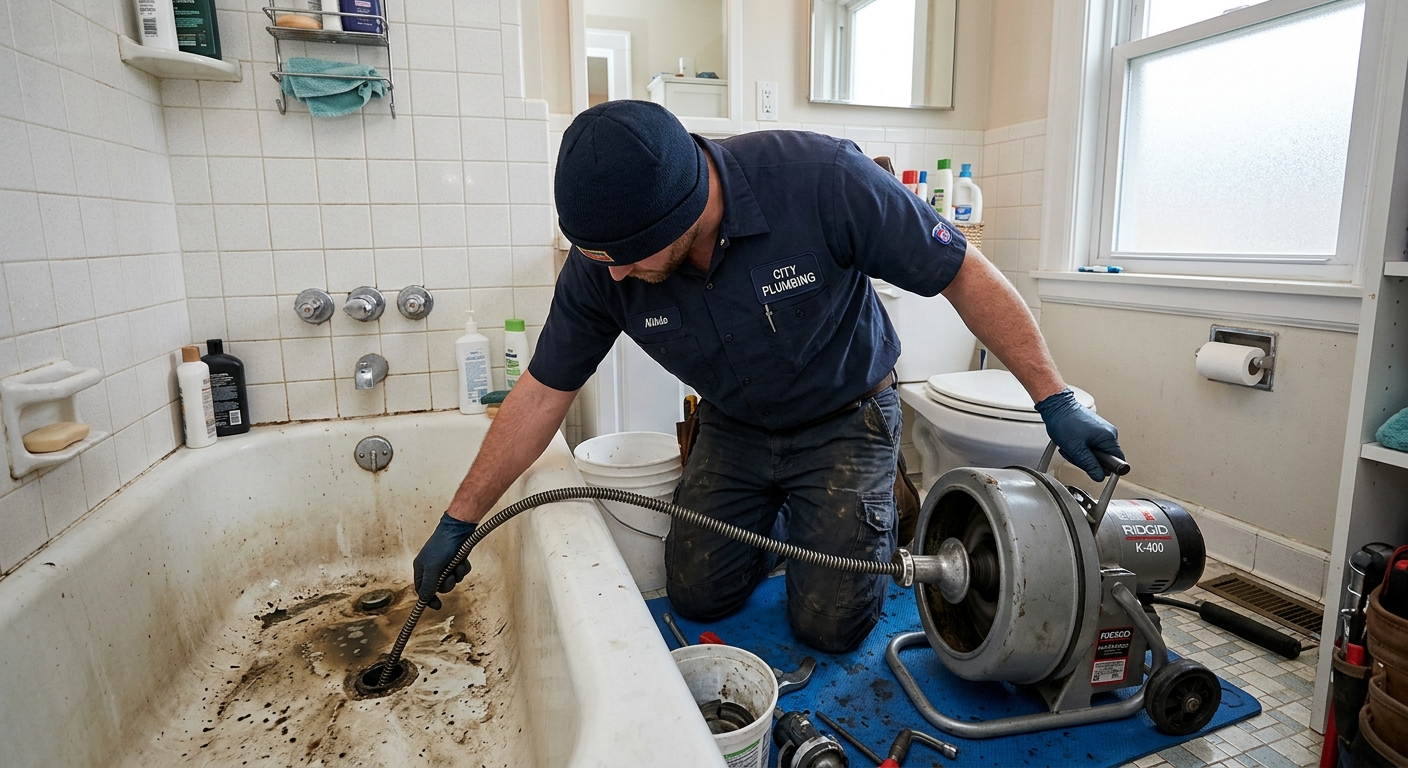
| Drain cleaning — main line |
augering or hydro-jet, camera if needed |
$350–$800 |
$200–$500 |
| Sewer line spot repair |
excavate or reline a failed section |
$2,000–$12,000 |
$2,000–$12,000 |
| Whole-house repipe |
replace supply lines throughout, patch and finish |
|
$3,500–$8,400 |
| Water service line replacement |
street to house, excavation and restoration |
|
$5,400–$12,000 |
Estimates for a typical East Lampeter home. Access difficulty and pipe material move these figures more than anything else.
Water quality and what it does to your pipes
Most homes in East Lampeter get their water from the City of Lancaster Water Bureau or a local municipal utility. If your home is on public water, you can ask for the annual water quality (consumer confidence) report, which will include current levels for hardness, pH, chlorine, and more. These reports are worth reading—hard water causes scale buildup inside pipes, water heaters, and appliances, quietly shortening their lives. Lancaster's water supply is typically on the harder side, so white buildup on fixtures is common. Hardness damages water heaters slowly; you might replace one after eight years where softer water would see twelve.
Softening does help, but systems aren’t cheap, and the salt and ongoing service add up. For an average homeowner, the payback is real if you’re spending money fixing or replacing fixtures before their time. Don't rush to install a system unless you’ve confirmed hardness well above what’s considered normal for municipal supply. A whole-house softener typically makes sense if you've already seen multiple fixtures corrode out, but cheap filter gadgets rarely make a difference beyond taste. Whole-house filtration is more about sediment and taste than actual pipe protection—point-of-use filters are enough for most drinking water concerns.
If your East Lampeter property runs on a private well—as in some outlying/agricultural township locations—no public report exists, and regular professional water testing (especially for bacteria, nitrates, and corrosion potential) is necessary. Don't let anyone sell you expensive treatment "just in case." Test first, and treat as needed.
What a plumbing quote should contain
When you get a quote from a plumber in East Lampeter, it should spell out not just the price, but exactly what you’re getting. There are two main billing styles: flat rate (one set price no matter how long it takes) and time-and-materials (hourly plus parts). Flat rate gives you price certainty, but usually builds in a cushion because the plumber takes on the risk of the unknown. Time-and-materials can come out cheaper for small, straightforward jobs, but can run high if issues are hidden behind old walls or floors—a common issue in Lancaster County.
A solid quote should state whether you’ll pay for diagnosis if you don't proceed, and whether that fee is applied to the repair if you do. The scope should be clear: “replace cracked pipe between shutoff and fixture” beats “fix pipe.” Restoration matters—does the price include patching drywall or just fixing the pipe? Permit costs should be listed if required. Make sure warranty terms for both labor and parts are separate and spelled out. After-hours or emergency surcharges aren’t a rip-off, but you should be told about them before work starts.
| Line item |
What to look for |
Red flag if… |
| Billing model |
flat rate or hourly, stated up front |
unstated |
| Diagnostic fee |
amount, and whether it credits |
vague |
| Scope |
what is opened, repaired and restored |
price with no scope |
| Restoration |
drywall and finish explicitly in or out |
silent |
| Permit |
included and priced |
'not needed' |
| Parts |
brand and model for fixtures |
'standard fixture' |
| Warranty |
labour period stated separately |
parts only |
Plumbing systems in East Lampeter homes
East Lampeter’s housing mix tilts toward single-family homes with nearly half (45%) built before 1980 (U.S. Census Bureau, ACS 2024). This means many houses still have some galvanized supply piping and cast iron or clay tile drains, especially if a large renovation hasn’t happened yet. If your house is over 60 years old and still on its original service line, that pipe may be lead, galvanized, or copper, depending on when the development was plumbed—and it’s likely seen at least one round of piecemeal repairs or replacements.
Water heaters in these homes might be on their third or even fourth life, depending on whether they were proactively replaced or just run until failure. Sewer laterals running to the street are often original clay or cast iron, common sources of cracks, tree root invasions, and backups. Repipe jobs—especially replacing all supply lines with PEX or new copper—are routine in this part of Pennsylvania's older housing stock and tend to be more invasive and costly than in newer neighborhoods. If your house was built post-1980, odds are it has copper, CPVC, or even some early PEX. While these newer pipes generally present fewer emergency leaks, original “builder grade” fixtures and water heaters often reach the end of their design life after 20-30 years, and you may see problems like weak water pressure or “orange water” as those originals wear out.
Licensing and permits for plumbing work in East Lampeter
Pennsylvania does not have statewide plumbing licensing—instead, licensing is handled city by city or township by township. In Lancaster city, your plumber may be licensed through the city, but this does not automatically transfer to East Lampeter Township or neighboring municipalities. The practical upshot is that when you're hiring, the right question is not “are you licensed” but “are you approved to do this work here?”
For most plumbing jobs in Lancaster city, a permit is required for any work that physically alters, expands, or adds value to the property. Simple same-fixture repairs, like swapping faucet cartridges or replacing a toilet flapper, generally don’t need a special plumbing permit in the city, but the rules in East Lampeter may differ since each township enforces its own building/plumbing code office under the Pennsylvania Uniform Construction Code (UCC), which is based on the IRC. Inspections are performed by the municipality or by the PA Department of Labor & Industry in areas that have opted out of enforcement.
For any job over $500, the contractor must be HIC registered (Home Improvement Contractor) through the Pennsylvania Office of Attorney General, and you can look up a registration at hic.attorneygeneral.gov. Insurance and workers’ compensation are mandatory for all employers and can be verified at WCAIS (wcais.pa.gov). Written contracts are required for jobs over $500, you get a 3-day right of cancellation, and waiving your homeowner’s insurance deductible is not legal.
Frozen pipes in East Lampeter: prevention and thaw
East Lampeter winters are real: frost penetrates 30 inches deep, and the winter design temperature is 12 °F. Constant freeze-thaw cycling makes exterior plumbing especially vulnerable. Pipes freeze in unheated spaces like crawlspaces, attics, garages, exterior walls, and run-outs to hose bibs. Here’s how it unfolds—a section freezes, pressure builds between the blockage and a closed faucet or valve, and the pipe splits, often away from where the ice actually sits. You don’t see water until the pipe thaws, sometimes flooding a basement or wall cavity without warning.
Prevention is the best money you’ll spend. Step one: make sure exposed pipes (crawlspace, garage, exterior wall cavities) are insulated and protected against drafts. For high-risk spots, heat tape is effective and fairly cheap to install. In serious cold spells, letting a trickle of water run overnight through a vulnerable faucet keeps lines moving. Open kitchen or vanity cabinet doors on exterior walls to let warm air circulate, and always shut off and drain outdoor spigots before the first freeze of fall.
If a pipe does freeze but hasn't burst, thaw it slowly with a hair dryer, a heat gun on low, or towels soaked with warm water—never use an open flame, which often turns a frozen pipe into a burned house. If you see water or hear the sound of spraying, shut off the water main and call for professional help. The cleanup and repair for a burst pipe in East Lampeter usually lands between $600–$1,200 when rapid response is needed—so an ounce of prevention is worth more than you think.
Choosing a water heater in East Lampeter
East Lampeter homeowners typically choose from gas tank, electric tank, gas tankless, or heat pump water heaters. For most, a traditional gas tank is cheapest to install and simple but is the least efficient and shortest-lived, and loses heat all day. Gas tankless heaters offer endless hot water and the longest lifespan but cost more to install and often require both a bigger gas line and new venting—expenses that catch some off guard. The heat pump water heater is the most efficient to run, but it needs plenty of room and absorbs heat from the surrounding air, chilling the installation area (a factor in finished basements or small utility rooms). It’s also noisier than the others.
Your best bet comes down to installation cost, running cost, and what fits in your home’s layout. If you’re sizing, look at the first-hour rating—not just gallons—to match your peak use. Modern code and good practice call for an expansion tank and a drain pan that’s piped to a floor drain or sump, especially in finished spaces. Most failures are the tank corroding out, not the controls.
| Type |
Installed cost |
Service life |
Operating cost |
Best when |
| Gas tank, 40–50 gal |
$1,200–$2,800 |
8–12 yrs |
moderate |
gas available, venting is easy, up-front cost matters |
| Electric tank, 40–50 gal |
$1,200–$1,900 |
10–15 yrs |
high |
no gas service, limited budget, easy install |
| Gas tankless |
$1,900–$2,800 |
18–25 yrs |
low-moderate |
long-term value, unlimited hot water, willing to invest up front |
| Heat pump water heater |
$1,900–$2,800 |
13–15 yrs |
lowest |
ample space, mild basement, electricity is the only option |
Frequently asked questions — plumbing in East Lampeter
Is a water softener worth it in East Lampeter?
Water softeners solve hard water problems—like scale buildup and shortened lifespan for water heaters and fixtures—by removing minerals such as calcium and magnesium. In many parts of East Lampeter, municipal water is on the harder side, so the benefits are real if you've lost water heater after water heater to buildup, or see frequent white deposits on your fixtures. That said, not everyone needs a softener. It only pays off if your water tests above the threshold for hardness and you’re seeing real consequences (failed appliances, ruined valves, or tight water flow). Overdoing it with a system that’s oversized or unnecessary just adds maintenance and salt expenses. For most homeowners here, a water softener is a luxury until issues start costing you serious money—replacing a water heater early at $1,200–$2,800 is a sign the math works for you.
Why do all my drains drain slowly at once?
When every drain in your East Lampeter home slows down together, it’s usually a main sewer line or septic issue, not a series of little clogs. Homes in this region—especially pre-1980 construction—may have original clay or cast iron laterals, prone to root intrusion, collapse, and buildup. If you’re on public sewer, tree roots and pipe sags are common causes. If you’re on a septic system, it could be a full tank or failed leach field. A typical main line cleaning costs $200–$500 (standard rate), and most shops will run a camera to confirm what’s happening. Don’t put off the call—if sewage backs up, the results are both costly and unsanitary.
Can I do my own plumbing work in East Lampeter?
In Pennsylvania, there’s no statewide plumbing license, but each municipality—including East Lampeter Township—sets its own rules on what work homeowners can do. In Lancaster city, and likely in East Lampeter, permits are needed for jobs that change or add to the plumbing system, while simple fixture swaps often don’t require one. Do-it-yourself work without the right permit, inspection, or sign-off can cause real trouble when selling your house or with insurance claims. If you stick to minor repairs—like changing a faucet washer or toilet handle—you’re generally fine. Anything beyond that, you should check with your township office. If you mess up a private repair, the cost to undo the damage could easily top $350–$1,200 for a burst pipe.
Why do plumbers charge a diagnostic fee?
Plumbers in East Lampeter and the rest of Pennsylvania often charge a diagnostic or service fee to show up, evaluate the problem, and propose a solution. This fee covers travel time, basic troubleshooting, and the value of a professional assessment—especially important for older homes with hidden issues. In many cases, the plumber credits this charge toward the repair if you go ahead with the job, meaning it’s not “extra” as long as you proceed. Typical service calls, like for a leak, may start around $350–$1,200, including diagnosis and repair. Always ask if the fee applies to work if you hire them, so you’re not surprised.
How much does a water heater replacement cost in East Lampeter?
For a standard 40–50 gallon gas or electric water heater, replacement in East Lampeter ranges from $1,200–$2,800, typical for this area. This price covers removing the old unit, installing and testing the new one, and hauling away the scrap. Costs run higher on emergency calls, after hours, or if code upgrades (expansion tank, drip pan, seismic straps) are needed. Older homes—especially those dating before 1980—can see extra costs for bringing venting or supply lines up to the latest standards. Tankless or heat pump options sit at the higher end, often with electrical or venting updates required. Always ask what’s included in the quote, especially if you have a finished basement that needs special care during installation.
What do I do about a burst pipe right now?
If a pipe bursts in your East Lampeter home, the first move is to shut off your main water supply immediately. For most houses, the shutoff is in the basement near the wall where the water service enters. Then open the lowest faucet in the house (often in the basement) to drain any remaining water and reduce pressure. Avoid standing water on electrical appliances or panels. Call a local plumber as soon as possible. Emergency pipe repairs here usually run $600–$1,200, depending on access, cleanup, and what was damaged. The faster you act—especially in older homes where water can find its way into wall cavities or basements—the less you risk in cleanup and future restoration costs.
Am I responsible for the water line under the street?
In Lancaster city and similar jurisdictions around East Lampeter, homeowners are responsible for the water service line from the property line (often at the curb) to the house—but not the public main under the middle of the street. However, if a leak happens between the curb valve and your foundation wall, you’re on the hook for all costs: digging, permits, and restoration. Water service line replacement in East Lampeter runs $5,400–$12,000 depending on distance, depth, and any paved driveways or other obstacles. Always check with your local utility office for the exact boundary, and consider water service line insurance, especially for older properties with original pipes.
How hard is the water in East Lampeter?
East Lampeter and much of Lancaster County draw water that’s considered moderately hard to hard, given both the municipal supply and regional geology. Residents often notice white deposits on fixtures, cloudy spots on glassware, and fairly frequent scale buildup in water heaters. If you’re seeing water heaters fail early (under 10 years), or spending time descaling coffee makers and washing machines, you’re not alone. Hard water impacts long-term costs—pushing some to install a water softener, though that isn’t necessary for everyone. Keep in mind that a premature heater replacement is a warning sign; typical installs here run $1,200–$2,800. Municipal water reports are available on request and show the current hardness for your area.
What do I do if a pipe is frozen but not burst?
If you notice a frozen pipe in your East Lampeter home but it has not burst, leave the affected faucet open and gently try to thaw the pipe with a hair dryer or a heat gun set to low—start closest to the open tap and work back. Never use an open flame. If you’re unsure where the freeze is, check crawlspaces, exterior walls, and unheated garages—common spots in homes of all ages. Open cabinet doors to let warm air in, and turn up the thermostat in the short term. If you can’t identify or safely thaw the blockage, call in a professional. The cost to thaw before a burst is usually much less than the repair for a rupture, which often hits $600–$1,200 when urgent response is needed. Acting early turns a headache into a manageable fix.