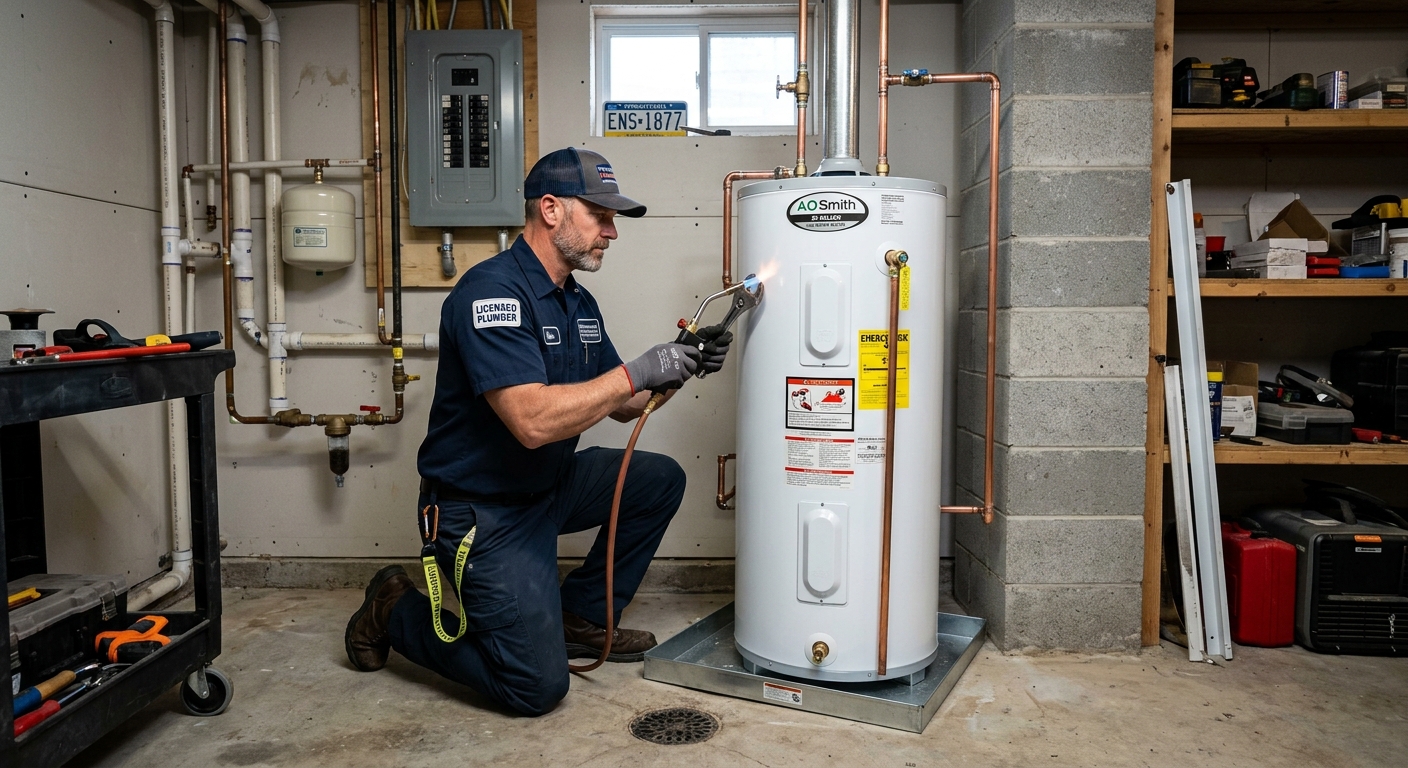
East Donegal plumbing prices by job type — 2026
East Donegal’s plumbing costs lean on a few specifics: an 81.0% homeownership rate means most residents are responsible for their own repairs, and with nearly 29% of homes built before 1980 (U.S. Census Bureau, ACS 2024), you’re just as likely to have galvanized or even lead supply pipes as modern PEX. If your house is older—like the pre‑1940 row and twin homes common across Lancaster city—you’ll likely face material-driven issues, with the pipe era shaping both failure rates and what you pay to resolve them.
Expect the same job to carry two prices, depending on whether it’s an emergency: a burst pipe at 2 a.m. draws an emergency rate, reflecting labor after hours, immediate dispatch, and diagnosis on the clock. With flexibility to wait till business hours, you can often pay less for the same result. That distinction runs through every service here.
Below are ballpark estimates for frequent jobs in East Donegal. The material—galvanized, copper, or PEX—and how hard it is to reach influence the bill more than anything else. In older homes, restoring plaster or drywall after a repair often matches or exceeds the plumbing work.
| Service |
Scope |
Emergency rate |
Standard rate |
| Emergency repair — burst pipe |
Locate, open, repair section, restore service |
$650–$1,300 |
$375–$1,300 |
| Water heater replacement (gas, 40–50 gal) |
Remove old, install, test, haul away |
$2,000–$3,000 |
$1,300–$3,000 |
| Drain cleaning — main line |
Augering or hydro-jet, camera if needed |
$350–$800 |
$200–$500 |
| Sewer line spot repair |
Excavate or reline a failed section |
$2,100–$13,000 |
$2,100–$13,000 |
| Whole-house repipe |
Replace supply lines throughout, patch and finish |
|
$3,700–$9,000 |
| Water service line replacement |
Street to house, excavation and restoration |
|
$5,800–$13,000 |
Estimates for a typical East Donegal home. Access difficulty and pipe material move these figures more than anything else.
Spot repairs or whole-house repipe?
It’s tempting to patch and pray, but repeated leaks are a sign the system is failing. The clear threshold in East Donegal: if you’ve had two or more leaks (especially pinholes or weeping joints) on the same pipe material within three years, it’s a pattern—don’t keep paying for plumber calls and new buckets. Common signals of widespread trouble include pressure drops throughout the house (not just at one sink), reddish or brownish water when you first turn a faucet, visible rust or white corrosion on exposed pipes, and that sinking feeling when the drywall is always drying out behind the same wall.
The older your house, especially if it matches the pre‑1940 stock seen in Lancaster city, the more likely you have galvanized pipe—vulnerable to internal rust closing up your waterlines and driving up whole-house repipe demand. PEX tubing is much faster and less invasive to install, but if you’re opening up the walls anyway, copper might be worth the extra cost, particularly for resale value. Don’t forget: In older homes, the plaster or lath repairs after a repipe can add nearly as much as the plumbing itself, especially if patching is extensive.
Here’s a quick grid on when to fix and when to replace:
| Situation |
Recommendation |
Cost |
Reasoning |
| One leak, accessible, modern pipe |
Spot repair |
$375–$1,300 |
Limited failure, pipe likely sound elsewhere |
| Two or more leaks in 3 years |
Partial repipe |
$3,700–$6,100 |
Material failure emerging, future leaks expected |
| Galvanized supply, pressure loss |
Full repipe |
$3,700–$9,000 |
Corrosion clogs; patching delays the inevitable |
| Polybutylene anywhere in the house |
Full repipe |
$3,700–$9,000 |
Known recall/claim risk; insurers penalize |
| Cast iron drain with root intrusion |
Camera, then reline or replace |
$2,100–$13,000 |
Roots signal cracks; spot repair rarely lasts |
| Suspected lead service line |
Test, then replace the lateral |
$5,800–$13,000 |
Permanently eliminate health and resale risk |
When to call now and when to wait until Monday
Every homeowner dreads the emergency call—and its bill. The emergency premium in East Donegal reflects faster dispatch, after-hours driving across thinly populated areas, overtime labor, and the need to diagnose under the gun rather than stepwise. If you call for a burst pipe Saturday at midnight, that repair is commonly in the $650–$1,300 range. The very same job during office hours could be handled for $375–$1,300, simply because the schedule and crew are set up for it.
True emergencies that justify an immediate call:
- Water flooding actively from a pipe or ceiling
- No water at all to the house (supply main failure)
- Sewage backing up into living spaces
- Any gas odor
Problems that almost always wait safely until business hours:
- Slow drip under a sink or at a shutoff valve
- One slow draining tub or sink (unless sewage is visible)
- A constantly running toilet
- Low pressure at a single fixture, with full pressure elsewhere
Know where your water main shutoff is, typically in a basement or utility room—turn that valve (clockwise) to stop a crisis from spreading. For toilets and sinks, shutoff valves are just below or behind each fixture. If you can stop the active leak, you can usually avoid emergency pricing.
Licensing and permits for plumbing work in East Donegal
Plumbing in East Donegal falls under Pennsylvania’s patchwork: there is no statewide plumbing license requirement—individual municipalities enforce their own code and may choose to require local licensure. That means a plumber certified for one township might have no standing in the next, so don’t just ask “are you licensed”—ask “are you licensed to work in this municipality?” For East Donegal, you’ll need to verify with the specific township office.
For emergency repairs or straight fixture swaps, many local governments, including Lancaster city, allow minor same-fixture repairs (like faucet or toilet part replacements) without a separate plumbing permit. Larger jobs—anything that alters, expands, or adds value to the plumbing system—require a proper building or plumbing permit and inspection. Permits are enforced by the local township or zoning office.
Every contractor working on a job worth more than $500 is required to hold a Home Improvement Contractor (HIC) registration from the Pennsylvania Office of Attorney General. Verify this at hic.attorneygeneral.gov. Workers’ compensation insurance is mandatory by law; you can confirm a contractor’s coverage via WCAIS at wcais.pa.gov. Always ask for certificates that specifically name your property and current dates before work begins.
Detection methods and what they cost
For leaks you can’t see, start with the free test: shut every tap and appliance, check your water meter (usually in the basement or at the curb), and see if the dial moves. If it does, you’ve got a hidden supply leak.
When that test points to a leak you can’t find, professional methods come next. Acoustic listening—a technician uses sensitive microphones to zero in on pressurized leaks—usually falls into the diagnostic fee, typically in the $375–$1,300 emergency call range or bundled under standard rates if scheduled. Thermal imaging detects temperature changes behind walls and floors; you’ll see this used when hot water lines are suspect. Tracer gas is for concealed or hard-to-reach leaks: a harmless, odorless gas is pumped into your lines, then sniffers locate where it escapes. If you’re on slab or have an in-ground leak, slab leak location combines listening equipment and tracer gas, usually pushing toward the upper end of the price spectrum because of the skill and specialty gear.
Common East Donegal cases are pipe runs inside old plaster walls or under slabs in pre-1980s homes. Any plumber eager to cut walls open before running acoustic or imaging diagnostics is cutting corners—pinpointing the leak first saves both money and damage.
Choosing a plumbing contractor
East Donegal homeowners have to vet more carefully than most: municipal-only plumbing licensing means you must confirm the contractor is registered for this township, not just Lancaster or another part of the county. Use the Attorney General’s HIC registry (hic.attorneygeneral.gov) for contract jobs over $500 and verify current insurance and workers’ compensation (via wcais.pa.gov). Ask to see a certificate naming your property, not just a generic policy. Firms should clearly state whether their crews do the work or if it’s subcontracted, and emergency dispatch costs should be spelled out before work begins.
- Confirm HIC registration and check expiration
- Check for current workers’ comp (WCAIS) and liability insurance
- Ask about township plumbing permit requirements for your job
- Request written estimates with a clear scope of work
- Get camera footage before any repipe or sewer work is quoted
- Ask if pressure testing or dye testing will confirm a leak
- Specify who will perform drywall/plaster repairs
- Expect a physical address, not just a phone number
- Ask what qualifies as an emergency and how rates jump outside hours
- Review contract terms: deposits, cancellation, materials warranty
- Get references for similar local projects
- Never accept unexplained line items or “just trust me” on big work
Red flags: any company unwilling to provide documentation, those quoting whole-house repipes without evidence (like camera footage or pressure readings), or those that pressure you for immediate decisions. With a moderately dense urban-to-rural mix in Lancaster County, you’ll find both solid small firms and out-of-area “storm chasers”—the latter usually disappear as fast as they show up.
Freeze risk and what to do about it
With a frost depth of 30 inches and a winter design temperature of 12°F, East Donegal gets its share of freeze-thaw cycles and moderate snowfall. Most pipe bursts don’t actually happen at the freeze point—the ice forms a plug, and when a faucet or valve is closed downstream, expanding pressure splits the pipe somewhere between the plug and a closed fixture. That’s why the leak often appears feet away from where the cold actually hit.
Pipes at risk: those on exterior walls, in unheated crawlspaces, running through cold garages, hose bibs, and any supply line crossing an unfinished attic. Older homes with less insulation—common in East Donegal’s pre-1980s housing—can see vulnerable spots anywhere outside the thermal envelope.
Preventing freeze-ups, from cheapest to costlier:
- Pipe insulation on exposed lengths
- UL-listed heat tape for pipes in crawlspaces or against exterior walls
- Letting a faucet trickle when lows dip toward single digits
- Opening cabinet doors at sinks on exterior walls
- Always shut off and drain outdoor spigots before the first hard freeze
To thaw, use a warm towel, hair dryer, or a specialty pipe-thawing machine. Never use an open flame or torch—too many house fires and melted pipes in this county each winter.
Unprotected lines that split cost far more to fix than to insulate. Emergency pipe repairs can quickly tally between $375–$1,300 plus restoration. Spending a few hours on prep beats a weekend call-out every time.
Frequently asked questions — plumbing in East Donegal
Why do plumbers charge a diagnostic fee?
A diagnostic fee covers the time and expertise needed to locate the problem, especially in older East Donegal homes where pipes are hidden behind plaster or in crawlspaces. In this area, tracking down a leak in a pre-1980s house often means more than just “taking a look”—you sometimes need specialized tools or camera gear to avoid unnecessary damage. The fee isn’t just to show up but reflects the training and equipment behind a solid diagnosis. Most diagnostic visits are credited toward the work if you hire the contractor. Diagnostic charges fall in line with the standard emergency call band: between $375–$1,300, depending on the urgency and complexity.
What do I do if sewage is backing up?
If you have sewage backing up in your East Donegal home, stop all water use immediately—every extra flush or run of water can push more waste into living spaces. If you’re on the city system, this often signals a main line blockage, common in older homes with clay or cast-iron pipes. For rural or exurban homes with septic, it could be a tank or field failure. Don’t use any cleaning agents or try to snake the main yourself in a full backup; call a plumber who can camera the line and determine if it’s a blockage or a collapse. Expect main line cleaning or spot repair to fall between $350–$800 for clearing, or much more if repair is needed.
Do I need a permit for plumbing work in East Donegal?
In East Donegal, permit requirements depend on the kind of work. For basic repairs—like swapping a faucet or replacing a toilet flapper—you likely don’t need a plumbing permit, following rules similar to Lancaster city. However, if your project alters or expands plumbing (installing a new water heater, rerouting lines, or replacing pipe runs), you generally do need a permit from the township office. These jobs also require proper inspection to ensure everything meets the Pennsylvania Uniform Construction Code (UCC). Be prepared for permit fees and wait times. For water heater replacement, for example, labor and permitting together usually cost $1,300–$3,000.
Should I repipe my East Donegal home or keep repairing?
For homes in East Donegal built before 1980, especially those with galvanized or polybutylene pipes, repeated leaks are a warning—not just bad luck. If you’ve had two or more leaks in three years on the same system, ongoing patch jobs are likely to stack up past the cost of a full or partial repipe. Galvanized lines tend to clog with rust, dropping pressure throughout the house, while polybutylene is a known insurance red flag. Full repipe costs range from $3,700–$9,000. Consider the disruption: plaster repair after the plumbing is often half the battle. For one-off leaks on modern pipes, spot repair is fine; but chronic issues point to replacement saving time, money, and hassle.
What causes low water pressure in East Donegal homes?
Most low water pressure complaints in East Donegal tie directly back to the age and material of your pipes. Galvanized steel—common in homes matching Lancaster city's pre‑1940 stock—corrodes from the inside, narrowing the opening and steadily cutting housewide pressure. Older service lines can also develop partial blockages, especially if there’s evidence of lead or rust in your first-draw water. If pressure drops only at one fixture, it’s usually a local issue—a failed cartridge or clogged aerator. Diagnosing a system-wide pressure issue may run you the standard emergency call range, about $375–$1,300, with a full repipe ranging much higher if that’s the outcome.
Does insurance cover a burst pipe in East Donegal?
In most East Donegal cases, a burst pipe caused by sudden freezing—if you’ve done normal maintenance like keeping the heat on—is covered by homeowner’s insurance for the resulting water damage and sometimes the repair itself. Insurers often won’t pay for gradual leaks or frozen pipes if you left the house unheated in winter. Replacement of failed systems, like a whole-house repipe after repeated leaks, is rarely covered unless you have an added policy. After a freeze, you’re looking at $375–$1,300 for emergency repairs, and your deductible applies. By law, a contractor here cannot waive your deductible.
How deep do water lines need to be buried in East Donegal?
Water lines in East Donegal should be buried at least 30 inches deep—this is the frost depth for south-central Pennsylvania, protecting against freeze-related splits during our pronounced freeze-thaw cycles. Even at that depth, exposure or thin soil can still pose risk in colder snaps, so check that incoming lines are insulated where they enter basements or crawlspaces. If you need to replace your main water service, expect excavation and restoration in the $5,800–$13,000 range, depending on length and whether you’re transitioning from lead or older pipe materials.
Is East Donegal on combined sewers or septic?
Within the greater Lancaster area, sewer configuration varies by location. East Donegal itself may include both public sanitary sewers and rural parcels with private septic systems, reflecting the area’s mix of suburban and exurban development. Lancaster city proper uses separated sanitary and storm sewers, while outer townships—including parts of East Donegal—commonly have individual septic systems, especially on agricultural lots. If you’re not sure which you have, look for a sewer bill or the presence of an outdoor tank lid. Diagnosing and cleaning a main sewer line, regardless of system, usually costs $350–$800 for a basic service call.
How much does a plumber cost in East Donegal?
The price for a plumber in East Donegal depends heavily on what needs fixing and whether it’s an emergency. Emergency repairs, like a burst pipe at 2 a.m., run between $650–$1,300, while routine, scheduled work such as replacing a water heater is typically $1,300–$3,000. Drain cleaning is a common call in older houses, running $200–$800 based on time and method. The age and construction of your home—nearly a third in East Donegal are pre-1980—often require longer labor and specialized skills for hidden or difficult-to-access piping, which can add to total costs.