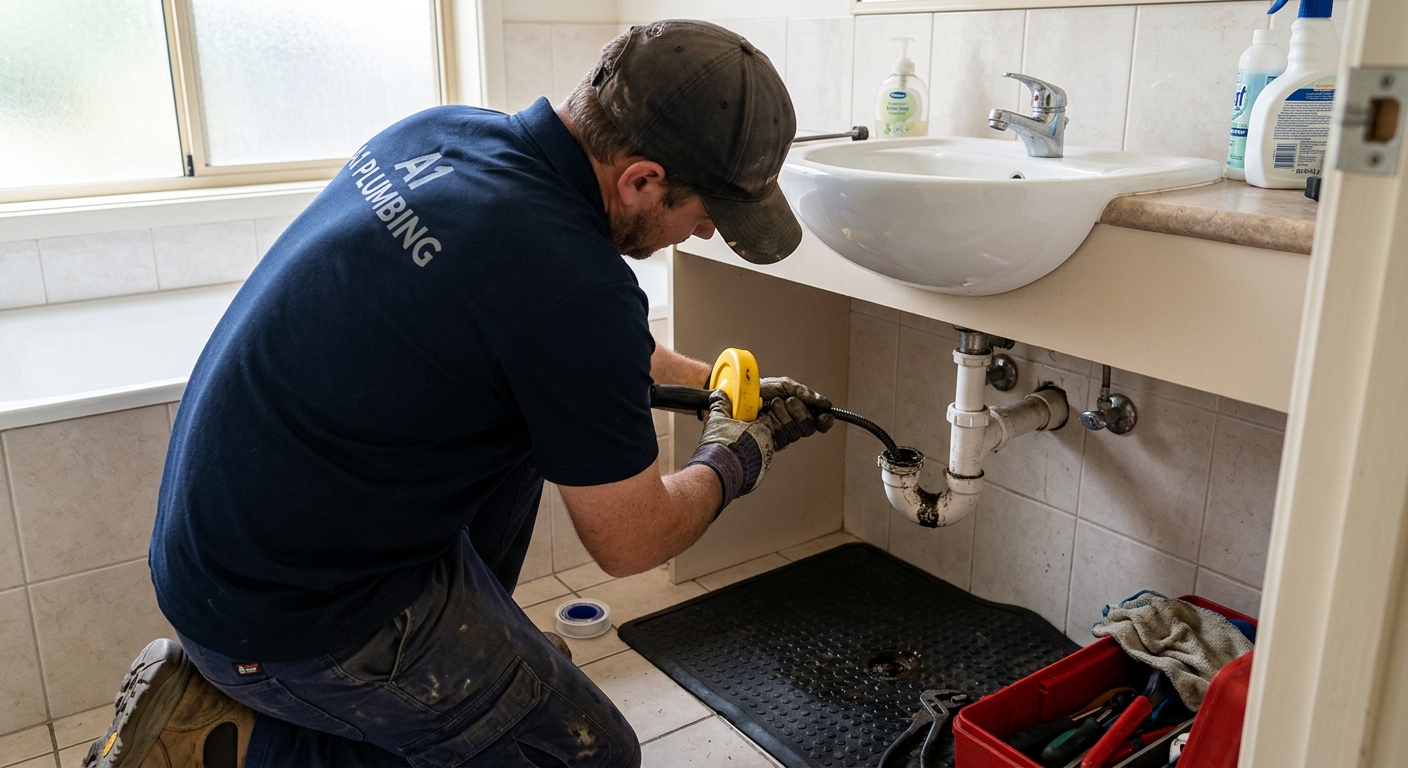
Plumbing costs in Richland — 2026
Richland homeowners, like those in Johnstown and surrounding boroughs, contend with plumbing costs shaped by the area’s housing stock and market realities. With 62.6% of homes here built before 1980 (U.S. Census Bureau, ACS 2024), the likelihood of facing galvanized pipes, aging drains, or complex restoration work is much higher than in newer subdivisions. The construction era tells you both the likely pipe materials and the headaches—replacing galvanized with copper or PEX is part of life for many here.
In Richland, the same problem comes with sharply different price tags depending on whether it’s an emergency call or scheduled repair. Burst pipes or major leaks discovered after hours cost more, and in rural Cambria County, travel surcharges make a real difference compared to Pittsburgh-area rates. With most homes single-family (68.2%), you’re likely facing individual service lines and dedicated repairs, not shared building systems.
Below is what you can expect to pay for plumbing work in Richland. These figures reflect the post-industrial, thin market of Johnstown–Cambria County and focus on single-family homes common to the area.
| Service |
Scope |
Emergency rate |
Standard rate |
| Emergency repair — burst pipe |
locate, open, repair section, restore service |
$550–$1,150 |
$325–$1,150 |
| Water heater replacement (gas, 40–50 gal) |
remove old, install, test, haul away |
$1,800–$2,700 |
$1,150–$2,700 |
| Drain cleaning — main line |
augering or hydro-jet, camera if needed |
$350–$800 |
$200–$500 |
| Sewer line spot repair |
excavate or reline a failed section |
$1,900–$11,500 |
$1,900–$11,500 |
| Whole-house repipe |
replace supply lines throughout, patch and finish |
|
$3,300–$8,100 |
| Water service line replacement |
street to house, excavation and restoration |
|
$5,200–$11,500 |
Estimates for a typical Richland home. Access difficulty and pipe material move these figures more than anything else.
Who is allowed to do plumbing work in Pennsylvania
Pennsylvania does not issue a statewide plumber’s license. Instead, plumbing is licensed at the municipal level. If you’re hiring for work in Richland or nearby Johnstown, verify that the person you hire is licensed or registered with the local government—being licensed in one city does not guarantee any credential in the next township. For example, the City of Johnstown requires local plumbing contractor registration, but Cambria County itself does not.
Plumbing work in Pennsylvania follows the Pennsylvania Uniform Construction Code (UCC), enforced by each municipality or, where municipalities have opted out, by the state. In Johnstown, any new fixture installation or alteration to supply/drainage lines requires a city permit and local inspection. Replacing a faucet or exposed trap in the same location typically does not need a permit in Johnstown, but this is not universal—always check with your local code office before starting work.
For any contract over $500, a plumber must have Home Improvement Contractor (HIC) registration, which you can verify at hic.attorneygeneral.gov. Employers must carry workers’ compensation insurance, verified through WCAIS at wcais.pa.gov. If your home was built before 1978, federal EPA Lead RRP rules apply for any work that disturbs painted surfaces—check certifiedrenovatorsearch.epa.gov to see if your contractor holds the necessary federal certification.
Finding a hidden leak in Richland
For Richland owners, the first leak test doesn’t require a plumber: shut every faucet and fixture in your house, then watch your water meter. If the meter dial is still spinning, you’ve got a supply-side leak somewhere on the property. This simple step can avoid a service call if you’re not sure a leak actually exists.
Professionally, leak detection starts at $325–$1,150 for most homes, depending on the access and complexity. Common tools include acoustic listening devices (which pick up even tiny leaks behind walls or under floors), thermal imaging (which reveals temperature changes from moisture escape), and tracer gas (injected into the line and detected at the leak point). Locating a slab leak or a leak inside a wall cavity can reach the upper end of the range due to time and specialized equipment.
For slab leaks (common in older cement-floored basements), professionals combine listening and tracing gas to pinpoint the failure. Hidden irrigation or branch lines are usually isolated through meter testing plus zone-by-zone shutoffs. Beware of any plumber who wants to cut open walls or slab first—modern practice is to find and mark the leak precisely before a single hole is made. That protects you from unnecessary repairs and drywall work.
Choosing a water heater in Richland
For Richland homes, the choice of water heater is mostly between storage tanks (gas or electric), tankless gas models, and heat pump water heaters. Standard tank heaters remain the cheapest to install and simplest to replace, but they lose heat while sitting and usually last 8–15 years. Tankless gas water heaters bring endless hot water and greater efficiency, but installation can become pricey if your existing gas line or vent aren’t large enough—very common in pre-1980 houses here.
Heat pump water heaters (hybrid electric) offer the lowest operating cost and now compete on initial pricing, but they pull heat from the air, making a cool basement colder and running noisy compared to tanks—something to consider if you finish your basement. They need plenty of air space and don’t work well in tight closets or very cold rooms, but can be a winning choice if you don’t have access to cheap natural gas or if the utility incentives line up.
Size your water heater by first-hour rating, not just gallon size: an active household or frequent guests can overwhelm even a 50-gallon tank if draws are heavy. Always install a thermal expansion tank and drain pan if possible, especially in finished spaces, because when heaters fail it’s usually the tank itself that gives out, not the controls.
| Type |
Installed cost |
Service life |
Operating cost |
Best when |
| Gas tank, 40–50 gal |
$1,150–$2,700 |
8–12 yrs |
moderate |
Existing gas, replacement |
| Electric tank, 40–50 gal |
$1,150–$1,800 |
10–15 yrs |
high |
No gas line, lower up-front |
| Gas tankless |
$1,800–$2,700 |
18–25 yrs |
low-moderate |
Upgrade, all-new install |
| Heat pump water heater |
$1,800–$2,700 |
13–15 yrs |
lowest |
Large, heated space, electric-only |
Spot repairs or whole-house repipe?
If your Richland home has had two or more leaks in the same material in three years, it’s not just bad luck—your plumbing has entered its failure phase. One isolated, accessible leak on copper or PEX is often worth repairing, but in Johnstown and the boroughs, old galvanized lines are routine and usually fail in clusters. Signals for needing major work include whole-house pressure drops (not just one fixture), rusty or brown water on first draw in the morning, greenish or powdery corrosion at joints, and repeated pinhole leaks.
When a house needs one or two spot repairs a decade, patchwork makes sense. But the labor and, especially in older homes with plaster walls, the restoration costs can rival the plumbing bill itself. PEX is cheaper and easier to route, copper is still reliable but pricey. Full repipes mean opening walls and ceilings—budget for restoration after the fact, especially in houses dating to the 1900–1940s mill era. Partial repipes can make sense where only one run is bad, but mismatched materials can be a future headache.
| Situation |
Recommendation |
Cost |
Reasoning |
| One leak, accessible, modern pipe |
Spot repair |
$325–$1,150 |
Cheapest fix, minimal restoration |
| Two or more leaks in 3 years |
Partial repipe |
$3,300–$5,400 |
Pattern of failure, stops ongoing leaks |
| Galvanized supply, pressure loss |
Full repipe |
$3,300–$8,100 |
Expiring material, new system lasts decades |
| Polybutylene anywhere in the house |
Full repipe |
$3,300–$8,100 |
Material with known failure, insurance risk |
| Cast iron drain with root intrusion |
Camera, then reline or replace |
$1,900–$11,500 |
Structural failure, roots will return |
| Suspected lead service line |
Test, then replace the lateral |
$5,200–$11,500 |
Health concern, mandatory disclosure |
Camera inspection, relining and replacement
In Richland and nearby boroughs, homeowners are typically responsible for the entire sewer lateral—the pipe running from your house to the main in the street or alley. This surprises many, since the most expensive repairs often lie beneath the public right of way.
Symptoms escalate from a single slow drain (often a local clog), to multiple slow drains or gurgling (likely a main line issue), to sewage backing up in the lowest fixture (definite main or lateral problem). A camera inspection is essential for diagnosing main line and lateral issues—never accept a quote for excavation, lining, or replacement without reviewing the actual footage.
Root intrusion is common in older, clay-tile laterals, and bellies (sags) or offsets (joints that have slipped) are frequent with earth movement or settling in post-industrial soils. Open-cut replacement is reliable but disruptive; trenchless relining costs about the same in this market but can spare your driveway or landscaping from destruction. Occupants outside the Johnstown sewer area may instead have a septic system—here, regular tank pumping (every 3–5 years) and watching for soggy leach fields or permanent backups are the main duties, and drainfield replacement is a different (sometimes worse) job than sewer lateral work.
Is your water line lead? How to find out
The Greater Johnstown Water Authority, which serves Richland, has reported ongoing lead service line replacements, but has not published a completed inventory listing which addresses are done. In practical terms, both the utility and the homeowner can own a portion of the water service line: the public side from the main into the curb, and your private side from curb to home. Replacement programs, when run, often only cover the public side, so you may be left with a lead segment on your property unless you act.
To check your own line, go to the main water shutoff where the pipe enters your house. Scratch an exposed section with a coin or screwdriver—lead is dull silver, very soft, and non-magnetic (test with a magnet to rule out galvanized steel). Don’t assume—test the actual material before planning a replacement.
If you believe you have a lead service line, check directly with the Greater Johnstown Water Authority rather than assuming there’s help with the cost. Removing the whole line, street to house, typically runs $5,200–$11,500 in Richland. Replacing just a portion can actually raise lead levels short-term, as old scale is disturbed. If you find or suspect lead, have the water tested and start planning for full replacement—the health and resale concerns outweigh the cost for buyers and families alike.
Frequently asked questions — plumbing in Richland
How deep do water lines need to be buried in Richland?
In Richland and the rest of Cambria County, frost protection is crucial. Pennsylvania Uniform Construction Code calls for a minimum burial depth to avoid freezing, which is set by local climate data. Here, the design frost depth is 36 inches—meaning water service lines need to be buried at least three feet below grade. This prevents freeze damage during our long, cold winters. If you’re replacing a line, always check that the plumber hits that minimum. A frozen line repair can easily cost $550–$1,150 (more with excavation). If your landscaping or driveway makes this depth difficult, discuss insulation and rerouting options with your plumber.
Am I responsible for the water line under the street?
Yes, in Richland and nearly every borough in Cambria County, the homeowner is typically responsible for the water service from the main in the street right up to where it enters your house. This includes the part under the road—so if a leak or break occurs in that stretch, you bear the repair and restoration costs. Water service line replacement from street to house runs $5,200–$11,500 in this area. If you’re unsure where your responsibility starts and ends, call the Greater Johnstown Water Authority before starting any project.
What does drain cleaning cost in Richland?
Drain cleaning costs in Richland depend on the severity and where the blockage sits. For a main line issue requiring augering or basic hydro-jetting, expect standard rates between $200–$500. If it’s after hours, a real emergency, or requires camera inspection, the bill can climb to $350–$800. Older homes in our area are more likely to experience repeat clogs—often from tree roots or aging cast iron. Ask if camera footage is included and always get a clear scope of work up front.
Who inspects plumbing work in Richland?
Plumbing inspections in Richland are handled locally. If you’re in Johnstown, the City of Johnstown Codes Enforcement Office inspects all permitted work involving new fixtures or alterations to supply and drain lines. Other boroughs and townships in Cambria County run their own code offices, so always check with your local office before work begins. For anything more than a faucet swap, expect a formal inspection before walls can be closed and payment is made. Permitted jobs start around $325–$1,150, so factor the permitting process into your project timeline.
What counts as a plumbing emergency?
A plumbing emergency in Richland includes any active leak with potential for property damage, a burst pipe, sewage backing up into the home, or total loss of water service. In winter, a frozen main is an emergency—delays risk major water damage when the pipe thaws. Most emergency calls in Richland involve burst galvanized pipes or failed water heaters, often after hours or on weekends. An emergency visit for a burst pipe or active leak usually runs $550–$1,150 here, reflecting both labor and travel costs felt in Cambria County.
Is Richland on combined sewers or septic?
Richland residents are mostly connected to separated sanitary and storm sewers if inside Johnstown service areas, but in outlying Cambria County townships, individual septic systems are still very common. If you’re on septic, you should schedule tank pumping every 3–5 years to avoid overflows and costly drainfield failure. If you have frequent slow drains or backups, the cause varies—inside Johnstown, check for blockages; outside, a failing leach field may require a full system repair costing as much as $1,900–$11,500.
Is a water softener worth it in Richland?
Whether a water softener is worth the investment in Richland depends on your specific water supply and taste preference. Most areas served by the Greater Johnstown Water Authority report moderate hardness—not enough to demand a softener unless you notice mineral buildup, soap scum, or dislike the taste. For many homes, the up-front cost isn’t justified unless you have older fixtures sensitive to scale or specific appliance warranties. Installation is usually a spot repair ($325–$1,150). If you’re unsure, have your water tested before spending.
What does repiping a house cost in Richland?
Whole-house repiping in Richland—often needed for homes with old galvanized piping—typically costs $3,300–$8,100. This wide range reflects not just the pipe material (copper is pricier than PEX) but also the type of walls and ceilings, how easy it is to access runs, and the finish work needed afterward. Homes from the 1900–1940s in Johnstown and surrounding boroughs are prime candidates due to systemic pipe failure. If your home needs frequent leak repairs, a repipe might save money and headaches long term.
Why do all my drains drain slowly at once?
When every drain in your Richland home runs slow—sink, shower, toilets—it’s a strong indicator the problem is main line or lateral, not just a single fixture. This is common in Johnstown-area houses with original cast iron or clay-tile drain pipes, where roots or collapse block the entire line. Before hiring, insist on a camera inspection (often included in mainline cleaning rates of $200–$500) to confirm the cause and location. If you also have gurgling or backups at the lowest fixture, call for service promptly to prevent sewage spills.