Plumbing costs in North Lebanon — 2026
In North Lebanon, your plumbing costs are shaped by the age of your home and whether you’re calling for an urgent fix or scheduling work ahead. With 57.1% of North Lebanon homes built before 1980 and a high homeownership rate of 89.3% (U.S. Census Bureau, ACS 2024), many properties still have original plumbing materials from the postwar and mid-century boom. In these homes, galvanized lines or cast iron drains are still common — and when they fail, the repair isn’t the same as on newer copper or PEX systems. For homeowners tackling kitchen or bath renovations, this often means a full galvanized-to-copper or PEX repipe. In more modern homes, you may still face original, builder-grade fixtures reaching end of life.
The biggest variable in any plumbing price here is whether the call is an emergency. Burst pipes and gushing leaks trigger immediate dispatch fees, especially after hours or during winter surges. For the same repair, the emergency response can nearly double the cost compared to scheduled work, and this distinction affects everything from leak fixes to water heater replacement. Below are current estimates for North Lebanon:
| Service |
Scope |
Emergency rate |
Standard rate |
| Emergency repair — burst pipe |
locate, open, repair section, restore service |
$600–$1,200 |
$350–$1,200 |
| Water heater replacement (gas, 40–50 gal) |
remove old, install, test, haul away |
$1,850–$2,700 |
$1,200–$2,700 |
| Drain cleaning — main line |
augering or hydro-jet, camera if needed |
$350–$800 |
$200–$500 |
| Sewer line spot repair |
excavate or reline a failed section |
$1,950–$12,000 |
$1,950–$12,000 |
| Whole-house repipe |
replace supply lines throughout, patch and finish |
|
$3,400–$8,300 |
| Water service line replacement |
street to house, excavation and restoration |
|
$5,400–$12,000 |
Estimates for a typical North Lebanon home. Access difficulty and pipe material move these figures more than anything else.
What construction era means for your pipes
If your North Lebanon property is among the 57.1% built before 1980, odds are the plumbing still relies on a mix of galvanized steel water lines and possibly cast iron or clay waste pipes. These materials reflect the area’s mid-20th-century construction wave. Galvanized supply pipes are now notorious for clogging up with rust and limiting flow, especially in homes that haven’t yet been upgraded to copper or PEX during renovations. Cast iron drains, meanwhile, can rot from inside out, and original clay tile sewer laterals from street to house are vulnerable to root intrusion and shifting soils.
In newer suburban developments—those built in North Lebanon’s post-1980 growth—your risks shift. Polybutylene supply lines (used mainly in homes from the late 1970s into the ‘90s) are known for premature failure, while builder-grade plumbing fixtures and the original water heater tend to be ready for replacement after about 15–20 years. PVC is more common for drains in these newer homes, resisting the root problems of older clay, but joints can separate with freeze-thaw cycles or settlement. A water heater in a newer home is likely on its first replacement, while a 1940s house may be on its third or fourth tank.
No matter the era, construction age in North Lebanon tells you what’s hiding behind the walls. Older stock means planning for repipes or drain upgrades, while newer means watching for supply recalls and end-of-lifecycle failures—different lists, but every house will face them eventually.
Sewer laterals: the pipe you own and can't see
Most homeowners in North Lebanon are surprised to learn that they are responsible for the sewer lateral—the buried pipe running from their house to the main in the street or alley. Even though you may never see it, if it fails, the repair costs and logistics are yours, not the city’s. In Lebanon city, which has separated sanitary and storm sewers, lateral failures typically show up as progressively worse symptoms: a single slow-draining fixture, then multiple slowed drains, then gurgling noises, and finally a backup at the lowest fixture (often a basement floor drain or tub). The same pattern applies in North Lebanon Township homes connected to municipal sewer.
Homes built before the 1980s often have clay tile laterals, prone to root intrusion at joints. Roots find their way in through tiny gaps and can choke off flow or fracture the pipe with freeze-thaw cycles. Even with newer PVC, bellies (low spots that collect water) and offsets at pipe joints are common from settling soil. If you’re quoted excavation or a “spot repair,” always demand to see camera inspection footage and request a digital copy. This footage is the only honest basis for a replacement or relining quote.
Outlying townships in Lebanon County frequently rely on septic systems. Here, regular tank pumping (every 3–5 years) prevents system failures, while a sluggish drainfield normally means a bigger problem than a blocked pipe—think soil saturation or root-bound trenches, not a main line clog.
Never accept a sewer repair quote in North Lebanon without camera evidence showing the exact spot and reason for the fix. It’s your best protection against unnecessary excavation and high bills.
Choosing a water heater in North Lebanon
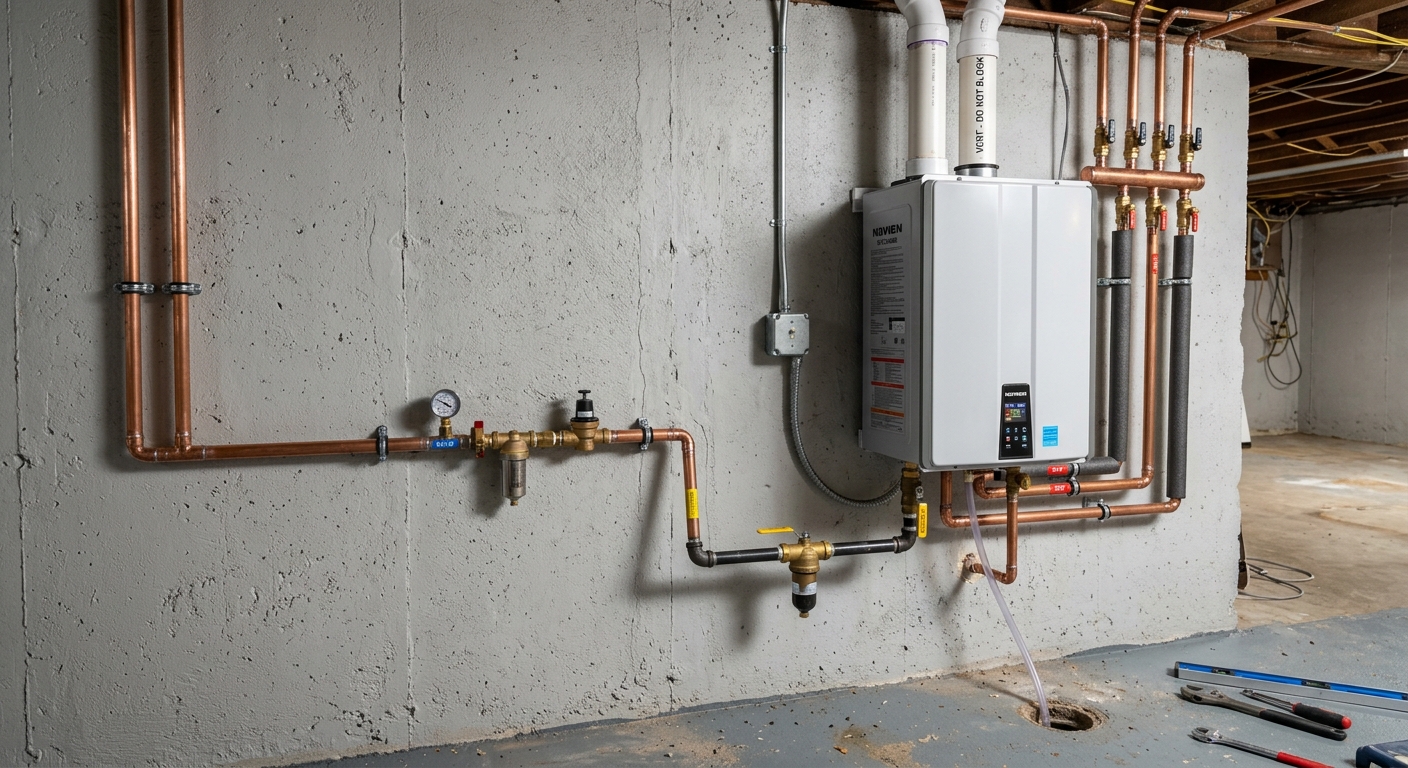
Water heaters are a significant cost in North Lebanon homes, whether it’s a planned upgrade or a rush replacement after a failure. Your main choices are traditional tank, tankless (on-demand), and heat pump (hybrid) water heaters. A gas or electric tank remains the cheapest to install, but expect it to last only 8–15 years and lose heat when idle (standby losses). A tankless water heater provides endless hot water, but the upfront cost is higher. Gas tankless models often require upsized gas piping and a new vent to meet code—costs that surprise many on older North Lebanon homes with small gas lines.
Heat pump water heaters are the most efficient, saving money long-term, but they require a large air volume (best in an unfinished basement or utility room) and can make the area cooler and louder. If your basement is finished or storage is tight, they may not be practical. Sizing is best done by first-hour rating rather than just tank size—how much hot water you get at peak demand, not just what fits in the tank. Don’t skip an expansion tank, especially on city water, and always put your heater in a pan with a proper drain. Most failures are tank corrosion, not controls, so it’s the vessel itself that counts.
| Type |
Installed cost |
Service life |
Operating cost |
Best when |
| Gas tank, 40–50 gal |
$1,200–$2,700 |
8–12 yrs |
moderate |
Existing gas service, moderate hot water needs |
| Electric tank, 40–50 gal |
$1,200–$1,850 |
10–15 yrs |
high |
No gas available, easy like-for-like swap |
| Gas tankless |
$1,850–$2,700 |
18–25 yrs |
low-moderate |
Endless hot water needed, budget for install upgrades |
| Heat pump water heater |
$1,850–$2,700 |
13–15 yrs |
lowest |
Large utility space, want to lower electric bill |
Verifying a North Lebanon plumber's credentials
In Pennsylvania, plumbing contractors are not licensed at the state level except in Philadelphia and Pittsburgh—everywhere else, licensing is municipal. That means a plumber can be fully qualified in one city and have no credential across the township line. When looking for a plumber in North Lebanon or Lebanon city, don’t just ask “are you licensed?” Instead, ask “are you authorized to work in this municipality?” If the job involves more than $500, the contractor must hold a Pennsylvania Home Improvement Contractor (HIC) registration, which you can verify at hic.attorneygeneral.gov.
Code enforcement in Lebanon County—including North Lebanon Township—runs through the Lebanon County Planning Department for many smaller municipalities, and all work subject to the Pennsylvania Uniform Construction Code must be inspected either locally or, if opted out, by the state Department of Labor & Industry. Plumbing work inside a home typically requires a permit if it involves new piping, water heaters, or involves health and safety. You should always receive a written contract for jobs over $500, with a three business-day right to cancel under state law.
For insurance, require documentation of current general liability as well as a workers’ compensation certificate—verifiable through WCAIS at wcais.pa.gov. This is essential to protect your property and avoid liability if anyone is injured on the job.
Frozen pipes in North Lebanon: prevention and thaw
Winters in North Lebanon bring a ground frost depth of 30 inches and a winter design temperature of 12°F—enough to freeze unprotected pipes during cold spells, especially with pronounced freeze-thaw cycles. Pipes burst when water freezes and expands, but the rupture point is usually between the ice blockage and a closed faucet; pressure builds dramatically as more ice forms, often breaking pipe wall or joints away from where the freeze actually started. This surprise means the entire affected run needs checking, not just the easy-to-see spot.
Common danger zones in Lebanon County include plumbing runs in uninsulated exterior walls, crawlspaces, garages, hose bibs, and poorly insulated attics. The lowest-cost protection is shutting off and draining exterior hose bibs in the fall—a step every homeowner should take before the first hard freeze. Interior pipe protection starts with pipe insulation in exposed or unheated spaces, followed by heat tape for persistent risks. During extreme cold, letting a faucet trickle (particularly at the farthest run) keeps water moving, while opening cabinet doors under sinks increases warm air flow.
If pipes freeze, use a hair dryer, heat gun, or a hot towel to thaw—never an open flame, as this risks fire or pipe damage. Preventing a frozen pipe is much cheaper than the $600–$1,200 price you could pay for an emergency burst pipe repair in North Lebanon.
How to find a good plumber in North Lebanon
Finding a reliable plumber in North Lebanon starts with verifying credentials—both registration and insurance. Because plumbing licensing is handled municipally, make sure the contractor is authorized to pull permits in your specific municipality, not just in the region. Check the contractor’s HIC registration for any job over $500 at hic.attorneygeneral.gov, and request a copy of workers’ compensation status through WCAIS (wcais.pa.gov). Demand a certificate of insurance listing your property by address. Ask if the plumber’s own crew is doing the work, or if they use subcontractors—this affects both accountability and response time for emergency work.
Understand up front how emergency dispatch and after-hours pricing works and confirm in writing. In Lebanon County’s moderate suburban–rural market, lower contractor density means travel surcharges are common; you should know about these before the job starts. Always demand documentation—especially for big-ticket repairs. No North Lebanon homeowner should agree to a repipe or sewer excavation based solely on a verbal diagnosis, without camera footage or a pressure test to justify it.
- Check HIC registration at hic.attorneygeneral.gov
- Ask if municipal permit is required and who inspects
- Verify municipal authorization to pull plumbing permits
- Require proof of insurance listing your address
- Confirm current workers’ compensation (wcais.pa.gov)
- Request written contract for jobs over $500
- Ask about use of subcontractors vs. in-house crews
- Clarify emergency pricing and response time
- Get camera footage for sewer jobs, not just a “test”
- Avoid high-pressure, same-day repiping quotes
- Beware “waived” insurance deductibles (it’s not legal)
- Check reputation with neighbors and local references
Red flags: any plumber who won’t provide permit documentation or insurance, who pushes for costly work without evidence, or who hesitates to provide camera or pressure-test results—especially for repipe or sewer repairs in this market, where unnecessary replacements still happen.
Frequently asked questions — plumbing in North Lebanon
What does repiping a house cost in North Lebanon?
A full whole-house repipe in North Lebanon typically ranges from $3,400–$8,300, depending largely on home size, accessibility, and the type of pipe materials chosen—copper runs higher, while PEX is generally more affordable. Most homes here built before 1980 have galvanized steel or aging copper, and in Lebanon city especially, old pipework can slow down water flow or develop pinhole leaks. Accessibility—finished basements, number of stories, and attic runs—move the price point most. If you’re planning bathroom or kitchen renovations, it’s often most practical to update plumbing at the same time, since walls are open anyway. Unless your pipework is badly rusted or leaking throughout, you usually don’t need a full repipe—often just the visible branch lines or the most aged runs. Ask for camera or pressure test evidence before committing to a large job.
What does emergency plumbing cost in North Lebanon?
Emergency plumbing in North Lebanon, such as a burst pipe or leak that needs immediate service, typically costs $600–$1,200 for the most common callouts. Emergency fees make up a big chunk of this, as plumbers here regularly charge more for after-hours, night, or weekend dispatch—especially during freezing conditions when calls spike. The faster the service, the higher the price may go within that range. If water is still running but contained (like a slow leak under a sink), you can often save by waiting for a standard appointment. Always ask the plumber to confirm emergency rates—including travel surcharges—up front, as these are common in Lebanon County's lower-density market.
Is a tankless water heater worth it in North Lebanon?
For many North Lebanon homeowners, a tankless water heater only pays off if your household uses a lot of hot water or you regularly run out during showers or laundry. Installation costs range from $1,850–$2,700, a step up from a standard gas or electric tank model. In older homes, the required upgrades—such as upsized gas lines or direct venting—can push costs higher. The energy savings aren’t huge unless your old tank was in tough shape, but you will get endless hot water and a longer service life (18–25 years). On a strict budget or in a smaller household, a standard tank heater is still more cost-effective. Only upgrade if you’re certain you need on-demand hot water and can handle the up-front installation work.
Are tree roots a common sewer problem in North Lebanon?
Yes, particularly in older North Lebanon homes with original clay tile sewer laterals. The clay pipes installed before the 1980s tend to crack at joints, providing easy access for tree roots that seek out moisture. These roots can crush, misalign, or completely block a sewer pipe. When this happens, you may face repairs from $1,950–$12,000 for spot excavation or trenchless relining. Regular drain cleaning can clear roots temporarily, but once blockage or pipe damage is confirmed by a camera inspection, replacement is the only real solution. Newer homes with PVC laterals have far less risk, but for the many Lebanon city and township households built mid-century, roots are a fact of life.
How do I tell what my pipes are made of?
In North Lebanon, it’s usually possible to check pipe materials at exposed locations—such as under sinks, in basements, or near the main shutoff. Galvanized steel feels heavy, is magnetic, and has threaded joints, while copper is reddish and joined by solder. Gray-blue plastic is likely polybutylene, while white or cream is PEX or PVC. Many homes in North Lebanon still have original galvanized supply lines behind walls, especially if built before 1980. If you’re unsure, have a reputable plumber inspect and test water flow at fixtures—old galvanized can close up silently over the years. If you discover significant corrosion or leaks, prepare for costs ranging from localized repairs (a few hundred dollars) to full repiping at $3,400–$8,300.
Who inspects plumbing work in North Lebanon?
In most of North Lebanon, plumbing inspections are overseen by the Lebanon County Planning Department when a permit is needed. They enforce the Pennsylvania Uniform Construction Code (UCC), based on the IRC. If a plumbing permit is pulled for new piping, water heater replacement, or major alterations, an authorized code official will inspect the work before walls are closed or systems are put back in service. In smaller outlying municipalities, building code enforcement may refer to county-level inspectors or, in rare cases, the state Department of Labor & Industry if the township has opted out. Always confirm with your plumber that the required permit is in place—most jobs over $500 should have written documentation for your records.
Should I wait until business hours to call?
If water is pouring from a broken pipe or you have a total sewer backup in North Lebanon, don’t wait—after-hours emergency rates apply, but water damage and sewage are far costlier if you delay. For less urgent issues, like a slow drain or a faint leak under a sink, you can usually wait until regular business hours and save significant money, since emergency callouts typically cost $600–$1,200. Always shut off your home’s main water valve if a leak starts, and never let water keep flowing while you wait. For non-emergencies, ask if a next-day or scheduled appointment is available—you’ll get the same repair at a lower rate.
Does insurance cover a burst pipe in North Lebanon?
Most standard homeowner insurance policies in North Lebanon do cover sudden and accidental water damage from a burst pipe, but not from gradual or neglected leaks. You’ll usually need to pay your deductible (which cannot legally be waived by the contractor), and coverage often excludes the cost to repair the pipe itself—focusing instead on restoring damaged walls and floors. Emergency repairs generally cost $600–$1,200, depending on the extent and location of damage. Always check your own policy and call your agent promptly to document the issue; most insurers require immediate mitigation (like shutting off the main valve) to keep coverage valid.
Do I need to drain outdoor spigots in North Lebanon?
Yes, in North Lebanon’s climate—with a 30-inch frost depth and winter design temperature of 12°F—it’s essential to drain and shut off outdoor spigots before the first hard freeze each fall. This simple step prevents the trapped water in exterior hose bibs and supply lines from freezing and bursting behind the wall, which leads to leaks and water damage inside. Even newer frost-proof sillcocks benefit from shutting off the inside valve and letting the line drain fully. The cost to repair a burst line from freezing can reach $600–$1,200 or more, depending on wall access and water damage. Spending 15 minutes every fall to drain your spigots is worth it compared to a midwinter emergency call.