East Norriton plumbing prices by job type — 2026
East Norriton’s 1950s–1970s housing stock dominates the local landscape, with more than 65% of homes built before 1980 (U.S. Census Bureau, ACS 2024). This era’s supply lines and drain pipes can dictate what work is common—and what it costs. With a high homeownership rate (71.7%) and most houses built in a boom of suburban expansion, plumbing repairs here often mean responding to original pipes reaching the end of their life, or water heaters failing after decades of service.
In East Norriton, whether your pipes burst at 2 p.m. or 2 a.m. will swing the price. The emergency rate covers after-hours or rapid-response work where damage is ongoing, while the standard rate applies when you can plan for the job. For all repairs, access matters: a line behind finished basement walls or under a kitchen slab will cost more.
| Service |
Scope |
Emergency rate |
Standard rate |
| Emergency repair — burst pipe |
locate, open, repair section, restore service |
$650–$1,300 |
$375–$1,300 |
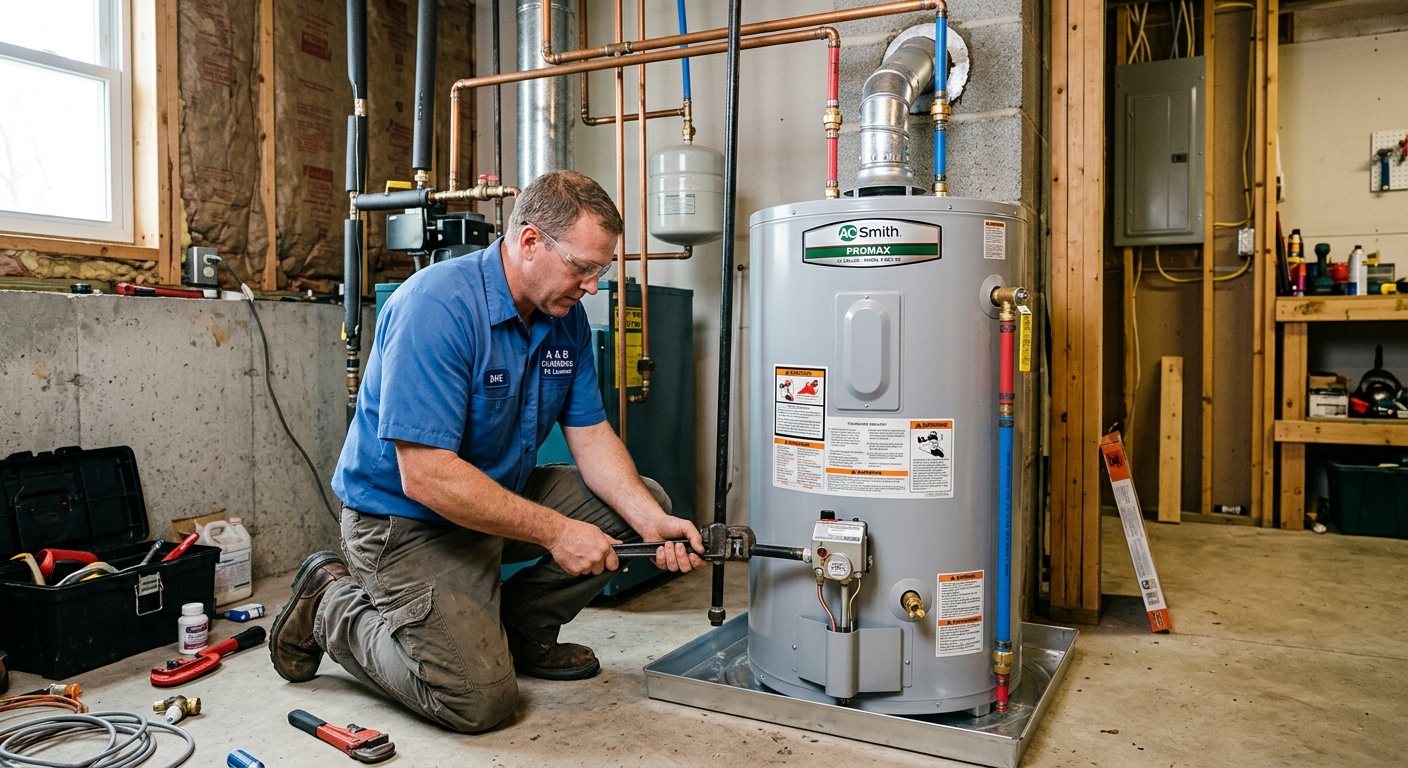
| Water heater replacement (gas, 40–50 gal) |
remove old, install, test, haul away |
$2,000–$3,000 |
$1,300–$3,000 |
| Drain cleaning — main line |
augering or hydro-jet, camera if needed |
$350–$800 |
$200–$500 |
| Sewer line spot repair |
excavate or reline a failed section |
$2,100–$13,000 |
$2,100–$13,000 |
| Whole-house repipe |
replace supply lines throughout, patch and finish |
— |
$3,800–$9,100 |
| Water service line replacement |
street to house, excavation and restoration |
— |
$5,900–$13,000 |
Estimates for a typical East Norriton home. Access difficulty and pipe material move these figures more than anything else.
Frozen pipes in East Norriton: prevention and thaw
East Norriton’s winters see the thermometer dip to 14 °F on design days, and the frost reaches 30 inches deep—not as harsh as some parts of Pennsylvania, but enough to burst pipes when a freeze strikes. Even moderate freeze-thaw cycles, combined with humid summer swelling and older pipe routing in 1950s–1970s homes, mean one cold night can do a lot of damage.
Most pipes that freeze won’t burst at the ice blockage itself but somewhere between the block and a closed faucet, where pressure rises as ice expands. When thaw comes, that’s where the leak sprays—often behind a kitchen wall, in an unheated crawlspace, or just beyond your hose bib. Garages, attics, and uninsulated basements are especially vulnerable in this area.
Prevention starts with the basics: insulate any exposed water line, especially in exterior walls or crawlspaces; use heat tape where insulation alone isn’t enough. Before the first hard freeze, always shut off and drain outdoor spigots. During a serious cold snap, open cabinet doors to let warm air circulate and let a faucet trickle overnight. These steps take less effort than dealing with a burst in the middle of January.
If a freeze does hit, thaw pipes with gentle heat—think a hair dryer or heating pad, never an open flame. Open the faucet on the affected line; thaw TOWARD the closed tap. Using a torch or flame is a quick way to create a bigger disaster, including fire.
Responding after the fact almost always lands in the emergency price band: a burst pipe repair here typically runs $650–$1,300, with more if walls or cabinets need opening. A roll of insulation is cheap; a restoration crew is not.
Vetting a plumber in Montgomery County
In Montgomery County, you want to confirm that any plumber you hire is properly registered, insured, and legally allowed to work in your particular municipality. Plumbing isn’t licensed statewide in Pennsylvania—instead, it’s up to each town or borough, so a company licensed in another city may have no credential in East Norriton. Always ask: are you allowed to pull permits and work here?
Start by confirming a contractor’s Home Improvement Contractor (HIC) registration with the Pennsylvania Office of Attorney General; every job over $500 needs it, and you can check at hic.attorneygeneral.gov. Make sure workers' compensation is in place and lists your property, which you can verify through WCAIS. For pre-1978 houses, check certification under the EPA Lead RRP Rule—Montgomery County is full of these homes.
Ask if crews are employees or subs, and see what emergency dispatch fees look like for nights or weekends. Short travel times in the suburban market mean you have a choice—don’t rush just because someone answers the phone first.
- HIC registration valid and listed at hic.attorneygeneral.gov
- Insurance certificate with your address as additional insured
- Current workers’ comp policy—check at WCAIS
- Verified ability to pull a plumbing permit in your municipality
- EPA Lead RRP certification for homes built before 1978
- Clear description of after-hours/emergency rates
- Written contract for jobs over $500 (required by law)
- Diagnostic fee and whether it credits toward repair
- Scope of work detailed, not just a price
- Warranty terms for both labor and parts
- Camera footage before any sewer or repipe quote
- Proof that crew doing work matches company listed
If someone quotes you a multi-thousand-dollar repipe or sewer replacement with no camera footage or test—pass. In a crowded contractor market like this, you can afford to be selective. Beware of high-pressure sales, lack of documentation, or “specials” for work you didn’t ask for.
Detection methods and what they cost
Start with a free leak test every East Norriton homeowner can do: close every faucet and appliance, then check your water meter. If the dial keeps moving and no water is in use, you’re losing water somewhere on the supply side.
Professional leak detection gets more specialized, especially in older houses where pipes may run beneath slabs or inside finished walls. Acoustic listening devices amplify the sound of escaping water, and are a staple for pinpointing supply leaks behind drywall or under floors. Thermal imaging cameras help find subtle “cold spots” which can mark a hidden leak in a wall or ceiling. For really challenging jobs—like a line under the concrete slab—plumbers may use tracer gas that escapes through the smallest crack and is detected with a sensitive probe.
Most line locating and leak detection jobs in East Norriton fall between $375–$1,300 depending on the time and tools required. The simple meter test costs you nothing. Professional acoustic and thermal imaging is typically in the lower end, while slab leak locating and tracing underground lines pushes the price higher.
A plumber asking to open walls or floors before attempting these detections is skipping steps. Pinpoint the leak first, then open only what you must. This saves you on patching and paint later.
Who is allowed to do plumbing work in Pennsylvania
Plumbing in Pennsylvania does not have a statewide license. Instead, each municipality can issue and enforce its own rules around who can legally work on your pipes. That means a plumber allowed to work in Norristown might not be cleared for East Norriton or Lower Merion—so always ask if your contractor can pull a permit here, not just anywhere.
Permits matter in Montgomery County. Any plumbing alteration, repipe, water heater, or new/revised water, sewer, or venting line needs a permit from your specific township or borough. For simple, like-for-like fixture swaps where the piping isn’t touched, no permit is required. Always confirm with your local office before work starts, as these rules can vary block by block.
Your inspector is from the township or, in some cases, a central authority if your municipality opted out. Ask to see proof of insurance—and make sure it names your address—and current workers’ compensation from WCAIS. Confirm the contractor’s Home Improvement Contractor (HIC) registration from the Attorney General’s database for jobs over $500, and check EPA Lead RRP credentials if your home predates 1978.
Never assume “licensed and insured” means valid for your address; the law in Montgomery County is specific and local.
What a plumbing quote should contain
In East Norriton, most plumbers work two ways: flat rate or time-and-materials. Flat rate means you see the whole price up front, with the contractor’s risk included if the job is more complex. Time-and-materials can be cheaper for quick fixes but grows if complications surface, especially in unpredictable old piping.
Always ask about diagnostic or “trip” fees and whether they credit toward the repair. The quote should spell out what areas are opened and what’s restored—if drywall, floors, or tiles need patching, is that work included or do you call someone else? It should list whether permits are part of the price and describe the warranty separately for labor and parts. “After-hours” rates, if they apply, need to be out in the open; in this market, there’s no reason not to know before the bill arrives.
| Line item |
What to look for |
Red flag if… |
| Billing model |
flat rate or hourly, stated up front |
unstated |
| Diagnostic fee |
amount, and whether it credits |
vague |
| Scope |
what is opened, repaired and restored |
price with no scope |
| Restoration |
drywall and finish explicitly in or out |
silent |
| Permit |
included and priced |
'not needed' |
| Parts |
brand and model for fixtures |
'standard fixture' |
| Warranty |
labour period stated separately |
parts only |
Camera inspection, relining and replacement
In East Norriton, as in most of Pennsylvania, you as the homeowner own the sewer lateral from the house all the way to the main—often reaching under your lawn, driveway, or even beneath the street. This is the number one source of surprise for many: blockages, bellies, or collapsed lines are your problem up to where the municipal line begins.
Pay attention to changes: one slow drain hints at a local issue, but when the lowest toilet backs up or multiple fixtures slow at once, the main sewer line is likely affected. Gurgling and foul smells aren’t just an annoyance—they warn of a deep blockage. In these older suburban homes, the pipe from house to street is frequently original, often clay tile or cast iron, which means root intrusion, misaligned joints (“offsets”), and sags (“bellies”) are common failure points.
Never accept a sewer excavation or replacement quote without first reviewing a camera inspection. The right plumber will run a video scope from your cleanout, showing the exact problem—root clump, offset, or collapse. Some issues can be fixed by spot-lining (relining a single section), others may require open-cut excavation or a full trenchless reline.
Norristown is served by municipal sewer; septic systems here are rare but do exist in the surrounding townships. For septic, tank pumping (typically every 2–3 years) and drainfield failure are entirely different headaches—“sewer backup” might mean a failed field, not a broken pipe.
For a sewer line spot repair in East Norriton, you’re looking at $2,100–$13,000 depending on depth, length, and whether the repair is in the yard or the street. Insist on seeing the footage—your wallet will thank you.
Frequently asked questions — plumbing in East Norriton
How long should a water heater last in East Norriton?
In East Norriton, most tank-style water heaters—especially gas 40–50 gallon models—last between 8–12 years. The exact lifespan depends on the mineral content of our water (East Norriton's water comes from Aqua Pennsylvania), how often you flush the tank, and whether the anode rod is inspected or replaced. In houses built in the 1950s–1970s, original water lines can accelerate heater replacement when corrosion develops. If your unit is approaching the 10-year mark and performance drops, or if you see rusty water, it’s smart to start budgeting or planning. Replacement typically runs $1,300–$3,000 in this area, all-in. Sometimes a failing water heater will show a slow leak or water under the tank—if so, budget for a replacement rather than repair, as most tanks aren’t worth patching by this age.
How much does sewer line repair cost in East Norriton?
For East Norriton homeowners, a spot sewer line repair—such as relining or replacing a failed section—runs from $2,100–$13,000 depending on the location and length. Shallow yard repairs are at the low end, while under-the-street or deep digs push costs higher. Keep in mind most homes here, built from the 1950s–1970s, still have original lateral lines, commonly clay tile or cast iron. Problems like root intrusion or a collapsed pipe are not rare in these older suburbs. Always demand a camera inspection before any quote, and get a copy of the footage, as repairs in East Norriton require permit approval and could impact your resale disclosure if not documented properly.
Do I need a permit for plumbing work in East Norriton?
Yes—East Norriton requires permits for most plumbing work beyond simple, like-for-like fixture swaps. If you’re having a water heater installed, a repipe, or new water, sewer, or vent lines added or altered, a permit is mandatory. The township or local municipality handles enforcement; inspection follows completion. If your job is under $500 and doesn’t alter the piping, you may not need a permit or contract. Always verify your contractor can pull a permit in East Norriton itself—not just “near” by being registered elsewhere. For a typical water heater replacement, expect to see permits and a written scope of work at a cost between $1,300–$3,000.
Am I responsible for the water line under the street?
In East Norriton, you are typically responsible for the water service line from the house all the way to the water main, even under sidewalks or the street until the municipal shutoff, which is consistent with most suburbs in Montgomery County. When a leak develops far from the house, your repair bill can be substantial due to the need to excavate and restore. Water service line replacement here, from the foundation to the curb or shutoff at the street, falls between $5,900–$13,000. Aqua Pennsylvania maintains the main line, but the lateral is yours. Always confirm the service limits with the water utility and township before starting work.
What counts as a plumbing emergency?
In East Norriton, a true plumbing emergency is any situation where water is actively leaking, flooding, or causing immediate property damage—burst pipes, sewage backups, and water heater ruptures qualify. Loss of all water service, or any leak near electrical panels or main shutoffs, is also urgent. If you smell gas near a water heater or hear water hissing where it shouldn’t, treat it as an emergency. Most emergency repairs—including burst pipes—fall in the $650–$1,300 band here due to urgent labor and after-hours rates. If you’re not sure, shut the main water valve and call a local plumber; don’t wait for visible damage.
Repair or replace a leaking water heater?
In East Norriton, this call often depends on the age of your heater and location of the leak. A leak around fittings, valves, or the drain can sometimes be repaired for less than a full replacement—but if the tank itself is leaking, or there’s water pooling at the bottom, it usually means internal rust-through. In most local homes, especially with the high mineral content in older pipes, replacement is the smarter and safer route. Typical replacement costs here are $1,300–$3,000. A patch or repair is rarely cost-effective if your unit is 8 years or older, as more problems aren’t far behind.
Is East Norriton on combined sewers or septic?
East Norriton itself is served by municipal sewer—so you do not need to worry about combined (storm + sanitary) sewers as some older cities have. True septic systems are rare within town boundaries but still present in outlying pockets of Montgomery County. If you have a septic system, regular pumping (not repair) is your main recurring cost, and slow drains may not be a pipe issue at all. For a sewer backup in East Norriton, assume it’s a main line problem first; spot repair here typically runs $2,100–$13,000 if the issue turns out to be with the lateral itself.
What does drain cleaning cost in East Norriton?
In East Norriton, main line drain cleaning typically ranges from $200–$500 for a routine call using an auger or hydro-jet, and up to $350–$800 if you need emergency, after-hours, or major root removal. The cost is driven by whether a camera is run after clearing—if you have repeat clogs in a 1950s–1970s house, it’s worth the extra camera inspection. Most tasks are finished in one visit here, but severe or recurring blockages mean you should rule out bigger problems like broken lines or sagging pipes.
Do I need to drain outdoor spigots in East Norriton?
Yes—draining outdoor spigots every fall is crucial around East Norriton, given our frost depth of 30 inches and the temperature drops into the teens in deep winter. Even frost-free hose bibs can freeze and rupture if the supply line wasn’t installed with a slope or fully drained. Shutting off the interior valve and opening the outdoor faucet before the first hard freeze prevents most burst-pipe calls, which run $650–$1,300 here if you miss this step. Many homes from the 1950s–1970s in East Norriton were built before today’s best practices—so don’t skip this annual chore.