Franklin plumbing prices by job type — 2026
Franklin, with its population of 6,964 and a homeownership rate above 70% (U.S. Census Bureau, ACS 2024), sees plumbing costs shaped by both demand and the age of its housing. More than half of the homes in Greene County, including Franklin, were built before 1980, and a large share date all the way back to 1900–1940. In plumbing, the construction era predicts the pipe material—whether it’s old galvanized, copper, or newer PEX—and that, more than anything, predicts what’s most likely to go wrong and what it will cost you.
Every plumbing job in Franklin carries two prices: an emergency rate—when you need help immediately to stop damage—and a standard rate for jobs you can schedule. Emergency calls for burst pipes or water leaks, for example, always cost more, not just for quicker response but often for night or weekend labor.
Homes built before 1940 often face repeated leaks in old galvanized supply lines, pushing repairs toward full or partial repiping. In these cases, material swaps to copper or PEX are common, and that can be one of the larger investments in an older Franklin home. Drain cleaning and water heater replacements also cost more when rushed as emergencies, but scheduled jobs can be managed for less, and you can avoid pricey travel surcharges often added by contractors from the Pittsburgh area.
| Service |
Scope |
Emergency rate |
Standard rate |
| Emergency repair — burst pipe |
locate, open, repair section, restore service |
$600–$1,150 |
$350–$1,150 |
| Water heater replacement (gas, 40–50 gal) |
remove old, install, test, haul away |
$1,850–$2,700 |
$1,150–$2,700 |
| Drain cleaning — main line |
augering or hydro-jet, camera if needed |
$350–$800 |
$200–$500 |
| Sewer line spot repair |
excavate or reline a failed section |
$1,950–$11,500 |
$1,950–$11,500 |
| Whole-house repipe |
replace supply lines throughout, patch and finish |
— |
$3,400–$8,200 |
| Water service line replacement |
street to house, excavation and restoration |
— |
$5,300–$11,500 |
Estimates for a typical Franklin home. Access difficulty and pipe material move these figures more than anything else.
The point where patching stops making sense
If you’ve needed two or more repairs for supply pipe leaks in the last three years in your Franklin home, especially on the same run or material, it’s rarely just bad luck—it’s the start of a pattern. Old galvanized pipes, common in homes built 1900–1940 in Greene County, corrode from the inside and will turn into a carousel of pinhole leaks, poor pressure, or bursts. Where plumbing is concerned, the era of your house often tells you what will go wrong next.
Watch for falling water pressure across your whole house (not just one fixture), rusty or brown water on the first draw of the day, or visible corrosion at exposed joints. These all signal that you’re chasing the clock, not saving money, by patching leak after leak. If you spot recurring pinholes or get two or more leaks within a few years, partial or full repiping is the real solution.
Copper and PEX are both solid choices for repiping. Copper lasts longest and stays reliable even in unheated crawlspaces, but it’s the priciest. PEX flexes around obstacles and reduces the need for wall demolition. Still, many homeowners forget the bill for patching old plaster or drywall after the plumbing is done. In Franklin’s older homes, repairing plaster can rival the plumbing cost itself—a real consideration if you want the finished job to look right again.
| Situation |
Recommendation |
Cost |
Reasoning |
| One leak, accessible, modern pipe |
Spot repair |
$350–$1,150 |
Modern piping and a clear cause mean repair makes sense. |
| Two or more leaks in 3 years |
Partial repipe |
$3,400–$5,500 |
Pattern of failure emerging—spot repairs add up fast. |
| Galvanized supply, pressure loss |
Full repipe |
$3,400–$8,200 |
Galvanized restricts flow—reliability is gone. |
| Polybutylene anywhere in the house |
Full repipe |
$3,400–$8,200 |
Material known to fail—replacement is the only fix. |
| Cast iron drain with root intrusion |
Camera, then reline or replace |
$1,950–$11,500 |
Roots mean it’s compromised—need a full assessment. |
| Suspected lead service line |
Test, then replace the lateral |
$5,300–$11,500 |
Lead is a health risk—replacement is the only safe move. |
Choosing a water heater in Franklin
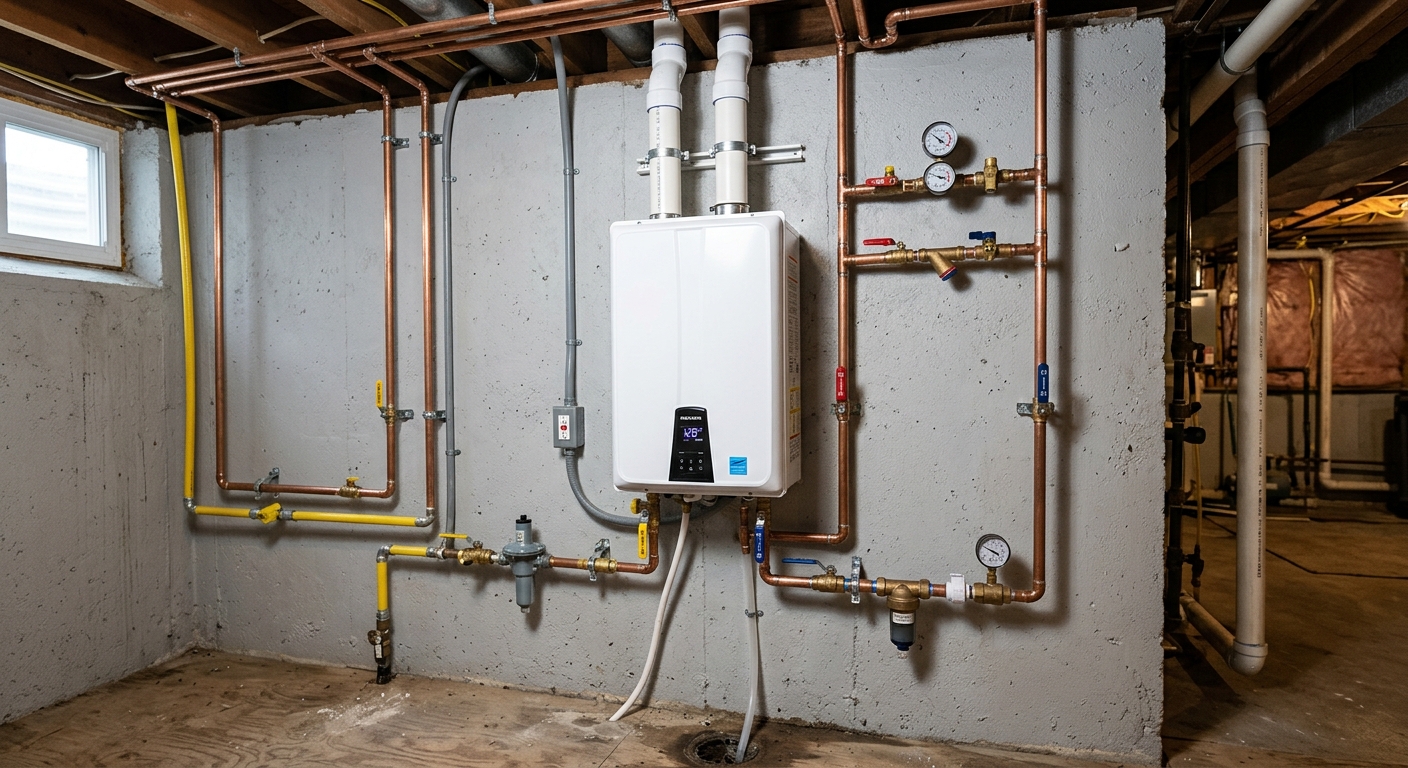
For Franklin homeowners, water heater choice is about more than price—it’s a blend of installation cost, lifespan, and what fits your house. Most homes are set up for either a 40 or 50-gallon gas or electric tank, which is the cheapest to install but has the shortest life and wastes heat even when you aren’t using hot water. Tankless gas models offer endless hot water and can last twice as long, but the install cost usually runs higher because many older homes—especially those built before 1980—need a bigger gas line and a proper vent, which can double your installation bill.
Heat pump water heaters are the most efficient option, but they need a big volume of warm air (not a cold crawl space), and they make noise—sometimes enough to matter if you have a finished basement. They’re best where your old water heater is already out in the open and you don’t mind the area getting a bit cooler.
Always size by first-hour rating, not just tank gallons, especially if multiple people shower in the mornings. Any new install should also include an expansion tank and a pan with a drain if you have finished space below. Don’t be shocked—when a water heater fails, it’s usually the tank rusting through, not the controls or thermostat.
| Type |
Installed cost |
Service life |
Operating cost |
Best when |
| Gas tank, 40–50 gal |
$1,150–$2,700 |
8–12 yrs |
moderate |
Existing gas with proper venting |
| Electric tank, 40–50 gal |
$1,150–$1,850 |
10–15 yrs |
high |
No gas service, simple replacement |
| Gas tankless |
$1,850–$2,700 |
18–25 yrs |
low-moderate |
Multiple users, willing to upgrade lines |
| Heat pump water heater |
$1,850–$2,700 |
13–15 yrs |
lowest |
Large, warm space and higher electric rates |
Sewer line problems in Franklin
In Franklin and the rest of Greene County, the general rule is that the homeowner owns the sewer lateral all the way from their house to the main—often including the section under the street. This can come as a shock, especially when a clog or collapse occurs far from the foundation and the repair cost is higher than most expect.
Symptoms of a trouble spot include one slow drain (often a local clog), multiple slow drains, gurgling from lower fixtures (hints at a blockage downstream), and backups at the lowest fixture on the main floor or basement. Before you accept any quote for sewer excavation or replacement, insist on seeing the video footage from a camera inspection—that’s the only way to confirm the real cause, whether it’s root intrusion through old clay tile pipes, a belly or sag where waste pools, or an offset joint from shifting ground.
Franklin Township and surrounding parts of Greene County have a mix of sewer and on-lot septic systems. If you’re on septic in Cumberland or Franklin, issues like slow drains and odors may have nothing to do with the lateral—you could just need your tank pumped (every 3–5 years is standard) or be facing a drainfield failure, which is a different repair entirely.
If your sewer line needs repair, always compare open-cut replacement (which tears up the yard but is sometimes the only fix for a collapsed line) with trenchless relining, which can preserve landscaping and hard surfaces. In Franklin’s hilly, clay-rich soil, either option comes with its own surprises—and costs.
Who is allowed to do plumbing work in Pennsylvania
Plumbing work in Pennsylvania is licensed at the municipal level—not by the state. That means a plumber can carry a license or credential in one city and have none in the next township. In Franklin and the rest of Greene County, there’s no countywide plumbing license, and it’s up to each municipality or borough to set their own requirements. For example, in Waynesburg Borough, permits are enforced for new or replacement interior plumbing piping, while smaller townships in Greene County may allow minor fixture repairs without a permit.
The key question to ask a plumber isn’t “are you licensed?” but “are you allowed to work here?” If your job is over $500—which includes almost every meaningful plumbing repair in Franklin—the contractor needs a Home Improvement Contractor (HIC) registration from the Pennsylvania Office of Attorney General. You can check this registration at hic.attorneygeneral.gov before signing a contract.
Insurance and workers’ compensation are also a must for any local employer—verify this through WCAIS at wcais.pa.gov. Larger jobs should include a written contract under the Home Improvement Consumer Protection Act, which also gives you a three business-day right to cancel. For work in homes built before 1978, ensure EPA Lead RRP rules are followed.
Comparing plumbing estimates in Franklin
When you get a plumbing quote in Franklin, you’ll usually see one of two billing models. Flat rate means you’ll know the total up front, but that price builds in the risk that something goes wrong—so you might pay a bit more for the certainty. Time-and-materials (hourly plus parts) can cost less on a straightforward job, but it leaves the final bill open if surprises pop up. The problem isn’t which model is used—it’s not knowing which you agreed to.
A proper estimate should clearly state whether a diagnostic fee applies and if it is credited against approved work. Scope is key: you want to see not just a price, but exactly what’s being repaired and what restoration (drywall, plaster, finish) is included. Permits, when needed, should be priced in. Parts should be listed by brand and model, not just “standard.” And make sure labor warranties and after-hours rates are spelled out, so you’re not hit with surprises down the line.
| Line item |
What to look for |
Red flag if… |
| Billing model |
flat rate or hourly, stated up front |
unstated |
| Diagnostic fee |
amount, and whether it credits |
vague |
| Scope |
what is opened, repaired and restored |
price with no scope |
| Restoration |
drywall and finish explicitly in or out |
silent |
| Permit |
included and priced |
'not needed' |
| Parts |
brand and model for fixtures |
'standard fixture' |
| Warranty |
labour period stated separately |
parts only |
Franklin's housing stock and its plumbing
Franklin’s housing stock shows its history right behind the wall. With 56.4% of homes built before 1980 and so many dating back as far as 1900, supply piping is often a patchwork—galvanized steel that’s been swapped piecemeal for copper or PEX as leaks appear. In homes that haven’t been fully repiped, you’ll often find odd transitions or sections of old pipe hiding in floors or behind walls. This also means you’re more likely to run into reduced water pressure, discolored water from corroding galvanized pipes, and supply lines that may contain lead at the main shutoff or water service.
On the drain side, older Franklin houses frequently have cast iron or clay tile waste lines. Clay tile, especially outside the foundation, is vulnerable to root intrusion from mature trees and may already have offsets or collapses from freeze-thaw cycles and shifting clay soil. Sewer laterals from this era are often the original, and issues sometimes become clear only when multiple fixtures back up.
Water heaters in these homes are almost never original—most are on their second or third replacement. For those in post-1980 houses, you’ll see more modern copper or PEX pipe runs, usually builder-grade fixtures, and occasionally polybutylene supply lines in homes from the late 1980s and early 1990s. Here, water heaters are more often near the end of their first service life.
Frequently asked questions — plumbing in Franklin
How do I shut off the water to my house?
In Franklin, almost every home will have a main shutoff valve on the supply line right after it enters the basement—or in a crawlspace if you have one. For homes built before 1940, these valves can be stiff or may not seal shut fully if they haven’t been exercised in years. Turn the wheel (or lever) clockwise to close it, and always check that the flow stops at a faucet. If you can’t find the inside shutoff or it’s stuck, look for the curb box near the street—Southwestern Pennsylvania Water Authority homes may require a special tool or a call to the utility. If you ever have a burst pipe and can’t stop the flow, an emergency repair call ranges from $600–$1,150 but can save a lot more in water damage.
Do I need to drain outdoor spigots in Franklin?
Absolutely—Franklin winters routinely dip below freezing and the local frost depth runs 36 inches. If you don’t drain and shut off outdoor faucets before the first hard freeze, trapped water can expand and burst the pipe inside the wall, leading to leaks hidden in finished basements or crawlspaces. In older Franklin homes, shutoff valves for outdoor spigots are usually inside, close to where the pipe exits. Always open the valve outdoors after shutting off the interior supply. Neglecting this simple chore could result in an emergency repair costing $350–$1,150 the next time winter breaks a pipe.
Who owns the sewer lateral, me or the city?
In Franklin and the broader Greene County area, the homeowner nearly always owns the sewer lateral all the way from the house to the main—including the section that runs under public sidewalks and even the street. This is a common source of misunderstanding: if you have a break or blockage outside your foundation, it’s still your responsibility to correct the problem, not the municipality’s. If you need a repair or replacement, costs in Franklin can reach $1,950–$11,500, depending on length and location, which is why many homeowners compare trenchless and open-cut methods closely before acting.
How much does sewer line repair cost in Franklin?
Sewer line spot repairs in Franklin typically fall within the $1,950–$11,500 range. The lower end is for shallow repairs near the house, while the top end covers deep excavations, relining, or repairs under paved areas or city streets. The most important step is always a camera inspection beforehand, as multiple slow drains or backups can have a range of causes. If you have a septic system instead of a municipal sewer connection (common in Franklin and Cumberland Townships), your costs and repair process are different, often starting with tank pumping or drainfield evaluation first.
Repair or replace a leaking water heater?
In Franklin, whether you repair or replace a water heater depends almost entirely on age and cause. For tank-style heaters, once you see rust or water leaking from the tank itself, replacement is the only real option—it can’t be reliably patched. If it’s just a bad valve or the thermostat, and the unit is less than 8 years old, a repair can be worthwhile. But with replacement costs between $1,150–$2,700, especially for gas or heat pump units, you’re often better off replacing a heater over 10 years old because a new unit brings better efficiency and a fresh warranty.
Do I need a permit for plumbing work in Franklin?
In Franklin Township and much of rural Greene County, permits are not usually required for minor fixture repairs in homes—but if you are replacing any interior plumbing piping in Waynesburg Borough, a borough building and plumbing permit is generally required. For larger jobs, always check with your local municipal office before hiring out work or starting a project. If your contract is over $500, state law also requires a Home Improvement Contractor (HIC) registration and a written contract. Plumbing projects like a whole-house repipe, which often run $3,400–$8,200, should always be fully permitted and inspected.
How hard is the water in Franklin?
Most Franklin homes on the Southwestern Pennsylvania Water Authority system have moderately hard water, though levels can fluctuate. Signs you have hard water include scale buildup on fixtures, cloudy spots on glassware, and premature failure of water heaters. While hardness won’t damage your pipes directly, it does shorten the life of appliances—tank water heaters in particular—meaning you may need replacement every 8–12 years (at $1,150–$2,700). If buildup is heavy, consider a softener, but check your specific supply before investing.
How do I tell what my pipes are made of?
To identify pipe material in your Franklin home, check exposed lines near the water heater, at the main shutoff, or unfinished basement runs. Galvanized steel feels heavy and is magnetic; copper is a reddish metal and joints are soldered; PEX is plastic and usually blue or red with crimped connections. If you see dull gray pipe, especially from the street, it might be lead—get it professionally tested. Knowing your pipe material matters for predicting problems: galvanized means possible restricted flow and corrosion, while PEX or copper means fewer worries. If you confirm galvanized or lead in the supply, replacement costs in Franklin run $3,400–$8,200 for a full repipe.
What does emergency plumbing cost in Franklin?
Emergency plumbing calls in Franklin cost more because of the fast response and after-hours labor often required. For a burst pipe, expect a total between $600–$1,150 for emergency repair—including finding the leak, cutting it out, patching, and restoring service. Water heater replacement on short notice (such as after a flood or tank rupture) will cost from $1,850–$2,700. Emergency rates can sometimes jump further if you need service nights or weekends, or if contractors apply a travel surcharge coming from outside Greene County—a common situation given the thin local contractor market.