Plumbing costs in Jefferson — 2026
Jefferson homeowners face plumbing costs shaped by the year their house was built and the material choices common at the time. In areas like Cranberry Township, the building boom from the 1990s to 2010s leaves most homes with modern PVC or PEX piping, large multi-bath layouts, and comparatively few legacy plumbing problems. By contrast, with 54.9% of Jefferson homes built before 1980 and a homeownership rate of 79.3% (U.S. Census Bureau, ACS 2024), older supply lines—often copper or even galvanized steel—dominate. When those older pipes go, repairs can be messy and expensive, especially when corrosion, scale, or in some neighborhoods, hidden lead fittings are found mid-job.
The biggest cost fork is whether the repair is an emergency. When a pipe bursts at night or a water heater starts leaking without warning, response fees, overtime, and urgent diagnostics quickly stack up. If you can schedule work in advance—even by turning off water at the main and living without hot water overnight—you avoid much of the premium. Emergency calls also move faster and less neatly: diagnosis, repairs, and cleanup all happen under time pressure, which sometimes drives up the cost or narrows your options for a proper fix.
Expect the range of charges below, depending whether you need a plumber now or can wait:
| Service |
Scope |
Emergency rate |
Standard rate |
| Emergency repair — burst pipe |
locate, open, repair section, restore service |
$600–$1,150 |
$350–$1,150 |
| Water heater replacement (gas, 40–50 gal) |
remove old, install, test, haul away |
$1,850–$2,700 |
$1,150–$2,700 |
| Drain cleaning — main line |
augering or hydro-jet, camera if needed |
$350–$800 |
$200–$500 |
| Sewer line spot repair |
excavate or reline a failed section |
$1,950–$11,500 |
$1,950–$11,500 |
| Whole-house repipe |
replace supply lines throughout, patch and finish |
— |
$3,400–$8,200 |
| Water service line replacement |
street to house, excavation and restoration |
— |
$5,300–$11,500 |
Estimates for a typical Jefferson home. Access difficulty and pipe material move these figures more than anything else.
What's in the water here
If you’re in Jefferson and get your water from Pennsylvania American Water’s Pittsburgh-area district, you have a public source that is required to publish an annual water quality report—always worth requesting or looking up if you have concerns about taste, odor, or safety. Public water here tends to be “moderately hard” thanks to the local geology, with enough mineral content to lay down visible scale inside water heaters and on faucets. Scale shortens the life of heating elements and appliances; flushing a tank yearly can help, but expect to replace water heaters more often than in truly soft water areas.
Aggressive water (low pH) is rarely an issue in Jefferson with treated supplies, so copper pinhole leaks aren’t as chronic as in parts of eastern Pennsylvania. If you’re considering a water softener, get your hardness tested first—many homes don’t need one, and the time to break even on salt and maintenance can be longer than just dealing with scale. Whole-house filters make sense for sediment or high chlorine taste, but $200 filters for routine city water are mostly oversold. If taste is your issue, a simple point-of-use carbon filter under your sink is usually enough.
For homes on private wells—which are more likely in the rural fringes of Butler County—no utility tests your water for you. You should have a basic annual test for bacteria, nitrate, and lead. Skip expensive equipment unless a lab finds something real and fixable.
Verifying a Jefferson plumber's credentials
Pennsylvania does not license plumbers at the state level. Each municipality sets its own requirements, meaning a plumber registered in Philadelphia or Butler City might hold no credential at all in Cranberry Township or Jefferson. In Butler County, the City of Butler keeps its own contractor registry for plumbers, but each township and borough can have different rules. Always ask: “Are you licensed for plumbing work here, in this municipality?”
For work over $500, Pennsylvania requires Home Improvement Contractor (HIC) registration, issued by the Office of Attorney General. You can easily verify a plumbing contractor’s HIC at hic.attorneygeneral.gov. For any job with employees on site, the company must also carry workers' compensation insurance, which you can check through the WCAIS system (wcais.pa.gov). Ask to see both certificates—current and naming their business—before work begins.
Permitting varies. In Cranberry Township, permits are mandatory for any new plumbing system installation or for adding to supply or drainage piping; the Cranberry Township Building Inspection Department handles inspection. In Butler City, simply swapping a faucet or toilet doesn’t usually require a permit if no pipes are being moved. Always make sure your contract specifies if the contractor is pulling required permits and scheduling inspections—a basic but often skipped step.
Comparing plumbing estimates in Jefferson
When you get a plumbing estimate in Jefferson, two billing methods dominate: flat rate, where you’re told the full price up front, and time-and-materials, where the clock and parts ticket decide what you pay. Flat rate protects you from surprises, but it’s built to cover the risk of difficult jobs—so you may pay a bit more for a simple fix. Time-and-materials can save on straightforward work, but gets expensive fast when troubleshooting drags on or parts are hard to reach. The main risk isn’t the model—it’s not knowing which you’re agreeing to ahead of time.
Expect a diagnostic fee for showing up and investigating; some plumbers credit this back against the work, others do not. Every quote should spell out the scope (what exactly is being cut into, replaced, and repaired), and whether wall, floor, or ceiling restoration is included. Always check if permit costs are included, since missing permits can mean failed inspections or fines. Labor warranties should be stated separately from parts, and you want parts brands/names—not just “standard faucet.” For after-hours emergencies, ask for rates to be disclosed before you agree to anything.
| Line item |
What to look for |
Red flag if… |
| Billing model |
flat rate or hourly, stated up front |
unstated |
| Diagnostic fee |
amount, and whether it credits |
vague |
| Scope |
what is opened, repaired and restored |
price with no scope |
| Restoration |
drywall and finish explicitly in or out |
silent |
| Permit |
included and priced |
'not needed' |
| Parts |
brand and model for fixtures |
'standard fixture' |
| Warranty |
labour period stated separately |
parts only |
Emergency rates versus scheduled work in Jefferson
How much you pay for plumbing in Jefferson comes down to speed. If you need someone out in the next hour or after dark—a flooded basement, total loss of water, or sewage pouring up a floor drain—you’ll pay an emergency premium. That rate covers after-hours dispatch, a trip charge, overtime pay, and the high-pressure diagnostic that might mean a partial fix now and a return visit for permanent work. Emergency repair of a burst pipe might run $600–$1,150, while the same repair scheduled for tomorrow can be as low as $350–$1,150 and never above.
Not every leak needs 24/7 service. A slow drip under a kitchen sink, one stubbornly slow drain, or a running toilet can almost always wait for business hours. True emergencies: water actively flooding the house, no water anywhere in the home (not just one bathroom), sewage backing up at the lowest fixture, or any kind of gas smell (natural gas leaks require a utility call, not just a plumber).
To keep costs down, every Jefferson homeowner should know where their main water shutoff is—usually a gate or ball valve near where the water line comes into the basement. Turn it clockwise to shut off the house. Toilets, sinks, and washing machines also have individual shutoff valves located on the supply lines. Shutting water off buys you time to schedule work, keep the repair bill reasonable, and prevents most avoidable water damage.
Choosing a water heater in Jefferson
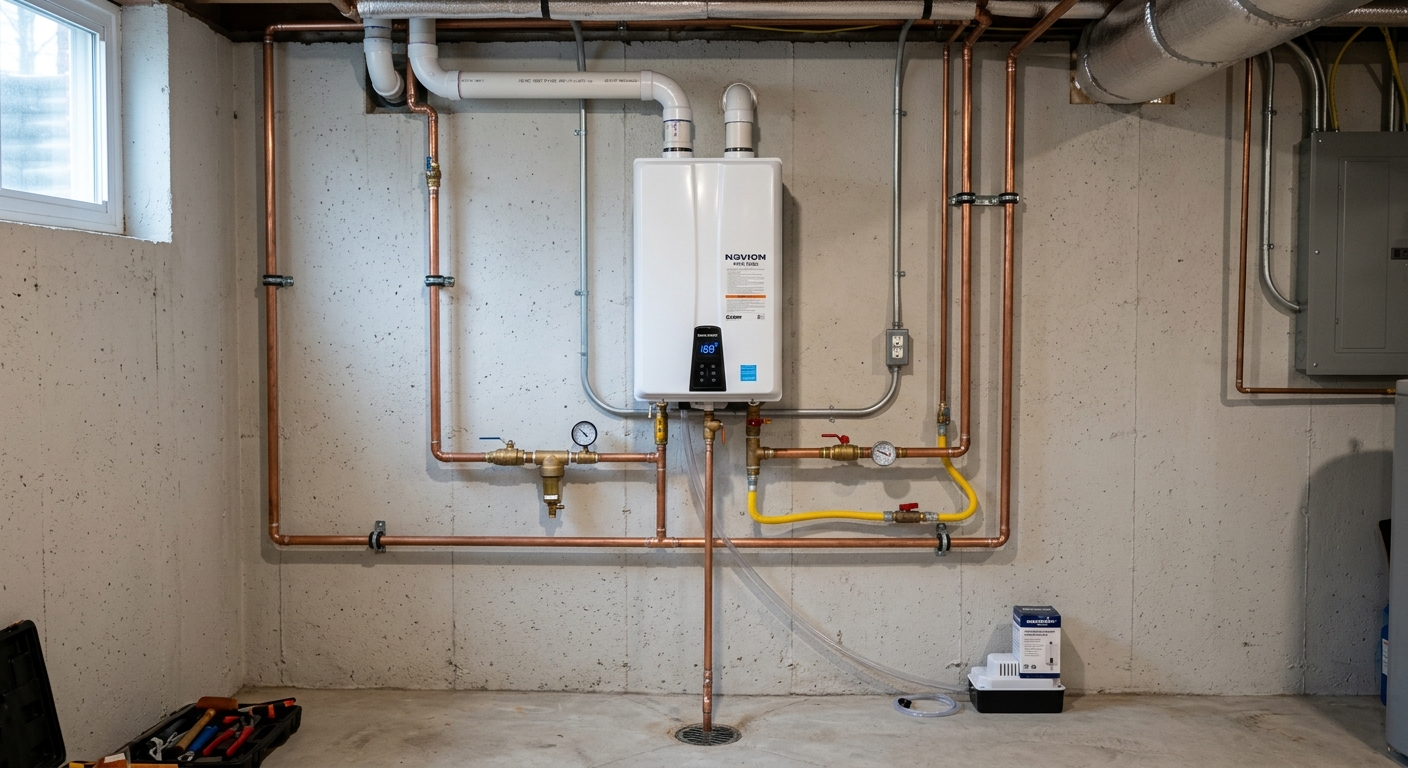
The right water heater for a Jefferson home comes down to how you use hot water and where you have space to put the unit. Most suburban homes built in the 1990s–2010s have gas lines run for tank heaters, but replacing with tankless or heat pump styles can mean upgrades you hadn’t budgeted for. Traditional tanks are cheapest to install and simplest to maintain. They last 8–12 years and lose some heat just sitting with hot water (standby losses). Most failures are from the tank rusting out, not the controls—catch leaks with a pan and drain if you have a finished basement.
Tankless gas heaters never run out of hot water and free up floor space. But install costs are higher, especially if you need a bigger gas line or a new vent (common here due to older flue setups), and annual descaling is a must with local hard water. Heat pump water heaters offer the lowest electric bills but need lots of open air and a relatively warm, unfinished basement or utility room. They’re noisy and discharge cold air, making them a bad match for many finished basements in Jefferson.
Sizing is by first-hour rating; a busy household with multiple simultaneous showers should make sure to check this number, not just the tank gallons. Expansion tanks and drain pans are code-required in some installs—never skip them. Upgrading just because the heater is old is rarely efficient—the tank leaking is the usual trigger for replacement.
| Type |
Installed cost |
Service life |
Operating cost |
Best when |
| Gas tank, 40–50 gal |
$1,150–$2,700 |
8–12 yrs |
moderate |
gas available, easy swap |
| Electric tank, 40–50 gal |
$1,150–$1,850 |
10–15 yrs |
high |
no gas, basic demand |
| Gas tankless |
$1,850–$2,700 |
18–25 yrs |
low-moderate |
constant use, small space |
| Heat pump water heater |
$1,850–$2,700 |
13–15 yrs |
lowest |
warm, unfinished basement |
Sewer line problems in Jefferson
In Jefferson, as in the rest of Butler County, you own the sewer lateral running from your house to the city main—even if the pipe goes under the sidewalk or street before connecting. Most problems don’t start as emergencies: if you notice one slow drain, monitor it; if multiple fixtures slow down together or you hear gurgling, trouble could be brewing in the main line. Sewage or gray water backing up at the lowest fixture signals an urgent blockage or even a failed line outside.
A reputable plumber will always perform a camera inspection to confirm the problem before quoting excavation or relining. Older lines here may be clay tile—especially in houses built before the 1980s—making them susceptible to root intrusion, shifting joints (“offsets”), and low spots (“bellies”) that catch debris. Spot repairs often involve open trenching. Trenchless relining is possible for straight, structurally sound sections and can be less disruptive.
In Cranberry Township and Butler City, houses connect to separate sanitary and storm sewers. Out in rural Butler County, many Jefferson houses still depend on a private septic system. For septic, routine tank pumping every 3–5 years keeps things running; drainfield failure is a different (and more expensive) problem than a clogged pipe. Whatever the source, never accept a sewer or drain excavation quote—you deserve to see the camera footage that justifies it.
Frequently asked questions — plumbing in Jefferson
What does repiping a house cost in Jefferson?
To repipe a whole house in Jefferson, expect a range of $3,400–$8,200. This covers removing old pipes—usually copper or galvanized in homes built before the 1980s—and replacing them with PEX or new copper. Most Jefferson homes are a mix of older builds (54.9% before 1980) and newer subdivisions with modern plumbing materials, so your exact price hinges on your home’s size and how walls are finished. PEX jobs go on the lower end, copper on the higher. This includes patching drywall and restoring finishes. For many older houses, repiping fixes pressure issues and hidden leaks for good, but it’s not needed unless there’s evidence of chronic leaks, discolored water, or corrosion.
Repair or replace a leaking water heater?
In Jefferson, most water heater failures stem from the tank rusting out. Repairs make sense only if the leak is from a fitting or the temperature/pressure relief valve—these are cheap repairs, often under $350–$1,150 depending on plumber minimums. If water is seeping from the base of the tank, replacement is the only fix. Most gas and electric tanks here last 8–12 years; if yours is older and leaking, especially in a finished basement, don’t waste money on repairs. Install costs for a new tank run $1,150–$2,700. Save yourself future headaches—replace the tank before it fails fully.
How hard is the water in Jefferson?
Water in Jefferson (from Pennsylvania American Water’s public supply) is considered moderately hard because of local limestone and shale. This leads to mineral buildup inside water heaters and on faucet aerators. That scale can shorten the life of water heaters and reduce fixture performance over time. While some homeowners add softeners to stop scale, the cost of adding and maintaining one often doesn’t pay back unless you’re dealing with clear signs of mineral buildup or sensitive appliances. In most cases, a tank flush or cleaning a faucet aerator does more for less than a $1,150–$2,700 system install.
Do I need a permit for plumbing work in Jefferson?
Permit requirements depend on where in Butler County you live. In Cranberry Township, you need a plumbing permit for any new system or if you’re adding piping—this covers things like bathroom additions or moving supply lines. The Cranberry Township Building Inspection Department checks the work. In Butler City, swapping out a fixture without touching pipes usually needs no permit. For projects over $500, always be sure your plumber is registered as a Home Improvement Contractor. Ask your plumber to handle the permit—if they say none is needed before checking your address, that’s a red flag.
How much does a water heater replacement cost in Jefferson?
In Jefferson, replacing a standard gas or electric tank water heater (40–50 gallons) costs $1,150–$2,700 installed. This includes removing the old tank, setting the new one, connecting piping and venting, and haul-away. Tankless and heat pump models are at the higher end—especially if extra venting or electrical upgrades are needed. The condition of your basement, how easy it is to reach the heater, and code-required extras (drain pans, expansion tanks) can shift the final number. Always ask for a full, written scope before work begins.
Who pays to replace a lead service line in Jefferson?
The homeowner is responsible for the water service line from the house to the street in Jefferson, just like the sewer lateral. If a lead service is found—a rare issue in Jefferson’s post-1990s subdivisions, but possible in homes built before the 1980s—you pay for replacement from the home’s wall out to where it meets the public main. The typical cost runs $5,300–$11,500 due to excavation and restoration. Some utilities offer partial reimbursement if they’re upgrading the public side, but you should always confirm before work begins.
Do I need to drain outdoor spigots in Jefferson?
Yes, you should drain and shut off outdoor spigots in Jefferson before winter. Southwestern PA gets multiple hard freezes (design temp 8°F, frost depth 36 in), and undrained hose bibs are a leading cause of burst pipes in the spring. If your house has a frost-free spigot, you still need to disconnect hoses. For traditional spigots, shut off the indoor valve, open the outside faucet to drain, and leave it open until spring. Even a minor flood from a burst pipe can result in $350–$1,150 in repairs—far more than a few minutes’ effort in the fall.
What do I do about a burst pipe right now?
If you discover a burst pipe in your Jefferson home, locate your main water shutoff valve—usually near where the pipe enters the basement—and turn it off clockwise right away. This stops additional water damage and buys valuable time. For most homeowners, stopping the flow converts an emergency to a semi-scheduled repair and can reduce the bill from $1,150 or more down to the standard $350–$1,150 range. Once water is off, open faucets to drain pressure, move valuables, and call a plumber. Only call after-hours service if you truly cannot go without water until the next business morning.
Is my water line lead?
In Jefferson, few water service lines are lead, especially in subdivisions built after 1990. But if your house was built before the late 1980s, it’s worth checking. Lead lines are soft, dull gray, and easily scratched with a key. Where visible (often near the meter or main shutoff), a magnet won’t stick. If your pipe matches this and your home’s age, consider a full replacement—a process that runs $5,300–$11,500. Pennsylvania American Water and the EPA also offer lookup tools for public side records. Remember, replacing only the public portion does not solve the problem; you are responsible for the home-to-street section.