What plumbers charge in West Hazleton
In West Hazleton, plumbing costs vary based on the urgency of your need. If you have an emergency like a burst pipe or an active leak, plumbers here rightly charge more for immediate response—especially given that many homes were built before 1980, and the older plumbing materials demand extra caution and time. With a homeownership rate of 65.5% and a high percentage of pre-1940 multifamily buildings, most jobs take longer and require more skill due to tight spaces and legacy galvanized or mixed piping. Construction era predicts not just the type of pipe in your walls but the odds of something failing—and what it’ll cost to set right.
The standard versus emergency rate matters—a planned water heater swap costs less than the same job if you’re ankle-deep in water on a Sunday night. Some services, like whole-house repiping, almost never trigger an “emergency rate”—but even routine fixes can turn urgent fast in a house with failing pipes or corroded connections. Access is often tight, and where you have original walls, restoring plaster or old lath adds cost above the basic plumbing work. Entry-level rates in the table below assume a straightforward job. Once you hit legacy galvanized, access sheets go up and so does your bill.
| Service |
Scope |
Emergency rate |
Standard rate |
| Emergency repair — burst pipe |
locate, open, repair section, restore service |
$500–$1,050 |
$300–$1,050 |
| Water heater replacement (gas, 40–50 gal) |
remove old, install, test, haul away |
$1,650–$2,400 |
$1,050–$2,400 |
| Drain cleaning — main line |
augering or hydro-jet, camera if needed |
$350–$800 |
$200–$500 |
| Sewer line spot repair |
excavate or reline a failed section |
$1,750–$10,500 |
$1,750–$10,500 |
| Whole-house repipe |
replace supply lines throughout, patch and finish |
|
$3,100–$7,400 |
| Water service line replacement |
street to house, excavation and restoration |
|
$4,800–$10,500 |
Estimates for a typical West Hazleton home. Access difficulty and pipe material move these figures more than anything else.
Finding a hidden leak in West Hazleton
The simplest way for a West Hazleton homeowner to check for a hidden supply leak costs nothing at all: shut off every faucet and appliance, then look at your water meter. If the dial moves, you have an active supply-side leak somewhere between the meter and your last fixture. If you’re on public water, the location of the meter and shutoff varies—and in older homes, access can be tricky because the pipes may run through tight crawl spaces or behind plastered walls.
Professional leak detection methods adjust to these realities. Acoustic listening devices pick up water movement in concealed pipes, often for $150–$350 extra on top of the repair cost. Thermal imaging cameras can spot cold spots in walls or floors—useful in houses with little wall insulation, common in pre-1940 stock—for roughly $200–$400. Tracer gas is more advanced (and more expensive, often $350–$600), best reserved for really stubborn leaks, especially those under slabs or in places where other methods fall short.
Plumbers should always pinpoint the problem before opening a wall or floor. Slab leaks, rare in West Hazleton but possible in homes with slab-on-grade additions, are usually found using acoustic or gas methods. Hidden leaks in old multi-unit buildings are often inside a web of pipes, requiring patience, a meter test, and sometimes a small camera or borescope inserted through a drywall hole no bigger than a golf ball. No plumber should be making big holes until they've proven (with camera footage or imaging) that there’s an actual leak where they're planning to open—otherwise you’re paying to repair a wall for nothing.
Verifying a West Hazleton plumber's credentials
In Pennsylvania, plumbing is not licensed at the state level; it’s done municipality by municipality. That means a plumber working legally in Wilkes-Barre could have exactly zero credential in Hazleton or Hazle Township. In Wilkes-Barre, specifically, local contractor licensing comes through the Wilkes-Barre City Code Enforcement Office. For West Hazleton, you must ask, “Are you licensed here in this municipality?”—not “Are you licensed?” full stop. This small detail matters: you want a permit pulled, work inspected, and assurance the person working in your home meets your local standards.
For plumbing jobs requiring a permit—such as any alteration to supply or drain lines—a permit is required in Wilkes-Barre and is usually followed by an inspection. If you’re outside Wilkes-Barre in Luzerne County, know that municipalities may contract their own inspectors or, if they’ve opted out, enforcement falls to the Pennsylvania Department of Labor & Industry. Always confirm whether your work needs a permit and, if so, who will be inspecting it.
Two other must-dos: confirm the company’s Home Improvement Contractor (HIC) registration through the Pennsylvania Office of Attorney General (hic.attorneygeneral.gov) and verify their workers’ compensation insurance status via the WCAIS system (wcais.pa.gov). This protects you if someone is injured on your property. Never skip these verifications—a local credential and valid insurance are what stand between you and a costly mistake.
Vetting a plumber in Luzerne County
Verifying a plumber in Luzerne County is about more than just licensing—it means making sure they’re registered where your job is. You can verify Home Improvement Contractor (HIC) registration at hic.attorneygeneral.gov. That’s required for any job over $500, but HIC registration does not substitute for local licensing if your municipality (like Wilkes-Barre) demands one. Always ask, “Can you show me your local (City or Township) licence?”—the answer may surprise you if someone mainly works outside your town. Ask for a copy of their insurance certificate naming your property (not just a generic policy), and check their workers’ compensation status quickly at wcais.pa.gov.
For old or large-scope repairs, such as repiping, always ask if the company uses their own crews or sends subcontractors—especially in the Scranton–Wilkes-Barre region, where competition is stiff and subcontracting is common. Confirm in writing how emergency rates work, whether a dispatch or diagnostic fee applies, and whether you’re agreeing to a flat rate or open-ended time-and-materials contract.
- HIC registration, checked at hic.attorneygeneral.gov
- Local contractor licence for your specific municipality
- Current insurance certificate, naming your address
- Workers’ comp policy status at wcais.pa.gov
- No refusal to document permit scope/number
- Clear, written scope of work
- Emergency rate and after-hours call-out transparent from the start
- No charge for permit only if your job truly doesn’t need one
- Company provides and explains warranty terms
- Own crew or named subcontractor declared up front
- Camera footage/proof before big repairs or repipes
- Response time explained and not overpromised during high demand
Red flags: anyone pushing a major sewer or repipe job without showing you in-person camera footage, or who won’t document a failed pressure test. In a crowded market, aggressive upsell is the sign of an operation that’s chasing volume, not reputation.
Spot repairs or whole-house repipe?
Here’s the line: if you’ve had two or more leaks in three years on the same old pipes, it’s time to price a repipe. One isolated leak on a modern line can be fixed cleanly and cheaply, but a pattern—especially in legacy galvanized or crusted copper—won’t get better with another hundred-dollar patch. In West Hazleton and much of Luzerne County, homes with repeated leaks often have the original piping from the pre-1940 apartment and rowhouse era. Telltale signs it’s time for more than a spot repair include: low pressure everywhere (not just at one faucet), brown or rusty water on first draw, corrosion visible at joints, and repeated pinhole leaks. If the first pinhole is followed by the second or third within a couple years, the rest are right behind.
The practical decision: copper lasts, but is costly—PEX costs less and is easier for tight spaces and attic feeds, but shouldn’t be exposed to UV or rodent risk. Drywall or plaster repairs are often forgotten in cost comparisons; in an older home with actual plaster, restoration can rival plumbing labor, especially if historic finishes or trim are involved. Partial repiping is sometimes practical where the bulk of old lines are in two or three accessible locations—but if all supplies are old and failing, a whole-house PEX conversion is usually cheaper in the long run.
| Situation |
Recommendation |
Cost |
Reasoning |
| One leak, accessible, modern pipe |
Spot repair |
$300–$1,050 |
Single incident, no sign of systemic issues |
| Two or more leaks in 3 years |
Partial repipe |
$3,100–$5,000 |
Pattern indicates system failing locally |
| Galvanized supply, pressure loss |
Full repipe |
$3,100–$7,400 |
Galvanized piping failing, risk of repeat leaks |
| Polybutylene anywhere in the house |
Full repipe |
$3,100–$7,400 |
Polybutylene is defect-prone and risks failure |
| Cast iron drain with root intrusion |
Camera, then reline or replace |
$1,750–$10,500 |
Root infiltration can’t be patched; must inspect entire run |
| Suspected lead service line |
Test, then replace the lateral |
$4,800–$10,500 |
Lead in water is hazardous; replacement is required |
Flat rate versus time and materials
Most West Hazleton plumbers use one of two pricing models. In a flat rate system, you get a set price for a defined scope: the contractor takes on the risk if it goes long. With time-and-materials, you pay the hourly rate and parts—simple jobs may run cheaper, but surprises drive costs up with no ceiling. Neither model is a scam; the trick is knowing what you agreed to in writing.
Ask if there's a diagnostic fee, and whether that fee applies to the work if you go ahead. The written quote should spell out not just the price, but exactly what gets opened, fixed, and restored, including whether drywall and floors are covered in the bid. For any job needing a permit, the quote should price and include it—“not needed” is only acceptable if the job truly falls below code thresholds. Warranty terms should clarify how long you’re covered for labor (not just parts), and any after-hours rates must be plain up front, not hidden in the fine print.
| Line item |
What to look for |
Red flag if… |
| Billing model |
flat rate or hourly, stated up front |
unstated |
| Diagnostic fee |
amount, and whether it credits |
vague |
| Scope |
what is opened, repaired and restored |
price with no scope |
| Restoration |
drywall and finish explicitly in or out |
silent |
| Permit |
included and priced |
'not needed' |
| Parts |
brand and model for fixtures |
'standard fixture' |
| Warranty |
labour period stated separately |
parts only |
What construction era means for your pipes
In West Hazleton, most homes—over 86%—were built before 1980, and many are much older. This isn’t just trivia. In practice, it reveals a lot about what’s behind your walls. Supply lines in pre-1940 multifamily stock are likely galvanized steel or early copper, both of which have lifespans that can be exceeded by a generation. You’re far more likely to find corroded elbow joints, build-up that throttles pressure at faucets, and deeply buried branch lines that nobody’s touched since FDR was president. The original sewer laterals in these homes are often clay tile (or cast iron in 1950s-1970s builds), vulnerable to root intrusion and ground shifting typical of the Northeast. Service lines to the street can be galvanized, copper, or—rarely—lead, depending on the installation year and utility policy at the time. Few water heaters in this housing stock are original; if yours is, it’s a museum piece. More often, you’re on your second or even third heater, and it pays to check the installation for code compliance—especially seismic strapping and expansion tanks, which weren’t standard decades ago.
In Luzerne County’s newer suburbs, the problems change. You may see builder-grade fixtures, PEX or polybutylene from the 1980s-1990s (the latter needing replacement), and water heaters reaching the end of their first life. Overall, newer doesn’t mean “no worries”—just a different set of warning signs and system lifespans to keep an eye on.
Frequently asked questions — plumbing in West Hazleton
Should I wait until business hours to call?
In West Hazleton, if water is pouring from a broken pipe or a leak is flooding your basement, don’t wait—get someone out as soon as possible. Professional emergency repairs here run between $500–$1,050. If there’s only a drip you can catch in a bucket, or the leak has stopped after shutting off the main, you might wait until business hours for the standard rate, anywhere from $300–$1,050. Just remember, older homes with galvanized pipe (common in the area) can hide water for hours before another wall or ceiling gets damaged. If you’re unsure, call and explain the exact situation—any reputable local plumber will tell you honestly whether it can safely wait or not.
Which utility supplies water to West Hazleton?
The water in West Hazleton is typically supplied through Pennsylvania American Water’s Luzerne County system, but some local borough authorities serve the surrounding neighborhoods as well. Knowing your supplier is important if you need to call for a street-side shutoff in a leak emergency. West Hazleton homes often have meters and main shutoff valves in tight basement locations, especially in pre-1980 stock. If you’re planning major work on anything from a service line to a meter swap—jobs that can approach $4,800–$10,500 for a replacement—it helps to call your water utility early, both for access and to verify rules around required inspections.
Is my water line lead?
In West Hazleton, homes built before 1950 could still have lead service lines from the main to the house, especially if no records show a prior replacement. Telltale clues: soft metallic pipe at the shutoff, a bulb-shaped joint, or silver-gray color that scratches easily. The only way to know for sure is to test at the entry. If lead is found, replacing the line typically costs $4,800–$10,500, including excavation and restoration. Don’t let anyone talk you into replacing a service line “just in case”—insist on a test or at least visual confirmation. The EPA Lead RRP Rule applies if other work disturbs painted surfaces in pre-1978 homes.
Why do plumbers charge a diagnostic fee?
In West Hazleton and throughout Luzerne County, a diagnostic fee pays for the time it takes a plumber to find the real problem—especially in older homes with complex, hidden piping. This fee, often in the $75–$175 range (sometimes credited toward the repair), covers the trip out, investigation, and basic testing. For a slow leak inside a wall or under a floor, that diagnosis can involve specialized cameras or acoustic equipment. The real value is avoiding unnecessary repairs; a few dollars up front often saves hundreds in guessing and damage. Good contractors here always state whether the fee will be credited against the job if you go ahead.
Is a tankless water heater worth it in West Hazleton?
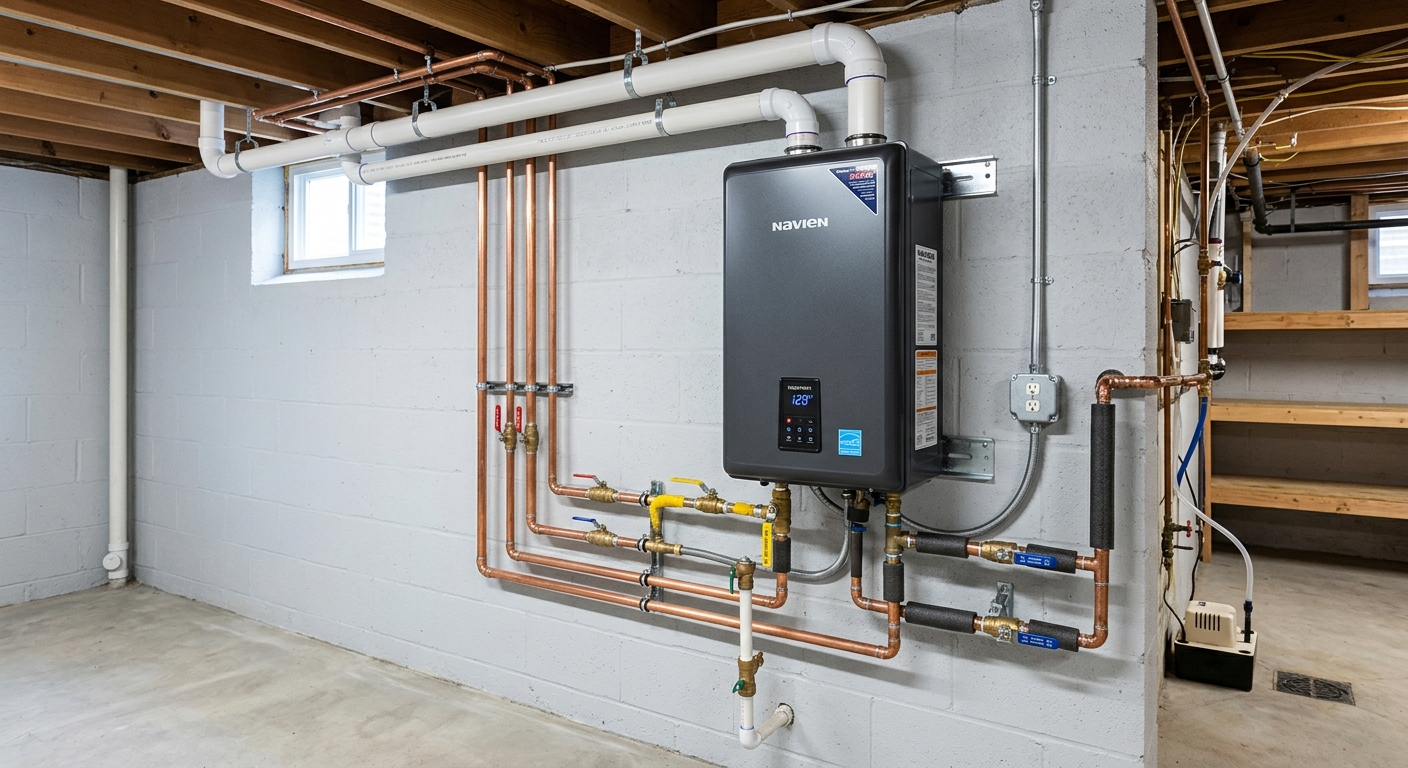
Tankless water heaters are popular throughout Pennsylvania, but their value in West Hazleton depends on your household size and hot water usage. Older homes may need upgraded gas or electric service to run a tankless properly, often adding to the cost above the water heater itself. A standard tank replacement is typically $1,050–$2,400. A tankless unit, properly installed, can cost significantly more up front, but saves on fuel long-term if your usage is high. Consider your house’s pipe runs too—retrofit in pre-1940s homes is not always straightforward. For most average-size West Hazleton homes, a new tanked heater is more practical unless you’re after endless hot water or have very high demand.
Who owns the sewer lateral, me or the city?
In West Hazleton, as in much of Luzerne County, the homeowner owns the sewer lateral—the pipe running from your house out to the city main in the street. If a root clogs or a break appears under your yard or driveway, repair costs are yours, not the municipality’s. Spot repairs on a lateral here typically cost from $1,750–$10,500 depending on excavation, length, and access. Only the city maintains and repairs the public main and sometimes the first few feet past the curb, but every responsibility line is different—ask your plumber and check with the local authority before digging.
Can I do my own plumbing work in West Hazleton?
Pennsylvania does not require a statewide plumbing license, so in theory, you can do your own work in West Hazleton. However, if local rules or the city require a permit or inspection for new or altered supply or drain lines, you must follow those procedures. Wilkes-Barre, for example, explicitly requires permits for such work. DIY repairs can turn into expensive lessons if you open walls or floors without following code: you may have trouble selling later or, worse, be held liable for damage if work fails. Professional repairs range from $300–$1,050 for minor leaks—sometimes worth every dollar to avoid hassle and code headaches.
How do I prevent frozen pipes in West Hazleton?
With a winter design temperature of just 4°F and a frost depth of 36 inches, frozen pipes are a real threat in West Hazleton, especially in old multifamily homes with minimal insulation. Keep basement and crawl space temperatures above freezing, insulate pipes along outside walls, and let faucets drip during deep cold snaps. In homes with legacy galvanized or copper running along exterior walls, failures from burst pipes are common. Emergency repair costs for winter burst pipes are $500–$1,050, and that doesn’t count water damage restoration. Proactive pipe insulation and air sealing are usually far cheaper than even one emergency call.
What does repiping a house cost in West Hazleton?
Repiping a typical West Hazleton home—often an older two-story with original piping—costs between $3,100–$7,400, with $5,000 a common midpoint for modest-sized homes. This covers full replacement using modern PEX or copper, patching walls after, and removing old material. The wide price range accounts for access: lath-and-plaster or tight spaces drive costs up. Some local contractors include basic wall repair, but restoration of historic finishes may be extra. If you’ve had repeated leaks, falling water pressure, or rusty water on startup (all common here), a full repipe is usually cheaper over time than chasing leak after leak each year.