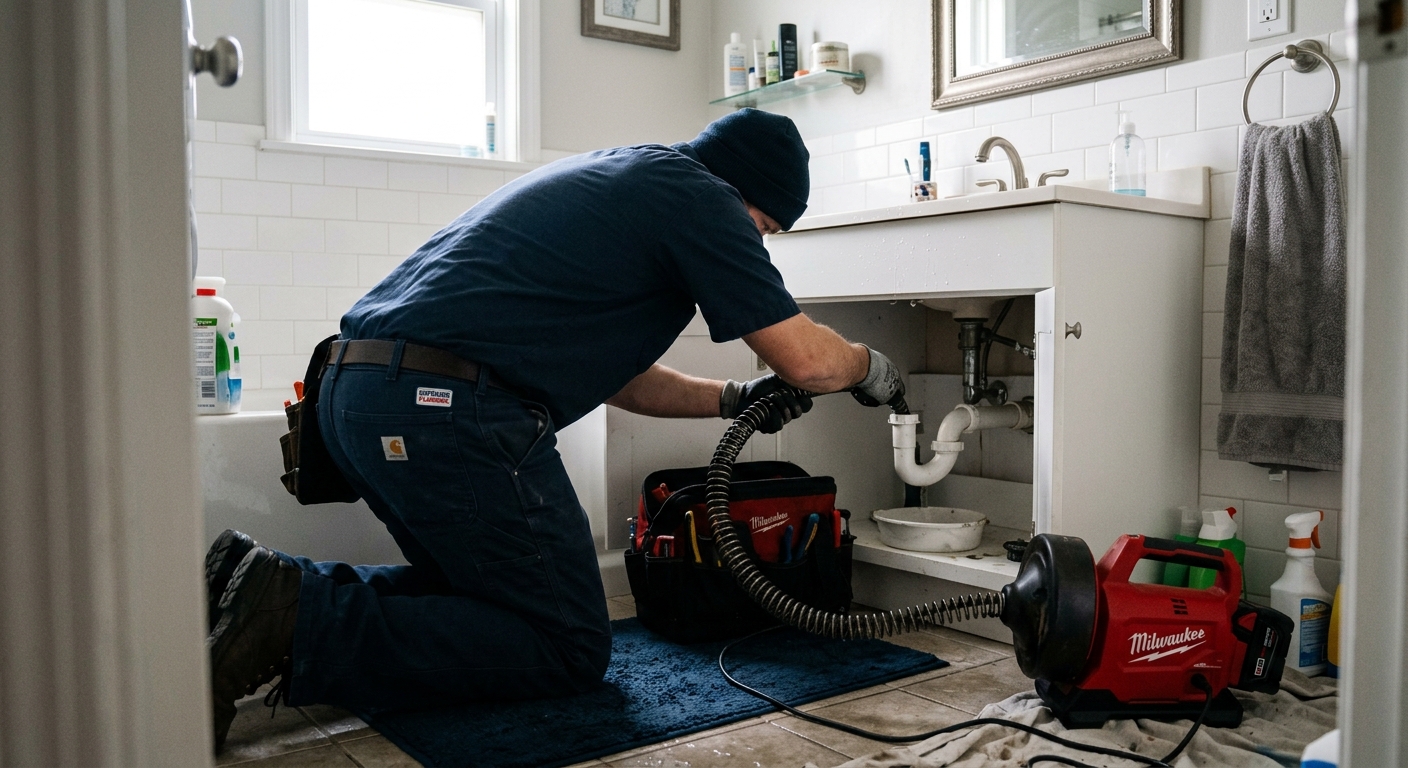
Plumbing costs in Scott — 2026
Scott homeowners face a plumbing cost landscape shaped by both climate and construction era. With 55.9% of homes built before 1980 and a majority as single-family houses (U.S. Census Bureau, ACS 2024), a large share of local plumbing systems still rely on galvanized steel or early copper piping. Older houses in Bloomsburg and Berwick, which date heavily from 1900–1940, often present aging supply lines and original clay sewer laterals, which are more susceptible to leaks, blockages, and corrosion than modern PEX or PVC systems. This directly impacts repair complexity and price.
In Scott and throughout Columbia County, plumber rates split dramatically between emergencies and scheduled jobs. The same pipe leak will cost more if you need someone after hours or on a weekend, not only because of true overtime but because local plumbers often charge travel surcharges due to the rural, spread-out nature of this market. Emergency dispatch can double—or more—the base rate for the job.
| Service |
Scope |
Emergency rate |
Standard rate |
| Emergency repair — burst pipe |
locate, open, repair section, restore service |
$600–$1,150 |
$350–$1,150 |
| Water heater replacement (gas, 40–50 gal) |
remove old, install, test, haul away |
$1,850–$2,700 |
$1,150–$2,700 |
| Drain cleaning — main line |
augering or hydro-jet, camera if needed |
$350–$800 |
$200–$500 |
| Sewer line spot repair |
excavate or reline a failed section |
$1,950–$11,500 |
$1,950–$11,500 |
| Whole-house repipe |
replace supply lines throughout, patch and finish |
|
$3,400–$8,200 |
| Water service line replacement |
street to house, excavation and restoration |
|
$5,300–$11,500 |
Estimates for a typical Scott home. Access difficulty and pipe material move these figures more than anything else.
Vetting a plumber in Columbia County
When hiring a plumber in Scott or anywhere in Columbia County, you need to confirm more than an ad or a handshake. Pennsylvania does not issue a statewide plumbing license—licensing is left to individual municipalities, which means a plumber can be fully licensed in one town and unqualified to pull a permit across township lines. Always ask if they can work legally in your exact location.
Start by verifying their Pennsylvania Home Improvement Contractor (HIC) registration at hic.attorneygeneral.gov if your job is over $500—a written contract and a cooling-off window are your rights. Get a copy of both their liability insurance (showing your address) and workers' compensation certificate; you can verify coverage through the state’s WCAIS system (wcais.pa.gov). Be direct: does their crew do the work, or do they send subs? For emergencies, request a clear rate structure before they roll a truck—travel charges are more likely here because Columbia County has fewer plumbers per square mile than most.
- Ask if the plumber is authorized to pull a permit in your municipality
- Check current HIC registration at hic.attorneygeneral.gov
- Verify insurance, naming your Scott property on the certificate
- Confirm workers' comp status via wcais.pa.gov
- Find out if their own employees or subcontractors do the work
- Request a written estimate and contract for any work over $500
- Clarify travel/trip charges, especially for emergencies or nights/weekends
- Ask how after-hours pricing is quoted up front
- See recent camera/video proof for any repipe or sewer replacement job
- Insist on a pressure test for any major repair
- Request proof of EPA Lead RRP certification for homes built before 1978
- Check for previous work references in Scott or your township
Red flags: big dollar quotes for pipe replacement without a camera inspection or pressure reading, refusal to provide insurance certs, or any push to skip a written contract. In this county, be extra wary of anyone unwilling to break down travel or material charges—distance and small operator density drive prices up, but shouldn’t mean corners get cut.
Licensing and permits for plumbing work in Scott
There is no statewide plumbing license in Pennsylvania. All licensing in this trade is up to the municipality—meaning that a plumber with credentials in one local town, like Bloomsburg, might have no permission to run pipe in neighboring townships such as Scott. Don’t stop at “Are you licensed?” Ask, “Are you licensed here for this exact job?” This goes double for more involved work like repiping, sewer, or new water service.
In Bloomsburg, the Town of Bloomsburg Code Enforcement Office reviews and issues plumbing permits. For the rest of Columbia County, including Scott, individual townships handle code enforcement and inspection. Installing or replacing building water or sewer piping—except a straightforward fixture swap—typically requires a plumbing permit in Bloomsburg, and most surrounding townships follow a similar model. Replacing a faucet or showerhead with a like-for-like fixture usually does not need a permit.
Pennsylvania requires all home improvement contractors signing jobs over $500 to hold HIC registration from the Office of Attorney General (verify at hic.attorneygeneral.gov)—and to give you a written contract with a 3-business-day right to cancel. For proof of liability insurance or workers’ compensation, ask for certificates naming your property and use the WCAIS system for extra verification. If any work disturbs painted surfaces in homes built before 1978, the contractor must be an EPA Lead RRP Certified Renovator.
Freeze risk and what to do about it
Scott and the rest of Columbia County sit in one of the coldest parts of Pennsylvania, with a frost depth of 36 inches and a winter design temperature of just 2 °F. That means long stretches when crawl spaces, basements, and pipes near the exterior can freeze solid—especially in older homes where insulation is spotty or pipes follow exposed routes. Most pipe bursts don’t actually happen at the frozen spot; they occur just downstream, between the ice plug and a closed faucet, where expanding ice pressurizes the section until something gives.
The most at-risk locations? Pipes in exterior walls, unheated crawlspaces, garages, and attached hoses or hose bibs—plus any supply lines running through a cold attic. Moving water doesn’t freeze as easily, so insulation is the first defense, followed by electric heat tape, letting one faucet trickle open on bitterly cold nights, or leaving cabinet doors open where pipes run inside walls. Before the first hard freeze, shut off and drain outdoor spigots (including bleeding any lines to detached garages or barns).
If a pipe does freeze, safe thawing uses a hair dryer or a dedicated pipe-thawing heat cable—never an open flame or torch, since that’s a house fire waiting to happen. Professional repair of a burst pipe after a freeze will run $600–$1,150 if you need emergency dispatch, so spending a few dollars on prevention is worth it.
Plumbing systems in Scott homes
A majority of Scott’s homes—over half—were built before 1980 (U.S. Census Bureau, ACS 2024), and older stock is common in nearby Bloomsburg and Berwick. In these houses, supply lines may still be galvanized steel or early copper, and drain pipes are often cast iron or original vitrified clay. It’s common to find sewer laterals made from clay tile, which are prone to roots and shifting, and water service lines that may still be galvanized, iron, or in some cases lead (especially in parts of Berwick).
Most water heaters in these older homes are on their second or third replacement cycles by now, so if you’re seeing rising fuel bills or unreliable hot water, the unit could be at end of life. When it comes to repiping, expect bids to recommend copper or modern PEX piping, both for reliability and code compliance.
Even in homes that aren’t true antiques, original drain and supply systems are rarely ideal. If your place is newer (built after 1980), pay attention to builder-grade fixtures and water heaters, which are often installed to minimum spec and may now be at the end of their reliable window. For any home, the best way to avoid costly surprises is a camera/sewer inspection and a pressure test of supply lines.
Sewer laterals: the pipe you own and can't see
In Scott, the full length of the sewer lateral—from your house to the street main—is the homeowner’s responsibility. That means if there’s a problem, the fix and the bill are entirely yours, even if the break is under the sidewalk or street.
Early warning signs usually go in order: a single slow drain, then multiple drains running slow, gurgling noises in the waste lines, and finally backup or flooding at the lowest drain or floor. If you see these, the first step is always a camera inspection—never let anyone quote excavation or full replacement until you have seen the footage for yourself. In older homes, clay tile lines are notorious for root intrusion (where small tree roots snake in), sections settling out of alignment (“bellies”), or joint offsets from decades of ground movement.
If a problem is found, you may face a choice between open-cut repair—digging up the damaged section—or trenchless relining, which avoids a full excavation. In Bloomsburg and Berwick, sewer connections run to public mains, while Scott’s outer townships rely heavily on private septic systems—meaning clog or backup there may need tank pumping, not pipe repair. If you’re on septic, stay ahead of trouble by pumping every few years and watching for drainfield signs of trouble (standing water, foul smell).
Bottom line: never sign for a sewer line replacement or spot repair until you have reviewed the actual (not stock) camera footage with a plumber you trust.
Emergency rates versus scheduled work in Scott
In Scott and greater Columbia County, the price gap between emergency and scheduled plumbing work is large. Emergency calls trigger higher rates due to after-hours dispatch, trip charges, overtime labor, and the “clock is ticking” nature of the diagnosis—while travel surcharges are common here since plumbers cover a broad rural service area.
True plumbing emergencies include: active flooding or spraying, any burst pipe causing water loss, sewage actively backing up into the home, and the unmistakable odor of gas. These can’t wait. But slow leaks (a drip at a joint or under a sink), one slow drain, or a running toilet are discomforts, not crises—book those during business hours and save substantially. For example, a burst pipe can hit $600–$1,150 for after-hours response, while the same fix scheduled for the next day might be $350–$1,150.
Every homeowner should know how to shut off their main water valve (usually found where the main line enters the basement or crawlspace), and use fixture shutoffs under each sink or toilet. Turning off your water can convert 90% of emergencies into manageable repairs—with a much smaller bill once business hours resume.
Frequently asked questions — plumbing in Scott
Do I need a permit for plumbing work in Scott?
In Scott and throughout Columbia County, plumbing permits are handled at the municipal level. In Bloomsburg, for example, a permit is needed when installing or replacing water or sewer piping, but simple fixture swaps (like-for-like faucets or showerheads) typically don’t require a permit. Around the rest of Scott, you should always check with your local code official, as requirements can differ. Remember, any job over $500 requires a written contract under Pennsylvania’s Home Improvement Consumer Protection Act. If you’re planning a big project like a water heater replacement—which runs around $1,150–$2,700—always clarify the permit situation before the work begins. Never take a contractor’s word—check with your own township office.
How do I tell what my pipes are made of?
In Scott’s older homes, especially those built before 1980, it’s common to find galvanized steel, copper, or even lead supply lines, along with cast iron or clay drains. You can often spot the difference visually under a sink or in the basement: galvanized steel looks a dull gray and may feel heavy; copper is reddish-brown; PEX is flexible and typically blue or red. Drains may be white/black plastic (PVC or ABS), or thick, rust-flakey iron. For a full-house repipe (replacing everything with modern copper or PEX), price starts at $3,400–$8,200. If you're uncertain or suspect lead, have a professional inspect the system—especially in homes predating 1940.
Are tree roots a common sewer problem in Scott?
Yes, tree root intrusion is a frequent problem for sewer laterals in Scott, particularly in older houses with clay or vitrified tile piping used widely in Bloomsburg and Berwick from 1900–1940. Roots seek moisture and squeeze through old joints, eventually clogging or breaking the line. This is often first noticed as slow drains or backups. Professional drain cleaning or hydro-jetting runs from $350–$800 for an emergency call. If roots have done serious damage, you may be looking at trenchless repair or even a full replacement, so always ask for a camera inspection before agreeing to a larger fix.
What do I do if a pipe is frozen but not burst?
If you open a faucet and get only a trickle, suspect a freeze but don’t panic. In Scott’s deep-winter cold, start by warming the exposed pipe using a hair dryer, heating pad, or a specialty pipe-thawing cable. Never use a blowtorch or open flame—older homes here often have flammable insulation and wood framing close by. Open up cabinets and get any heat source you safely can to the pipe’s location. If water flow doesn’t return in a couple hours, or you spot any bulging, call a plumber—waiting too long can turn a $50 DIY fix into a $600–$1,150 burst repair if things go wrong.
What do I do about a burst pipe right now?
First: turn off your home’s main water shutoff valve, usually located just after the water line enters your basement or crawlspace. That will stop active flooding. If the leak is localized, you can turn water off at the closest supply valve under a sink or toilet. Mop up standing water, move furniture or valuables, and call a local plumber who works in Scott. Most will charge $600–$1,150 for emergency service, so if shutting off the water buys you time, ask if you can safely wait for normal hours and save some money. Document everything for insurance—especially in older homes where one leak can point to wider corrosion.
Who owns the sewer lateral, me or the city?
In Scott and throughout Columbia County, the entire sewer lateral running from your house to the street main is your responsibility. The public sewer utility in Bloomsburg or Berwick is only responsible for the main lines, not the pipes on your property or even the section running under the street. So blockages, collapses, or root damage are all on the homeowner to pay and fix. Typical spot repairs, whether open trench or trenchless, run from $1,950–$11,500 depending on depth and access. If you’re considering a house, always ask for a recent lateral camera inspection report before buying.
How much does sewer line repair cost in Scott?
Sewer line spot repairs in Scott price out between $1,950–$11,500 for both emergency and scheduled work, according to local plumber estimates. The wide range is due to variables: depth, length to the street, traffic control, pipe age (clay tile is common in older homes) and how much access is required. Minor pipe section relines may be closer to the lower end; long trenches through mature trees or city streets can cost much more. Always start with a camera inspection, which many plumbers apply toward the cost if repair is needed.
Is trenchless sewer repair reliable?
Trenchless sewer repair—where a liner is inserted into the old pipe, minimizing excavation—has proven reliable in many older Scott homes with clay or cast iron laterals. It’s particularly useful where landscaping, walks, or driveways would otherwise need digging up. The key is that the host pipe must be stable enough to support the liner and that joints aren’t irreparably misaligned. Trenchless repairs usually cost just as much as open-trench in this region ($1,950–$11,500 range), but can be less disruptive. You should still review actual camera footage and bore test results to ensure it’s the best method for your line.
What does drain cleaning cost in Scott?
For main line drain cleaning in Scott, standard rates run $200–$500 if you can wait for normal business hours and don’t need after-hours dispatch. If you’re dealing with a sudden backup and call outside regular hours, the price can go up to $350–$800. Prices cover augering, hydro-jetting, and—if needed—a camera inspection to identify roots or breaks. Before agreeing to recurring cleanings, ask for camera documentation to make sure a more serious issue isn’t going undetected.