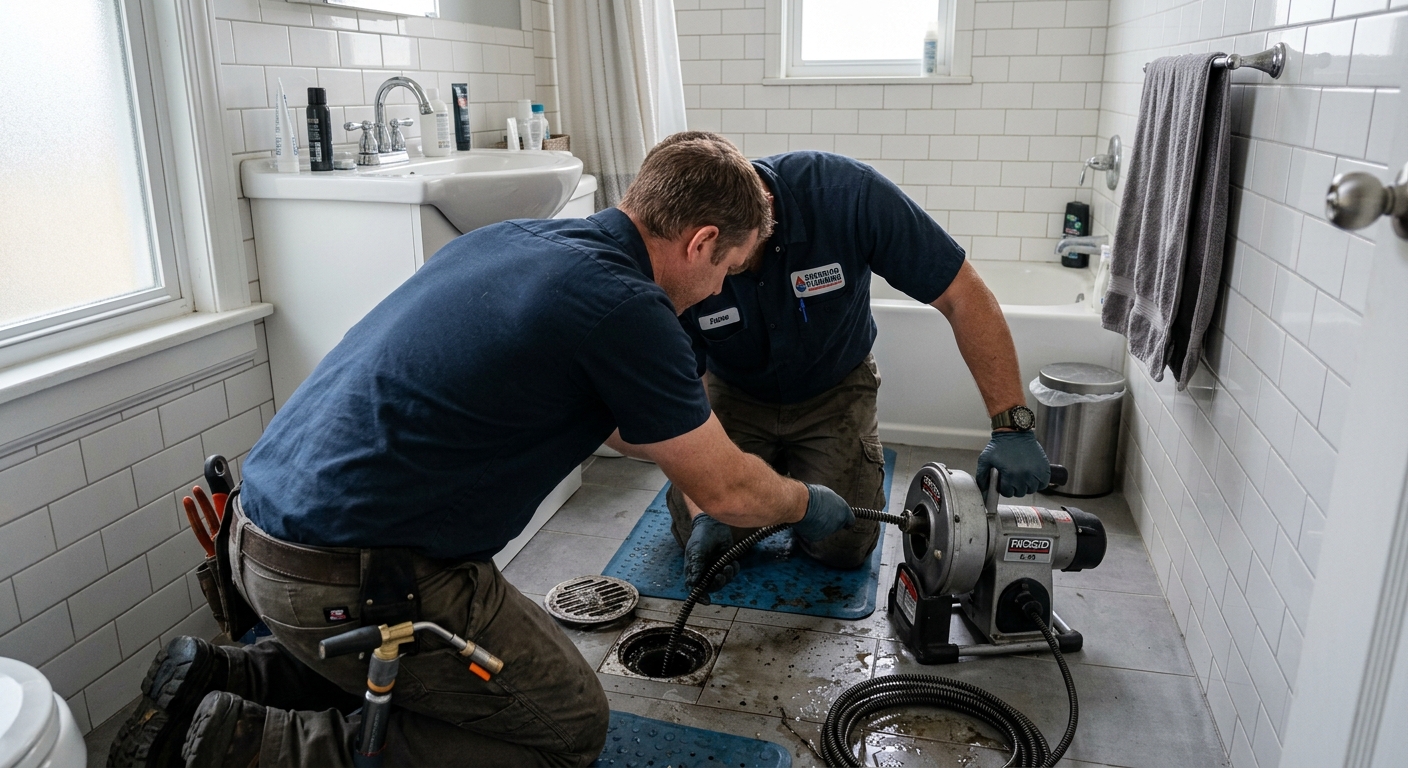
Plumbing costs in Phoenixville — 2026
In Phoenixville, plumbing prices track closely with both the age of your home and whether you call for emergency help in the middle of the night. With a population of 18,723 and more than half of homes built before 1980 (U.S. Census Bureau, ACS 2024), a good chunk of the local housing stock sits in that transitional range where copper and aging PVC have replaced truly ancient pipe — but now, those once-modern materials are getting brittle. That’s especially important in Chester County, where major housing growth from 1960 to 2000 drives demand for copper-to-PEX repipes and spot repairs on tired PVC sewer lines. The main lesson for Phoenixville homeowners: construction era predicts your piping, which predicts both what fails and roughly what you’ll pay.
Homeowners should know up front: the same job can cost two very different numbers depending on whether it’s an emergency. If a pipe bursts at 2 a.m. on a freezing January night, you can expect to be charged toward the higher end of the price band. Routine work scheduled during business hours is less expensive. Below you’ll find typical local price ranges for the most common services:
| Service |
Scope |
Emergency rate |
Standard rate |
| Emergency repair — burst pipe |
locate, open, repair section, restore service |
$650–$1,300 |
$375–$1,300 |
| Water heater replacement (gas, 40–50 gal) |
remove old, install, test, haul away |
$2,100–$3,100 |
$1,300–$3,100 |
| Drain cleaning — main line |
augering or hydro-jet, camera if needed |
$350–$800 |
$200–$500 |
| Sewer line spot repair |
excavate or reline a failed section |
$2,200–$13,000 |
$2,200–$13,000 |
| Whole-house repipe |
replace supply lines throughout, patch and finish |
$6,300–$9,300 |
$3,800–$9,300 |
| Water service line replacement |
street to house, excavation and restoration |
$7,000–$13,000 |
$6,000–$13,000 |
Estimates for a typical Phoenixville home. Access difficulty and pipe material move these figures more than anything else.
What construction era means for your pipes
If you own a home in Phoenixville, its build year gives you clues not just about the architecture, but the plumbing hidden in your walls and floors. With 57.3% of homes built before 1980, it’s common to find a patchwork: copper or even old galvanized supply lines connected to cast iron or early PVC drains, and a sewer lateral that may well still be original clay tile. Most water service lines from the street are copper or, in rare cases for the oldest properties, lead — but for the large number of Phoenixville homes built during Chester County’s 1960–2000 housing boom, expect copper or plastic as the norm.
In these houses, the first water heater was probably replaced around the 15-year mark, with many now on their second or third unit. Copper supply pipes, common in homes from the 1960s onward, still have life but are nearing the age where pinhole leaks and joint failures pop up, especially if your water is a bit aggressive (slightly acidic). If your home had any major additions or renovations after the early 2000s, look for PEX supply lines — usually blue for cold and red for hot, crimped instead of soldered, and flexible enough to snake around bends.
For homes built after 1970, plastic drain lines (typically PVC) replace most cast iron, reducing the corrosion risk but introducing the possibility of joint separation over decades. If your Phoenixville house predates 1980 and no major pipework has been done, check for cast iron drains and clay tile sewers, both now a leading cause of root intrusion and blockages. Bottom line: newer doesn’t mean problem-free, it simply means you’re looking at the next set of issues — builder-grade fixtures reaching end of life, and plastic joints before modern best practice.
Frozen pipes in Phoenixville: prevention and thaw
Phoenixville winters may not rival Erie, but with a frost depth of 30 inches and a winter design temp of 14°F, the freeze-thaw cycle is a fact of life. The most common burst scenario is well-known among local plumbers: water in the line freezes and forms a solid plug, usually in an uninsulated run. Pressure then builds between the ice and your closed faucet, causing pipes to split — often not at the frozen point, but further upstream, making both the leak and the fix harder to find.
Trouble spots in Phoenixville homes include pipes routed through exterior walls, unheated crawlspaces, attics with little insulation, attached garages, and especially hose bibs not properly winterized. In older sections of town, pipes often run close to the unheated foundation or above drop ceilings, raising risk where insulation is minimal.
To prevent freezing, start with pipe insulation wherever pipes run through chilly spaces. Next up in effectiveness is electric heat tape for extreme cold. On frigid nights, a slow drip from the most distant faucet can keep water moving enough to prevent freezing. Opening vanity or kitchen cabinets lets warm air circulate to pipes. Always shut off and drain outdoor spigots before deep winter hits.
If you do find a frozen pipe, use a hair dryer, heat lamp, or portable heater to gently warm the area — never an open flame, which can spark a fire or damage the pipe. If you return home to water everywhere, expect the aftermath to run between $375–$1,300 for an emergency burst repair. Preventive steps almost always pay for themselves here.
Pipe materials in Phoenixville homes and how they fail
Pipe archaeology in Phoenixville is practically a sport. Homes built before 1960 often have galvanized steel supply lines, easily spotted if a grayish pipe is heavy, magnetic, and shows a dull, mottled surface. These lines corrode from the inside out, slowly choking off water pressure and eventually leaking. After the postwar copper boom (1950s onward), most supply lines are copper: rigid, reddish, and joined by soldered fittings. Copper holds up well, but aggressive water can eventually eat pinholes and cause joint failures.
If your Phoenixville home was built or repiped during the brief polybutylene era (late 1970s–1995), you’ll see gray-blue flexible lines with aluminum or plastic crimp rings at the fittings—avoid these if possible, as they’re prone to catastrophic failure and many insurers won’t write a policy for homes that still have them. PEX, the current standard since the 2000s, is flexible plastic: red for hot, blue for cold, and notched with plastic or brass fittings. PEX is durable but can degrade with direct sunlight exposure or at poorly crimped connections.
On the drain side, cast iron was the rule before 1975—recognizable by its heavy, dark gray color and dull “clank” when tapped. With age, it rusts through, especially at joints and floors, and develops cracks or scale buildup. Pre-1980, many homes in Chester County, including Phoenixville, have clay tile sewer laterals from house to street, an archaic material that lets tree roots wedge in at each section. PVC (and ABS) drains, now standard, are white or black plastic and resist most chemical and root attacks, but can fail at joints or by crushing from ground movement.
| Material |
Typical era |
Failure mode |
Service life |
| Galvanized steel supply |
pre-1960 |
internal corrosion, pressure loss |
40–60 yrs |
| Copper supply |
1950s–present |
pinhole leaks, joint failure |
50–70 yrs |
| Polybutylene supply |
late 1970s–1995 |
fitting failure, sudden bursts |
unreliable |
| PEX supply |
2000s–present |
fitting or UV degradation |
40–50 yrs |
| Cast iron drain |
pre-1975 |
corrosion, cracking, scale |
50–75 yrs |
| Clay tile sewer lateral |
pre-1980 |
root intrusion at joints, offset |
50–60 yrs |
| PVC / ABS drain |
1970s–present |
joint separation, crushing |
50+ yrs |
Licensing and permits for plumbing work in Phoenixville
Plumbing in Pennsylvania is licensed at the municipal—not the state—level. There is no statewide plumbing license, so in Chester County, your plumber must be registered (and sometimes tested) with the specific township or borough where the work is being performed. Phoenixville homeowners: don’t just ask, “are you licensed?”—ask, “are you registered for plumbing in this municipality?” Local licensing is enforced in some Chester County townships, so even a plumber who’s licensed in Philadelphia could have zero standing to pull a permit in Westtown Township or West Chester Borough.
For major work (like repipes or new fixtures), townships such as West Goshen require a plumbing permit for anything connected to public water or sewer; other Chester County jurisdictions have their own code offices. Expect inspections to confirm work meets the Pennsylvania Uniform Construction Code—based on IRC and enforced by local authorities. Always insist on seeing a written estimate or contract—Pennsylvania’s Home Improvement Contractor registration is mandatory for jobs over $500, and you can check it at hic.attorneygeneral.gov.
Workers’ compensation insurance is required for any employer—verify it through WCAIS (wcais.pa.gov). Any plumber you hire should be able to prove coverage and proper registration before work starts. For homes built before 1978, federal law (EPA Lead RRP Rule) covers renovation work—double-check the company’s credentials if your project will cut, drill, or replace lead-based materials.
Lead service lines in Phoenixville
Aqua Pennsylvania’s 2024 inventory for Chester County reports that fewer than 1% of active water service lines are still lead, but if your Phoenixville home dates to the early 20th century or predates widespread copper adoption, it’s worth checking. The water service line is split into the utility-owned portion (usually from the street main to your curb box or property line) and the homeowner’s side (from the curb box to your house). Replacement programs, where they exist, may only address the utility-owned stretch, leaving homeowners to handle the rest. Always confirm with Aqua Pennsylvania—which serves many in southeast Chester County—and never assume a replacement covers your whole line.
You can test for lead at the point where the water line enters your basement: scrape the pipe gently with a coin. If it reveals shiny silver and a magnet won’t stick, you may have lead. Copper shows a reddish hue, while galvanized steel appears gray and is magnetic. If any portion turns up lead, call both the water company and a plumber familiar with Chester County protocol.
Be aware: partial replacements can initially elevate short-term lead risk by disturbing scale inside old pipes, even while improving safety over the long run. Aqua Pennsylvania’s current stance is public; their inventory is available online, and you should contact them directly for any available cost-share offers, as Chester County’s program details can change year to year.
If you do need to replace your service line, expect costs in the $6,000–$13,000 range, depending on length, access, and restoration requirements—less if trenchless methods are feasible, more if the route runs under paved driveways or mature trees. If you’re facing lead replacement, pricing is best compared against a spot sewer repair, with similar factors affecting your final bill.
Comparing plumbing estimates in Phoenixville
Most plumbers in Phoenixville will quote you either a flat rate or a time-and-materials (hourly-plus-parts) model. A flat rate offers price certainty and covers the contractor’s risk if the job runs long; you’ll generally pay more for this assurance. Time-and-materials tends to be cheaper on a straightforward fix but can pile up quickly if the issue is hidden or complex—always know which billing model you’re being offered.
A typical estimate should call out any diagnostic or trip fee and clarify if it applies against the work (many do, some don’t). Good quotes lay out the scope: not just the price, but exactly where and what will be opened, repaired, and whether floors, walls, or landscaping are restored as part of the contract. Ask if the bid includes all required permits (a must for supply, drain, or water service work in Chester County). For larger jobs, labor warranty and fixtures/parts warranty are often separate—two years on labor, longer on the water heater, for example. Finally, confirm the after-hours or emergency rate—all plumbers know these are different numbers, and the good ones explain them up front.
| Line item |
What to look for |
Red flag if… |
| Billing model |
flat rate or hourly, stated up front |
unstated |
| Diagnostic fee |
amount, and whether it credits |
vague |
| Scope |
what is opened, repaired and restored |
price with no scope |
| Restoration |
drywall and finish explicitly in or out |
silent |
| Permit |
included and priced |
'not needed' |
| Parts |
brand and model for fixtures |
'standard fixture' |
| Warranty |
labour period stated separately |
parts only |
Frequently asked questions — plumbing in Phoenixville
Is a water softener worth it in Phoenixville?
In Phoenixville and the broader Chester County area, most municipal water comes from Aqua Pennsylvania’s southeast division, which typically delivers moderately hard water—not extreme, but enough to notice minor scale buildup over time. Whether you “need” a softener comes down to personal preference and the condition of your fixtures. Most homes will not see pipe damage severe enough to justify a softener as a pipe-preservation device. That said, if you notice white crusty deposits on faucets or you’re installing a new water heater (which in Phoenixville costs $1,300–$3,100), a softener can extend appliance life by reducing scale. If you don’t care about minor water spots or “slick” water feel, save your money for more pressing repairs. For pre-1980 homes with galvanized or copper, the benefit is marginal; focus more on leaks and overall plumbing condition.
Does Pennsylvania license plumbers at the state level?
Pennsylvania does not have a statewide plumbing license. Instead, each municipality in Chester County—including Phoenixville, West Chester Borough, and several nearby townships—sets its own requirements. Some, like Westtown Township, issue their own plumbing contractor registrations, while others may rely on the state-mandated Home Improvement Contractor (HIC) registration for contracts over $500. This means a plumber licensed in one town may not have credentials to pull permits in the next. Always ask your plumber, “Are you registered for plumbing in this municipality?” This keeps you protected if anything goes wrong, especially on major jobs like water heater replacement or whole-house repiping. Insurance and proper contracts matter more than a generic “licensed and insured” ad.
How do I tell what my pipes are made of?
The simplest way to identify pipe material in your Phoenixville home is a scratch and magnet test on an exposed section (like the basement near the water shutoff). Copper pipes are reddish and won’t stick to a magnet. Galvanized steel appears gray, is weighty, and magnets stick easily. Lead is dull silver, soft, and the magnet won’t stick; a quick scrape with a coin leaves a shiny mark. PEX and polybutylene are plastic, flexible, and usually colored (red, blue, or gray). For drains, cast iron is dark, heavy, and clangs when tapped, while PVC and ABS are light white or black plastic. If you still have polybutylene, consider replacement: whole-house repipe runs $3,800–$9,300 in Phoenixville. Knowing your pipes helps you anticipate failure and prioritize repairs.
How do I prevent frozen pipes in Phoenixville?
With Phoenixville’s moderate but real winter lows (down to 14°F) and a frost depth of 30 inches, prevention is essential for pipes running through exterior walls, crawl spaces, and unheated garages. Start by insulating all pipes in these locations—this is cheap insurance compared to a burst, which can cost $375–$1,300 to repair after damage. On the coldest nights, open cabinet doors to let warm air circulate, let the most distant faucet trickle if you’re worried, and use heat tape for particularly exposed lines. Don’t forget to shut off and drain all outdoor hose bibs before winter really sets in. If a pipe freezes, thaw it gently with a hair dryer—never a torch. The cost of these preventive steps is trivial next to repairing flood damage and restoring finished spaces, particularly in older Phoenixville homes with tricky pipe runs.
Is a sewer line replacement covered by homeowner's insurance?
In Phoenixville and the rest of Chester County, most homeowners’ policies exclude coverage for normal wear-and-tear on sewer lines, including root intrusion, pipe collapse, or clogs between house and street. Some policies offer a limited “service line” endorsement for an added premium—check the specifics and exclusions. Full replacement of a water or sewer lateral (costing $6,000–$13,000) is usually out-of-pocket unless the damage is sudden and accidental, like from ground movement or a one-off event. For spot repairs (like a single failed joint or root intrusion), expect to pay $2,200–$13,000 depending on access. It’s smart to scope your line with a camera every decade or so, especially in pre-1980 homes or if you’ve noticed slow drains.
How do I shut off the water to my house?
Every Phoenixville homeowner should know the location of the main shutoff. In most Chester County homes, it’s found where the water line enters the basement—typically a round or lever-style valve just after the water meter. Turn clockwise to shut off. If your valve is stuck, do not force it; an old gate valve might snap, turning a minor issue into a major repair (which could run $375–$1,300 on an emergency call). If you’re planning plumbing work, always test the shutoff in advance. For those on public water via Aqua Pennsylvania, there’s usually a curb box in your yard as an emergency backup—which a plumber or utility worker can access with special tools.
What does emergency plumbing cost in Phoenixville?
The price for emergency plumbing service in Phoenixville ranges from $375–$1,300 for a typical burst or active leak, with after-hours calls trending toward the upper end, especially if the job requires significant restoration or urgent excavation. Most contractors build in a trip charge or urgent service fee—ask up front whether this is in addition to or rolled into the total. If you can safely shut off the water and wait until normal hours, you may save hundreds. Common emergencies—like frozen or burst pipes—are more likely in homes built before 1980 due to aging materials. For less-urgent jobs, scheduling ahead is always cheaper, and some contractors will even credit the diagnostic if you proceed with repair.
What does repiping a house cost in Phoenixville?
Whole-house repiping, where all supply lines are replaced with new copper or PEX, typically lands between $3,800–$9,300 for a single-family Phoenixville home (the majority of which were built before 2000). Costs move higher if your house has multiple floors, complex routing, or numerous finished walls to patch. If your supply pipes are galvanized steel or polybutylene, replacement is more urgent and may even be required by some insurers. Repiping is usually a one-time investment that will outlast your ownership, often with a 25-year or longer warranty on materials. Always insist on an estimate that spells out drywall, floor, and finish restoration, as these are the items where scope confusion is most common.
Are tree roots a common sewer problem in Phoenixville?
Yes—especially in Phoenixville and the surrounding older Chester County neighborhoods, where pre-1980 homes often still have original clay tile (or sometimes cast iron) sewer laterals. Clay is especially vulnerable at the joints, where roots from mature street and yard trees can intrude and cause slowdowns or blockages. Fixing a root intrusion usually means a spot repair, which can run from $2,200–$13,000 depending on how much pipe needs replacement and how hard it is to reach. Keeping up with regular drain cleaning and periodic camera inspections can help catch root issues before they result in backups or bigger repairs. If you’re buying a home in Phoenixville, a sewer scope is a modest investment that can help you budget and negotiate repairs.