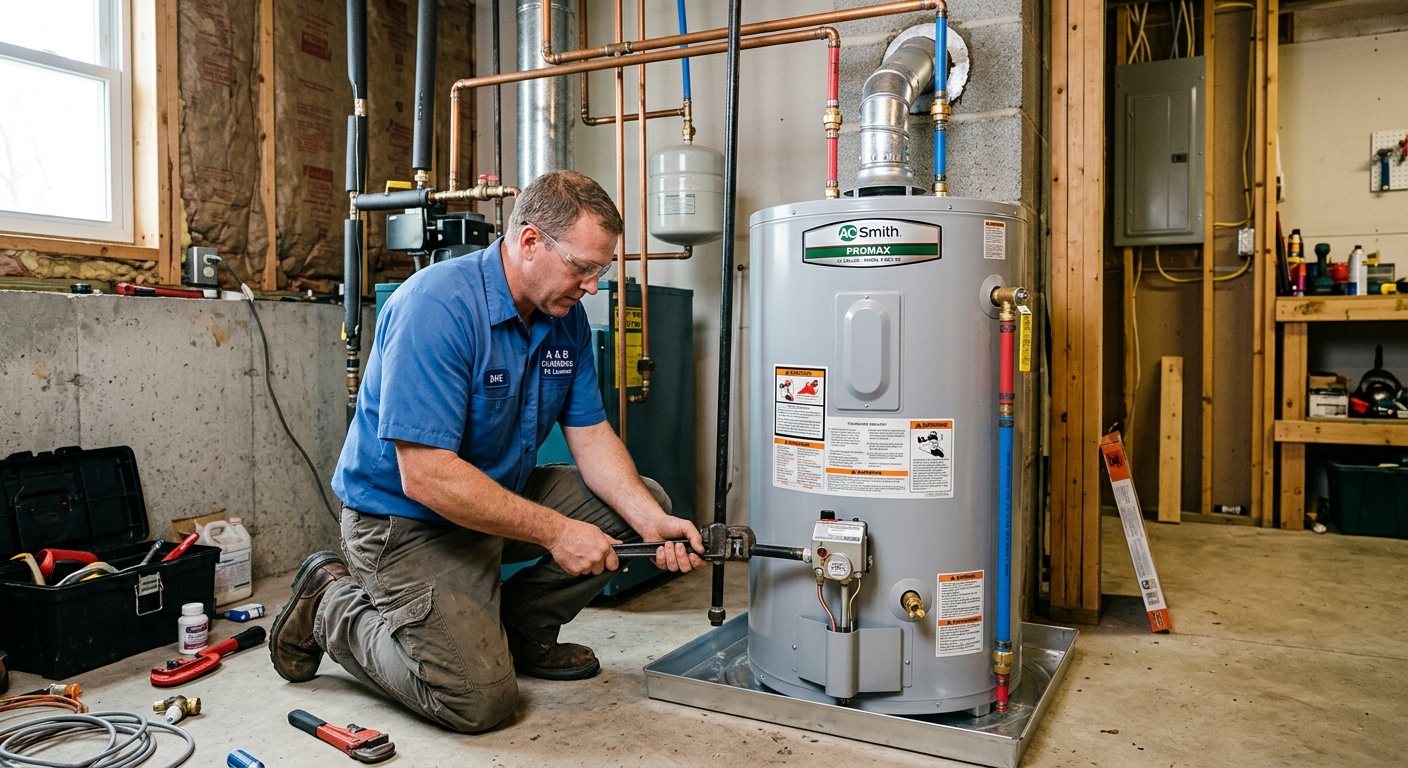
Warwick plumbing prices by job type — 2026
Warwick, Pennsylvania, sits in a region where construction history and local housing stock drive both what goes wrong with your plumbing and what it costs to fix it. With a homeownership rate of 76.2% and nearly 28% of homes built before 1980 (U.S. Census Bureau, ACS 2024), many Warwick properties still have either their original galvanized pipes or first-generation copper and PEX upgrades. That matters: older pipes are more likely to burst or clog, pushing up repair costs—especially in emergency calls where labor rates spike outside standard hours.
Every job has two price tags—one for emergencies, and one for standard hours—because it’s urgency, not the job itself, that changes the cost the most. If you wake to water on the floor or a leaking ceiling, expect the emergency rate. If you plan ahead for a water heater swap or main line service, you’ll generally see the standard range. Lancaster city’s high percentage of pre‑1940 row and twin homes means galvanized-to-copper or PEX replacement is common, and access can be tricky, adding to labor costs.
| Service |
Scope |
Emergency rate |
Standard rate |
| Emergency repair — burst pipe |
locate, open, repair section, restore service |
$600–$1,250 |
$350–$1,250 |
| Water heater replacement (gas, 40–50 gal) |
remove old, install, test, haul away |
$1,950–$2,900 |
$1,250–$2,900 |
| Drain cleaning — main line |
augering or hydro-jet, camera if needed |
$350–$800 |
$200–$500 |
| Sewer line spot repair |
excavate or reline a failed section |
$2,100–$12,500 |
$2,100–$12,500 |
| Whole-house repipe |
replace supply lines throughout, patch and finish |
- |
$3,600–$8,800 |
| Water service line replacement |
street to house, excavation and restoration |
- |
$5,700–$12,500 |
Estimates for a typical Warwick home. Access difficulty and pipe material move these figures more than anything else.
Sewer line problems in Warwick
In Warwick and much of Lancaster County, the homeowner owns the sewer lateral all the way from the house to the main, even if that run extends under the sidewalk or street. This is where the biggest surprises and costs can come up: most people don’t realize a blockage or collapse outside their foundation is still their responsibility.
Common symptoms start with one slow drain (often a local clog), progress to multiple slow drains or gurgling fixtures, and culminate in sewage backing up at the lowest point—typically a basement laundry sink or floor drain. When multiple fixtures struggle at once, the issue is usually in the main line, not within the house.
Diagnosis should always start with a camera inspection, not a shovel. Don’t accept any trenching or relining quote without being shown camera footage of the blockage, break, or root mass—this is the industry best practice, and protects you from unnecessary excavation. In older laterals, especially where original clay tile was used, root intrusion is very common, along with “bellies” (sags) or misaligned joints that collect debris.
Repairs range from open-cut replacement (digging up and swapping out the line) to trenchless relining technologies. Relining is less destructive, especially in established yards, but not every pipe can be saved this way, especially if there are full collapses or severe offset joints.
Many outlying townships rely on individual septic systems. Septic problems usually show up as surfacing water near the drainfield or slow drainage throughout the house. Proper tank pumping—every 3–5 years—is critical for system health, and full drainfield replacement can rival sewer line repair costs.
When to repipe a Warwick home
The line between a one-time repair and needing a whole-house repipe is clearer than most homeowners are told. If you’ve had two or more leaks in the same piping system within three years—especially on galvanized steel or polybutylene—it’s a clear pattern of failure, not just bad luck. Other signs are steadily falling water pressure throughout the house, brown or orange water on first draw, visible rust or corrosion at pipes and joints, and repeated pinhole leaks in copper or PEX.
In older Warwick homes, particularly Lancaster city’s pre‑1940 row and twin homes, galvanized-to-copper or PEX replacement is routine. Full repipes solve widespread problems but always remember: while PEX is less expensive and flexible, copper may be standard in exposed basements or for resale value. Many forget that drywall, plaster, and even tiling repair after plumbing work in old homes can cost as much—or more—than the pipes themselves.
Spot repairs make sense for isolated failures in accessible locations, but systemic issues demand more. Partial repipes target only failing branches, but a full repipe is typically most cost-effective if your pressure is dropping or if you discover polybutylene or lead in the lines anywhere.
| Situation |
Recommendation |
Cost |
Reasoning |
| One leak, accessible, modern pipe |
Spot repair |
$350–$1,250 |
Isolated issue, economical fix |
| Two or more leaks in 3 years |
Partial repipe |
$3,600–$5,900 |
Systemic failure on old material |
| Galvanized supply, pressure loss |
Full repipe |
$3,600–$8,800 |
Material done for, long-term fix |
| Polybutylene anywhere in the house |
Full repipe |
$3,600–$8,800 |
Recall material, insurance risk |
| Cast iron drain with root intrusion |
Camera, then reline or replace |
$2,100–$12,500 |
Drainage repair or upgrade needed |
| Suspected lead service line |
Test, then replace the lateral |
$5,700–$12,500 |
Health hazard, city pushing replacements |
Plumbing systems in Warwick homes
Most Warwick homes were built post-1980, but nearly 28% predate 1980, with a mix of colonial era properties and suburban houses. Older homes—especially those echoing Lancaster city stock—likely still have sections of galvanized steel in their supply lines, with cast iron or clay tile for drains and sewer laterals. If you have visible thick, threaded pipe at the water meter or odd-tasting brownish water, it may be time to test for galvanized or, in rare cases, lead.
In post-1980 Warwick and the surrounding suburbs, you’re more likely to see copper combined with early PEX, and ABS or PVC for branch drains. Many homes from the 1980–1995 window used problematic polybutylene (“PB”) supply pipe; if your shutoff valves are all gray plastic and pipes flex where they enter the wall, it’s worth investigating. These same homes usually have their first water heater heading past 20 years or will be on their second by now.
If you own a newer home, your risk is less about total system failure and more about leaky builder-grade fixtures and water heaters nearing the end of their first or second life. But new doesn’t mean bulletproof: pay attention to pressure changes, odd leaks in finished basements, and any unexplained water stains on floors or ceilings. Common replacements in newer stock are failing cartridge faucets or water heater tanks with burnt-out elements or scale plugging.
What a plumbing quote should contain
In Warwick, you’ll see two types of plumbing billing: flat rate (‘job price’) and time-and-materials (T&M). Flat rate means you get a set price—good for predictability, especially in emergencies, but it bakes some risk into the quote for the contractor. T&M can be cheaper for straightforward fixes, but costs can spiral if hidden problems surface. The real pitfall is not knowing which you’ve agreed to until the job is underway.
A clear quote should list any diagnostic fees (and say if these are credited to the work), specify what will be opened and restored, show if permits are included, and note if wall/floor repairs are in the price or left for you. Also look for a split warranty: labor (workmanship) and parts (fixtures/materials) are two different things. For emergencies or after-hours calls, expect to see higher rates—these should be disclosed before any commitment.
| Line item |
What to look for |
Red flag if… |
| Billing model |
flat rate or hourly, stated up front |
unstated |
| Diagnostic fee |
amount, and whether it credits |
vague |
| Scope |
what is opened, repaired and restored |
price with no scope |
| Restoration |
drywall and finish explicitly in or out |
silent |
| Permit |
included and priced |
'not needed' |
| Parts |
brand and model for fixtures |
'standard fixture' |
| Warranty |
labour period stated separately |
parts only |
Hardness, treatment and fixture life in Warwick
Most Warwick homes are served by the City of Lancaster Water Bureau or a local township authority, both of which publish annual water quality reports upon request. Water in this region tends to be moderately hard—a natural result of south-central Pennsylvania’s limestone geology. Scale build-up impacts water heater and fixture life, as hard water causes mineral deposits that shorten tank longevity and can clog faucet screens or showerheads.
If you notice reduced flow or your water heater struggles after just a few years, mineral scale is a likely culprit. Water softeners can help, but installation and salt cost means payback is slow unless you’re dealing with very high hardness or sensitive appliances. Softener sales are often oversold—don’t invest unless you’re experiencing real scale issues or appliance failures.
For those on private wells or with older rural properties using individual systems, know that no one publishes a water quality report for you. Annual or biennial well tests are wise, especially for iron and bacteria—not every “off” taste is due to hardness alone.
Whole-house filtration can be worthwhile if your water has odors or visible particles, but point-of-use filters at sink or fridge can address most taste or lead concerns for a fraction of the price.
Verifying a Warwick plumber's credentials
Pennsylvania has no statewide plumbing license—licensing is handled by individual municipalities. That means a plumber licensed in Lancaster may have zero legal standing in Warwick Township, and vice versa. When hiring, ask not “Are you licensed?” but “Are you licensed to work in this township?”
The Pennsylvania Uniform Construction Code applies here, but code enforcement is local—Warwick Township inspects its own plumbing and building work. In nearby Lancaster city, any project that alters or adds value to a property (beyond simple faucet or toilet repairs) requires a building or plumbing permit. Jurisdictions enforce this differently, but all legitimate electricians must have Home Improvement Contractor (HIC) registration from the Pennsylvania Office of Attorney General for jobs over $500. You can verify this at hic.attorneygeneral.gov.
Insurance and workers’ compensation are mandatory for any contractor employing others—check a contractor’s workers’ comp status via WCAIS (wcais.pa.gov) before signing. For homes built pre-1978, ask if the contractor is EPA Lead RRP Rule-certified, which is required for any work disturbing painted surfaces. Always get a written contract for any job over $500, and remember you have a 3 business-day right of cancellation under the Home Improvement Consumer Protection Act.
Frequently asked questions — plumbing in Warwick
Do older Warwick homes have galvanized pipes?
Homes in Warwick, particularly those built before 1980, are likely to have at least some original galvanized steel pipes. This is even more common in homes built closer to the center of Lancaster County, where the older housing stock matches the pre‑1940 city profile. Galvanized pipes corrode from the inside out, leading to falling water pressure, brownish water, and leaks that become more frequent with age. If your home fits this era and you’ve had more than one pipe leak in the last few years, it’s a strong indication the system is failing as a whole. At that point, spot repairs may only drag out the inevitable. A full repipe for a typical Warwick home generally runs $3,600–$8,800, but sometimes a partial repipe can get you by for less if only some sections are bad.
Is trenchless sewer repair reliable?
Trenchless sewer repair is a strong option for many Warwick homeowners whose laterals are accessible and structurally sound enough for relining. These techniques, including pipe bursting and cured-in-place liners, can fix long stretches of pipe without tearing up landscaping or hardscaping. Not every scenario is suitable, though; if the old pipe has totally collapsed or major joints are offset, excavation may be unavoidable. Still, when the conditions are right, trenchless methods can save time, restore service quickly, and keep total costs within the usual repair range—often $2,100–$12,500 for spot repairs. Always insist on reviewing camera footage from your own line before signing on for any repair method.
Who owns the sewer lateral, me or the city?
In Warwick and most surrounding Lancaster County municipalities, the homeowner owns the sewer lateral from the house all the way to the municipal main—including any portion that runs beneath sidewalks or the street. While it surprises many, this means blockages, collapses, or root intrusions under public property are still your responsibility. If a problem occurs in this stretch, all repair work, including restoration, falls to you. Spot repairs to these laterals typically cost $2,100–$12,500, depending on length, depth, and restoration needs. Always get a camera inspection before approving any work.
Do I need to drain outdoor spigots in Warwick?
Yes, you should absolutely drain and shut off outdoor spigots every fall before the first hard freeze in Warwick. South-central Pennsylvania experiences pronounced freeze-thaw cycles and occasional deep cold snaps—frost can reach 30 inches deep. If you skip this step, even “frost-free” sillcocks can burst if water remains trapped behind the valve. Cracked exterior lines are among the most common emergency calls in spring, and repairing a burst spigot line can easily fall in the $350–$1,250 band if it’s inside a finished wall. Take ten minutes in late fall, and you might save a thousand dollars and a ruined basement carpet.
Should I wait until business hours to call?
If water is pouring out from a burst pipe, sewage is backing up into the lowest drain, or the main water line to your home has failed, don’t wait—these are true emergencies. The longer you delay, the more water damage can spread and the higher your restoration bills later. However, if you have a slow drip under a sink or a small leak you can contain with a bucket, you’re usually better off waiting for regular business hours to avoid emergency labor rates. In Warwick, after-hours bursts and leaks are routinely billed in the $600–$1,250 range for emergency calls, while standard rates for small leaks can be much lower if you catch them early.
What does repiping a house cost in Warwick?
Repiping a whole house in Warwick—usually swapping out old galvanized, polybutylene, or compromised copper with PEX or new copper—runs $3,600–$8,800 for a typical single-family home. The biggest variables affecting the price are access and wall restoration: older homes with plaster or difficult-to-reach lines may end up on the higher end, while homes built with unfinished basements or open joist spaces often fall lower. Always factor in the cost of patching drywall, tile, or plaster after the pipes are in place. If you only need a partial repipe, figures start at $3,600–$5,900, but systemic issues almost always point to doing the full job at once.
How much does a water heater replacement cost in Warwick?
Replacing a gas water heater (40–50 gallon) in Warwick ranges from $1,250–$2,900, including removal, installation, testing, and hauling away the old tank. High-efficiency units, tight access situations, or extra work bringing lines up to code can nudge you toward the upper end of that range. Routine swaps in open basements can come in lower, especially during regular hours. If your heater is more than 12 years old or has visible leaks around the base, budget for a replacement soon—it’s often more cost-effective than repeated repairs.
How long should a water heater last in Warwick?
In Warwick, with its moderately hard municipal water, a tank-style water heater typically lasts 10–15 years. Hardness minerals buildup leads to scale inside the tank, which slowly reduces efficiency, increases heating costs, and eventually causes leak-through at the bottom. If your heater is past the 12-year mark or you’re noticing colder showers and popping noises from the tank, it’s time to start budgeting for replacement. A new tank water heater (installed) usually falls in the $1,250–$2,900 range for a standard gas unit in this area. Proactive replacement beats a surprise cold shower and the hassle of emergency plumbing rates.
Do I need a permit for plumbing work in Warwick?
Permit requirements in Warwick depend on the extent of the plumbing work. Minor repairs like replacing a faucet cartridge or toilet fill valve usually don’t need a permit. However, any project that physically alters, expands, or adds value to your home—such as water heater replacements, water service line swaps, or substantial pipe rerouting—requires a plumbing or building permit. Your township or Lancaster city’s codes division handles the permits and inspections. Permit and inspection fees should be included in your plumber’s quote for jobs over $500, and written contracts are mandatory under Pennsylvania’s Home Improvement Consumer Protection Act. Always confirm with your contractor that all required permits are in place before work starts.