What plumbers charge in Morrisville
In Morrisville, plumbing costs reflect the age and design of the homes—87.0% were built before 1980 (U.S. Census Bureau, ACS 2024), and more than two-thirds are single-family, often with original or aging supply lines. If you live in a post-war house similar to the Levittown stock in Falls Township, you’re also dealing with decades-old copper or galvanized pipe, which is prone to leaks, corrosion, and failure. For plumbing, the age and type of material used underneath your floors and behind walls predict both what’s likely to go wrong and what you’ll pay.
The biggest single factor in what you’ll actually pay is whether the call is routine or an emergency. Emergencies (burst pipes, active leaks, and lost service) draw a premium because of response time and the urgency of turning the system back on safely. Routine jobs can usually wait for scheduling, saving you both on labor and on parts markup commonly seen in rapid-response repairs.
| Service |
Scope |
Emergency rate |
Standard rate |
| Emergency repair — burst pipe |
locate, open, repair section, restore service |
$650–$1,300 |
$375–$1,300 |
| Water heater replacement (gas, 40–50 gal) |
remove old, install, test, haul away |
$2,100–$3,000 |
$1,300–$3,000 |
| Drain cleaning — main line |
augering or hydro-jet, camera if needed |
$350–$800 |
$200–$500 |
| Sewer line spot repair |
excavate or reline a failed section |
$2,200–$13,000 |
$2,200–$13,000 |
| Whole-house repipe |
replace supply lines throughout, patch and finish |
— |
$3,800–$9,200 |
| Water service line replacement |
street to house, excavation and restoration |
— |
$5,900–$13,000 |
Estimates for a typical Morrisville home. Access difficulty and pipe material move these figures more than anything else.
Morrisville's housing stock and its plumbing
Morrisville’s homes bear the strong mark of the county trend: the vast majority, 87.0%, were built before 1980. That means most plumbing systems underfoot and overhead are original or on their second round. Supply pipes are likely to be copper or sometimes galvanized steel. Galvanized pipe rusts from the inside out and pinholes in copper are common, thanks to both age and local water chemistry. For main drains, cast iron and clay tile are standard in this era; both materials suffer from root infiltration and cracking over decades, and clay tile in sewers is notably break-prone.
If your home falls on the newer side, you may instead see builder-grade PVC for drains and PEX for supply—but these are much less common given the age profile. Postwar development, as seen in Levittown, relied on copper for supplies, often in undersized diameters that struggle with today’s demands—and the lifespan of those original pipes is usually over. Water heaters in these homes are typically on their second or even third replacement cycle by now, and it’s rare that fixture shutoff valves or hose bibbs haven’t been swapped at least once. If you still have galvanized or aging copper, leaks are a matter of “when,” not “if.” If you have PVC or PEX from a later remodel, failures are fewer but more commonly related to installation practices.
Choosing a water heater in Morrisville
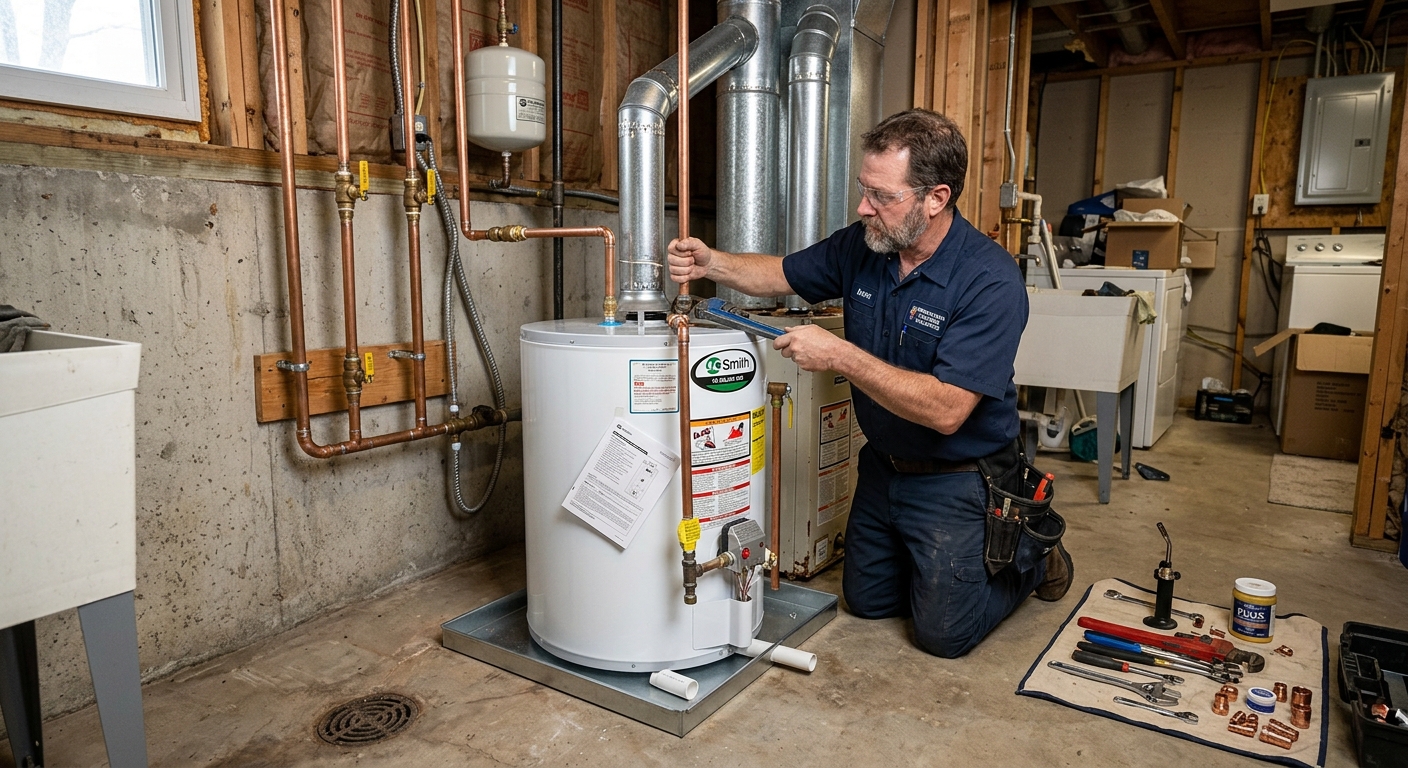
If you’re looking to replace your water heater in Morrisville, your real choices come down to the classic gas or electric tank, gas tankless, or heat pump models. The cheapest to install are standard tanks—gas or electric—ranging from $1,300–$3,000 depending on access and whether code upgrades (like an expansion tank or new valve) are needed. Tank types have the shortest life (8–15 years), and when they fail, it’s almost always the tank that gives way, not the thermostat or controls. That means sudden leaks.
Tankless gas models promise endless hot water but come at a premium—installations run $2,100–$3,000 and often require a larger gas line and a modern vent, which can add hundreds if your home isn’t set up for it. They pay back only if you have high usage or want to reclaim some storage space.
Heat pump water heaters are the least expensive to operate but need a large, warm space (like a utility room or basement with standing room and regular air temperature). They cool the air around them and can be noisy—not a good match if your basement is a living space or bedroom.
Sizing in Morrisville should be by “first-hour rating,” not just tank size. Local code and best practice now require expansion tanks and a proper drain pan with discharge. Always ask for these on the quote. If your last heater lasted 10–15 years, that’s typical for this area.
| Type |
Installed cost |
Service life |
Operating cost |
Best when |
| Gas tank, 40–50 gal |
$1,300–$3,000 |
8–12 yrs |
moderate |
gas line and vent in place, average use |
| Electric tank, 40–50 gal |
$1,300–$2,100 |
10–15 yrs |
high |
no gas, lower up-front budget |
| Gas tankless |
$2,100–$3,000 |
18–25 yrs |
low-moderate |
long-term home, space-saving, higher use households |
| Heat pump water heater |
$2,100–$3,000 |
13–15 yrs |
lowest |
large utility area, moderate climate, high electric rates |
Lead service lines in Morrisville
Bucks County Water & Sewer Authority, which supplies much of Morrisville, has reported about 2,000 known or suspected lead service lines still pending replacement across the county. Both the water utility and the homeowner share responsibility for what reaches your tap: usually, the pipe from the street main to the curb is utility-maintained, but from there (the curb to your meter or main valve), it’s homeowner-owned. Replacement programs, when offered, often cover only the public side—partial replacements can actually spike lead levels temporarily because disturbing old pipes knocks loose protective mineral scale, exposing raw lead directly to drinking water.
To check your own line, look at where the pipe enters your basement or crawlspace. Use a coin or key to scratch the pipe: bare, shiny metal that doesn’t attract a magnet is nearly always lead. If you’re unsure, your best bet is to ask Bucks County Water & Sewer Authority for their published service line inventory or call them and ask about your address directly. Never assume you’re covered by a replacement program unless you see it in writing.
A full water service line replacement—from street to house with excavation and restoration—runs $5,900–$13,000 for most Bucks County homes. If only the homeowner-owned section needs work, the cost drops but rarely below $3,800–$9,200. If your home dates to the pre-1950 wave or you’re in a block with confirmed lead, get the line checked. The health and property value benefit is clear.
Comparing plumbing estimates in Morrisville
When reviewing plumbing quotes in Morrisville, the most important detail is how the job is billed. Flat-rate pricing gives you certainty—what you see on the page is what you’ll pay, unless the scope changes. The contractor takes on much of the risk. Time-and-materials can be fairer for simple problems, but can add up fast if there are surprises in your old walls or floors. Neither method is inherently better; the real problem comes when the quote doesn’t spell out which model is being used.
Look closely at whether there’s a diagnostic or service fee and if it’s applied toward the job if you move forward. A solid estimate in Bucks County will state specifically what will be opened, repaired, and what level of restoration is included. If drywall, tile, or flooring patching isn’t mentioned, assume it’s not in the scope. Insist on warranty details for labor and parts, and confirm if after-hours rates apply.
| Line item |
What to look for |
Red flag if… |
| Billing model |
flat rate or hourly, stated up front |
unstated |
| Diagnostic fee |
amount, and whether it credits |
vague |
| Scope |
what is opened, repaired and restored |
price with no scope |
| Restoration |
drywall and finish explicitly in or out |
silent |
| Permit |
included and priced |
'not needed' |
| Parts |
brand and model for fixtures |
'standard fixture' |
| Warranty |
labour period stated separately |
parts only |
Hardness, treatment and fixture life in Morrisville
Morrisville homes on public supply from Bucks County Water & Sewer Authority deal with moderate water hardness—enough to scale water heaters and fixtures over time. Hardness shortens the life of tanks and faucets and leads to pinhole leaks in copper pipes, a familiar issue in homes built before 1980. If you’re curious about the specifics, the utility is required to publish an annual water quality report, which you can request directly.
Water softeners will extend the life of appliances and pipes, but for most Morrisville homes, the payback is years, not months, unless your water heater or dishwasher needs replacing every few years. Whole-house filtration is rarely justified unless you’re focused on taste or allergy; most families do just as well with a point-of-use faucet filter or drinking system.
Private well owners (still common north of town) should test their own water annually—no utility or state agency will do it for you. Filtration and softening needs are entirely dependent on specific well chemistry, and there’s no substitute for professional testing. Always be wary of anyone pushing high-cost treatment gear without recent test data for your address.
Licensing and permits for plumbing work in Morrisville
In Pennsylvania, plumbing is not licensed statewide. Licensing is handled by local municipalities. There isn’t a state-issued plumbing license, so the right question to ask a plumber is not just “are you licensed,” but “are you licensed here?” For example, a plumber with credentials in Philadelphia or Pittsburgh may hold no license in Morrisville; each local code office sets its own enforcement.
For Bucks County, towns like Bensalem and Bristol require permits for any plumbing that changes water or drain layouts or adds fixtures; minor repairs such as faucet or showerhead swaps commonly do not. Always check with your municipal code office before starting. Inspections are carried out by the local building department. For jobs over $500, your contractor must be registered as a Home Improvement Contractor (HIC) by the Pennsylvania Office of Attorney General—verify at hic.attorneygeneral.gov— and must carry workers’ compensation insurance. You can verify coverage through WCAIS at wcais.pa.gov. For major jobs involving lead paint and older pipes, federal EPA Lead RRP rules apply in homes built before 1978; certification can be checked at certifiedrenovatorsearch.epa.gov.
Frequently asked questions — plumbing in Morrisville
What does drain cleaning cost in Morrisville?
In Morrisville, main line drain cleaning typically costs between $200–$500 for a scheduled visit with clear access. If you’re dealing with a true emergency—like a total blockage, sewer backup, or active flooding—the price usually jumps to $350–$800 because of after-hours response and the need for immediate, sometimes more invasive, work. Prices here reflect the older plumbing systems common in the area; clay or cast iron drains, found in most pre-1980 homes, are more prone to root blockages and sometimes require both augering and hydro-jetting. Camera inspection may be included above the base price, so always ask if you’re quoted at the high end. Be wary of high-pressure upsells; most Morrisville homeowners can keep costs closer to the lower end unless the pipe is badly damaged or access is unusually difficult.
Should I leave a faucet dripping in cold weather?
For older Morrisville homes with pipes run along uninsulated exterior walls (typical in pre-1980 houses), a slow drip during deep freezes can prevent pipes from freezing and bursting—a repair that runs $375–$1,300 locally. It’s not a substitute for insulation, but it’s a cheap form of risk reduction for vulnerable sections. Newer homes or those with modern piping layouts insulated to the Pennsylvania Uniform Construction Code generally don’t need this, but if you have any doubt—especially if you live in a Levittown-era structure with exposed piping—it’s a safe step. Don’t forget to open cabinets under sinks to allow warm air to reach the pipes. If you’re repeatedly leaving faucets running, it may be time to consider rerouting or insulating those lines.
Should I repipe my Morrisville home or keep repairing?
If your Morrisville home still has original galvanized steel or copper supply lines from before 1980, repiping usually pays off in the long run. Repeated pinhole leaks, rust, and poor water pressure add up quickly—single repairs average $375–$1,300, and after just a few, full replacement becomes more economical. A whole-house repipe in Bucks County runs $3,800–$9,200, depending on access and material. If your pipes are newer and made from PEX or modern copper, spot repairs are usually fine. Older homes (especially those built like Levittown’s stock) almost always benefit from a full update if you’re having recurring trouble; delaying just increases costs and water damage risk.
How do I shut off the water to my house?
In most Morrisville homes, the main shutoff is where the water line enters from the street—often in the basement along the front foundation wall. The valve will be a round wheel or a lever. Turn it clockwise until it stops; do not force it if it won’t move easily. If your valve is rusty or doesn’t work, address it now before you face a true emergency, since replacing it during an emergency call will greatly increase your costs (up to $1,300). For those in homes with water meters at the street, you may need a special key—that’s usually a call to the water authority. Always test by turning on a faucet after shutting off to ensure water stops flowing.
How do I verify a plumber's licence and insurance?
In Morrisville, ask two things: Is your plumber registered as a Home Improvement Contractor (HIC) with the Pennsylvania Attorney General (check at hic.attorneygeneral.gov), and do they have current workers' compensation insurance (verify at wcais.pa.gov)? There is no statewide plumbing license—municipalities handle local licensing, so clarify if the plumber is approved for work in your specific township or borough. For jobs over $500, a written contract is required, and you have a three-day right to cancel under Pennsylvania law. Don’t accept excuses—if you’re spending on plumbing services, those verifications are basic consumer protection in Bucks County.
Is my water line lead?
Many Morrisville homes—especially those built before 1950—are at risk for lead service lines, as reported by Bucks County Water & Sewer Authority. To check, locate the pipe where water enters your home. Scratch it with a coin: if it’s silver, soft, and a magnet won’t stick, it could be lead. Lead lines are a health risk and should be replaced, which typically costs $5,900–$13,000 if the full run is swapped out. If you’re unsure, contact Bucks County Water & Sewer Authority and ask about their service line inventory for your address; don’t assume you’re safe just because neighbors had theirs replaced.
Which utility supplies water to Morrisville?
Morrisville’s public water is provided by Bucks County Water & Sewer Authority, which manages service and publishes annual water quality reports for customers in the area. This is important if you’re upgrading fixtures or replacing service lines—coordination with the utility ensures code-compliant work and can sometimes reveal eligibility for lead service replacement support. Replacement of a deteriorated service line typically costs $5,900–$13,000, but only the portion on your property is your responsibility. Always check with the utility for current records and guidance before starting any major water line work.
Who owns the sewer lateral, me or the city?
In Morrisville and most of Bucks County, the homeowner owns and is responsible for the sewer lateral from the house all the way to the main connection at the street or property line. The city or township owns the street main, but everything from your house to that tie-in point is yours—including all costs for repair or replacement, which can range from $2,200–$13,000 depending on access and length. Before having any work done, check with your municipality for inspection or permit requirements—they can vary even between neighboring townships.
How much does a water heater replacement cost in Morrisville?
The typical range for a gas water heater replacement (40–50 gallons) in Morrisville is $1,300–$3,000—most homeowners pay around $2,100 with haul away, code upgrades, and permit included. Electric tank replacements may cost toward the lower end, while tankless or heat pump models run $2,100–$3,000 installed. Final price depends on access, need for upgraded venting (for gas and tankless), and whether you require a new expansion tank or drain pan (now usually code-required). Older homes with tight basements may also see additional labor charges.