South Londonderry plumbing prices by job type — 2026
South Londonderry sits in a suburban–rural part of Lebanon County, where about 73.9% of homes are owner-occupied and nearly 40% were built before 1980 (U.S. Census Bureau, ACS 2024). The age of your house goes a long way toward predicting what you’ll pay for plumbing work. Lebanon city’s housing stock is full of mid-century homes, where old galvanized or steel piping often needs replacing with copper or PEX during kitchen or bath updates. If you’re in a newer home, builder-grade materials dominate, but keep in mind polybutylene supply lines and original fixtures can cost you, just in a different way.
Here’s what you need to know up front: the same repair can cost more than double if it’s treated as an emergency call. Plumbers in South Londonderry—and throughout Lebanon County—charge higher rates for jobs that can’t wait, particularly after hours or if there’s active flooding. Even standard work comes in bands depending on pipe access and material, but emergencies always land at the top end.
| Service |
Scope |
Emergency rate |
Standard rate |
| Emergency repair — burst pipe |
locate, open, repair section, restore service |
$600–$1,200 |
$350–$1,200 |
| Water heater replacement (gas, 40–50 gal) |
remove old, install, test, haul away |
$1,900–$2,800 |
$1,200–$2,800 |
| Drain cleaning — main line |
augering or hydro-jet, camera if needed |
$350–$800 |
$200–$500 |
| Sewer line spot repair |
excavate or reline a failed section |
$2,000–$12,000 |
$2,000–$12,000 |
| Whole-house repipe |
replace supply lines throughout, patch and finish |
$3,500–$8,500 |
$3,500–$8,500 |
| Water service line replacement |
street to house, excavation and restoration |
$5,500–$12,000 |
$5,500–$12,000 |
Estimates for a typical South Londonderry home. Access difficulty and pipe material move these figures more than anything else.
Plumbing systems in South Londonderry homes
South Londonderry’s housing mirrors the rest of Lebanon County, split between mid-twentieth-century builds and newer suburban houses. With nearly 40% of the homes built before 1980 (U.S. Census Bureau, ACS 2024), there’s a good chance you have galvanized steel or early copper supply lines, cast iron drain stacks, and maybe a clay tile sewer lateral if your home was built before the mid-70s. These older supply pipes corrode or clog internally, and sewer lines invite root intrusion at the joints. Many of these houses have gone through at least two or more water heaters by now.
If your home is newer—subdivisions built from the late 1990s onward—it was likely piped with modern copper, PEX, or, for a window in the late '70s to mid-'90s, problematic polybutylene. These homes are more likely to have plastic (PVC or ABS) waste lines and a PVC water service from the street. When water heaters start dying here, it’s usually the first replacement, not the second or third rodeo. Builder-grade fixtures in these homes often reach their end of life together, putting pressure on your budget every 15–20 years.
Remember: newer does not mean trouble-free, it just means different challenges. Polybutylene is notorious for sudden failure at fittings, and low-end copper can pit and spring pinholes due to local water chemistry. Whether your plumbing system is aging metal or builder-grade plastic, keeping tabs on pipe material and visible joints can save you a major headache in both eras.
Detection methods and what they cost
The simplest—and totally free—leak check in South Londonderry: shut off all water-using fixtures and appliances, then watch your water meter. If the dial keeps turning, you likely have a leak on the supply side, potentially under the slab, in a wall cavity, or even outside to irrigation lines.
For tougher cases, there are several professional leak detection methods. Acoustic listening uses sensitive microphones to “hear” escaping water, and it’s the first tool for most slab or underground leaks—typically $350–$800 total if done with service. Thermal imaging can find hot water leaks in wall cavities (by spotting heat signatures) and usually adds a couple hundred to the cost. Tracer gas (filling lines with a safe, odorless gas and detecting where it escapes) is reserved for the most stubborn leaks, often more common in complex or multi-branch homes. Slab leak location, involving several of these tools, generally runs at the higher end because specialty gear and site tracing are required.
If you have a hidden irrigation leak, a good plumber will use pressure testing and valve isolation methodically, not just start digging randomly. For leaks in wall cavities, careful listening or imaging is key—anyone proposing to open up your drywall without first pinpointing the location is working backwards and leaving you with repair costs you might not need. Expect to pay $350–$1,200 depending on complexity.
Who is allowed to do plumbing work in Pennsylvania
In Pennsylvania, plumbing is not licensed at the state level. Each municipality—like Lebanon, North Londonderry, or South Londonderry—sets its own requirements. That means a plumber with credentials in one city may have no standing next door. The real question for homeowners in South Londonderry is: “Are you licensed to work here?” not just “Are you licensed?” Some larger cities, like Philadelphia and Pittsburgh, run their own licensing and examination, but those are exceptions.
Permitting and inspections also follow these local rules. In Lebanon County, the Lebanon County Planning Department oversees the Pennsylvania Uniform Construction Code (UCC) for several townships, including parts of the Londonderry area. For building additions or new dwellings in North Londonderry Township, UCC permits from the County are mandatory.
Beyond licensing, any contract over $500 triggers the Home Improvement Contractor (HIC) registration requirement, issued by the Office of Attorney General. You can verify a contractor’s HIC status at hic.attorneygeneral.gov, and confirm workers’ compensation coverage on WCAIS (wcais.pa.gov).
Every contract over $500 must be in writing, and you get a three-day right of cancellation—no handyman should be pressuring you to sign or start “under the table.” And it’s illegal for any Pennsylvania contractor to offer to waive your insurance deductible. If you’re in a pre-1978 house, EPA lead rules also apply, so verify their certifications if they’ll be disturbing old paint.
Frozen pipes in South Londonderry: prevention and thaw
South Londonderry winters see pronounced freeze-thaw cycles and a frost depth of 30 inches, with design temperatures dropping to 12 °F. The damage isn’t just from the freeze itself but from what happens after: when a pipe freezes, an ice plug forms. Water between that plug and a closed faucet or valve becomes pressurized as the freeze expands, causing bursts away from the frozen section—often inside a wall or floor where it can run for hours.
The most vulnerable pipes are in exterior walls, unheated crawlspaces, garages, unconditioned attics, and, most commonly, outdoor hose bibs. Any section exposed to winter air is at risk. Preventing this is far cheaper than fixing it. First, insulate accessible pipes in susceptible areas. Heat tape is next on the list—used correctly, it keeps problem sections above freezing. On the coldest nights, let a faucet trickle to relieve pressure, and open under-sink cabinet doors to get warm air to pipes along outer wall runs. Every fall, shut off and drain outdoor spigots—don’t skip this step, as it’s usually the culprit on first hard freeze nights.
If pipes do freeze, use a hair dryer, heat gun, or space heater—never an open flame, which is a fire and insurance hazard. Thaw slowly from the faucet end back toward the ice. If you’ve suffered a burst, a South Londonderry emergency repair often runs $600–$1,200, not counting potential drywall or flooring repair. A ten-dollar foam wrap starts looking like a bargain real fast.
Dating your plumbing by what it's made of
Every home’s pipes tell a story. In Lebanon city’s mid-century stock, you’ll often find original galvanized steel supply lines, which rust from within, narrowing water flow until the pressure drops and leaks form at the threads. If your home was “modernized” in the '70s or '80s, copper may have replaced some original runs. Copper might outlast its installer, but aggressive water, sometimes found in Lebanon County, still causes pinhole leaks or pitted joints. The notorious polybutylene, used from the late 1970s through the mid-1990s, fails at connections and is uninsurable in many places. PEX is the new gold standard—flexible and easy to retrofit—though it can degrade if exposed to sunlight during storage or installation.
For drains, cast iron stacks were standard until the mid-’70s. Over time, they corrode and crack, especially at joints. Clay tile was laid for sewer laterals in homes built before 1980; roots attack the joints, and offsetting is common. Since the 1970s, PVC or ABS took over, lasting decades unless crushed or poorly joined.
Want to check what you have? Try a magnet: it sticks to galvanized but not copper. Scratch an exposed supply: steel is dark gray, copper is — well — copper, and polybutylene is grayish-blue. PEX is usually bright blue (cold) or red (hot) and flexible. Threaded joints often point to steel; soldered or crimped gives you copper or plastic.
Tie the era of your house to these materials, and you’ll know roughly how much life those pipes have left:
| Material |
Typical era |
Failure mode |
Service life |
| Galvanized steel supply |
pre-1960 |
internal corrosion, pressure loss |
40–60 yrs |
| Copper supply |
1950s–present |
pinhole leaks, joint failure |
50–70 yrs |
| Polybutylene supply |
late 1970s–1995 |
fitting failure, sudden bursts |
unreliable |
| PEX supply |
2000s–present |
fitting or UV degradation |
40–50 yrs |
| Cast iron drain |
pre-1975 |
corrosion, cracking, scale |
50–75 yrs |
| Clay tile sewer lateral |
pre-1980 |
root intrusion at joints, offset |
50–60 yrs |
| PVC / ABS drain |
1970s–present |
joint separation, crushing |
50+ yrs |
Tank, tankless or heat pump water heater?
Most homes in South Londonderry are set up for either gas or electric tanks. The standard gas tank (40–50 gallons) is the cheapest up front, simplest to swap, but has the shortest life and loses heat steadily even when you’re not using hot water. Electric tanks cost a bit less to install, cost more to run, but usually last a couple years longer before replacement.
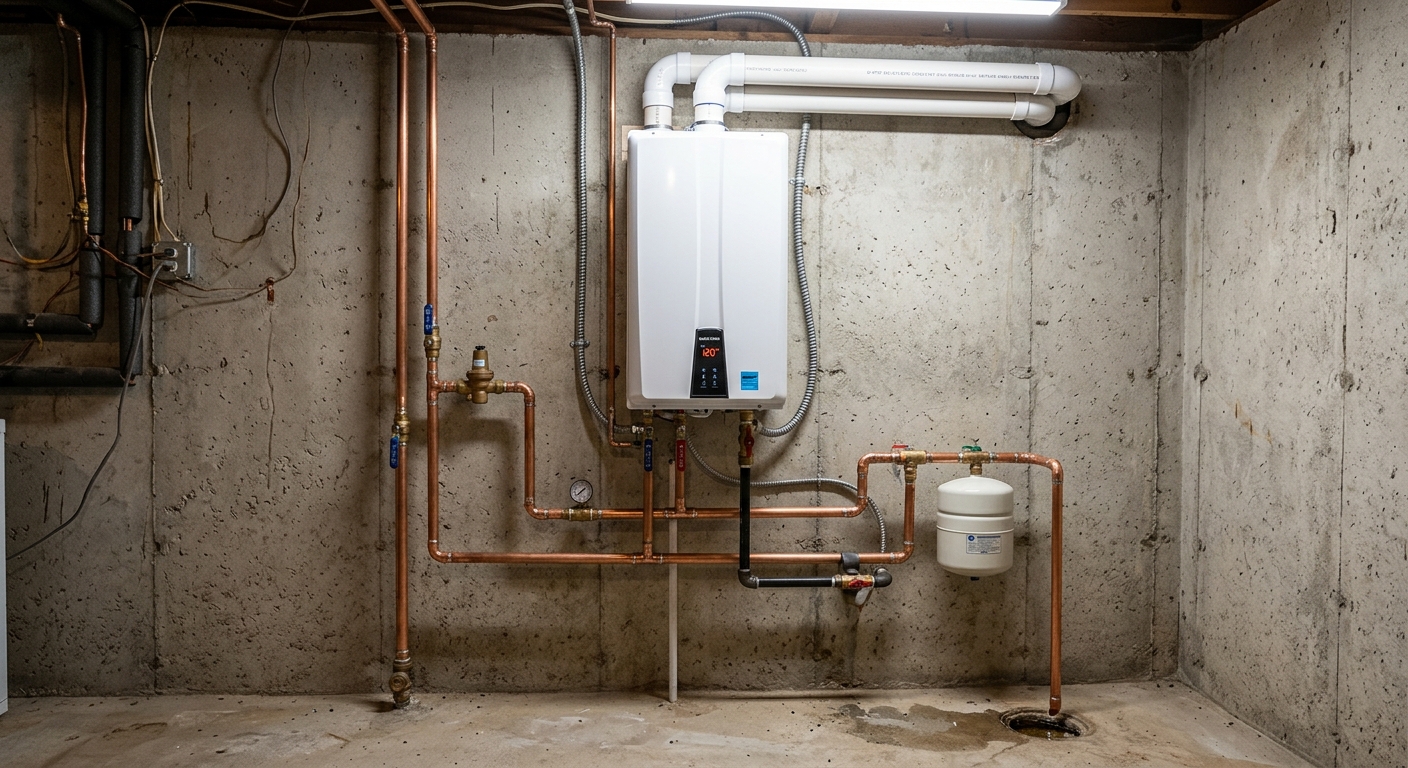
Tankless gas heaters promise endless hot water and higher efficiency, but here’s what your bigger-box installers often don’t mention: you may need a wider gas line or upgraded venting, and that can drive a typical job toward the high end of $1,900–$2,800. Annual maintenance is a must. If you’re already committed to a gas line, it’s a good option for compact homes or where demand is staggered.
Heat pump water heaters are the cheapest to run—essentially air conditioners that move heat from the basement or utility room into the tank. Downsides: they’re loud (like a window AC), they work best above 50°F, and they cool the space they sit in. Skip these in a finished basement unless you can live with the hum and temperature drop.
No matter what type, size it by its “first-hour rating”—the most hot water you can get in one hour—rather than just the gallon size. Expansion tanks are now required by many codes if you have a backflow preventer. Nearly every failure in South Londonderry is the tank rusting out, not some control board failing. Once the tank leaks, replace it.
| Type |
Installed cost |
Service life |
Operating cost |
Best when |
| Gas tank, 40–50 gal |
$1,200–$2,800 |
8–12 yrs |
moderate |
Replacement, existing gas |
| Electric tank, 40–50 gal |
$1,200–$1,900 |
10–15 yrs |
high |
No gas line, lower upfront |
| Gas tankless |
$1,900–$2,800 |
18–25 yrs |
low-moderate |
Endless hot water, retrofit |
| Heat pump water heater |
$1,900–$2,800 |
13–15 yrs |
lowest |
Open basement, electric-only |
Frequently asked questions — plumbing in South Londonderry
How do I verify a plumber's licence and insurance?
Pennsylvania does not license plumbers at the state level. Each municipality in Lebanon County—including South Londonderry—may set its own requirements. Always ask if the plumber is licensed to work specifically in your township. For any job over $500, the contractor must have Home Improvement Contractor (HIC) registration from the Pennsylvania Office of Attorney General—verify at hic.attorneygeneral.gov. For workers' compensation coverage, check their insurance certificate and confirm on WCAIS (wcais.pa.gov). Every contract over $500 must be written, and you get a 3-day right to cancel under state consumer protection rules. If someone isn't upfront about these credentials, find another contractor. For reference, an emergency burst pipe repair might run $600–$1,200, so paperwork is not optional.
What does emergency plumbing cost in South Londonderry?
Emergency plumbing rates are always higher in South Londonderry, just like the rest of Lebanon County. When a pipe bursts at night or there’s active water leaking, expect to pay between $600–$1,200 for emergency burst pipe repairs, depending on access and the time of day. These higher rates are because plumbers have to drop everything and often pay extra labor or travel surcharges—especially since our area lies between Harrisburg and Lancaster, where travel rates can get rolled in. If you can wait for a next-day call on a non-urgent issue, the standard price slides back toward $350–$1,200.
How much does a plumber cost in South Londonderry?
Plumber rates in South Londonderry are shaped by home age and who you call. For most standard, non-urgent plumbing work—like a water heater swap or drain cleaning—expect to spend somewhere between $1,200–$2,800 for water heaters and $200–$500 for mainline drain cleaning. Emergency calls, or jobs needing same-day response, almost always land at the higher end. Local plumbers may be cheaper than companies traveling in from Harrisburg or Lancaster, who often add travel surcharges in our moderate suburban–rural market. Always get a written quote up front for anything over $500, per Pennsylvania’s consumer protection act.
What do I do about a burst pipe right now?
In South Londonderry, the first step is always to shut off your water at the main in the basement or crawlspace. Open a faucet at the lowest level to relieve pressure—stopping the leak is more important than anything else. Mop up standing water and call a plumber right away; clean up helps prevent secondary damage while you wait. Depending on age, the pipe may be steel, copper, or PEX, and access can dictate how quickly repairs can happen. Burst pipe repairs as an emergency typically cost $600–$1,200, but that’s a bargain compared to the cost of letting water pool behind walls or under floors. Don’t use makeshift fixes like tape or clamps; temporary patches usually fail and can double your repair bill later.
Is a sewer line replacement covered by homeowner's insurance?
Most homeowner's insurance policies in South Londonderry (and all of Lebanon County) do not cover sewer line repairs unless damage is from a sudden, specific event (like a tree falling). Typical failures—root intrusion in an old clay tile lateral or collapse from age—are treated as wear and tear, not insurable loss. Sewer line spot repairs can range widely, from $2,000–$12,000. If your policy includes a “service line endorsement,” check for coverage, but standard plans usually exclude it. Always call your insurance agent before authorizing major work, and ask the plumber for camera inspection footage; it helps document your claim if there is any possibility of coverage.
Repair or replace a leaking water heater?
In South Londonderry, if your water heater is leaking from the actual tank—not just a supply line or drain valve—replacement is nearly always the only cost-effective route. Tank failures cannot be repaired, and a quick fix is throwing good money after bad. Replacement runs $1,200–$2,800 for a standard 40–50 gallon gas model. If it's only the relief valve or a flex line, a repair may run under $200, and sometimes the tank can keep going for a few more years. If your heater is more than 10 years old, planning for replacement avoids waking up to a basement flood.
How long should a water heater last in South Londonderry?
Most tank-type water heaters in South Londonderry last 8 to 12 years for gas models, or up to 15 years for electric tanks, thanks to moderate water chemistry. That aligns with most Lebanon County homes: a mid-century house probably has its third heater by now, while homes from the 2000s are hitting their first replacements. Premature failures are usually related to hard water or sediment buildup, but tanks rusting out is by far the usual end. When replacing, expect to spend $1,200–$2,800, depending on type and location. Tankless models stretch to the 18–25-year range with regular maintenance but come at a higher upfront cost.
Do I need to drain outdoor spigots in South Londonderry?
Yes—every late fall before the first hard freeze, drain and shut off outdoor spigots. South Londonderry gets frequent freeze-thaw cycles and winter lows near 12 °F. Undrained hose bibs are the leading cause of winter burst pipe calls, and repairing the damage can run $600–$1,200 in emergency rates. Locate your shutoff valve (often inside the basement near the spigot), turn it off, and open the outside tap to drain the line. For frost-free sillcocks, it’s still smart to remove the hose and check that no water is trapped. This ten-minute habit can save you hundreds come January.
How hard is the water in South Londonderry?
Water hardness in South Londonderry comes from the Lebanon Authority public water system. While exact numbers aren’t available here, most of Lebanon County gets moderately hard to hard water. You’ll notice this as scale in tea kettles, buildup on shower heads, or premature failure of water heaters. Hard water doesn’t ruin supply lines directly, but it can shorten the life of tank water heaters—which is part of why most local heaters last 8–12 years before needing replacement, usually at a cost of $1,200–$2,800. If you’re getting lots of buildup, consider a softener; otherwise, flush your heater yearly to extend its life.