Jackson plumbing prices by job type — 2026
Jackson homeowners pay a wide range of prices for plumbing work, and the difference between an emergency call and a planned repair can easily double the bill. If you’re dealing with a burst pipe at 9 p.m., for instance, you’re almost always seeing the high end. Routine jobs booked in advance, like a scheduled water heater replacement or main drain cleaning, usually see a lower rate. You’re also more likely to encounter pipe material problems in Jackson than in most places: nearly 44% of homes here were built before 1980, and that era’s pipes are at or past their original design life (U.S. Census Bureau, ACS 2024). Jackson’s market mirrors York City’s, where most housing dates to 1900–1950—here, old galvanized or cast iron means more frequent (and sometimes urgent) work to upgrade to copper or PEX supply lines.
Between a high homeownership rate and a majority of properties being single-family, plumbing costs reflect both a greater scope of work per house and older systems needing more attention. Below are typical 2026 prices for common jobs in Jackson, considering both emergencies and standard scheduling.
| Service |
Scope |
Emergency rate |
Standard rate |
| Emergency repair — burst pipe |
locate, open, repair section, restore service |
$600–$1,200 |
$350–$1,200 |
| Water heater replacement (gas, 40–50 gal) |
remove old, install, test, haul away |
$1,950–$2,800 |
$1,200–$2,800 |
| Drain cleaning — main line |
augering or hydro-jet, camera if needed |
$350–$800 |
$200–$500 |
| Sewer line spot repair |
excavate or reline a failed section |
$2,000–$12,000 |
$2,000–$12,000 |
| Whole-house repipe |
replace supply lines throughout, patch and finish |
|
$3,600–$8,600 |
| Water service line replacement |
street to house, excavation and restoration |
|
$5,600–$12,000 |
Estimates for a typical Jackson home. Access difficulty and pipe material move these figures more than anything else.
What construction era means for your pipes
In Jackson, the age of your house tells you plenty about your plumbing risks and what to plan for. With nearly 44% of local homes built before 1980 (U.S. Census Bureau, ACS 2024), many properties still have their original piping—whether that’s galvanized steel supply lines (pre-1960), cast iron drains, or even clay tile sewer laterals. In these homes, pressure problems, rusty water, slow drains, and cracked laterals are all common triggers for repair calls. Often, it’s not the first call you’ve made—the third or fourth water heater and at least one round of partial pipe replacement are typical by now.
If your place is part of the newer suburban wave (post-1980), you’re probably looking at copper, PEX, or even polybutylene supply lines (for late 1980s and early 1990s homes). The main worry in these homes isn’t so much leaks due to corrosion as it is failing crimp joints, unexpected bursts from polybutylene, or the end of life for builder-grade fixtures and water heaters. Even “modern” plastics have a lifespan, and polybutylene in particular is notorious for splitting at fittings.
Whether your pipes are aging metal or early-generation plastic, their era predicts their likely failure mode. If your water heater is from the early 2000s, it’s on borrowed time. If you find a shutoff valve with a galvanized pipe stub, you’re probably due for a larger upgrade. And in every case, what’s behind your walls is mostly determined by when the house went up.
Pipe materials in Jackson homes and how they fail
Jackson’s homes reflect the same trends as York City, with many properties built from 1900 to 1950. During that era, galvanized steel was standard for supply pipes—recognizable by its dull gray color, magnetic response, and threaded joints. Over time, these pipes narrow from inside-out rust, causing weak pressure before they ever spring a leak. Later upgrades swapped in copper, usually joined by soldering and sporting a bright, unpainted look—a material that can last decades but sometimes fails with pinhole leaks if the water chemistry is aggressive.
If your home went up in the late 1970s to 1995, check for polybutylene, typically blue or gray flexible pipe. Crimped fittings are their weak spot, and many insurers simply won’t write a new policy until it’s gone. PEX—now the norm in new installs—is flexible and uses metal or plastic ring fittings, and won’t corrode like metal, though it can suffer from UV or fitting degradation.
For drains, cast iron pipes are thick and ring with a tap, but by 50-75 years in, they may be rough, scaled, or cracked inside. Clay tile—orange-brown, heavy, and almost always used for underground sewer lines before 1980—tends to leak at the joints from root intrusion. Plastic (PVC/ABS) drain pipes, white or black, are the modern standard and typically last 50+ years.
To identify your material: scratch an exposed supply pipe; gray plus powder is galvanized, bright orange is copper, blue/gray plastic is likely polybutylene, and red/blue flexible is PEX. Examine the joints: magnetic and threaded is usually galvanized; soldered is copper; plastic rings signal PEX. Subtract the home’s era from the typical lifespan below for a sense of your system’s remaining years.
| Material |
Typical era |
Failure mode |
Service life |
| Galvanized steel supply |
pre-1960 |
internal corrosion, pressure loss |
40–60 yrs |
| Copper supply |
1950s–present |
pinhole leaks, joint failure |
50–70 yrs |
| Polybutylene supply |
late 1970s–1995 |
fitting failure, sudden bursts |
unreliable |
| PEX supply |
2000s–present |
fitting or UV degradation |
40–50 yrs |
| Cast iron drain |
pre-1975 |
corrosion, cracking, scale |
50–75 yrs |
| Clay tile sewer lateral |
pre-1980 |
root intrusion at joints, offset |
50–60 yrs |
| PVC / ABS drain |
1970s–present |
joint separation, crushing |
50+ yrs |
Finding a hidden leak in Jackson
Before you call a plumber in Jackson, try a basic meter test: close every faucet and fixture inside and outside, then check your water meter. If the dial or digital readout is moving, you have a leak between the meter and somewhere inside. This is a free check and catches leaks in both old galvanized and newer copper/PEX systems, which are common here. If the meter is steady, chances are the leak is on the drain side or from a running fixture you missed.
Professional leak detection relies on acoustic listening (“listening sticks”), thermal imaging (infrared cameras), tracer gas (for hard-to-find spots), and moisture meters. In Jackson, expect to pay $350–$1,200 for a full leak detection if cutting drywall is needed—but any good plumber should pinpoint the leak before opening up your walls. For slab leaks (rare here, but not unheard of) or irrigation leaks, tracer gas or acoustic tools usually do the job. A leak inside a wall is often traced by shutting off supplies one by one and watching the meter and moisture readings.
Ask your plumber about non-destructive location methods before agreeing to exploratory demolition. Any call to open up walls or floors without localizing the leak first is a sign to seek a second opinion.
Freeze risk and what to do about it
South-central Pennsylvania’s frost depth is 30 inches and the winter design temperature in Jackson drops to 12 °F. Freeze-thaw cycles are pronounced, and moderate snowfall means a cold snap with no insulating snowpack can catch many homeowners off guard. Most burst pipes here don’t fail at the spot they freeze—the ice expands upstream, but it’s the blocked pressure against a closed fixture that splits the pipe downstream. That’s why the break often appears away from any visible frost.
In Jackson homes, watch exterior walls, unheated crawlspaces, garages, and anywhere pipes run through an attic or next to a leaky basement window. Hose bibs are vulnerable, especially on pre-1980 homes lacking frostproof fixtures. Prevention is far cheaper than a split pipe—insulate pipes in vulnerable spots, use heat tape for trouble zones, and leave faucets on a slow drip on the coldest nights. Opening cabinet doors under sinks along exterior walls helps warmer indoor air circulate. Always shut off and drain outdoor spigots before the first real freeze.
If you discover a frozen section, thaw it gently using a hair dryer or heat gun—not an open flame, which can set your house on fire faster than it thaws the ice. Act at the first sign of trouble because calling for emergency burst pipe repair after a failure usually means a bill of $600–$1,200. Spending a few hours insulating pipes saves far more than what you’ll pay in repairs and water damage cleanup.
Licensing and permits for plumbing work in Jackson
Pennsylvania does not issue a statewide plumbing license. Instead, plumbing work is licensed by the municipality, not the state—so a plumber registered in York City may not be permitted to work in Spring Garden Township, and vice versa. Jackson itself follows the Pennsylvania Uniform Construction Code (UCC), based on the IRC, enforced either by the municipality or by the PA Department of Labor & Industry in towns that have opted out. In neighboring Spring Garden Township, local plumbing registration is a must.
For permits, York City requires one for any new or altered plumbing system work beyond simple fixture swaps. If you’re only replacing a sink, toilet, or faucet in the same spot, no permit is required in York City, but moving or changing supply/drain locations means inspection will be involved. Each local office runs its own permit process and inspection schedule.
Any contract over $500 requires the contractor to have a Home Improvement Contractor (HIC) registration from the Office of Attorney General. You can verify HIC status at hic.attorneygeneral.gov. All Pennsylvania-based employers must carry workers’ compensation insurance, checkable at WCAIS (wcais.pa.gov). Importantly, the written contract is your protection under state consumer law, and you get three business days to cancel. Do not hire anyone who waives your insurance deductible or lacks proper registration in your municipality.
Water heater replacement decisions
In Jackson, about 44% of homes were built before 1980, so whether you’re on your first or third water heater, it pays to choose wisely. The three options are: standard tank (gas or electric), tankless, and heat pump water heaters. Each has a place, but not every home is set up for all three.
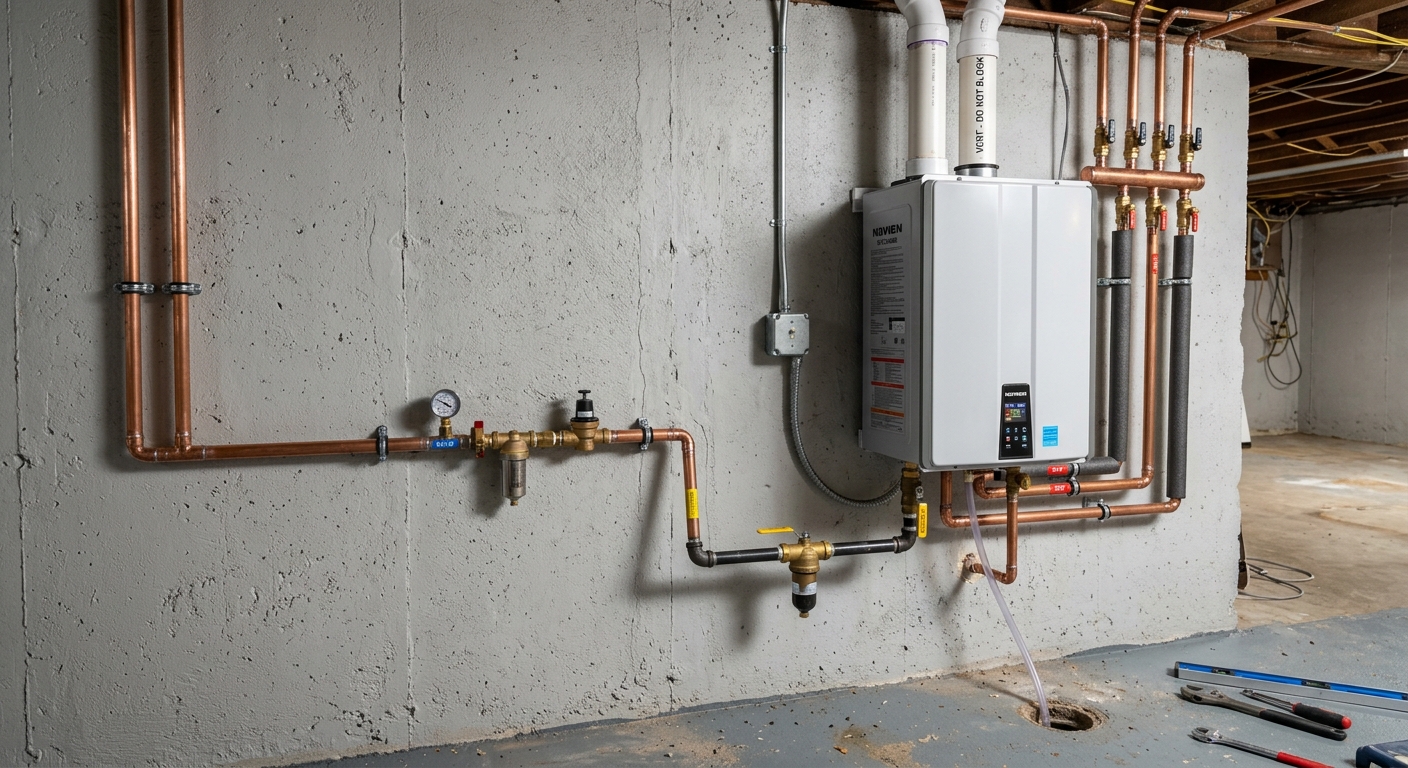
Tank water heaters (gas: $1,200–$2,800; electric: $1,200–$1,950) are the go-to for easy replacement. They last 8–15 years, depending on maintenance and water hardness. But standby losses mean you’re always heating a full tank, whether you’re using it or not. Tankless gas units ($1,950–$2,800) give endless hot water, run longer (up to 25 years), but cost more to install. They may also require you to upsize both the gas line and the vent. That can be a surprise, especially in homes with an old furnace and a small gas main.
Heat pump water heaters ($1,950–$2,800) are cheapest to operate and environmentally friendly; they pull heat from the surrounding air and cool the room they’re in. They’re not ideal in tight, cold basements and can be noisy. They work best in larger, warmer spaces—plan placement before deciding.
Rather than just gallons, size by first-hour rating—how much hot water you’ll need at peak use. Expansion tanks are required by the code for closed-loop setups. Always use a drain pan and a proper drain line, especially if your heater is above a finished area. Nearly all failures start with a leaking tank, not the controls or thermostats.
| Type |
Installed cost |
Service life |
Operating cost |
Best when |
| Gas tank, 40–50 gal |
$1,200–$2,800 |
8–12 yrs |
moderate |
existing gas line, average usage |
| Electric tank, 40–50 gal |
$1,200–$1,950 |
10–15 yrs |
high |
no gas, lower upfront budget |
| Gas tankless |
$1,950–$2,800 |
18–25 yrs |
low-moderate |
long-term savings, space priority |
| Heat pump water heater |
$1,950–$2,800 |
13–15 yrs |
lowest |
warm location, no gas, energy savings |
Frequently asked questions — plumbing in Jackson
Which utility supplies water to Jackson?
The vast majority of Jackson homes are served by York Water Company, which supplies public water in York City and many nearby municipalities throughout York County. If you’re unsure, check your water bill or look for the distinctive York Water Company meter and logo. Being on a public utility means you have access to their service desk for issues like meter reading disputes or water quality testing. For residents in the few areas not on York Water Company mains, check if your property is on a private well—this changes both your water quality risks and your plumbing responsibility. Public water from York means that when you have a supply-side leak, you’re looking at the local price range of $350–$1,200 for repairs.
How much does sewer line repair cost in Jackson?
In Jackson, sewer line repair costs depend on how severe the failure is and how accessible your line runs are. For a spot repair, expect to pay anywhere from $2,000–$12,000, with most typical jobs coming in close to the middle of that range. Spot repairs for a clay tile or cast iron lateral usually involve limited excavation or trenchless lining. If your yard is hard to access or the line is extra deep—think older homes around York City’s 1900–1950 stock—it will push the price up. If you experience a full collapse requiring a total line replacement, that’s when you hit the top end of the scale.
Should I reline or replace my sewer line?
Whether to reline or replace the sewer depends on its age, material, and the kind of failure. Many Jackson homes have clay tile or cast iron lines that fail locally from root intrusion or cracking at the joints. Relining is often less disruptive and faster, especially if you have landscaping or hardscape to preserve. Typical spot relining costs between $2,000–$12,000 in Jackson. But: if the pipe has collapsed, shifted, or is badly offset at multiple points, you’ll need a full replacement, especially for pre-1950s homes where patching doesn’t last. Ask your plumber for a camera inspection first—don’t pay for relining if the line is missing chunks or backpitched.
How do I prevent frozen pipes in Jackson?
Jackson’s winter lows are routinely at or below 12 °F, which puts pipes at risk anywhere insulation is thin. For less than the cost of an emergency call ($600–$1,200), you can insulate pipes in crawlspaces and attics, use heat tape where accessible, and always shut off and drain exterior spigots before the first freeze. A slow but steady drip from a vulnerable faucet on the coldest nights can be the difference between a nuisance and a disaster. Leave cabinet doors under sinks along exterior walls open during cold snaps to let warm air circulate. In extreme weather, sometimes the best “investment” is a trickle of water—cheaper than a burst and water-soaked floors.
Who pays to replace a lead service line in Jackson?
York Water Company, serving most Jackson residents, completed full replacement of lead service lines in its York City system following a comprehensive inventory of historic services. If your property is on their system, your service line is no longer lead, and you incur no direct cost for lead line replacement under current conditions. For anyone on a private well or other supplier not covered by York Water Company, replacement costs would fall entirely to the homeowner—expect to pay $5,600–$12,000 locally for water service line replacement using today’s labor and material rates.
Can I do my own plumbing work in Jackson?
Pennsylvania does not regulate plumbing work at the state level; instead, licensing is handled by each individual municipality. Jackson follows local UCC enforcement, and in neighboring areas like York City, permits are required for new or altered systems. If you’re only replacing an existing fixture—say, swapping out a faucet or toilet in the same spot—you can typically proceed without a permit. But running new lines or moving fixtures means you must get a permit, expect inspections, and possibly face required registration even for DIYers. If you’re talking about larger jobs (like a main line repair which can run $2,000–$12,000), hiring a pro is usually the smarter and cheaper route long-term, especially when you consider local insurance and code requirements.
What do I do if sewage is backing up?
First, stop using all water right away—don’t flush toilets, run taps, or do laundry. If you’re in Jackson and on public sewer through York City’s separated system, call a licensed plumber immediately for a main line inspection. Most blockages are local to your line and can be cleared with augering or hydro-jetting, which will run between $200–$800 depending on if it’s an emergency. If sewage reaches drains above the basement, it signals a central blockage and not a failed fixture. Outlying Jackson homes with septic tanks should call a septic specialist. Don’t let anyone open up floors or dig until a camera scope pinpoints the problem.
Why do all my drains drain slowly at once?
When every drain in the house slows down, it points to a problem with your main sewer line—that means either a buildup, root intrusion, or even a collapse, rather than an issue with one sink or tub. In Jackson, older homes with cast iron or clay tile lines are especially susceptible to these problems. Main line drain cleaning (hydro-jetting or auger, with camera inspection if needed) typically runs $200–$800 here, and it’s usually done through a main clean-out. Don’t waste money on repeated use of chemical drain openers; they rarely solve deep blockages and can damage old pipes. If a plumber suggests replacing fixtures when all drains are slow, they’re missing the real problem.
Why do plumbers charge a diagnostic fee?
In Jackson—and throughout Pennsylvania—a diagnostic fee covers the time, transportation, and tools needed to properly evaluate a problem before repair. Think of it as a baseline for a skilled inspection: leak detection, camera scoping your main, or troubleshooting pressure issues all require professional labor and equipment. The fee typically ranges from the lower end of the emergency repair price band ($350–$600). Most reputable plumbers will apply all or part of this fee toward the final bill if you proceed with the work. Be wary of anyone who gives a flat “free” estimate on jobs where real diagnosis, like locating a hidden leak or ruling out main line blockage, is needed—those costs often hide somewhere else on the invoice.