Chambersburg plumbing prices by job type — 2026
In Chambersburg, plumbing costs swing sharply depending on one factor: is your call an emergency? The same burst pipe on a quiet weekday morning, versus the same job at 2 am or with your basement flooding, draws two very different rates. Homeowners here are mostly in houses built before 1980 (66.1% per U.S. Census Bureau, ACS 2024), with a homeownership rate of 42.2%. Along I-81 and in the Borough, decades of copper and PEX upgrades reflect an area that has already seen one round of major repiping and plenty of septic repairs. Pipe material and how hard it is to reach matter just as much as the job type: older galvanized lines clog and corrode, while newer PEX resists freezing but can still split if water is left shut off in unheated wings.
Below you’ll find 2026 price bands for common plumbing work in Chambersburg. Emergencies cost more—sometimes much more—so prevention and routine repairs are well worth scheduling before you’re up against it at night or during a freeze-thaw swing. Sewer, water, and gas service work in the Borough generally require a permit, with costs partially driven by required inspections and restoration needs. For rural Franklin County, simpler fixture swaps or minor repairs might not require a permit but still track to the table below.
| Service |
Scope |
Emergency rate |
Standard rate |
| Emergency repair — burst pipe |
locate, open, repair section, restore service |
$550–$1,100 |
$325–$1,100 |
| Water heater replacement (gas, 40–50 gal) |
remove old, install, test, haul away |
$1,750–$2,600 |
$1,100–$2,600 |
| Drain cleaning — main line |
augering or hydro-jet, camera if needed |
$350–$800 |
$200–$500 |
| Sewer line spot repair |
excavate or reline a failed section |
$1,850–$11,000 |
$1,850–$11,000 |
| Whole-house repipe |
replace supply lines throughout, patch and finish |
— |
$3,200–$7,900 |
| Water service line replacement |
street to house, excavation and restoration |
— |
$5,100–$11,000 |
Estimates for a typical Chambersburg home. Access difficulty and pipe material move these figures more than anything else.
Verifying a Chambersburg plumber's credentials
Pennsylvania doesn’t issue a statewide plumbing license. Instead, plumbing trades are licensed municipally. In Chambersburg Borough, only a plumber who has passed the Borough’s own exam and holds their local license is authorized to pull plumbing permits or inspect gas, water, or sewer work. This isn’t just paper: a plumber licensed in the city of Chambersburg may hold no credential in any Franklin County township, and vice versa. Always ask “Are you licensed to do this work here?” rather than relying on a general “licensed and insured” claim.
Permits are required in the Borough of Chambersburg for any new or replacement water, sewer, or gas service piping. The Borough Codes Department enforces the Pennsylvania Uniform Construction Code (UCC), based on the IRC. Surrounding townships have their own offices, but in more rural parts of Franklin County, swapping out a toilet or faucet typically doesn’t trigger a permit requirement.
For contractor legitimacy, every job over $500 requires the contractor to have Pennsylvania Home Improvement Contractor (HIC) registration, which you can verify at hic.attorneygeneral.gov. Written contracts for these jobs are mandatory. Employers must also carry workers’ compensation coverage—searchable for free at the state’s WCAIS system (wcais.pa.gov)—which protects the homeowner if a worker is injured on your property. Never accept a quote that asks you to waive your homeowners insurance deductible, as it’s illegal under the Home Improvement Consumer Protection Act.
Frozen pipes in Chambersburg: prevention and thaw
Chambersburg experiences pronounced freeze-thaw cycles, with a 30-inch frost depth and a winter design temperature of 12 °F. These temperature swings are hard on plumbing—especially pipes in older houses pre-dating modern insulation. Franklin County’s post-1970 suburban housing stock means you’ll see a mix of well-protected PEX and unprotected copper or older galvanized lines in garages, unheated crawlspaces, on exterior walls, basements, or attic spaces. Outdoor hose bibs and pipes in unconditioned spaces are the main freeze points.
The most common failure is not where the ice forms, but where the pipe is between that blockage and a closed faucet. As pressure builds behind the ice, the pipe splits or bursts once temperatures rise. Prevention beats repair every time, as emergency fixes cost $550–$1,100—often more at night or on holidays.
- Insulate all pipes in unheated areas. Use foam sleeves or fiberglass wrap, widely available at local hardware stores.
- Heat tape can be applied to pipes in high-risk locations, with models available for DIY installation.
- Let a faucet trickle (preferably on the lowest level) during arctic blasts to keep water moving.
- Open cabinet doors under sinks on exterior walls when it gets cold, letting warm air circulate.
- Shut off and drain outdoor spigots in fall. This cost-nothing step prevents among the most common springtime repairs.
If you find a frozen pipe, never use an open flame to thaw it. A hair dryer or space heater pointed at the frozen section, or warm towels applied, is safest. Thawing too quickly can actually increase the risk of a burst, so be patient and monitor for leaks once water flows. Quick prevention steps can easily save you hundreds to over a thousand dollars in the aftermath.
What a plumbing quote should contain
Plumbing quotes in Chambersburg tend to follow one of two billing models: flat-rate or time-and-materials. Flat-rate pricing gives you a total for the full job, insulating you against surprises but often costing a bit more than hourly unless the job becomes complex. Time-and-materials can be less costly for simple fixes but leaves you open to overages on longer repairs. Neither model is inherently bad; the danger is when which one applies isn’t spelled out clearly.
Standard practice is to charge a diagnostic fee for the initial visit, sometimes credited against the total if you proceed. Your quote should spell out the work being done (the “scope”), whether permits are included, and if wall or floor repairs are part of the deal or left to you. Make sure warranties are specified separately for labor and parts. If you may need work done off-hours, the after-hours rate should be disclosed. Missing details here mean headaches later. Here’s what belongs in every serious quote:
| Line item |
What to look for |
Red flag if… |
| Billing model |
flat rate or hourly, stated up front |
unstated |
| Diagnostic fee |
amount, and whether it credits |
vague |
| Scope |
what is opened, repaired and restored |
price with no scope |
| Restoration |
drywall and finish explicitly in or out |
silent |
| Permit |
included and priced |
'not needed' |
| Parts |
brand and model for fixtures |
'standard fixture' |
| Warranty |
labour period stated separately |
parts only |
Sewer line problems in Chambersburg
In Chambersburg and the surrounding townships, the homeowner is typically responsible for the full sewer lateral from house to street. That means any blockage, collapse, or intrusion outside your foundation—and sometimes all the way into the street—is your repair bill. The most common signs of an issue: one slow drain (often just a clog), then multiple slow drains, gurgling sounds as fixtures run, and finally backups at the lowest fixture—usually a basement shower or floor drain.
Never approve an excavation or expensive repair without a proper camera inspection. It’s the single most important diagnostic step; don’t take a guess from above ground. In Franklin County’s older homes, clay tile laterals let tree roots in at the joints, while cast iron can crack or scale up. Bellies (sagging sections) and pipe offsets are common excavation finds. Your options will be traditional open-cut replacement or trenchless relining; the method depends on the pipe’s condition, material and the location under driveways or landscaping. Repairs and spot replacements fall between $1,850–$11,000, so get at least two bids and insist on seeing the actual footage before signing anything.
Chambersburg Borough is on separated sanitary and storm sewers. North, south, and west of town, many homes are still on septic. Septic problems show as slow drains throughout the house, soggy yards, or sewage backups after heavy rain. Pump every 3-5 years, and know that total drainfield failure is a different repair from a sewer lateral—it’s about soil, not pipe.
Bottom line: always see the camera footage. Camera, then quote, then dig.
Detection methods and what they cost
The simplest test for a supply-side leak in Chambersburg is free: make sure all faucets and fixtures are off, then check your water meter. If the dial is moving, there’s a leak somewhere beyond what you can see. This step can narrow things down before you call anyone.
Professional leak detection brings in higher-tech tools. Acoustic listening devices track hissing or running water inside walls or under slabs—useful for copper or PEX pipes. Thermal imaging spots temperature difference where pipes are hidden in drywall or floors. Tracer gas (typically nitrogen or a safe smoke) is pumped into a line and sniffed out from the exterior, pinpointing hard-to-find leaks without cutting. Slab leak locating, common in midcentury slab-on-grade homes, generally costs between $325–$1,100 depending on method and access. Camera scopes are used for drain and sewer leaks, mapping the pipe path and break.
An experienced plumber won’t start opening walls or upending flooring until they’ve located the leak. If demolition is suggested as the first step, get a second opinion; proper detection limits damage and cost.
Dating your plumbing by what it's made of
If your Franklin County home sits among the post-1970 I-81 suburbs or spans a pre-1980 street in Chambersburg, your pipes are nearly always a window into the home’s construction era. Material type predicts what goes wrong—and what you’re likely up against during a repair, replacement, or inspection. Here’s how to read the clues:
- Galvanized steel: Dull gray, magnetic, threaded fittings. Most often in homes built before 1960. Narrowing bores, rusty water, and pressure loss are giveaways that the pipe is closing up from inside. Leaks follow soon after.
- Copper: Reddish-brown pipe, non-magnetic, joints soldered or pressed. Common from the 1950s onward. Durable, but pinhole leaks can develop thanks to aggressive water chemistry, turning up as greenish crust or faint weeping.
- Polybutylene: Gray or blue flexible plastic, with barbed or crimped connectors, rare after 1995. Sudden fitting failures are common, and these pipes are nearly uninsurable and usually scheduled for replacement.
- PEX: Usually red, blue, or white flexible plastic, no scale, fitted with metal rings or plastic expansion fittings. Standard in new builds since the 2000s and favored for repipes. Reliable, but UV will degrade exposed runs over years.
- Cast iron drain: Black, dull, very heavy, with leaded joints. Typical in homes before 1975. These develop scale and corrosion inside, often crack near fittings, and can last up to 75 years.
- Clay tile sewer: Orange-brown, rigid rings, unglazed, easily broken. Prevalent in pre-1980 builds. Prone to root intrusion and joint separation.
- PVC/ABS drain: White (PVC) or black (ABS) smooth plastic, glued joints, installed after the 1970s. Durable if protected from crushing.
To check yours, find an exposed pipe and scratch it lightly with a coin—gray and magnetic means galvanized, shiny copper hue isn’t painted is copper, soft plastic is PEX or polybutylene. A magnet won’t stick to copper or plastic, and a threaded joint generally means steel. Knowing what you have is the first step to judging how soon you may face a repipe or spot repair.
| Material |
Typical era |
Failure mode |
Service life |
| Galvanized steel supply |
pre-1960 |
internal corrosion, pressure loss |
40–60 yrs |
| Copper supply |
1950s–present |
pinhole leaks, joint failure |
50–70 yrs |
| Polybutylene supply |
late 1970s–1995 |
fitting failure, sudden bursts |
unreliable |
| PEX supply |
2000s–present |
fitting or UV degradation |
40–50 yrs |
| Cast iron drain |
pre-1975 |
corrosion, cracking, scale |
50–75 yrs |
| Clay tile sewer lateral |
pre-1980 |
root intrusion at joints, offset |
50–60 yrs |
| PVC / ABS drain |
1970s–present |
joint separation, crushing |
50+ yrs |
Frequently asked questions — plumbing in Chambersburg
What does drain cleaning cost in Chambersburg?
Drain cleaning for a main line in Chambersburg typically falls between $200–$500 for standard, non-emergency service. If you’re dealing with an urgent backup in the evening or over the weekend, that price jumps to $350–$800. Price depends on whether your blockage is reachable with a standard auger or if hydro-jetting and a camera inspection are required. In most cases, a simple main line snaking is enough, especially for homes with newer PVC or PEX drains. If you have older cast iron or clay pipes (common in pre-1980 homes in the borough and outlying Franklin County), expect more frequent cleanouts or recommendations for replacement. Always ask if the price covers both the unclogging and the camera inspection—some shops separate the two.
Is my water line lead?
In the Borough of Chambersburg, a small number of lead service lines remain, but the water department has an active replacement program. Countywide data is not available, so the only way to know for sure is to inspect your own service line—look at where it enters your basement or crawlspace. Lead pipes are dull gray, easily scratched, and will not attract a magnet. If your home was built before 1980, or if you see a short, thick, silvery pipe before copper or PEX transitions, consider a licensed plumber for confirmation. Replacing a lead water service from the street to the house typically costs between $5,100–$11,000. The Borough requires a permit for this job, and any work involving excavation of public sidewalk or street. If you have any suspicion, request a free test kit or a plumber’s assessment—knowing is better than guessing.
How do I prevent frozen pipes in Chambersburg?
To prevent frozen pipes in Chambersburg, focus on insulation, heat tape for exposed runs, and drainage. The region's 30-inch frost depth and those single-digit winter nights make pipes in exterior walls, crawlspaces, and garages especially vulnerable. Open cabinet doors to get warm air to supply lines, let the lowest faucet in the house drip gently during cold snaps, and always shut off and drain outdoor spigots before the first hard freeze. These low-cost steps beat paying an emergency plumber $550–$1,100 for a burst or split line. If you’re heading out of town for a winter weekend, keep the house heat above 50°F and have someone check in. Prevention here costs pennies; a repair bill—especially if your insurance deductible applies—costs far more.
Is a tankless water heater worth it in Chambersburg?
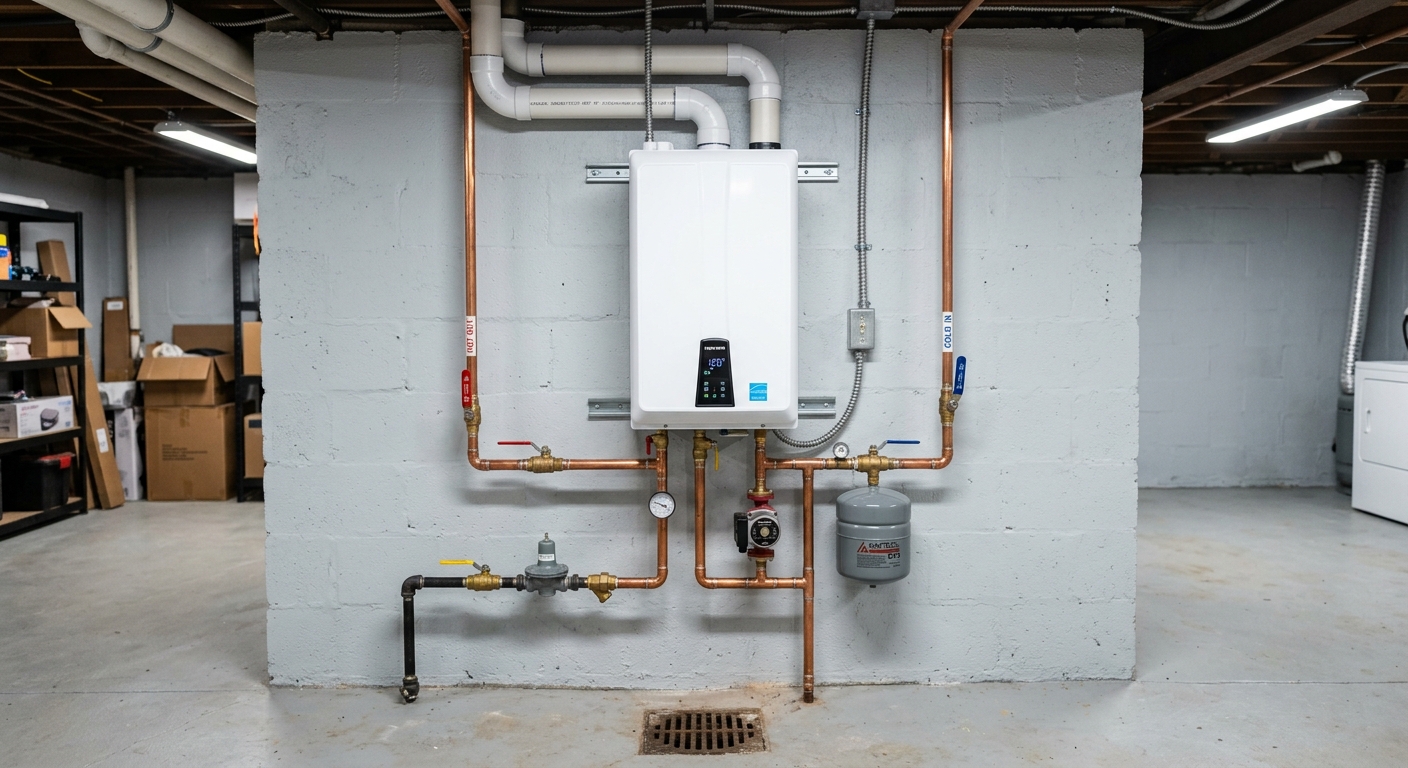
For most homes in Chambersburg, a tankless water heater is a nice upgrade, but not always a money-saver. Installation costs can run higher than standard tanks, often not fitting in the $1,100–$2,600 band for 40–50 gallon replacement. Tankless models do save space, provide endless hot water, and are ideal if your household runs showers and laundry at odd hours. But expect a higher upfront price for both the unit and the gas or vent upgrades often required in Franklin County homes built before 1980. For a family with steady hot water use, a standard gas tank is cheaper to install and repair. If you’re on the fence, ask for a bid both ways and consider your actual usage—sometimes the best answer is sticking with what works.
Should I wait until business hours to call?
If your basement is actively flooding, or you can’t stop water from a burst pipe, call right away—damage spreads fast and waiting may void insurance coverage. But if it’s a slow drain, a trickle at a faucet, or an intermittent leak, waiting until business hours can save you the after-hours premium. For example, an emergency burst pipe repair in Chambersburg costs $550–$1,100, but the same work during regular hours can be as low as $325–$1,100. Triage: shut off the main valve, mop up, and see if you can stabilize before calling for emergency help. If you’re unsure, call and describe the problem—most shops will honestly tell you if it can safely wait.
What does repiping a house cost in Chambersburg?
Whole-house repiping in Chambersburg falls in the $3,200–$7,900 range for a typical three-bedroom. Price swings are due to pipe access, house age, and materials (copper or PEX, with copper usually the pricier option). Franklin County’s housing along I-81 often means crawling through low basements and patching behind tiled walls, so restoration costs matter too. Often, pipe replacement includes drywall repair to a “paint-ready” finish; make sure your bid spells this out. The older the original pipes (especially if you have galvanized or polybutylene), the more likely a full repipe is cheaper in the long run than chasing leak after leak. Always get bids in writing, ask which walls or floors must be opened, and make sure permits and inspections are included if you’re inside the Borough.
Does Pennsylvania license plumbers at the state level?
Pennsylvania does not have a state-level plumbing license. Instead, licensing is at the municipal level. In Chambersburg, for example, only plumbers who have passed the Borough-specific exam and license process are allowed to pull plumbing permits and perform work on water, sewer, or gas service lines needing inspection. If you’re hiring for a job over $500, the contractor must also carry Pennsylvania Home Improvement Contractor (HIC) registration, verifiable at hic.attorneygeneral.gov. The bottom line: ask not just “are you licensed,” but “are you licensed here, for this work?” And always get their HIC registration number and insurance proof—don’t take a business card or logo at face value.
Is a sewer line replacement covered by homeowner's insurance?
In Chambersburg, most homeowner’s insurance does not cover the cost of replacing your sewer lateral unless you’ve added specific sewer and drain backups, or there’s sudden accidental damage (like a digging accident). Wear and tear, root intrusion, and collapse from age or tree roots—common for clay tile and cast iron lines in Franklin County—are rarely paid for, unless you purchased add-on “service line coverage.” Sewer line replacements in the area cost between $5,100–$11,000, and all restoration (sidewalk, landscaping) is typically out of pocket. Always check your policy, ask your agent about service line endorsements, and never rely on standard coverage for buried pipe issues.
Is Chambersburg on combined sewers or septic?
In Chambersburg Borough, sewers are separated—there’s a sanitary sewer system and a separate storm water system, which keeps rainwater out of your household drains (and reduces basement backup risk during storms). Outside town, in much of Franklin County’s rural stretch, septic systems are common. If you’re in a township, you likely have a septic tank and drainfield, which should be pumped every 3–5 years to avoid failure or soggy lawn issues. A sewer line repair in Chambersburg typically costs $1,850–$11,000, while most septic work hinges on regular maintenance and the health of the drainfield. Ask your realtor or plumber if you’re unsure which applies at your address.