Plumbing costs in Carbondale — 2026
Carbondale homes, with a population just under 9,000 and over half of households owning their residence (U.S. Census Bureau, ACS 2024), reflect the challenges of northeastern Pennsylvania’s older housing stock. In Scranton, Old Forge, and similar Lackawanna County towns, much of the housing pre-dates 1940. These homes were often built with galvanized steel or even cast iron pipes, leading to higher odds of pipe corrosion and clogs. The era your home was built predicts your likely pipe material, and the pipe material predicts what will go wrong—plus what repairs will cost.
For plumbing work in Carbondale, nearly every service carries two prices: emergency and standard. If a pipe bursts at 9 p.m. or you wake to a flooded basement on a January morning, expect to pay the emergency rate. Planned work—like replacing a water heater before it fails—falls under standard pricing. Emergency calls add labor costs, sometimes require expedited permits (in municipalities that require them), and often jump to the front of the line during cold snaps or storms when every plumber is booked out.
| Service |
Scope |
Emergency rate |
Standard rate |
| Emergency repair — burst pipe |
locate, open, repair section, restore service |
$550–$1,100 |
$325–$1,100 |
| Water heater replacement (gas, 40–50 gal) |
remove old, install, test, haul away |
$1,700–$2,500 |
$1,100–$2,500 |
| Drain cleaning — main line |
augering or hydro-jet, camera if needed |
$350–$800 |
$200–$500 |
| Sewer line spot repair |
excavate or reline a failed section |
$1,800–$11,000 |
$1,800–$11,000 |
| Whole-house repipe |
replace supply lines throughout, patch and finish |
— |
$3,100–$7,600 |
| Water service line replacement |
street to house, excavation and restoration |
— |
$4,900–$11,000 |
Estimates for a typical Carbondale home. Access difficulty and pipe material move these figures more than anything else.
Is your water line lead? How to find out
Carbondale’s water is typically supplied by Pennsylvania American Water or Scranton Sewer Authority–related entities, depending on address. In Scranton and adjacent areas, these utilities are under active lead service line inventory and replacement programs, but do not publish a full “lead free” claim. The key point: both the utility and homeowner own a portion—the utility typically owns the line to the curb or property line, while homeowners own the “lateral” into the house. Replacement programs often cover only one side at a time. If your home has a lead line and the utility upgrades just their half, this can disturb mineral scale and actually spike lead levels in the short run.
To check your own line, find where the pipe first enters your cellar or basement. Wipe clean, use a coin to scratch: lead is soft, silver-gray, and non-magnetic. If a magnet sticks, it’s not lead. While you can ask your water utility if your address shows “lead unknown” or confirmed, program specifics can change—so ask directly, and don’t assume eligibility or coverage until confirmed in writing.
A full replacement, including digging from the street to your house and restoring your yard, runs $4,900–$11,000 in Carbondale. If only the inside portion requires upgrading, that’s closer to a whole-house repipe: $3,100–$7,600. Many older homes here (85.7% built before 1980) are at real risk of lead or galvanized lines from the curb, so checking is hardly a wasted effort.
Remember, disturbing an old line can temporarily raise lead levels, so always flush lines thoroughly after any plumbing work.
Freeze risk and what to do about it
With winter lows design-rated at 4 °F and a code-mandated frost depth of 36 inches, Carbondale and the rest of Lackawanna County see real risk of burst pipes every winter. The ground snow load (40 psf) and severe ice-dam exposure mean vulnerable plumbing is often tested to its limits. Most people picture a pipe splitting right where it ices, but the actual burst often comes between a frozen blockage and the next closed faucet or valve. As water expands to ice, pressure builds downstream until the pipe fails—often out of sight, leading to flooding behind walls or in crawlspaces.
The worst-affected locations: pipes inside exterior walls, unheated basements and garages, crawlspaces, and any routes through attics. Hose bibs often fail if not properly drained before the first hard freeze.
- Insulate any accessible pipe in unconditioned or close-to-exterior spaces.
- Install heat tape where insulation alone won’t cut it—especially on long runs near the rim joist or in a garage ceiling.
- Let a faucet drip during the coldest nights to keep water moving.
- Open the cabinet doors under kitchen or bath sinks on exterior walls.
- Always shut off and drain outdoor spigots in fall; don’t forget the supply valve inside the house.
If a pipe bursts, the typical emergency repair in Carbondale is $550–$1,100. Preventing a freeze is almost always cheaper than paying for flood damage plus an urgent winter callout. For thawing, use a hair dryer or space heater—never an open flame. Slow, gentle heating is safest, and always start closest to the faucet so melting water can escape.
Galvanized, copper, PEX, cast iron
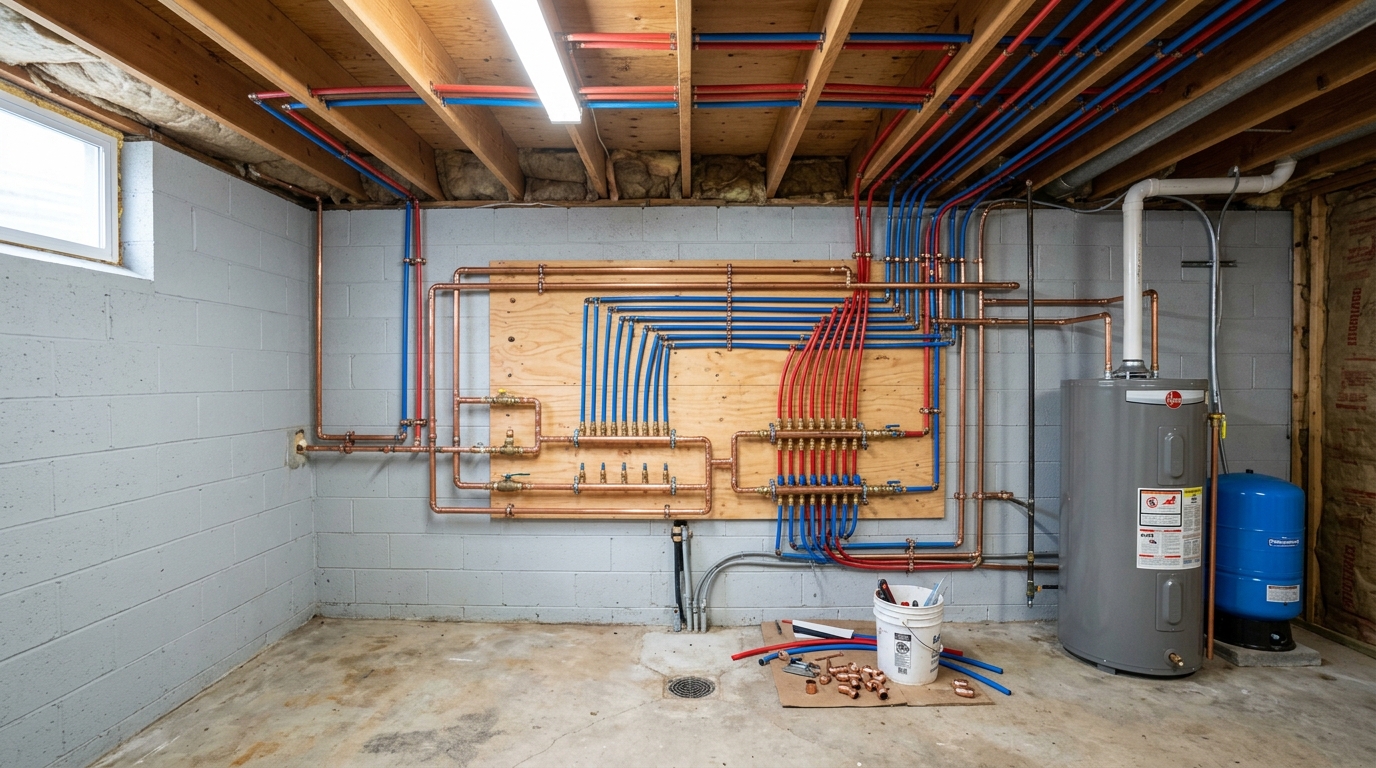
In Carbondale and broader Lackawanna County, many homes trace to before 1940. Galvanized steel was the default supply line for decades here, succeeded by copper after mid-century, with PEX and PVC/ABS coming on strong in the 2000s. For drains, cast iron dominated up to the 1970s; now it’s mostly PVC. Each material tells its own story—if you see gray, threaded pipe that a magnet sticks to, that’s galvanized, and it’s losing diameter inside year by year. Copper is reddish and only soldered or pressed at joints. PEX is flexible and color-coded (red hot, blue cold, white or gray universal). Cast iron is heavy, black or rust-splotched and joined by lead and oakum or rubber couplings. Clay sewer lateral is off-white or orange-brown, found in old yards, and fails at roots and offsets.
Galvanized pipe is a special worry: the corrosion narrows flow, drops your water pressure and then leaks, with a “runway” in the 40–60 year range. If your home predates 1960 and you haven’t repiped, you’re likely living on borrowed time. Copper can be great, but aggressive water will pit it fast—watch for blue-green stains or tiny pinholes. Polybutylene? That’s “stop the presses”—it’s got a notorious record and is usually replaced by insurers or as a condition of sale. PEX, done right, is now standard. Cast iron drain pipes usually fail between 50–75 years, often at joints or where corrosion eats through. Clay tile lets in roots as soon as mortar dries out or the ground shifts.
| Material |
Typical era |
Failure mode |
Service life |
| Galvanized steel supply |
pre-1960 |
internal corrosion, pressure loss |
40–60 yrs |
| Copper supply |
1950s–present |
pinhole leaks, joint failure |
50–70 yrs |
| Polybutylene supply |
late 1970s–1995 |
fitting failure, sudden bursts |
unreliable |
| PEX supply |
2000s–present |
fitting or UV degradation |
40–50 yrs |
| Cast iron drain |
pre-1975 |
corrosion, cracking, scale |
50–75 yrs |
| Clay tile sewer lateral |
pre-1980 |
root intrusion at joints, offset |
50–60 yrs |
| PVC / ABS drain |
1970s–present |
joint separation, crushing |
50+ yrs |
Who is allowed to do plumbing work in Pennsylvania
Pennsylvania does not issue a statewide plumbing license. Instead, plumber licensing and permit requirements are decided by each municipality. In Lackawanna County, including Carbondale and Scranton, each town may set its own rules—or in some, no local license may exist. For example, Scranton maintains its own permit registration system, while other municipalities operate under their own or contracted code enforcement.
This means hiring a “licensed plumber” only counts if they’re registered in your municipality; a license elsewhere in Pennsylvania (or even the next township) doesn’t automatically transfer. The right question isn’t just “are you licensed,” but “are you licensed to pull permits and inspected here?” It matters—an unqualified installer can leave you with an uninsurable or dangerous job.
Plumbing changes—like water heater swaps, alterations, or whole-house repipes—need a permit in Scranton and most nearby boroughs. In Scranton, the Department of Licensing, Inspections & Permits inspects the work. Insurance and workers’ compensation are both required by state law for employers; you can verify a contractor’s home improvement registration at hic.attorneygeneral.gov and check workers’ comp via WCAIS (wcais.pa.gov).
For jobs over $500, a written contract is legally required—protects you under the Home Improvement Consumer Protection Act. Never sign anything that offers to “waive your deductible”; it’s not legal here. Bottom line: always check credentials in your specific municipality before work starts.
Detection methods and what they cost
If you suspect a leak in Carbondale, start simple: shut off all fixtures, stop appliances, and check your water meter. If the dial is still moving, you likely have a supply-side leak. This test costs nothing and can rule out a billing fluke right away.
When a leak isn’t visible, professionals use several tools. Acoustic listening uses amplified microphones to pinpoint pressurized leaks in floors or walls—expect this to cost in the low hundreds. Thermal imaging cameras, which spot temperature differences in wall cavities, are useful for hot-water lines. Tracer gas (often helium or hydrogen) is for the cases where every other method fails; the gas is introduced and sensors sniff out the escape. Slab leak detection—common in homes with on-grade slabs or finished basements—relies on a combination of acoustic, thermal, and gas methods, and often runs closer to the upper end of diagnostic charges.
Pipes inside finished walls, under slabs, or in outdoor irrigation lines are where you want proper location—not guesswork. A plumber who suggests opening up the walls before identifying the source is cutting corners at your expense. Good detection shrinks the demolition needed and speeds your repair—so insist on it. Actual leak repair in Carbondale runs $325–$1,100 once the source is found, with detection efforts sometimes billed separately if especially complex.
Tank, tankless or heat pump water heater?
A Carbondale homeowner weighing a new water heater has three real options: tank (gas or electric), tankless, and heat pump. The classic tank is the cheapest to put in and fits where an old one sat, but has the shortest expected life and wastes energy by keeping water hot around the clock. Tankless heaters provide endless hot water and save energy, but installation averages higher—not least because in most older homes (built before 1980, per local profile) the gas piping may be undersized, and the venting requires upgrades for code. It’s a common unpleasant surprise on day two of a tankless install.
Heat pump water heaters cost the same or a little more up front than a tankless, but are by far the cheapest to run—as long as you have enough space for air flow (unfinished basement or utility room), and are okay with their tendency to cool the surrounding air and make some noise. They work better where the ambient temperature stays above freezing and there’s enough volume for the compressor to “breathe.” Placing them in a finished, heated basement can be disruptive.
When sizing, ignore the gallon count and look for the “first hour rating”—that’s gallons delivered before the hot runs out. Always add an expansion tank if required by code, and set the heater in a pan with a real drain, not just a loose pipe. Almost every failure is a tank split, not the thermostat or control board.
| Type |
Installed cost |
Service life |
Operating cost |
Best when |
| Gas tank, 40–50 gal |
$1,100–$2,500 |
8–12 yrs |
moderate |
space is tight, gas line in place |
| Electric tank, 40–50 gal |
$1,100–$1,700 |
10–15 yrs |
high |
lowest up-front cost, no gas |
| Gas tankless |
$1,700–$2,500 |
18–25 yrs |
low-moderate |
endless hot water, new construction |
| Heat pump water heater |
$1,700–$2,500 |
13–15 yrs |
lowest |
ventilated utility room, moderate climate |
Frequently asked questions — plumbing in Carbondale
Is trenchless sewer repair reliable?
Trenchless sewer repair is well established in Carbondale and the broader Lackawanna County area, particularly for homes with difficult access or new landscaping. Typical methods—pipe bursting or cured-in-place lining—are reliable if the existing pipe has not already collapsed or turned to mush. The method won’t cure severe dips (“bellies”) or crushed sections, but can extend a clay tile or cast iron lateral’s life by decades. Expect spot repairs to run $1,800–$11,000 depending on location and access. For pre-1980 homes, root intrusion at the joints is a common failure mode, so camera inspection before any trenchless quote is essential. A reputable Carbondale plumber will warranty both the lining and the reinstated connections. For truly unstable soil, sometimes digging is still needed, but in most situations, trenchless holds up as advertised.
How do I shut off the water to my house?
In Carbondale, you’ll usually find the main shutoff on the pipe just inside where your water service enters the basement—often at the front foundation wall, sometimes near a meter provided by Pennsylvania American Water or the Scranton Sewer Authority. Turn the valve fully clockwise (right) to shut off. Very old houses (pre-1940) may have seized or valve types that don’t fully close. If your shutoff is stuck, this is a prime case for an emergency repair ($325–$1,100). Every homeowner here should make sure the main works before an emergency—test it and label it now rather than searching when a pipe bursts.
How much does sewer line repair cost in Carbondale?
Sewer line repair in Carbondale varies mainly by where the break is and what’s overhead. A spot repair, which means excavating or relining a failed section, typically costs between $1,800–$11,000. If your yard is paved, deep, or has utility conflicts, costs can be at the high end. Many homes in older parts of Lackawanna County have clay tile sewer laterals, which commonly fail at the joints where roots enter—video inspection is the only way to confirm. Complete replacements, especially under city roads, can exceed this range. Always request a camera inspection and demand a written scope so you’re not surprised by extra “found” footage.
Who pays to replace a lead service line in Carbondale?
In Carbondale, ownership of the water line is split: the utility (like Pennsylvania American Water) maintains the supply up to the curb, and the homeowner owns the lateral from curb into the house. Local utilities in the Scranton area have replacement programs but do not guarantee full coverage for both sides. If only your side is lead or galvanized, you may be fully responsible; if both sides are being replaced, sometimes the utility covers their portion and you pay for yours. Cost for just the homeowner-owned side runs $3,100–$7,600. Always check the utility’s inventory for your address, then call for current program details—never assume coverage without a written confirmation. Even if your line is untouched, disturbing it during other plumbing work can temporarily increase lead levels, so plan for flushing after any replacement.
Does Pennsylvania license plumbers at the state level?
No, Pennsylvania does not have a statewide plumbing license. Every city, borough, or township—like those in Lackawanna County—sets its own rules. Scranton administers its own permit system, while others in the county may operate under contracted agencies. This means a plumber licensed in Scranton might not be licensed to pull permits in Carbondale or Old Forge. Always ask if your contractor is registered and permitted for your specific town. The state does require Home Improvement Contractor (HIC) registration for jobs over $500, which you can verify at hic.attorneygeneral.gov. For bigger jobs, like a water heater replacement at $1,100–$2,500, proper local permitting is critical.
How hard is the water in Carbondale?
Carbondale, supplied mostly by Pennsylvania American Water and adjacent systems, generally sits in the moderate-to-hard water range—enough to notice scaling on fixtures and inside tank water heaters after several years. Hard water accelerates scale in older galvanized pipes, cutting pressure, and builds up fastest in homes with hot water circulating or heat pump water heaters. If you have to descale faucets or spot white mineral rings, it’s a sign your pipes are accumulating the same. While not an emergency, over time this contributes to the typical water heater replacement life of $1,100–$2,500 every 8 to 15 years. A softener helps but isn’t always necessary for everyone.
What does repiping a house cost in Carbondale?
Repiping a whole house in Carbondale runs between $3,100–$7,600. The range depends mainly on house size and how much drywall or plaster needs to be disturbed to reach all the lines. Most jobs involve replacing old galvanized supply with PEX or copper, plus restoring any finishes cut open. Older homes—a real majority here, with 85.7% of the housing stock built before 1980—are especially prone to complete repipes, as original pipe is often far beyond its safe life. Good contractors patch and paint after, while budget jobs may leave walls open. Always ask for a written breakdown before signing; repiping is a major investment, but it solves ongoing leak and low-pressure issues for decades.
How do I prevent frozen pipes in Carbondale?
Preventing frozen pipes in Carbondale starts with insulation—wrap every exposed run in unheated spaces, especially near exterior walls, crawlspaces, attics, or under porches. Next in line: install heat tape on pipes that stay cold or drafty. During the coldest winter nights, leave a trickle running at any vulnerable faucet and open cabinet doors to circulate indoor heat below sinks. Outdoor spigots should be shut off and drained from inside before the first hard freeze—which, in northeastern Pennsylvania, hits sooner than many expect. Prevention is always less costly than burst repairs, which average $550–$1,100 plus any water damage restoration. A basic insulation upgrade or $30 of heat tape pays for itself in one winter’s peace of mind.
What does discoloured water on first draw mean?
Discoloured or rusty water when you first turn on a tap—especially after a period of no use—usually points to older galvanized pipe that’s corroded internally, or cast iron supply somewhere along your line. In Carbondale’s older housing, it’s common, especially in pre-1960 homes that haven’t been repiped. The color is iron oxide, not lead, but it’s a sign your pipe is reaching the end of its life. If the color clears after running a minute, the issue is likely your branch pipes, not the utility’s main. Budget for a supply line or whole-house repipe, which typically comes to $3,100–$7,600 locally. Consistent or increasing discoloration shouldn’t be ignored—it rarely gets better on its own.