Plumbing costs in South Lebanon — 2026
Plumbing pricing in South Lebanon, like everywhere, boils down to when you call. The same repair job — whether it’s a burst pipe or a water heater swap — can cost twice as much if you need it done right now, compared to a scheduled visit. Emergency rates cover nights, weekends, and anytime a plumber has to drop everything to get your water back on.
South Lebanon is firmly suburban with a strong owner-occupant presence (78.9%), and more than half the homes (51.7%) were built before 1980 (U.S. Census Bureau, ACS 2024). In practice, that means older piping materials like galvanized steel can be lurking behind the walls. When that comes up — especially during bathroom or kitchen upgrades — costs creep up fast. Galvanized pipe is labor-intensive to remove, and upgrades often involve switching to copper or PEX, both for longevity and code compliance. It only takes a couple of leaks before a repipe makes more financial sense than another patch.
If you’re considering a major repair or renovation in Lebanon city’s older housing stock, expect labor and material costs to hinge on pipe type and how easily the plumber can get to the problem area. Access issues in tight crawlspaces or finished basements move the price as much as the material itself. Planned jobs cost less than emergencies, but surprises in older plumbing can lead to change orders and additional costs.
| Service | Scope | Emergency rate | Standard rate |
|---|
| Emergency repair — burst pipe |
locate, open, repair section, restore service |
$600–$1,250 |
$350–$1,250 |
| Water heater replacement (gas, 40–50 gal) |
remove old, install, test, haul away |
$1,950–$2,900 |
$1,250–$2,900 |
| Drain cleaning — main line |
augering or hydro-jet, camera if needed |
$350–$800 |
$200–$500 |
| Sewer line spot repair |
excavate or reline a failed section |
$2,100–$12,500 |
$2,100–$12,500 |
| Whole-house repipe |
replace supply lines throughout, patch and finish |
— |
$3,600–$8,800 |
| Water service line replacement |
street to house, excavation and restoration |
— |
$5,700–$12,500 |
Estimates for a typical South Lebanon home. Access difficulty and pipe material move these figures more than anything else.
Hardness, treatment and fixture life in South Lebanon
Most South Lebanon homes receive water from the Lebanon Authority public water system. If you’re on their line, you can request the annual water quality report, which details hardness and any notable additives. Hardness in this part of south-central Pennsylvania means extra minerals, usually calcium and magnesium, which will settle out as scale inside your water heater and on faucet aerators. This scale cuts the life of water heaters and anything with a heating element, sometimes shaving a decade off a tank that might otherwise last 15 years.
Copper pipe is common in many updated homes, but aggressive water can chase pinhole leaks, particularly where the pH dips or where past repairs used incompatible materials. If you see blue or green stains near joints, get it checked before repiping becomes your only option. Softener systems do remove hardness, which can slow down scale buildup. But a softener is only worth it if you see clear evidence: clogged showerheads, rumbling heater tanks, or reduced flow. Softener salt, ongoing maintenance, and water waste add cost. For many in South Lebanon, the payback isn’t certain, but if you have family with skin issues, it can be worth considering for comfort.
Whole-house filtration is usually overkill unless your water report indicates something specific. For taste, odor, or dedicated drinking water, point-of-use filters — under a kitchen sink, for instance — cover the concern without the expense. If you’re outside the city and on a private well, none of this applies: you’ll need to test your own water, ideally every year, since no public report covers your property. Think twice before buying into elaborate treatment equipment if a simple fix will do.
Detection methods and what they cost
If you suspect a leak in your South Lebanon home, start with the simplest test: shut off every faucet and appliance that uses water, then check your water meter (usually out by the curb or basement wall). If the dials or digital registers still move, you’ve got an active leak somewhere on the supply side. This test costs you nothing but a few minutes.
Professional leak detection comes in when the meter test confirms a leak but you can’t see or hear it. Acoustic listening devices are often the first tool out of the truck, amplifying the sound of running water to pinpoint a leak behind drywall or under a slab. This runs around $350–$800 in South Lebanon, depending on accessibility. Thermal imaging cameras detect subtle temperature changes but work best for hot-water line leaks. Gas tracing — pumping a safe, traceable gas through the suspect line and using sensors to sniff it out — can find elusive leaks under concrete or outside, but it costs more, often bundled into slab leak location at $600–$1,250. Camera scopes, especially for drain and sewer leaks, are standard at $200–$800.
Don’t let anyone start punching holes before they’ve tried these non-destructive options. In older South Lebanon homes, service lines may cross under drives or additions. Leaks under the slab or inside a finished wall can be found with technology first, not a hammer. A good plumber will trace, isolate, and then open up only as a last step. Hidden irrigation leaks are rare but often located with a pressure test and careful sectioning, not guesswork.
Plumbing systems in South Lebanon homes
In South Lebanon and the surrounding Lebanon County area, just over half the homes (51.7%) predate 1980 — that shapes everything about the plumbing system you inherit. In older houses, you’ll commonly find galvanized steel supply lines from the original build, sometimes patched or partially swapped for copper during a kitchen or bath remodel. Where those upgrades haven’t happened, expect pressure loss and a higher risk of leaks from internal corrosion. Often, drain lines from this era are cast iron inside, feeding to a clay tile sewer lateral. Both are vulnerable to root entry and eventual collapse at the joints, especially in treed neighborhoods.
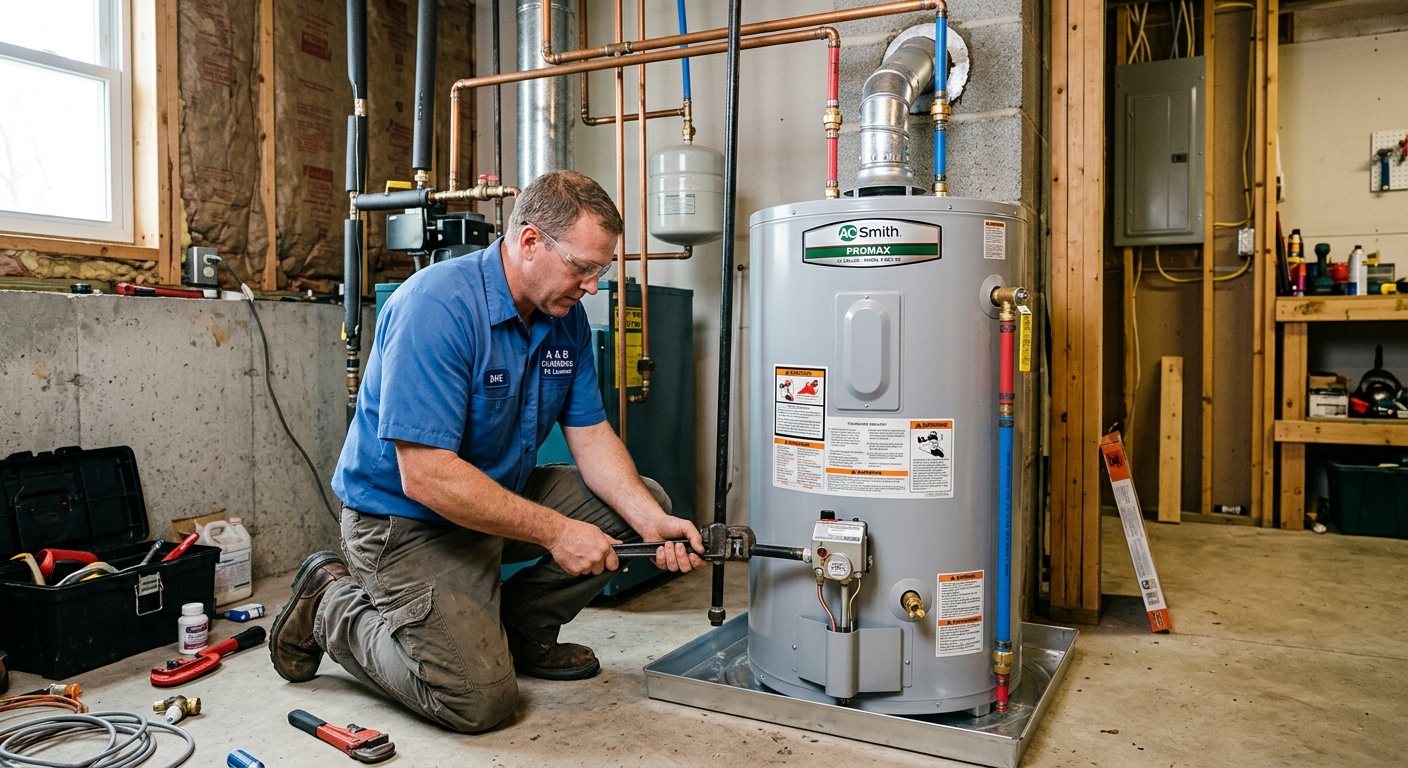
Water heaters in these homes are rarely approaching their first life — if your tank looks older than your car, odds are it’s a second or third replacement, with scale buildup always a concern if no softener is in place. Out in the newer subdivisions, usually north or west of the city, copper or PEX is common for supply lines, with PVC or ABS used for newer drain systems. Polybutylene crops up in some late 1970s through mid-1990s construction, and, if found, deserves a hard look for replacement.
Original builder-grade fixtures tend to near their end after 25–40 years, so don’t assume all is well just because a home is “newer.” In South Lebanon, housing age doesn’t just affect pipe material, but also access — retrofitting modern PEX into tight chases built in the 1950s or ’60s can add both time and cost. Every project in these homes starts by identifying what’s hidden in the walls and calculating the runway left before the next major job.
The point where patching stops making sense
At some point, continuing to patch your plumbing stops being smart and becomes a slow-motion money pit. For South Lebanon’s older homes, the signal is clear: two or more leaks on the same piping material in three years is not random — it’s a warning that the system’s time is up. Galvanized, polybutylene or even aging copper lines all reach this stage, and every new repair tends to chase the next weakest link in the chain.
Look for these signs: household-wide pressure drops (not just at one faucet), rusty or dirty water when turning on the tap, visible corrosion or green scale at exposed joints, and a history of pinhole leaks. These are not one-off nuisances; most point to widespread deterioration — common in Lebanon city’s mid-century housing stock where galvanized-to-copper or PEX repiping happens frequently during modern upgrades.
Copper can be spot-repaired if isolated and still in good shape. PEX is forgiving, usually only needing a fitting or short run replaced. The catch is, in homes built before the 1980s, plaster wall repair after plumbing can rival the pipe work itself. Older lath and plaster isn’t like drywall; finish work is labor-intensive and costs often surprise homeowners more than the repipe does. Partial repipes (just near the kitchen, just the bath) are sometimes tempting, but be honest about whether you’re just deferring the big job — costs multiply if the same crew has to come back piecemeal over a few years.
| Situation | Recommendation | Cost | Reasoning |
|---|
| One leak, accessible, modern pipe |
Spot repair |
$350–$1,250 |
Material is reliable; isolated failure |
| Two or more leaks in 3 years |
Partial repipe |
$3,600–$5,900 |
Pattern suggests systemwide weakness |
| Galvanized supply, pressure loss |
Full repipe |
$3,600–$8,800 |
Bore narrows, repeated issues likely |
| Polybutylene anywhere in the house |
Full repipe |
$3,600–$8,800 |
Uninsurable, at-risk of bursting |
| Cast iron drain with root intrusion |
Camera, then reline or replace |
$2,100–$12,500 |
Roots point to joint failure; relining stops recurring issues |
| Suspected lead service line |
Test, then replace the lateral |
$5,700–$12,500 |
Testing confirms risk; full replacement safest |
Verifying a South Lebanon plumber's credentials
Pennsylvania does not license plumbers at the state level. Instead, plumbing is regulated municipally — each city or township can set its own requirements for permits and contractor qualifications. In practical terms, a plumber licensed to work in Lebanon city might hold no credential at all in South Lebanon Township or North Londonderry Township. When you’re hiring, ask directly: “Are you licensed to work here?” That’s the only question that matters; statewide trade licensing just doesn’t exist in Pennsylvania plumbing outside Philadelphia and Pittsburgh, both of which run their own separate registries.
For any home improvement contract over $500, Pennsylvania requires written contracts under the Home Improvement Consumer Protection Act (HICPA), and your contractor must be registered with the Pennsylvania Office of Attorney General as a Home Improvement Contractor (HIC). You can verify their status at hic.attorneygeneral.gov. Don’t hire anyone who won’t show you their HIC registration.
Workers’ compensation is mandatory for every plumbing employer, and you can confirm coverage through WCAIS (wcais.pa.gov). Local code enforcement varies: in Lebanon County, the Planning Department handles Uniform Construction Code (UCC) permits for several townships. Anywhere you add a building addition or new dwelling, UCC building permits are required. Always get a copy of your permit (if one is required by your municipality) and confirm who will perform inspections — it may be the municipality or the Department of Labor & Industry for opted-out areas. For homes built before 1978, ensure EPA Lead RRP certification for any work that disturbs painted surfaces. Protection for the homeowner is strongest when all these steps are followed, so never accept shortcuts.
Galvanized, copper, PEX, cast iron
The plumbing in a typical South Lebanon or Lebanon city home is a layer cake of materials, each telling you when the last big upgrade happened. Where supply lines are original, expect galvanized steel in homes built before 1960. Galvanized looks dull gray, is heavy, and a magnet will stick to it. It corrodes from the inside out — not always obvious until water pressure plummets and leaks show. Scratch it with a screwdriver and you’ll see a silvery metal beneath. For homes redone in the ’60s or later, copper is standard — reddish brown, turns green where old joints sweat, will not attract a magnet, and is usually joined by solder. Copper is rugged but in parts of Lebanon County with aggressive water, pinhole leaks can show up by year 50. PEX tubing, flexible and usually red, blue, or white, is current practice and forgiving to retrofits. Polybutylene is a gray or blue plastic, used late ’70s through mid-’90s, and is notorious for failing at the fittings — if you spot it, consider full replacement.
Drain lines in the area’s mid-century homes are often cast iron inside (magnetic, dark, and rings when tapped) with clay tile out to the street — clay is brownish, brittle, and comes in short pipe sections, prone to root intrusion at every joint. By the late 1970s, PVC or ABS became standard; both are plastic, lightweight, and joined by glue rather than threads.
Estimate years left by era: galvanized systems are always on borrowed time if they haven’t failed. Cast iron drains hit their problems from 50 years onward. If your Lebanon home hasn’t seen a repipe since before the Reagan era, you’re due.
| Material | Typical era | Failure mode | Service life |
|---|
| Galvanized steel supply |
pre-1960 |
internal corrosion, pressure loss |
40–60 yrs |
| Copper supply |
1950s–present |
pinhole leaks, joint failure |
50–70 yrs |
| Polybutylene supply |
late 1970s–1995 |
fitting failure, sudden bursts |
unreliable |
| PEX supply |
2000s–present |
fitting or UV degradation |
40–50 yrs |
| Cast iron drain |
pre-1975 |
corrosion, cracking, scale |
50–75 yrs |
| Clay tile sewer lateral |
pre-1980 |
root intrusion at joints, offset |
50–60 yrs |
| PVC / ABS drain |
1970s–present |
joint separation, crushing |
50+ yrs |
Frequently asked questions — plumbing in South Lebanon
What do I do about a burst pipe right now?
If you’re dealing with a burst pipe in South Lebanon, the first step is to shut off the main water valve as quickly as possible. Most shutoffs are in the basement, usually near where the water line enters from outside. Turn it fully clockwise. Next, open a faucet in the lowest part of the house to drain out excess water and relieve pressure—this can limit damage before help arrives. Once water is off, mop up standing water and move belongings out of harm’s way. Only then, call a local plumber for emergency service. For this type of emergency, expect a service charge of $600–$1,250, depending on time of day and how accessible the repair is. If you’re not comfortable doing the shutoff or don’t know where it is, tell the plumber that before they come. Don’t delay—quick response is the difference between a repair bill and structural damage.
What does drain cleaning cost in South Lebanon?
Drain cleaning in South Lebanon typically ranges from $200–$500 for a standard main line blockage during business hours. If you need augering, hydro-jetting, or a camera inspection because the clog is stubborn or you suspect roots, it climbs toward $350–$800, especially on evenings or weekends. These prices reflect actual Lebanon County labor and travel patterns—not what you might hear from a city plumber out of Harrisburg or Lancaster with a big travel surcharge. Always ask if they include the camera, because that’s the best way to spot issues with older cast iron or clay pipes (common here). If a plumber quotes far more, or insists on replacing pipe before seeing what’s wrong, get a second opinion.
Do older South Lebanon homes have galvanized pipes?
Yes, a good share of homes in South Lebanon and Lebanon city were built before 1980, and galvanized steel was the standard water supply line through the 1950s and early 1960s. If the house hasn’t had a complete repipe, there’s a strong chance you have galvanized somewhere behind the walls or in the basement. Galvanized pipe loses water pressure from internal rust long before it actually leaks, and once problems start, they’re likely to keep coming. If you need more than a single patch, replacement costs in this area fall around $3,600–$8,800 for a whole-house repipe, but sometimes just the bathroom or kitchen lines are done during remodels. Get an honest assessment—sometimes partial repiping buys you time, but wholesales are unavoidable if it’s failing everywhere.
What do I do if a pipe is frozen but not burst?
In a South Lebanon winter, pipes can freeze—especially in crawlspaces or along outside walls. If you suspect a pipe is frozen but hasn’t burst (for example, no flow from certain faucets but no water seen), shut off the water supply to that section as a precaution. If you know exactly where the freeze is, you can try gently warming the pipe using a hair dryer or space heater, starting at the area nearest the faucet and moving toward the coldest spot. Never use open flames. Once flow returns, check closely for any new leaks, since pipes often split while frozen and only leak as they thaw. If you’re unsure or can’t reach the pipe, call a local plumber for professional thawing—a service that usually falls within the $350–$1,250 emergency repair band. Always address cold spots for next winter with insulation or rerouting so it doesn’t happen again.
What causes low water pressure in South Lebanon homes?
Most common culprits for low water pressure in South Lebanon are aging pipe material and buildup inside galvanized or cast iron sections, especially in homes built before the 1980s. If you have copper or PEX and pressure suddenly falls at every fixture, check your main shutoff or municipal supply for issues. Otherwise, home-wide pressure drops are usually traced to corroded galvanized piping, where the bore narrows until barely a trickle gets through. Fixing it often means a partial or whole-house repipe (around $3,600–$8,800, depending on size and material). Sometimes, just one faucet or line is affected—then the issue could be a faulty cartridge or a local clog. Don’t let anyone sell you a pressure booster until the old lines are ruled out; band-aids don’t fix corrosion.
Is a tankless water heater worth it in South Lebanon?
Tankless water heaters are marketed hard in South Lebanon, but the payback isn’t always there. Tankless models cost more upfront than standard tanks—often more to install, too, with possible gas line or venting upgrades on top. You’re looking at a starting point above the typical tank band of $1,250–$2,900. They save energy if your demand is steady and you have a large family, but for many Lebanon County homes, especially those with only two or three people, it can take many years to break even. If you replace lots of older galvanized piping during renovations, tankless is easier to add since venting can fit with new pipe runs. But unless you have specific space or unlimited hot water needs, a conventional tank still makes the most sense for most homes here.
Who owns the sewer lateral, me or the city?
In South Lebanon and Lebanon city, the property owner is responsible for the sewer lateral—the pipe that runs from your house to the city main (or to your own septic tank in surrounding townships). Issues like clogs, root intrusion, or a collapsed lateral are your problem to fix, not the municipality’s, right up to where it joins the utility’s main sewer line. Spot repairs for a failed lateral run from $2,100–$12,500, depending on the length and depth, as well as how much digging and restoration is required. In outlying townships with septic systems, the whole system—tank, lateral, and field—belongs to you, and all maintenance and replacement is on your tab. Before starting any excavation, confirm with your township and call PA One Call to mark utilities.
Does Pennsylvania license plumbers at the state level?
No, Pennsylvania does not license plumbers statewide. Instead, plumbing trade licensing is set and enforced locally—each municipality decides what, if any, license or exam is required. This means a plumber fully qualified for jobs in Harrisburg or Philadelphia may have zero standing in South Lebanon if not registered in your specific township. For consumers, the minimum state requirement is Home Improvement Contractor (HIC) registration with the Pennsylvania Office of Attorney General, verified at hic.attorneygeneral.gov. This is especially important for work over $500. Always check both the HIC registration and confirm with your township whether your plumber can pull permits in your area—don’t assume all “licensed” plumbers are legal to work on your home.
What does repiping a house cost in South Lebanon?
Repiping a whole house in South Lebanon, whether it’s upgrading from galvanized to copper or PEX, runs anywhere from $3,600–$8,800, with most typical jobs landing around $5,900. The price swings with home size, access, and whether you have old plaster or drywall walls. Labor costs account for the bulk of the expense, followed by materials; houses built before 1980 (over half in Lebanon city) usually involve more wall patching and tricky routing. If you only need part of the house done—like an isolated kitchen or bath, or half of a split-level—the cost drops, but be honest about whether you’ll just have to open up the rest in a year or two. Sometimes the best value is getting the whole job finished at once.