Plumbing costs in Lititz — 2026
Homeowners in Lititz, where 69.4% of properties are owner-occupied and 72.5% of the housing was built before 1980 (U.S. Census Bureau, ACS 2024), face some of the most variable plumbing costs in Pennsylvania. Construction era matters here: Lancaster city’s extensive pre‑1940 row and twin homes often come with old galvanized pipes, which commonly need replacing with copper or PEX, sharply impacting both the problem and the price. In these houses, supply line leaks and drain failures are typically the result not of bad luck, but predictable aging material.
The same job will cost more as an emergency—nights, weekends, or when water is actively leaking—than as a scheduled visit. For example, fixing a burst pipe after-hours might run $600–$1,200, but the same repair by appointment can be as little as $350. Spot repairs and water heater replacements show similar gaps.
| Service |
Scope |
Emergency rate |
Standard rate |
| Emergency repair — burst pipe |
locate, open, repair section, restore service |
$600–$1,200 |
$350–$1,200 |
| Water heater replacement (gas, 40–50 gal) |
remove old, install, test, haul away |
$1,900–$2,800 |
$1,200–$2,800 |
| Drain cleaning — main line |
augering or hydro-jet, camera if needed |
$350–$800 |
$200–$500 |
| Sewer line spot repair |
excavate or reline a failed section |
$2,000–$12,000 |
$2,000–$12,000 |
| Whole-house repipe |
replace supply lines throughout, patch and finish |
— |
$3,500–$8,500 |
| Water service line replacement |
street to house, excavation and restoration |
— |
$5,500–$12,000 |
Estimates for a typical Lititz home. Access difficulty and pipe material move these figures more than anything else.
Comparing plumbing estimates in Lititz
In Lititz, the way your plumber bills the job means as much as the actual problem. Two main models exist: flat rate and time-and-materials. Flat rate quotes give you one price for the job, regardless of how long it actually takes. This is good for price certainty—it bakes in the contractor’s risk for unpredictable issues. Time-and-materials (T&M), by contrast, means you pay for hours worked and materials used. On simple jobs, T&M can come out cheaper, but on anything complex (older houses in Lititz, think hidden galvanized or cast iron), it’s financially open-ended. The real trap is not understanding which you’ve agreed to.
Look at the estimate itself. Does it state what will actually be done, and if so, in what rooms and to what finish? Is there a separate diagnostic fee, and does that roll into the total if you approve the work? Are permits and patching (wall/floor) included? Warranty terms matter—labor (the installer's work) and parts (the faucets, heater) should be spelled out and separated. Emergency work should have rates and surcharges laid out up front. A well-written scope provides peace of mind; one-line quotes are trouble.
| Line item |
What to look for |
Red flag if… |
| Billing model |
flat rate or hourly, stated up front |
unstated |
| Diagnostic fee |
amount, and whether it credits |
vague |
| Scope |
what is opened, repaired and restored |
price with no scope |
| Restoration |
drywall and finish explicitly in or out |
silent |
| Permit |
included and priced |
'not needed' |
| Parts |
brand and model for fixtures |
'standard fixture' |
| Warranty |
labour period stated separately |
parts only |
Verifying a Lititz plumber's credentials
Plumbing licensing in Pennsylvania is handled at the municipal level, not by the state. This means a plumber licensed in one city may not be approved to work in the next township. In other words, the right question to ask is, “Are you licensed to work here in Lititz?”—not just “Are you licensed?”
Lancaster County is a patchwork: Lancaster city enforces permits for any plumbing work that physically alters, expands, or adds value to a property. In the city, you’ll deal with the Bureau of Building Code Administration; surrounding townships, including areas around Lititz, run their own codes or zoning offices. For minor repairs, like replacing a toilet flapper or faucet, permits usually aren’t needed. If the job involves replacing pipes, opening walls, or changing the system, a plumbing permit is almost always required. If in doubt, your contractor should take responsibility for the permit and inspection process.
For projects over $500, any contractor must be registered with the Pennsylvania Office of Attorney General as a Home Improvement Contractor (HIC)—you can verify their number at hic.attorneygeneral.gov. All employers must also carry workers’ compensation insurance, which you can confirm through WCAIS at wcais.pa.gov. Ask to see both the insurance certificate (with your property named) and proof of HIC registration before work begins. In older homes (pre-1978), federal EPA rules also apply for lead, and you can verify certification at certifiedrenovatorsearch.epa.gov.
Finding a hidden leak in Lititz
If you suspect a hidden leak in your Lititz home, start with a simple test: shut off every fixture and appliance that uses water, then check your water meter. If the dial is still moving, you have a supply-side leak—even with nothing running. This step is free and tells you whether to keep hunting inside or call a pro.
Professional leak detection in Lititz uses several tools. Acoustic listening equipment can pinpoint pipes leaking inside walls or floors, usually running $350–$800, rolled into an emergency rate if urgent. Infrared thermal imaging traces temperature changes that signal moisture, useful for slow leaks in wall cavities or ceilings. Tracer gas (a mix of hydrogen and nitrogen) is rare for most homes but valuable for locating very small leaks or ones under concrete slabs.
Slab leaks—where the main water line runs through a basement floor—are diagnosed first by isolating each branch to confirm the leak's location, not by busting up concrete blindly. For irrigation line leaks outside, a combination of pressure testing and electronic listening narrows the search before any digging begins. No reputable Lititz plumber should open up walls, ceilings, or floors before positive location. With construction this old, tearing things apart without proof does more harm than good.
Dating your plumbing by what it's made of
In Lancaster city and throughout Lititz, the material in your pipes offers a direct clue to both age and risk. Pre‑1940 row and twin homes, common in the county, were almost always built with galvanized steel supply lines and cast iron drains. Galvanized pipes, which are dull gray, often threaded at the joints and magnetic, corrode on the inside. Over decades, pressure drops as the bore narrows before you ever see a leak.
Homes built after World War II commonly switched to copper supply lines—copper’s reddish tint and soldered joints are easy to spot. Copper offers better water pressure but can develop pinhole leaks, especially with Lancaster’s sometimes aggressive water chemistry. Late 1970s to mid-90s brought polybutylene, a blue-gray flexible plastic. If you find flexy blue-gray pipe with crimped aluminum bands, that’s polybutylene—it fails suddenly at the fittings and is now widely uninsurable.
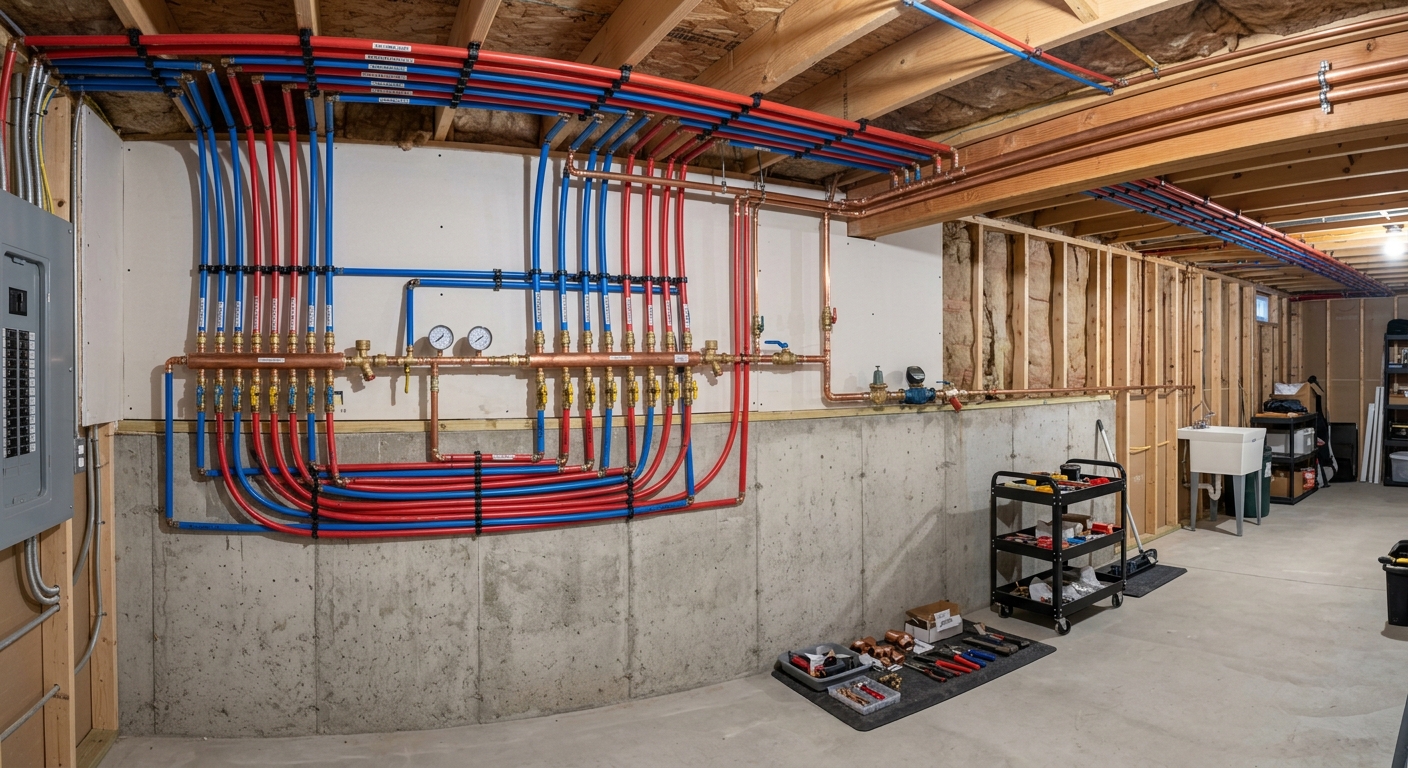
Most modern installs are PEX—plastic, typically red or blue, connected with brass or plastic crimp rings. For drains, older homes will still have cast iron (dark, heavy, magnetic), with clay tile (tan and brittle) used on sewer laterals until about 1980. PVC and ABS are white or black plastic installed from the 1970s forward.
If your copper is original 1950s or 60s, plan for replacement within the next ten to twenty years. Galvanized should be replaced as soon as practical: the low pressure and rust risk mean you’re living on borrowed time, and a whole-house repipe runs $3,500–$8,500.
| Material |
Typical era |
Failure mode |
Service life |
| Galvanized steel supply |
pre-1960 |
internal corrosion, pressure loss |
40–60 yrs |
| Copper supply |
1950s–present |
pinhole leaks, joint failure |
50–70 yrs |
| Polybutylene supply |
late 1970s–1995 |
fitting failure, sudden bursts |
unreliable |
| PEX supply |
2000s–present |
fitting or UV degradation |
40–50 yrs |
| Cast iron drain |
pre-1975 |
corrosion, cracking, scale |
50–75 yrs |
| Clay tile sewer lateral |
pre-1980 |
root intrusion at joints, offset |
50–60 yrs |
| PVC / ABS drain |
1970s–present |
joint separation, crushing |
50+ yrs |
Vetting a plumber in Lancaster County
Because plumbing licensure is handled municipally in Pennsylvania, Lititz homeowners must verify credentials in their own township. Always ask if the company is licensed to work in Lititz specifically, not just the next town over. Check for a current Home Improvement Contractor (HIC) registration at hic.attorneygeneral.gov, and request a certificate of insurance that names your property and covers both liability and workers’ compensation, verifiable at wcais.pa.gov.
In Lancaster County’s mixed urban-rural market, some companies keep their own work crews; others subcontract. Emergency dispatch fees and after-hours surcharges should be disclosed in writing. For old houses, beware the company recommending a whole-house repipe or sewer lateral without showing you camera footage or a clear pressure test—solutions should match the diagnosis.
- Confirm HIC registration via hic.attorneygeneral.gov
- Ask if licensed to work in Lititz
- Obtain insurance certificate naming your address
- Check workers’ comp status at wcais.pa.gov
- Request permit responsibility in writing
- Get a written scope and warranty, not just a price
- Ask if drywall/finish is included
- Require emergency rates in writing before approval
- Ask whether crews are direct employees or subs
- Insist on video/camera evidence for sewer or repipe proposals
- Check for EPA lead-safe certification for pre-1978 homes
- Don’t accept “standard fixture”—demand model info
In a moderately dense market like Lancaster County, aggressive upselling and vague pricing are red flags. Never approve sewer replacement or major repipe based on a quick look—ask for proof.
Camera inspection, relining and replacement
In Lititz, as across almost all of Lancaster County, the homeowner is responsible for the sewer lateral running from the house all the way to the main, sometimes right to the curb or even into the street. This point of ownership causes frequent disputes—know where your responsibility ends.
Symptoms start small: a single slow drain, progressing to multiple slow drains or gurgling, and eventually a backup at the lowest fixture in the home (usually a basement drain or shower). Before any excavation or major repair quote, a plumber should run a camera from an accessible cleanout to visually inspect the lateral. In homes built before 1980, with clay tile laterals common around Lititz, the biggest culprits are root intrusion at the joints and sections that have shifted (offsets) or sunk (bellies).
Relining (trenchless) can restore interior smoothness and block roots without open trenching, but if the pipe has collapsed or is heavily offset, a full open-cut replacement may be your only option. Never accept a sewer repair or replacement quote without seeing the camera footage—the evidence is the difference between a $500 cleaning and a $12,000 dig.
If your property isn’t in the city and uses septic, the issue is completely different: regular tank pumping (every 3–5 years) and monitoring drainfield function are critical. Slow or backed-up drains on septic often mean problems outside the plumbing, not inside.
Frequently asked questions — plumbing in Lititz
Can I do my own plumbing work in Lititz?
In Pennsylvania, plumbing licensing is handled by each municipality. In most cases throughout Lancaster County, including Lititz, you can legally perform minor plumbing repairs on your own home—like swapping out faucets or repairing a toilet—provided the work doesn’t alter or expand the supply or drain system. Anything that involves opening walls, adding new fixtures, or replacing pipe branches usually triggers permit requirements. For those jobs, a professional must pull the permit and have the work inspected. If you skip the permit, you could run into trouble with insurance, future home sales, or just getting work corrected. Even if you do the labor yourself, expect at least an inspection fee from the city or township. For any job where a pro would charge over $500, a written contract and proper registration (HIC) is required under the Home Improvement Consumer Protection Act.
What does emergency plumbing cost in Lititz?
Emergency plumbing in Lititz—think burst pipes, severe leaks, or a backed-up sewer—comes at a premium, especially if you call after-hours or on weekends. Most local plumbers have a higher dispatch or diagnostic fee for nights and weekends, often rolled into the total bill if you approve their recommended work. For a burst pipe, the typical emergency repair is in the $600–$1,200 range, compared to $350 if you can wait for a regular appointment. Water heater replacement in an emergency also runs higher—from $1,900–$2,800. Always ask for written emergency rates, and be cautious if the estimate lacks itemized emergency surcharges—clarity up front prevents surprises.
What do I do if sewage is backing up?
If sewage is backing up into a Lititz home, stop running water immediately—don’t flush toilets, run washers, or let sinks drain until the cause is identified. If you’re on city sewer, the top causes are a blockage in the main drain (inside or just outside the house) or a failing sewer lateral, especially in areas with older clay tile sewer lines. Camera inspection should always come before agreeing to any major work or excavation, since a simple clearing might resolve what looks like a huge problem. For sewer line spot repairs in Lititz, expect between $2,000–$12,000, but a camera inspection or hydro-jetting might fix it for as little as $200–$800. If you’re on septic, a tank pump-out (typically $300–$500, not a plumbing job per se) might be needed, especially if the backup is at every fixture.
Do older Lititz homes have galvanized pipes?
Yes—Lititz and Lancaster city neighborhoods are packed with houses built before 1940, where galvanized steel supply pipes were the norm. These pipes corrode from the inside over time, leading to low water pressure and discolored water. In fact, most calls for poor pressure in older homes end up tracing back to old galvanized lines. If your house is older and has never been repiped, replacing those lines with copper or PEX is a common job, with a typical cost in Lititz of $3,500–$8,500 for a whole-house update. You can check with a magnet or by scratching the surface: galvanized will look silver-gray, be magnetic, and usually has threaded joints.
What do I do if a pipe is frozen but not burst?
In Lititz, winters regularly bring hard freezes, and frozen pipes are a routine headache. If you suspect a pipe is frozen but hasn’t burst (i.e., no water getting through, but no visible leak), turn off the water supply to that branch of the house if you can. Open the faucet nearest the freeze to relieve pressure. Gently warm the pipe with a hair dryer or portable heater—never use an open flame. Older homes with pipes run through unheated crawlspaces or exterior walls are most at risk. If you catch the freeze before a burst, you’ve likely saved yourself an emergency repair of $600–$1,200. If you can’t thaw it, or if you find evidence of a split once thawed, call a pro right away.
What causes low water pressure in Lititz homes?
Low water pressure is one of the top complaints from Lititz homeowners, especially in older homes with galvanized pipes. These pipes fill with scale and rust, restricting flow long before you see leaks or visible corrosion. If your home was built before 1960 and you experience poor pressure at all fixtures, suspect old galvanized lines and consider a repipe—costing between $3,500–$8,500. Other causes include main supply line leaks (check your water meter for signs of a hidden leak), pressure-reducing valve failures, or local utility work temporarily lowering pressure. For newer homes with copper or PEX, the problem is often at a specific fixture or shut-off, which can be fixed quickly and affordably.
Is a water softener worth it in Lititz?
Water in Lititz comes from the City of Lancaster Water Bureau for most city addresses (see county facts), and suburban areas tap into local municipal sources. While the hardness level is moderate, some find scale buildup in appliances and on fixtures to be a nuisance. If you notice frequent scale on shower heads or reduced efficiency in your water heater, a basic water softener might be justified—installation typically runs under $2,800 if bundled with a new water heater. That said, not every house truly needs one; periodic descaling and cleaning are effective in many cases. For those on well water in outlying townships, water chemistry varies and testing is the first step before any investment in softeners or filters.
How much does a plumber cost in Lititz?
Most service calls for Lititz homeowners—diagnosing and repairing leaks, clearing a clog, or replacing a water heater—range from $200–$2,800, depending on urgency and what’s needed. Standard repairs, like fixing a dripping pipe or replacing a toilet, usually fall at the lower end. If you need major work—like a whole-house repipe, sewer line spot repair, or water service replacement—the total runs from $3,500–$12,000. Always request an itemized estimate that spells out the billing model, scope, restoration, warranty, and permit fees. In Lititz, the biggest price differences come from whether you’re dealing with old galvanized, copper, or PEX, and whether the job must be handled as an emergency.
Does insurance cover a burst pipe in Lititz?
In Lititz and throughout Pennsylvania, most homeowners insurance policies cover damage from a burst pipe—such as water-soaked drywall or flooring—but not the plumbing repair itself. So, if a pipe freezes and bursts, your insurer will generally pay for cleanup and repairs to your home’s structure, but the plumber’s bill for stopping the leak, which averages $600–$1,200 for a typical emergency repair, is usually your responsibility. Keep in mind: insurance won’t cover damage due to longstanding neglect or unheated spaces left unprotected. Always report and document water damage promptly, and check your policy for specific exclusions. Never trust a contractor who offers to waive your deductible, as that’s prohibited under Pennsylvania law.