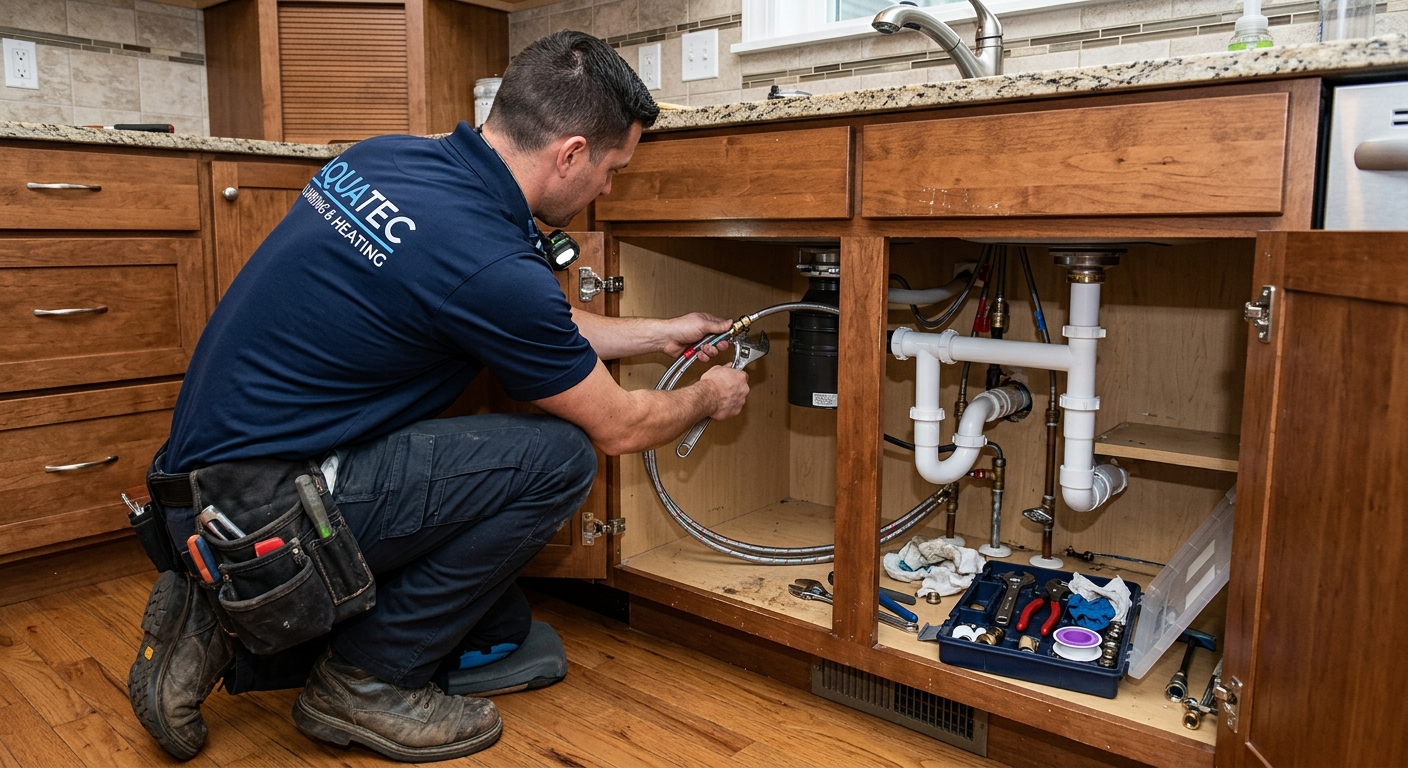
Hatboro plumbing prices by job type — 2026
Hatboro, with its population of 8,176 and 80.5% of homes built before 1980 (U.S. Census Bureau, ACS 2024), is a classic southeastern Pennsylvania suburb where your plumbing costs are closely tied to the age of your home. Most houses from the 1950s to the 1970s were built with galvanized or early copper pipes, which means jobs like repiping, water heater replacement, and emergency leak repair are especially common here. What catches many homeowners off guard is not just the cost of the plumbing, but that the same repair can cost double if it’s an emergency. If you have an active leak after hours or over a weekend, you can expect to pay a premium for the initial dispatch, even before a wrench turns.
In Hatboro, pipe material and access matter most when estimating your costs. Galvanized lines that have aged out can mean you’re deciding between ongoing spot repairs and a one-time repipe, while cramped crawlspaces or finished basements can drive up labor for even simple repairs. Dense housing means most jobs have short travel times—no extra miles to bill for, but you will see prices land right in the local bands with little room for negotiation.
| Service |
Scope |
Emergency rate |
Standard rate |
| Emergency repair — burst pipe |
locate, open, repair section, restore service |
$650–$1,300 |
$375–$1,300 |
| Water heater replacement (gas, 40–50 gal) |
remove old, install, test, haul away |
$2,100–$3,100 |
$1,300–$3,100 |
| Drain cleaning — main line |
augering or hydro-jet, camera if needed |
$350–$800 |
$200–$500 |
| Sewer line spot repair |
excavate or reline a failed section |
$2,200–$13,000 |
$2,200–$13,000 |
| Whole-house repipe |
replace supply lines throughout, patch and finish |
$3,800–$9,300 |
$3,800–$9,300 |
| Water service line replacement |
street to house, excavation and restoration |
$6,000–$13,000 |
$6,000–$13,000 |
Estimates for a typical Hatboro home. Access difficulty and pipe material move these figures more than anything else.
Water heater replacement decisions
In Hatboro, where most homes date to the 1950s, 60s, and 70s, your water heater choice matters for both comfort and cost. Tank-style water heaters are the least expensive to install and fit most people's needs, but because they store hot water, they waste energy just sitting. Expect a shorter service life (typically 8–12 years for a gas model) and sooner replacement, especially with hard water from public systems. Tankless gas units give endless hot water and take up less space, but that extra convenience comes with a higher initial price and often requires upgrading your gas line and vent—surprises that can run your installation bill higher than you think.
Heat pump water heaters are the lowest to run for energy, making sense only if you have enough space, some warmth, and you don’t mind the cool air and compressor noise. Installing one in a finished basement or tight laundry closet isn’t ideal, especially in Hatboro's older homes. Electric tank units cost less up front, but they run at the highest ongoing cost. Sizing should be by first-hour rating (how much hot water you’ll get in an hour of heavy use), not just tank volume. Don’t skip the expansion tank or a drip pan with a drain—code requires them in most replacements, and they save headaches.
Most failures happen because the tank rusts out, not because the controls or burners go bad. If your heater is leaking from the bottom, it’s time to replace—it can’t be patched. Whichever type you choose, check that your installer plans for the full code requirements—not just swapping the tank.
| Type |
Installed cost |
Service life |
Operating cost |
Best when |
| Gas tank, 40–50 gal |
$1,300–$3,100 |
8–12 yrs |
moderate |
Existing gas, simple replacement |
| Electric tank, 40–50 gal |
$1,300–$2,100 |
10–15 yrs |
high |
No gas supply, moderate use |
| Gas tankless |
$2,100–$3,100 |
18–25 yrs |
low-moderate |
High demand, want endless supply |
| Heat pump water heater |
$2,100–$3,100 |
13–15 yrs |
lowest |
Plenty of space, unfinished basement |
Spot repairs or whole-house repipe?
In Hatboro homes from the 1950s through the 1970s, most pipe failures are not a once-in-a-lifetime event. If you've had two or more leaks on the same type of pipe in three years, that's the tipping point—ongoing spot repairs are usually throwing good money after bad. The real signals: you notice weak pressure everywhere (not just one faucet), rusty or yellow water out of a tap that clears up, corrosion at pipe joints you can see, or you keep patching pinholes that seem to appear randomly. Those are all pointing to a failing supply system.
For one leak, especially on accessible modern pipe, a spot repair makes sense; you’ll pay somewhere between $375–$1,300. But once the pattern sets in, repiping (either partial or whole-house) is the right move. In these older houses, copper and PEX are your primary choices. Copper lasts longer and is proven but is pricier up front. PEX is easier to work with, less invasive, and generally comes in lower on labor costs. Don't overlook what’s on the other side of the walls—hat older Hatboro housing has plenty of plaster, and patching and painting after a repipe can rival the plumbing itself for cost and hassle.
| Situation |
Recommendation |
Cost |
Reasoning |
| One leak, accessible, modern pipe |
Spot repair |
$375–$1,300 |
Isolated incident, pipe is in good shape otherwise |
| Two or more leaks in 3 years |
Partial repipe |
$3,800–$6,200 |
Emerging pattern – underlying material is at end of life |
| Galvanized supply, pressure loss |
Full repipe |
$3,800–$9,300 |
Galvanized never recovers, flow will keep dropping |
| Polybutylene anywhere in the house |
Full repipe |
$3,800–$9,300 |
Material is unreliable, insurance issues |
| Cast iron drain with root intrusion |
Camera, then reline or replace |
$2,200–$13,000 |
Patch repairs don’t last, address the segment |
| Suspected lead service line |
Test, then replace the lateral |
$6,000–$13,000 |
Eliminate health risk, permanent fix |
Galvanized, copper, PEX, cast iron
The year your Hatboro house was built says nearly everything about the plumbing material behind your walls. If it’s pre-1960, galvanized steel pipes ruled the day—these look dull gray, are magnetic, and have threaded joints. By the mid-1950s, copper became the suburban standard: bright when scratched, not magnetic, and joined with soldered fittings. Polybutylene made a brief, problematic appearance from the late '70s into the '90s. Current practice is PEX—flexible, usually blue or red, and joined with crimp bands. Your drains are likely cast iron (thick, dull, and heavy) or, if your home was updated in the last few decades, plastic (PVC or ABS).
Failures follow a pattern: galvanized slowly clogs before it leaks; old copper gets pinholes if the water is aggressive; polybutylene is a ticking time bomb at the fittings; cast iron eventually cracks and scales up, sometimes inviting root intrusion in older main drains made of clay tile. Scratch an exposed pipe or check those joints—what you see gives a clue to your risk, and with most Hatboro homes now over 50 years old, it is worth asking how much longer you have until a project forces your hand.
| Material |
Typical era |
Failure mode |
Service life |
| Galvanized steel supply |
pre-1960 |
internal corrosion, pressure loss |
40–60 yrs |
| Copper supply |
1950s–present |
pinhole leaks, joint failure |
50–70 yrs |
| Polybutylene supply |
late 1970s–1995 |
fitting failure, sudden bursts |
unreliable |
| PEX supply |
2000s–present |
fitting or UV degradation |
40–50 yrs |
| Cast iron drain |
pre-1975 |
corrosion, cracking, scale |
50–75 yrs |
| Clay tile sewer lateral |
pre-1980 |
root intrusion at joints, offset |
50–60 yrs |
| PVC / ABS drain |
1970s–present |
joint separation, crushing |
50+ yrs |
Who is allowed to do plumbing work in Pennsylvania
In Pennsylvania, plumbing is not licensed at the state level. The Pennsylvania Uniform Construction Code (UCC) sets the rules, but actual licensing and permitting are handled by each municipality. That means a plumber who is licensed and familiar with code inspections in Norristown may have no legal standing at all in the next township. For you in Hatboro, the right question is not “are you licensed” but “are you licensed here, in this municipality?” Always confirm before signing a contract.
Permits are required for plumbing alterations, repipes, water heater installs, or any changes to your water, sewer, or vent piping. Minor, like-for-like fixture swaps without piping changes usually don’t need a permit. Local municipal offices handle inspection, not the state.
For contracts over $500, make sure your contractor has a Home Improvement Contractor (HIC) registration from the Pennsylvania Office of Attorney General—verify it at hic.attorneygeneral.gov. Every employer working on your house in Hatboro must carry workers' compensation insurance, which you can confirm via WCAIS (wcais.pa.gov). For work in older homes, any disruption to painted surfaces requires an EPA Lead Renovation, Repair, and Painting (RRP) certified renovator if your home dates before 1978. No plumber should offer to waive your homeowner’s insurance deductible; that’s prohibited by state law.
Hardness, treatment and fixture life in Hatboro
Hatboro gets its public water supply from Aqua Pennsylvania, which means you’re on the same system as most Montgomery County residents in this area. All public water providers are required to publish an annual water quality report—if you’re curious about exactly what's in your water or how hard it is, request that report directly.
Water hardness in this region is moderate, and you’ll see scale accumulation in fixtures and inside your water heater over time. That buildup shortens water heater life and can reduce flow through aerators and showerheads, but for most Hatboro homeowners, it’s an annoyance, not a crisis. Some copper pipes develop pinhole leaks sooner with aggressive (lower pH) water, but this is less common on Aqua Pennsylvania supply compared to older private wells.
Whole-house water softeners remove scale but come with upfront and ongoing salt costs. They make sense for specific appliances, like tankless water heaters, but many Hatboro homes do well without them. Point-of-use filters (under the sink or at the fridge) are a good choice for taste and chlorine removal, but whole-house carbon filters are rarely worth it unless there’s a specific taste or odor problem. Don’t let anyone convince you to buy unnecessary expensive filtration—know your water first.
Frozen pipes in Hatboro: prevention and thaw
Hatboro winters see a frost depth of 30 inches and a winter design temperature of 14°F, with the region experiencing moderate freeze-thaw cycles—enough to burst unprotected pipes when the cold hits. Most pipe bursts don’t happen exactly where the ice forms. Instead, as ice blocks the pipe, pressure builds up between the ice plug and a closed faucet or valve, and the pipe ruptures wherever it’s weakest—sometimes feet away from the actual freeze.
Vulnerable areas in Hatboro homes are exterior wall runs, crawlspaces, garages, unconditioned attics, and outside hose bibs. Pipes near rim joists in unfinished basements are also high-risk. Prevention is straightforward and costs less than a single service call: add pipe insulation, install heat tape where pipes can’t be moved, allow a slow trickle during the coldest nights, open cabinet doors under sinks to let warm air circulate, and always shut off and drain outdoor spigots before the first hard freeze.
If you do discover a frozen section, use a hair dryer or a heating pad—never an open flame, which is an actual fire risk and not permitted. Addressing a burst pipe after the fact runs anywhere from $375–$1,300 in Hatboro. Preventing a freeze with basic materials is always the better bet.
Frequently asked questions — plumbing in Hatboro
How much does a water heater replacement cost in Hatboro?
A standard water heater replacement in Hatboro runs between $1,300–$3,100, depending on whether you need a gas or electric unit, and how complex the installation is. The lower end covers a straightforward swap in an accessible basement without unexpected repairs. If your home is older (like many built before 1980 here), you might also need upgrades like an expansion tank, updated venting, or a new drip pan to meet code. Emergency replacements, nights or weekends, are at the upper end of the band. Don’t be surprised if your installer suggests a model with a better first-hour rating—that’s more important than raw gallon size for most families in this market.
What does repiping a house cost in Hatboro?
Repiping a whole home in Hatboro costs between $3,800–$9,300, depending on the pipe material (copper is pricier than PEX) and how much finish work your walls require. Most of Hatboro's housing stock is from the 1950s to 1970s, so these jobs are common. The plaster walls and sometimes tricky access in older homes add labor—and the repair to surfaces after the plumbing can be half the project. If you’ve had repeated leaks or your house still has galvanized or polybutylene, a full repipe is usually more cost-efficient over a few years than endless spot repairs. Always ask for a detailed estimate that includes both pipe replacement and wall patching.
Is trenchless sewer repair reliable?
Trenchless sewer repair can be a reliable solution for many Hatboro homes, especially if your sewer lateral is made of clay or early cast iron (typical for pre-1980 houses). Modern trenchless methods (like pipe lining or pipe bursting) limit yard damage and reduce restoration costs, but they are not always an option if your pipe has collapsed or if roots have invaded extensively. Expect costs between $2,200–$13,000, depending on the length and access. Always insist on a camera inspection beforehand—Hatboro’s dense, older lots often have tricky curves or offsets that some trenchless equipment can’t manage.
Am I responsible for the water line under the street?
In Hatboro, as in most of Montgomery County, property owners are responsible for the water service line from the street main to their home—including the section under sidewalks or even the street right-of-way. If this lateral fails or leaks, replacement costs typically run from $6,000–$13,000. The public water utility, Aqua Pennsylvania, covers only the main line—not service laterals. Always check if you have insurance or a warranty plan for this section; for older homes, testing for lead is wise, and full replacement is now best practice, especially on pre-1980 lines.
Does Pennsylvania license plumbers at the state level?
Pennsylvania does not license plumbers at the state level. Instead, each municipality has its own rules. In Hatboro, this means your plumber must be licensed specifically within the local jurisdiction—not just somewhere else in the state. Always ask, “are you licensed here?” and don’t just settle for a Home Improvement Contractor (HIC) number. Permits are required for most plumbing changes such as water heater replacements or major repairs, which usually run from $375–$1,300. If in doubt, your municipal code enforcement office can confirm your contractor’s credentials.
What causes low water pressure in Hatboro homes?
The most common causes of low water pressure in Hatboro are aging galvanized steel pipes, partially closed main shutoff valves, and mineral build-up in older fixtures. Most homes here, built before 1980, had galvanized or early copper plumbing, so if you notice whole-house pressure drops (not just at one faucet), your pipes may be closing up inside with rust or scale. Repeated repairs on these old systems eventually cost more than replacement—a full repipe falls in the $3,800–$9,300 range. If you’re on Aqua Pennsylvania’s system and only one fixture is slow, cleaning out aerators and showerheads can help. If the problem is house-wide, it’s probably time for a camera inspection and a talk about options.
What do I do if sewage is backing up?
If you have sewage backing up in the basement or worse, stop using water immediately and call a local Hatboro plumber. This can be urgent—backups often signal a main line blockage from roots (common with older clay or cast iron laterals) or a collapsed pipe. The typical cost for main drain clearing is $200–$500, but if the problem is further out in the yard, relining or spot repair could run up to $13,000. Always insist on a camera inspection first before major digging—many issues can be solved without full excavation, especially in the denser neighborhoods of suburban Montgomery County.
Should I leave a faucet dripping in cold weather?
In Hatboro, where winter design temps hit 14°F and the frost line runs 30 inches deep, letting a faucet drip slightly on the coldest nights is cheap insurance. This keeps water moving, which makes freezing far less likely—especially for lines in exterior walls or unheated crawlspaces common in older local homes. The cost to repair a burst pipe after a freeze is $375–$1,300, but leaving a single faucet on rarely adds more than a few dollars to your bill for a night or two each season. Combine this with insulating pipes and keeping cabinets open around plumbing for best results.
How hard is the water in Hatboro?
Water in Hatboro, supplied by Aqua Pennsylvania, is typically considered moderately hard. This means some scale will build up on fixtures and inside appliances, shortening the efficient life of things like water heaters (sometimes pushing replacements closer to the lower end of the $1,300–$3,100 range). Most homeowners here get by with routine cleaning and periodic descaling, but if you notice rapid buildup, a water softener can help for certain appliances. Always request your utility’s latest water quality report if you want details—the public system is required to provide it annually. Whole-house filtration is usually only needed for taste or odor, not hardness, in this area.