What plumbers charge in Windsor
In Windsor, plumbing costs can swing widely depending on the nature of the job and how soon you need it done. Emergency calls—meaning a burst pipe or water gushing somewhere—almost always come at a premium, not just for the work but for mobilizing a crew fast. Routine work, scheduled during regular hours, costs less. The difference can be hundreds of dollars for exactly the same repair.
Windsor homeowners are mostly living in single-family houses (78.6%), with a steady presence of properties built before 1980 (31.8%) (U.S. Census Bureau, ACS 2024). This era matters—York City’s housing stock largely dates 1900–1950, so it’s common to find original galvanized lines (which corrode shut and eventually leak) alongside copper or PEX from more recent repairs. Materials drive both the problem and the price: corroded galvanized means shutoffs and frequent repipes, while copper and PEX are less trouble until they approach end of life or run into poor water chemistry.
In short, know if your call is an emergency or routine, and know what pipe’s in your walls—both weigh hard on what you’ll pay. Here’s what Windsor homeowners typically see:
| Service |
Scope |
Emergency rate |
Standard rate |
| Emergency repair — burst pipe |
locate, open, repair section, restore service |
$650–$1,250 |
$375–$1,250 |
| Water heater replacement (gas, 40–50 gal) |
remove old, install, test, haul away |
$2,000–$2,900 |
$1,250–$2,900 |
| Drain cleaning — main line |
augering or hydro-jet, camera if needed |
$350–$800 |
$200–$500 |
| Sewer line spot repair |
excavate or reline a failed section |
$2,100–$12,500 |
$2,100–$12,500 |
| Whole-house repipe |
replace supply lines throughout, patch and finish |
— |
$3,700–$8,900 |
| Water service line replacement |
street to house, excavation and restoration |
— |
$5,800–$12,500 |
Estimates for a typical Windsor home. Access difficulty and pipe material move these figures more than anything else.
Is your water line lead? How to find out
Homeowners in Windsor are served by York Water Company, which publicly reported it completed replacement of all known lead service lines in its York City system after a full inventory. That covers both the utility-controlled segment (street to curb) and—where programs applied—sometimes the customer-owned segment (curb to house). Still, in older homes, especially those from the early 1900s to 1950, it’s smart to check the pipe coming into your basement to confirm what you actually have.
Private lateral lines are your responsibility. The split point is almost always at the curb or property edge: York Water Company takes care of their side, but from the curb in, it’s on the homeowner. Replacement programs elsewhere often only cover the utility half, so if you’re outside York City or unsure, always ask York Water Company directly—don’t assume the whole line was swapped. Some municipalities ask for shared cost, but unless you read that from an official York Water Company notice, plan to cover yours.
To check material: look where the water line comes through your wall or floor—often near the water meter. Use a coin to scratch the pipe. If it’s shiny gray and magnets won’t stick, it could be lead. Copper is reddish, and galvanized is dull gray but magnetic. Be aware that replacing just half a lead line can spike lead levels temporarily by disturbing built-up scale—so full replacement, not a partial, is the safest call.
Should you need to replace a private water service line, Windsor homeowners typically pay $5,800–$12,500. If a whole-house repipe is triggered by in-house materials, expect $3,700–$8,900. Call your water company first for a current status and potential cost-sharing; don’t spend a dollar without confirming what’s already been done.
Licensing and permits for plumbing work in Windsor
Pennsylvania does not have a statewide plumbing license system. Instead, licensing—where it exists—is done by each municipality. That means a plumber licensed in York might be unlicensed across the township line, so the key question is, “Are you licensed here?” Spring Garden Township, within York County, operates its own plumbing license registry—if your home falls there, make sure the contractor is listed. Outside of these, look for Home Improvement Contractor (HIC) registration, which Pennsylvania requires for work over $500. You can confirm an HIC registration at hic.attorneygeneral.gov.
Permits are another local matter. In York City, any work that alters or installs new plumbing beyond mere fixture swap-outs requires a permit and inspection from the City of York Bureau of Permits and Inspections. Swaps done in the same location—like replacing a faucet—do not typically need one. In surrounding Windsor-area townships, check the local permit office. For any permitted job, ask who will handle inspections, and request a copy of the permit.
Insurance matters, too. Pennsylvania mandates workers’ compensation for all employers, which you can verify at WCAIS (wcais.pa.gov). Never take a contractor’s word—online lookups are built for homeowners to check directly. If in doubt on credentials or scope, ask your township’s office before signing.
Finding a hidden leak in Windsor
If you suspect a hidden leak in your Windsor home, start with a simple, free check: the meter test. Shut off every faucet, appliance and fixture. If your water meter’s dial still moves, you’ve almost certainly got a supply-side leak somewhere between the meter and your pipes or fixtures.
Professional leak detection builds from there. The main methods are:
acoustic listening devices (for pipes inside walls or floors),
thermal imaging (finding warm or cold areas caused by leaking pipes, especially hot water), and,
in rare, stubborn cases, tracer gas (injecting an inert gas and using a sensitive sniffer to find where it escapes). Slab leaks (where a pipe runs under a concrete slab) typically require a combination of acoustic and thermal tools. Leaks inside wall cavities are usually located with listening and thermal scans—no one should open up drywall in Windsor unless they’ve identified at least the zone first. Irrigation line leaks outdoors often need tracer gas or acoustic gear to distinguish from seasonal ground saturation.
A thorough leak detection and isolation in Windsor typically runs from $375–$1,250, depending on how invasive or urgent the work becomes. If your plumber wants to break open walls before doing any locating with meters or cameras, that’s backwards—find first, open up later for repair.
Galvanized, copper, PEX, cast iron
The era your Windsor home was built in nearly always tells you what’s in the walls. York City’s housing stock largely dates 1900–1950, so older homes are often a patchwork: galvanized steel, swaps to copper or PEX, sometimes cast iron for drains, and the occasional clay tile sewer lateral. Here’s what to look for and how to tell what you’ve got:
- Galvanized steel: Dull gray, magnetic, threaded fittings. Scratches to a silvery finish. Found in homes before 1960, these pipes corrode from the inside out, losing pressure before springing leaks. If your water pressure drops over time and fixtures are slow, likely culprit.
- Copper: Bright reddish or brown, nonmagnetic, joined by solder. Common since the 1950s in York. Long-lived but can develop pinholes in aggressive water or from electrical grounding issues.
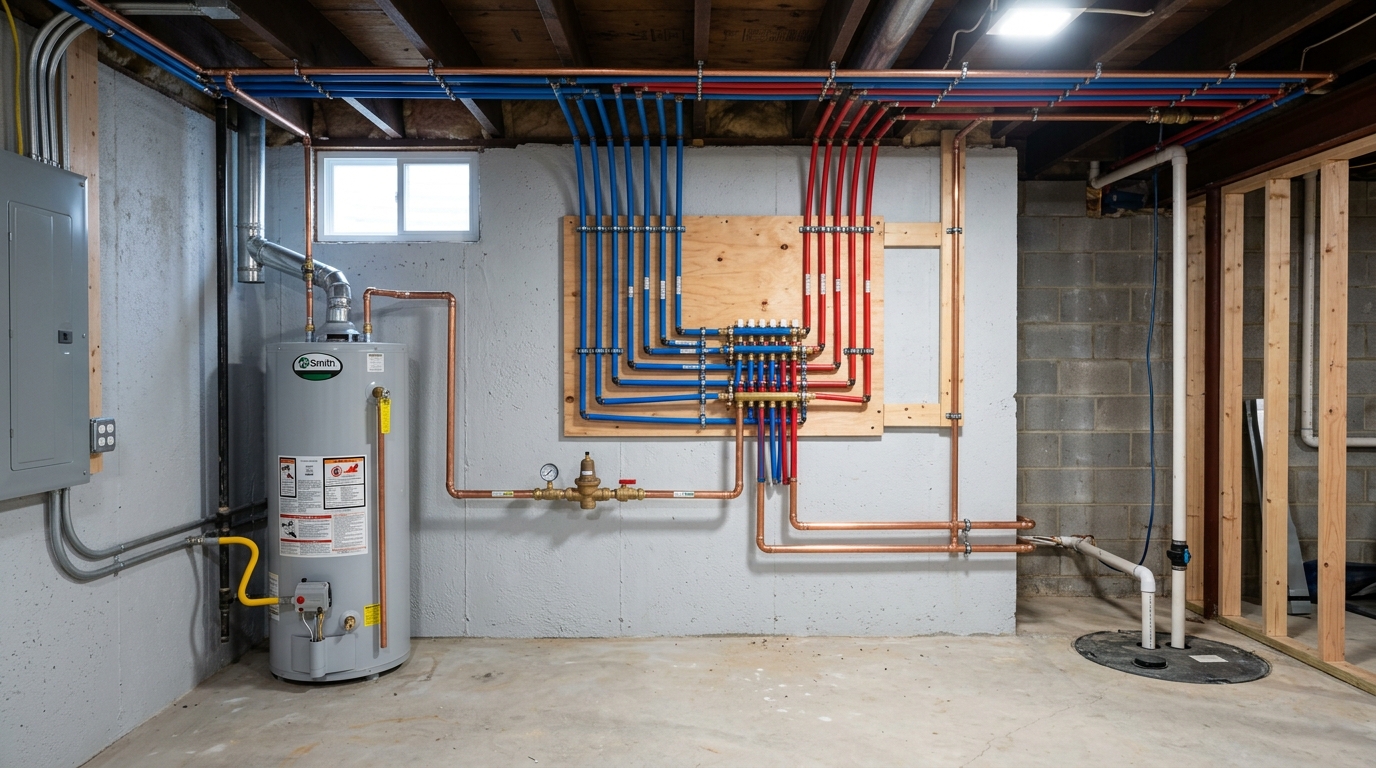
- PEX: Flexible, usually blue or red, with crimped ring fittings. Current practice in York County. Fewer joint failures, but sunlight (UV) damages exposed runs.
- Polybutylene: Usually gray or blue, flexible, joined with barbed metal fittings. Last used in the 1990s—prone to unannounced, catastrophic failure at fittings and rejected by many insurers.
- Cast iron: Black, very heavy, bell-and-spigot or no-hub joints. Standard for drains until 1975, corrode and scale shut from inside, or crack lengthwise.
- Clay tile (sewer): Orange-brown, clay rings joined at wide bells. Roots easily invade at joints; expect trouble at 50 years.
- PVC/ABS: White or black plastic, glued joints. Common for both drains and sewers since the 1970s.
Homes built pre-1960 with galvanized or cast iron are due for repipe or drain work, often spotted by pressure loss, frequent clogs, or visible rust. Copper and PEX have more years in them if undisturbed, but by 50–70 years, any material can fail. One exposed pipe and a five-minute scratch test in your basement will often tell the whole material story.
| Material |
Typical era |
Failure mode |
Service life |
| Galvanized steel supply |
pre-1960 |
internal corrosion, pressure loss |
40–60 yrs |
| Copper supply |
1950s–present |
pinhole leaks, joint failure |
50–70 yrs |
| Polybutylene supply |
late 1970s–1995 |
fitting failure, sudden bursts |
unreliable |
| PEX supply |
2000s–present |
fitting or UV degradation |
40–50 yrs |
| Cast iron drain |
pre-1975 |
corrosion, cracking, scale |
50–75 yrs |
| Clay tile sewer lateral |
pre-1980 |
root intrusion at joints, offset |
50–60 yrs |
| PVC / ABS drain |
1970s–present |
joint separation, crushing |
50+ yrs |
Flat rate versus time and materials
Every Windsor homeowner should know which billing model their plumber is using before work starts. Flat rate means you pay a preset amount for the whole job—good for price certainty, since the contractor eats any cost overruns. Time-and-materials charges you for labor by the hour plus parts, and can be less on simple jobs with no surprises, but the price is open-ended if something gets complicated once work begins. Neither model is a ripoff—trouble comes from not knowing what’s in your contract.
Look for these details in your quote: Is there a diagnostic fee, and does it credit toward final work? Does the written price spell out what will be opened, repaired, and restored? Are permit fees included? Wall and floor restoration often get left out—be sure they’re either included or excluded in black and white. Warranty should be clearly stated for labor separately from parts. After-hours and emergency rates need to be disclosed before any agreement is signed.
| Line item |
What to look for |
Red flag if… |
| Billing model |
flat rate or hourly, stated up front |
unstated |
| Diagnostic fee |
amount, and whether it credits |
vague |
| Scope |
what is opened, repaired and restored |
price with no scope |
| Restoration |
drywall and finish explicitly in or out |
silent |
| Permit |
included and priced |
'not needed' |
| Parts |
brand and model for fixtures |
'standard fixture' |
| Warranty |
labour period stated separately |
parts only |
Camera inspection, relining and replacement
In Windsor and surrounding townships, homeowners are usually responsible for the sewer lateral from the house all the way to where it meets the public main—often under the street. The utility rarely maintains any of your lateral, and disputes often start when a backup occurs and the homeowner learns this too late.
Symptoms range from a slow single drain (just a clog), to multiple drains gurgling or backing up (a mainline problem), to actual sewage coming up at the lowest drain, usually a basement floor drain or utility sink. When you have more than one fixture affected, a camera inspection is your next move—never skip this. The camera will show not just clogs but also root intrusion (especially in old clay tile), collapsed pipes, or offset joints.
If your lateral is clay tile, as is common in pre-1980 Windsor and York homes, root intrusion at joints is to be expected after 40–60 years. Cast iron can corrode and collapse. For serious issues, you’ll be quoted open-cut (excavation) or trenchless relining—relining saves your yard but won’t fix a belly (a sag where waste sits in the line).
Outlying Windsor-area townships also have many properties with septic systems instead of public sewer. Septic care is different: keep up with tank pumping every 3–5 years, and know that drainfield failure is a different headache compared to clogs in the pipes.
Above all: never accept a quote for excavation or replacement without seeing the camera footage. Get it in writing, and know where your responsibilities begin and end.
Frequently asked questions — plumbing in Windsor
What does discoloured water on first draw mean?
Discoloured water on first draw, especially after water has been sitting unused, is a common complaint in older Windsor homes, particularly those with galvanized steel or cast iron pipes dating back to the 1900–1950 era. The most likely cause is internal corrosion and rust from aging supply lines. If the color clears after running for a minute, it’s a strong indicator that iron or rust is sloughing off the inside of old pipes—not an immediate health crisis, but a signal the pipes are at end of life. Left unchecked, this will eventually choke off flow and can lead to leaks. Pipe replacement for a typical Windsor home comes in at $3,700–$8,900. If your water stays brown or sediment appears in every tap, call your water supplier to rule out a main flush or municipal work. If it’s just first-draw in the morning, it’s likely a house-side problem.
What do I do if sewage is backing up?
If sewage is coming up in your Windsor home—usually in the basement or at the lowest fixture—stop all water use immediately. This protects you from flooding even more and prevents contamination from spreading. You likely have a main drain clog or, in older neighborhoods with clay tile or cast iron lines, a blockage from roots or collapsed pipe. The next step is to book an emergency main line drain cleaning—expect a charge of $350–$800 for after-hours service. Insist on a camera inspection before any excavation is suggested; in Windsor, many old lines are ready for more serious attention, and it’s not unusual to find that recurring blockages signal the line itself needs repair or replacement. If you’re on a septic system in the outlying townships, also check if your tank is due to be pumped.
Who inspects plumbing work in Windsor?
Plumbing inspections in Windsor are handled at the municipal level. If you live in the City of York, the City of York Bureau of Permits and Inspections manages plumbing permits and inspections for new or altered systems. Surrounding townships—including those in Windsor—run their own permit offices and enforce the Pennsylvania Uniform Construction Code (UCC) based on the IRC. Always ask your plumber if they're registered locally and who will schedule the inspection after the work is completed. For jobs over $500, HIC registration is also required and you can always check for a valid Home Improvement Contractor (HIC) number on the state attorney general’s website for peace of mind.
Why do plumbers charge a diagnostic fee?
In Windsor, it’s standard for plumbers to charge a diagnostic fee when coming out to identify a plumbing issue. This fee covers the skilled labor, travel, and sometimes specialized tools required to determine the exact cause—especially on complex jobs or hidden leaks. Often, reputable plumbers will credit this fee toward the final repair cost if you go forward with the recommended work, but not always, so ask first. You’ll typically see a diagnostic rate of $375–$1,250 for emergency leak tracing or complex supply issues in York County. This model is fair when the scope is unknown, as it keeps the plumber from rushing or over-quoting without actually seeing the problem.
How much does a water heater replacement cost in Windsor?
Swapping out a gas water heater (40–50 gallon size, which is typical in Windsor’s mostly single-family homes) runs $1,250–$2,900, depending on difficulty of access and whether your system needs upgrades to bring it up to code. Emergency, after-hours replacements will hit the higher end, with standard scheduled jobs closer to the middle of the range. This bundle price should include drain down, haul-away of the old unit, code-compliant installation, and testing. If you get a quote, make sure it includes both parts and labor, as well as permit fees if required by your township. Don't settle for a one-line “water heater” quote—always ask for a line-by-line breakdown.
Who owns the sewer lateral, me or the city?
In Windsor and broader York County, the homeowner nearly always owns the sewer lateral from the home to the main—including the stretch running under sidewalks and streets. This can be a shock when a blockage or collapse happens and you learn restoration costs—spot repairs start around $2,100–$12,500. The city or utility only handles the main beneath public streets. For septic systems prevalent in the rural townships, you are responsible for everything—the tank, lines, and drainfield. If someone promises “city will take care of it,” be wary: always check with your municipality permit office and get line-ownership clarified before committing to major work.
Is a water softener worth it in Windsor?
Windsor’s water falls in the moderate hardness range, courtesy of York Water Company’s public supply that serves most of the area. Scale buildup is possible over decades, but most modern appliances can handle the mineral content without damage. If you have pinhole leaks in copper pipes or appliances crust up quickly, a softener might help—just be sure the issue isn’t due to aggressive water chemistry or failing pipe material from the pre-1950 era first. The cost to install a softener isn’t cheap (typical plumbers will quote $1,250–$2,900 for a full install), so unless you’re seeing clear evidence of build-up or rapidly failing water heaters, it’s usually not the highest priority fix.
Do I need to drain outdoor spigots in Windsor?
Yes, in Windsor’s freeze–thaw climate—where the winter design temp can dip to 12°F and frost depth is 30 inches—outdoor spigots must be drained and shut off each fall. If you don’t, trapped water will freeze and can split the pipe, leading to leaks inside the wall that easily result in an emergency repair bill of $375–$1,250. Most homes built after 1980 have frost-free sillcocks, but older Windsor homes, especially those with original galvanized or copper plumbing, still rely on shutoff valves in the basement. Always disconnect hoses and bleed off any water from the line before the first hard freeze, or you risk a major winter repair.
How hard is the water in Windsor?
Windsor’s public water, provided by York Water Company, is moderately hard, typical for south-central Pennsylvania’s aquifers and treatment processes. Scale can build up over many years in older copper and steel pipes, eventually slowing flow or shortening appliance life. Houses with mostly PEX or newer copper won’t see much trouble, but if your home still uses galvanized lines or old water heaters, keep an eye out for white crust or heating element failure. Home softener installation runs $1,250–$2,900, but most Windsor residents (with water heaters replaced every 10–15 years) will never need to bother. Check your manufacturer’s appliance guides for water hardness limits if you’re at all concerned.