What plumbers charge in Exeter
Exeter homeowners see two very different plumbing price tags depending on timing. If you call for a burst pipe at midnight, you’ll pay an emergency premium compared to calling during the day or for scheduled upgrades. In Exeter, with 2,006 owner-occupied homes and a heavy share of older houses (69.4% built pre-1980, U.S. Census Bureau, ACS 2024), what you pay comes down to both urgency and construction era. The reality is, older Wilkes-Barre and Hazleton houses often have legacy galvanized steel pipes behind thick plaster, raising both the difficulty and cost to access and repair compared to newer suburban stock.
Material makes a difference no matter the job. Old galvanized lines restrict flow and are tough to patch, sometimes making replacement the best value. Sewer issues? Clay tile laterals mean root intrusion and unstable joints—digging through narrow backyards or tight multifamily lots takes longer and costs more than cutting concrete in new developments.
Here’s what to expect for common jobs in Exeter. These ranges reflect the most typical scenarios I see—and the jump between emergency and standard rates is real. If your job requires extra travel to thinner outlying townships, or if a wall opening reveals the worst, pricing moves up.
| Service |
Scope |
Emergency rate |
Standard rate |
| Emergency repair — burst pipe |
locate, open, repair section, restore service |
$550–$1,100 |
$325–$1,100 |
| Water heater replacement (gas, 40–50 gal) |
remove old, install, test, haul away |
$1,750–$2,600 |
$1,100–$2,600 |
| Drain cleaning — main line |
augering or hydro-jet, camera if needed |
$350–$800 |
$200–$500 |
| Sewer line spot repair |
excavate or reline a failed section |
$1,850–$11,000 |
$1,850–$11,000 |
| Whole-house repipe |
replace supply lines throughout, patch and finish |
|
$3,300–$7,900 |
| Water service line replacement |
street to house, excavation and restoration |
|
$5,100–$11,000 |
Estimates for a typical Exeter home. Access difficulty and pipe material move these figures more than anything else.
Dating your plumbing by what it's made of
In Exeter’s housing, pipe material nearly always tells you how far along its timeline you are. Much of Wilkes-Barre and Hazleton’s pre-1940 multifamily stock used galvanized steel. This pipe is dull gray, threads with fittings (never soldered), and accepts a magnet. If you scratch it with a coin, you’ll expose a silver metal that rusts dull brown on old pipes. The main clue: low pressure at every tap, even if your neighbor’s is fine. Galvanized usually means you’re staring down a repipe, as it corrodes from the inside first, closing off flow, then eventually leaks where you least want them.
Copper appeared mid-century. It shines reddish-brown, doesn’t attract a magnet, and is joined by soldered fittings. Typical failure? Pinholes, usually in homes with aggressive water, and leaks at joints if the installation was rushed. Polybutylene (cloudy gray, flexible, joined with crimp bands) showed up from the late 1970s until about 1995, then fell out of favor as failures mounted. Modern builds and repipes use PEX (usually red, blue, or white plastics), joined with expansion or crimp rings, and excels in both flexibility (for fishing through old framing) and longevity—provided it’s protected from sunlight and installed well.
Drains run cast iron (dense, heavy, stains at joints) in older homes, with a 50–75 year lifespan before corrosion or cracks dictate action. Clay tile sewers fail at joints where roots break in. PVC/ABS drains (white or black plastic, glued not threaded) generally avoid these root issues and last beyond 50 years if undisturbed.
| Material |
Typical era |
Failure mode |
Service life |
| Galvanized steel supply |
pre-1960 |
internal corrosion, pressure loss |
40–60 yrs |
| Copper supply |
1950s–present |
pinhole leaks, joint failure |
50–70 yrs |
| Polybutylene supply |
late 1970s–1995 |
fitting failure, sudden bursts |
unreliable |
| PEX supply |
2000s–present |
fitting or UV degradation |
40–50 yrs |
| Cast iron drain |
pre-1975 |
corrosion, cracking, scale |
50–75 yrs |
| Clay tile sewer lateral |
pre-1980 |
root intrusion at joints, offset |
50–60 yrs |
| PVC / ABS drain |
1970s–present |
joint separation, crushing |
50+ yrs |
Verifying a Exeter plumber's credentials
Pennsylvania does not issue a statewide plumbing license. Plumbing is licensed and enforced at the municipal level. This means a plumber may be registered for work in Wilkes-Barre but hold no credential in Exeter or nearby townships—so always ask: "Are you locally licensed for the job?" In Wilkes-Barre, the City Code Enforcement Office handles both contractor licensing and building code enforcement, and this pattern is common in the Luzerne County small-city core. Exeter and other towns may require their own registration, especially for supply or drain line work.
For any plumbing job involving new or altered supply or drain lines in Wilkes-Barre, a permit is required, and the Code Enforcement Office will conduct inspections. Emergency work may be performed out of hours for safety, but the contractor must pull a permit and complete any required inspection once offices open.
For contracts over $500, the plumber must be a Home Improvement Contractor (HIC), registered with the Pennsylvania Office of Attorney General. You can verify this at hic.attorneygeneral.gov. Insist that your contractor provides a current certificate of workers’ compensation coverage, which you can check through the WCAIS system (wcais.pa.gov). These two checks help protect you against uninsured work and scams.
Exeter's housing stock and its plumbing
With 69.4% of Exeter homes built before 1980 (U.S. Census Bureau, ACS 2024), you are likely dealing with galvanized steel for water supply, cast iron beneath your floors for drains, and possibly a clay tile lateral running out to the street sewer. Many of these systems are living on borrowed time. In homes of this era, original lines might have been partially updated—a copper patch here, a PEX repair there—but it's just as common to find the original galvanized choking off your pressure, or cast iron drains growing brittle and leaky by now.
In the majority of Exeter’s single-family homes (67.6%), your main water service line may be the original lead or galvanized pipe if it predates the early 1950s, or copper, if replaced later but seldom updated again. Water heaters in homes of this age are rarely the first—they may be on their second or third by now, and if pushing 10–15 years, they’re candidates for pre-emptive replacement before a final tank burst floors your basement.
Newer constructions also exist but are much less common. These might have builder-grade copper or (in late-70s to 90s pockets) even polybutylene pressurized lines. If your house hails from the early 2000s on, you’re nearly certain to have PEX supply lines, PVC or ABS drains, and almost certainly no clay tile sewer left. But regardless of age, every system comes with its own set of issues—especially if original materials were never fully replaced.
Tank, tankless or heat pump water heater?
For most Exeter homes, a standard tank water heater (gas or electric) remains the default pick because of the region’s housing stock. They cost the least to install—$1,100–$2,600—and are reliable for 8–15 years. Their flaw is wasted energy: standby heat loss, since they keep a tankful of water hot all the time. Gas tank models are most common here due to utility availability, but electric tanks show up in some older multifamilies.
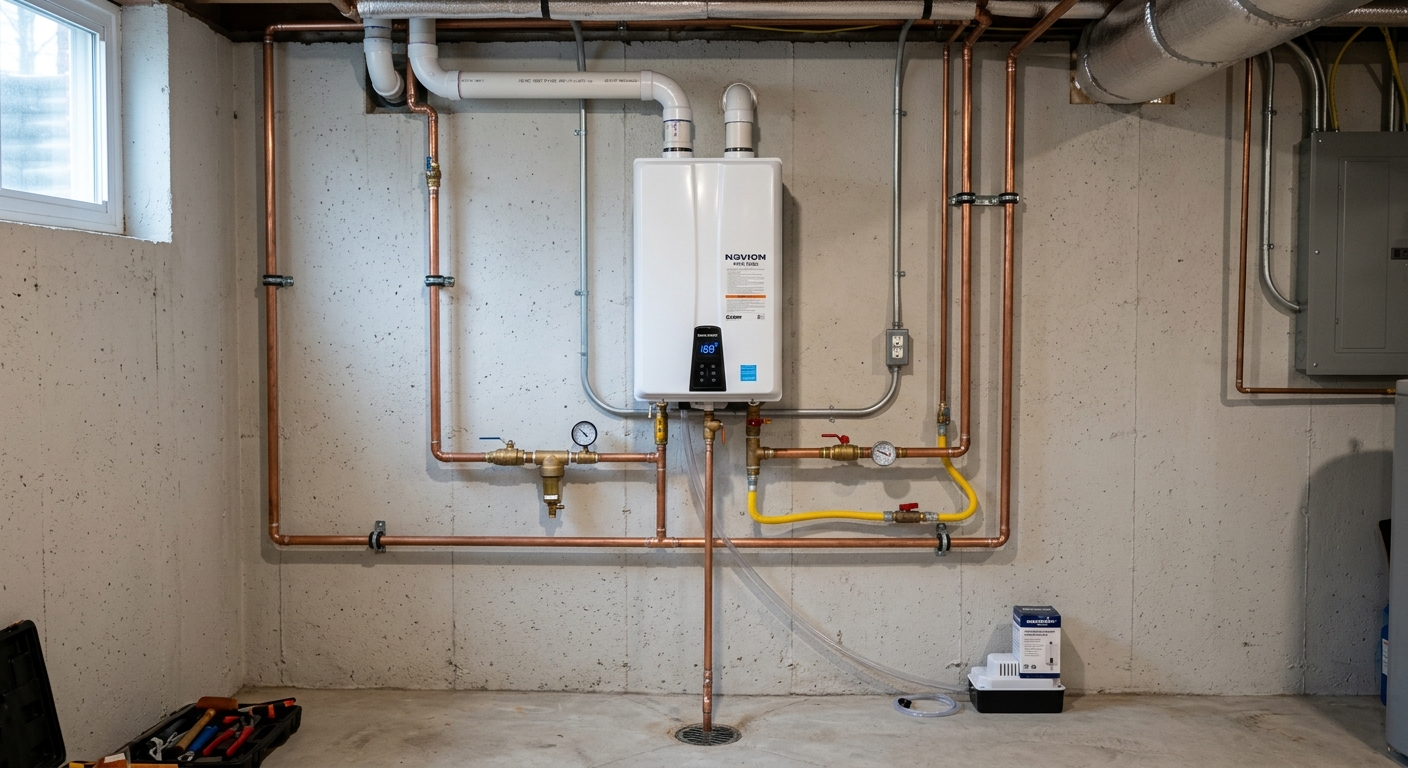
Tankless gas heaters deliver endless hot water, but don’t get starry-eyed: installation costs more ($1,750–$2,600), and you often need a beefier gas line and new venting. If your existing gas supply is already maxed out for heating and cooking, those upgrades drive total costs up quickly. They shine for larger families who value unlimited hot water, but their savings won’t pay back overnight. Maintenance—de-scaling—matters more with hard water, which Exeter sometimes sees.
Heat pump water heaters are the cheapest to run but they want a larger, warmer basement or utility space. They extract heat from the air, cooling the room—not ideal in a finished or small basement—and some models buzz loud enough to notice upstairs. In older tight housing, space and noise are a real barriers.
Size should be based on first-hour rating, not just tank size—match it to peak demand, not maximum storage. Don’t skip an expansion tank or a drip pan with floor drain where code or common sense suggests—failures nearly always start with the tank rusting out, not the controls. Pick for your house, not the sales pitch.
| Type |
Installed cost |
Service life |
Operating cost |
Best when |
| Gas tank, 40–50 gal |
$1,100–$2,600 |
8–12 yrs |
moderate |
standard replacement in most Exeter homes |
| Electric tank, 40–50 gal |
$1,100–$1,750 |
10–15 yrs |
high |
if no gas service or in smaller multifamily |
| Gas tankless |
$1,750–$2,600 |
18–25 yrs |
low-moderate |
high hot water demand, can upgrade gas line |
| Heat pump water heater |
$1,750–$2,600 |
13–15 yrs |
lowest |
ample basement space, electric service, warm zone |
The point where patching stops making sense
In Exeter, there’s a clear tipping point for repiping: two or more leaks in the same material over three years tells you it’s not just “bad luck.” That’s especially true with the pre-1940s galvanized steel common to local housing. When you start seeing brown water on first draw, house-wide low pressure (not just at one faucet), or visible rust and bubbling joints, the best money isn’t on another patch—it’s on a planned upgrade before a catastrophic failure finds you unprepared (and uninsured for flood damage).
Patching modern copper or PEX in a finished basement may work for an isolated leak (expect $325–$1,100), but once the pattern forms or the pressure drops everywhere, spot repairs get wasted fast. There’s more to the cost than pipe: every run you open in Exeter’s older houses is surrounded by thick plaster, hardwood, or tile—and restoring those finishes can rival or exceed the plumbing bill. For a whole-house copper or PEX repipe you may be looking at $3,300–$7,900 or more, depending on accessibility and finish repair. Cast iron and clay tile drains signal trouble when roots break in or collapses cause repeat backups; sometimes, a camera and spot-relining keeps a system running, but at the upper end those trenchless fixes resemble the cost of full replacement.
| Situation |
Recommendation |
Cost |
Reasoning |
| One leak, accessible, modern pipe |
Spot repair |
$325–$1,100 |
Localized issue, no trend |
| Two or more leaks in 3 years |
Partial repipe |
$3,300–$5,300 |
Material at end of life |
| Galvanized supply, pressure loss |
Full repipe |
$3,300–$7,900 |
Choked flow, leak risk |
| Polybutylene anywhere in the house |
Full repipe |
$3,300–$7,900 |
Unreliable, uninsurable |
| Cast iron drain with root intrusion |
Camera, then reline or replace |
$1,850–$11,000 |
Spot or system failure |
| Suspected lead service line |
Test, then replace the lateral |
$5,100–$11,000 |
Health and code risk |
Hardness, treatment and fixture life in Exeter
Most Exeter-area homes are served by Pennsylvania American Water or a borough public utility. These utilities must publish annual water quality reports—it’s worth requesting yours for the latest local testing. Hardness is moderate to high in some zones and that translates to faster scale buildup in tank water heaters and on faucet aerators, which cuts appliance life and water pressure.
If you’re seeing white scale, cloudy glasses, or slow-filling kettles, your fixtures are telling you something. A softener can extend water heater life and reduce cleaning, but it adds salt to your wastewater and costs more to run and maintain than many people expect. Most Exeter homes don’t need a high-dollar whole-house filtration system unless there’s a specific water quality issue; point-of-use filters at drinking taps are often plenty. For copper pinholes, the culprit is sometimes aggressive, slightly acidic water—rare, but worth checking if you notice blue-green staining.
If you’re on a private well (more common in the outlying rural townships), you’re on your own for testing—no agency will send you a report. In that case, annual testing for bacteria and minerals is smart, and shock treatment or point-of-entry filtration is only needed if results come back bad. Don’t let anyone sell you equipment before you see a lab report.
Frequently asked questions — plumbing in Exeter
How deep do water lines need to be buried in Exeter?
In Exeter and across Luzerne County, water service lines must be buried below the frost depth to prevent freezing, which means at least 36 inches deep. This is not just a best practice—northeastern Pennsylvania’s winters regularly drop below 4°F, and heating degree days average 6,100 per year. Burying lines at this depth insulates them from frost, but older homes and DIY jobs sometimes have shallower mains, leading to freeze-ups during extra-cold snaps. If you’re digging up a lead or galvanized service to full replacement, expect to pay $5,100–$11,000, including excavation and site restoration. Cutting corners on depth isn’t worth the risk: one hard freeze can burst a main, and the fix is always pricier than doing it right the first time.
Do older Exeter homes have galvanized pipes?
Yes—most pre-1960 housing throughout Exeter and the Wilkes-Barre area was originally piped in galvanized steel, and many properties built before 1980 still have some in place, especially for main risers or branch lines. Galvanized pipes corrode from the inside, causing rusty water and pressure loss before leaks develop. In Exeter, where nearly 70% of homes are pre-1980 (U.S. Census Bureau, ACS 2024), it’s not unusual to find original galvanized that’s well past its 40–60 year life. If you notice reddish discoloration, reduced flow, or repairs piling up, a whole-house repipe may be in order, with costs typically running $3,300–$7,900 depending on the home size and finishes.
What does drain cleaning cost in Exeter?
For main line drain cleaning in Exeter, expect to pay $200–$500 for standard service. Emergency rates—after hours, or when water is backing up actively—push that range to $350–$800. Routine clogs often clear up quickly with augering, but if roots, collapsed clay, or persistent blockages are found, camera inspection or hydro-jetting raises the cost. Older Exeter houses with cast iron or clay tile underground tend to get more root intrusion, especially if mature trees run alongside older laterals. Prevention (no wipes or grease) beats emergency calls every time, and if the same drain clogs twice in a year, it’s worth camera scoping before it turns into a grander repair.
Is a sewer line replacement covered by homeowner's insurance?
For Exeter homeowners, typical policies exclude coverage for gradual wear or corrosion of pipes—unfortunately, that’s what’s behind most clay tile or cast iron sewer failures in the area. Sudden damage from “covered perils” (like a vehicle striking a clean-out or tree falling on above-ground connections) may qualify, but plain age, root intrusion, and shifting ground are nearly always excluded. Sewer line spot repairs or full replacements can be spendy, often ranging from $1,850–$11,000 depending on the length and access. Some insurance carriers offer a supplemental “service line” rider—worth asking about before a problem is discovered, not after. Always read the fine print; don’t assume coverage without getting it in writing first.
Why do plumbers charge a diagnostic fee?
Diagnostic fees cover the time, experience, and tools needed to troubleshoot plumbing issues—even if you don’t ultimately approve the repair. In Exeter, driving out to a home on the edge of Luzerne County for a leak or a backed-up line isn’t just a quick look; finding the actual problem might require opening walls, investigating several fixtures, and making sure the fix matches local code. Most reputable plumbers apply the diagnostic fee toward your repair if you hire them, and for an emergency water leak, that first visit typically falls within the service call range of $325–$1,100. A legitimate fee also signals a licensed, insured pro—not a drive-by handyman. If you’re ever in doubt, ask in advance how the charge works and whether it applies to final repair cost.
What causes low water pressure in Exeter homes?
In Exeter, the most common culprit for low water pressure is aging galvanized steel pipes—still present in much of the pre-1980 stock. Internal rust and scale narrow the opening, choking off flow long before the pipe actually leaks. City water pressure from Pennsylvania American Water is generally consistent, so if your neighbors have good pressure and you don’t, it’s a house problem. Other causes include sedimented faucet aerators, failed pressure regulators, or a near-clogged main shutoff valve. Galvanized repipes run $3,300–$7,900 for a whole house, but don’t spend big until you’ve tested pressure at several locations and ruled out quick fixes like cleaning faucet screens or checking for partially closed valves.
Should I wait until business hours to call?
If you have an active leak, water spraying inside your home, or a sewer backup rising toward finished floors, don’t wait—call right away. Emergency rates in Exeter do run higher—plan on $550–$1,100 for a burst pipe repair after hours versus the lower end for a scheduled daytime fix. For issues like a slow drain, water heater pilot that’s gone out, or a persistent but managed drip, you can usually wait until regular business hours to save on trip and labor charges. In all cases, know where your main shutoff valve is—that can save hundreds and a carpet before the plumber arrives. In Exeter’s older housing with aging pipes, waiting can turn a $500 repair into a much costlier flood cleanup.
Do I need a permit for plumbing work in Exeter?
If you’re changing or adding any supply or drain piping—especially in Wilkes-Barre—permits are required. The Wilkes-Barre City Code Enforcement Office sets the standard for contractor licensing and building permits across the small-city core, and permits must be pulled for any substantive plumbing change: new water heaters, new lines, or significant drain work. In every case over $500, your contractor should have valid Home Improvement Contractor registration (verify at hic.attorneygeneral.gov) and current workers’ comp insurance (WCAIS). If you’re in a nearby township, check with your local office; don’t let a contractor do “under the radar” work that the city, insurer, or future buyers may give you headaches over. Permit fees are small compared to the risk.
Repair or replace a leaking water heater?
Most leaking water heaters in Exeter are beyond repair. If you’re seeing water at the base or rust around the tank seam, that’s a failed tank and the fix is replacement, not repair. Typical installed price for a standard gas or electric tank unit sits between $1,100–$2,600 around Exeter. Replacing a leaking relief valve or supply fitting before full failure can buy you some time, but most tank failures come suddenly and leave little warning. In older homes, skipping a pan or expansion tank is inviting trouble. If your unit is less than eight years old and the leak is at a fitting or valve, ask for an honest assessment first—but at 10+ years, save your repair money for the new heater instead.