Plumbing costs in Warrington — 2026
Warrington homeowners, like most in Bucks County, face a wide range of plumbing costs that depend on when the work happens and what’s involved. A burst pipe at 2 a.m. will always cost more than if you catch it before walls are soaked—the difference between a middle-of-the-night call and a standard service is often hundreds of dollars. This matters in Warrington, where 81.2% of homes are owner-occupied and a third were built before 1980 (U.S. Census Bureau, ACS 2024), because construction era is the single biggest predictor of pipe material and lurking problems.
Levittown in Falls Township is dominated by post‑1950 mass‑built homes with aging undersized copper and galvanized plumbing needing frequent replacement, and those materials drive up the cost of both repairs and full replacements. Copper pinholes or clogged galvanized pipe can mean your water pressure drops and leaks pop up where you can’t see them. Emergency repairs, especially for active leaks, are the priciest. On the other hand, routine work like a planned water heater swap generally comes in on the low end of the bands below.
| Service |
Scope |
Emergency rate |
Standard rate |
| Emergency repair — burst pipe |
locate, open, repair section, restore service |
$700–$1,400 |
$400–$1,400 |
| Water heater replacement (gas, 40–50 gal) |
remove old, install, test, haul away |
$2,200–$3,200 |
$1,400–$3,200 |
| Drain cleaning — main line |
augering or hydro-jet, camera if needed |
$350–$800 |
$200–$500 |
| Sewer line spot repair |
excavate or reline a failed section |
$2,300–$14,000 |
$2,300–$14,000 |
| Whole-house repipe |
replace supply lines throughout, patch and finish |
— |
$4,000–$9,800 |
| Water service line replacement |
street to house, excavation and restoration |
— |
$6,300–$14,000 |
Estimates for a typical Warrington home. Access difficulty and pipe material move these figures more than anything else.
Who is allowed to do plumbing work in Pennsylvania
Plumbing in Pennsylvania is not licensed at the state level. Instead, it’s up to each municipality to set their own rules—a plumber licensed in one township or borough may have no standing in the next. In Bucks County, towns like Bensalem, Warminster, and Bristol run their own code offices. Always ask if your plumber is licensed or registered specifically for Warrington or the town where the work is happening, not just “in Pennsylvania.” For any contract above $500, your contractor must have a Home Improvement Contractor (HIC) registration from the Pennsylvania Office of Attorney General. You can verify this at hic.attorneygeneral.gov.
For permits, some Bucks County towns (like Bensalem Township) require a plumbing permit for any work that alters water or sewer piping layout or adds fixtures. In others, such as Falls Township, like-for-like fixture swaps inside existing bathrooms commonly do not trigger a permit. Plumbing inspections are handled by the town’s code office or, in the rare case your municipality opted out, by the PA Department of Labor & Industry. Code compliance follows the Uniform Construction Code (UCC), which is based on the International Residential Code.
Workers’ compensation insurance is mandatory for all employers in Pennsylvania, including plumbers. Homeowners can (and should) verify coverage using the state’s WCAIS system at wcais.pa.gov. Never accept a contractor who can’t document both insurance and, for larger jobs, their HIC status.
Choosing a water heater in Warrington
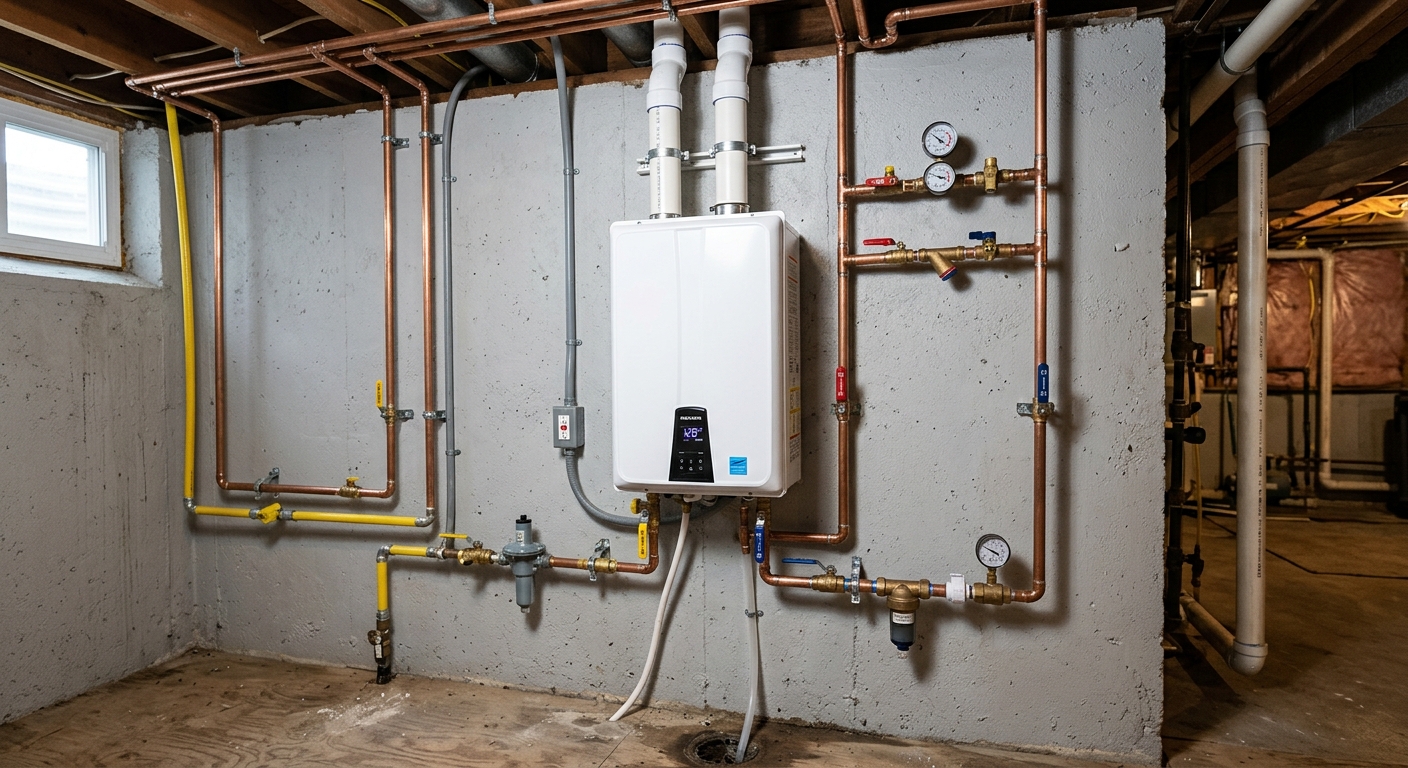
When it’s time to replace a water heater in Warrington, the choice comes down to four main types: gas tank, electric tank, gas tankless, and heat pump (hybrid) models. The cheapest to install is usually a gas or electric tank, but both waste some energy keeping 40–50 gallons hot around the clock—called standby loss. A tank heater lasts 8–15 years depending on type. With tankless, you get endless hot water, but the install is higher and most gas units need upsizing of your gas line and special venting—surprises that aren’t cheap. A heat pump heater is efficient and least expensive to run, but it needs lots of airflow and will cool the room it sits in, which gets uncomfortable or even loud in a finished basement.
Don’t focus on gallon size—what matters is the “first-hour rating,” which measures how much hot water the unit delivers for everyone’s morning shower or back-to-back laundry. In Bucks County homes built before 1980, expansion tanks (to handle pressure from water shut-off valves) and drains or pans (to contain leaks) are essential. Most replacements are needed because the tank rusts through, not because the electronics fail. If you’re on the fence about tankless or hybrid, do the math carefully—lower energy bills pay back only if you use lots of hot water.
| Type |
Installed cost |
Service life |
Operating cost |
Best when |
| Gas tank, 40–50 gal |
$1,400–$3,200 |
8–12 yrs |
moderate |
gas line present, typical family use |
| Electric tank, 40–50 gal |
$1,400–$2,200 |
10–15 yrs |
high |
no gas supply, moderate hot water demand |
| Gas tankless |
$2,200–$3,200 |
18–25 yrs |
low-moderate |
endless hot water, higher initial outlay, space saving |
| Heat pump water heater |
$2,200–$3,200 |
13–15 yrs |
lowest |
ample space, warm basement, electric only |
Flat rate versus time and materials
In Warrington, plumbers will quote the job either as a flat rate or as time and materials (T&M). Flat rate means you get one fixed price for the work described, with the contractor absorbing risk if something takes longer. It’s predictable, but usually slightly higher to account for worst-case scenarios. T&M means you pay for labor by the hour plus parts, which can save money on straightforward jobs, but can balloon if things get complicated. Neither approach is inherently better or a sign of honesty—the risk is misunderstanding which one you agreed to.
You should see a diagnostic or service fee spelled out at the start (often credited if you go ahead). Quotes should list what’s actually repaired, if drywall/floor is finished or left open, and if the cost of permits is included. Look for specifics on fixtures (not just “builder grade”) and see that the warranty on labor is separate from any part warranties. After-hours or emergency surcharges should always be disclosed in advance. If anything in the bid feels vague or is left blank, ask before signing anything.
| Line item |
What to look for |
Red flag if… |
| Billing model |
flat rate or hourly, stated up front |
unstated |
| Diagnostic fee |
amount, and whether it credits |
vague |
| Scope |
what is opened, repaired and restored |
price with no scope |
| Restoration |
drywall and finish explicitly in or out |
silent |
| Permit |
included and priced |
'not needed' |
| Parts |
brand and model for fixtures |
'standard fixture' |
| Warranty |
labour period stated separately |
parts only |
Water quality and what it does to your pipes
Most of Warrington is served by Bucks County Water & Sewer Authority, which publishes an annual water quality report that you can request. This will tell you if the water is considered “hard” (higher in minerals), which causes scale to build up in water heaters, showerheads, and valves—shortening the life of everything it touches. “Aggressive” water with low pH eats copper from the inside, causing pinhole leaks common in older Bucks County homes.
A water softener will prevent new scale, but between the cost of the system and adding salt, it only sometimes pays back in this area. Unless your fixtures and water heater are failing early or you see white scale on faucets, most Warrington homeowners can skip the softener. For taste, odor, or specific health concerns, you can add a whole-house carbon filter, but smaller point-of-use filters (like under the kitchen sink) solve most issues for much less money.
If you’re on a private well, routine testing is the only way to know what’s in your water. For those on public water, review the annual report and skip any high-pressure sales pitches about filters you don’t need.
Pipe materials in Warrington homes and how they fail
In Warrington and the rest of Bucks County, pipe material is all about when your house was built. Levittown in Falls Township is dominated by post‑1950 mass‑built homes with aging undersized copper and galvanized plumbing needing frequent replacement. Pre-1960 homes often have galvanized steel pipes—gray, heavy, and joined with thick threads. Galvanized lines corrode slowly from the inside out, so you’ll lose water pressure long before you see a drip. Scratching the outside with a screwdriver reveals a silver-gray metal, and a magnet will stick.
Copper pipes, the norm for homes built from the 1950s through the 1990s, are reddish and joined by solder. These last decades, but aggressive water can cause pinhole leaks, especially where the main comes in or in long runs. Polybutylene, installed between the late 1970s and 1995, usually has a gray-blue color and crimped plastic or metal fittings. It’s now considered unreliable and some insurers won’t cover homes with it due to sudden failures at fittings. Modern homes use PEX (flexible plastic, typically red, blue, or white), which resists freezing and installs quickly, but sunlight degrades exposed PEX. Drains and sewer lines vary too—cast iron (pre-1975) rusts, cracks and scales up; clay tile (pre-1980) roots into the joints; and PVC or ABS (post-1970s) lasts, but joints can separate or be crushed if not bedded properly.
Check exposed pipes in your basement or at the meter. Push a magnet to see if you’ve got steel. Look for solder joints (copper), flexible colored lines (PEX), or old gray-blue plastic (polybutylene). Use the table below to estimate what you have and how much longer it might last.
| Material |
Typical era |
Failure mode |
Service life |
| Galvanized steel supply |
pre-1960 |
internal corrosion, pressure loss |
40–60 yrs |
| Copper supply |
1950s–present |
pinhole leaks, joint failure |
50–70 yrs |
| Polybutylene supply |
late 1970s–1995 |
fitting failure, sudden bursts |
unreliable |
| PEX supply |
2000s–present |
fitting or UV degradation |
40–50 yrs |
| Cast iron drain |
pre-1975 |
corrosion, cracking, scale |
50–75 yrs |
| Clay tile sewer lateral |
pre-1980 |
root intrusion at joints, offset |
50–60 yrs |
| PVC / ABS drain |
1970s–present |
joint separation, crushing |
50+ yrs |
Lead service lines in Warrington
According to the Bucks County Water & Sewer Authority, there are about 2,000 known or suspected lead service lines across the county. Most of Warrington is served by this utility, and while the utility oversees the section from the main to the curb, homeowners are on the hook for the lateral running from the curb to the house. Replacement programs, where they exist, often only cover the utility side; you’ll need to check with Bucks County Water & Sewer Authority for the current policy or to see if you’re in line for work—or if you’re responsible for coordination and cost.
You can roughly identify a lead service line yourself: look at the water line where it comes into the basement. Lead pipes are soft, dull silver, and easily scratched with a key (a nickel-like shine appears beneath the surface) and will not attract a magnet. If you aren’t sure, your water supplier can help with identification, and you should consult their published service line inventory for your address.
Partial lead replacements—replacing only one side—can briefly worsen lead levels by disturbing scale, so push for complete replacement wherever possible. If you find out your line is lead, budget and plan proactively: a full water service line replacement in Warrington typically runs $6,300–$14,000, but it’s the most effective way to end the risk long-term. Always verify cost-sharing options and current programs with the utility—don’t count on coverage without confirmation.
Frequently asked questions — plumbing in Warrington
Do I need to drain outdoor spigots in Warrington?
Yes, you absolutely should—Warrington’s winter design temperature is 14 °F and frost reaches 30 inches deep here. Water left in exterior hose bibs or their supply lines can freeze solid, splitting the pipe inside your wall or foundation. That kind of burst often doesn’t show up until you turn the spigot back on in spring. Repairs for a split pipe inside a wall can easily run $400–$1,400 if emergency access or wall restoration is needed. Every fall, close any inside supply valves to outdoor spigots, then open the spigot to drain any remaining water. If you don’t have indoor shutoffs, consider adding them—the small upfront cost is nothing compared to repairing a hidden burst next year.
Is Warrington on combined sewers or septic?
The answer depends on your location in Bucks County. If you’re in Bensalem Township, you’re connected to separate sanitary sewer and stormwater systems, while many northern Bucks County communities—including rural Warrington—still have plenty of individual onsite septic systems. There’s no combined sewer overflow problem here, but if you’re on septic, all wastewater (sinks, showers, toilets) goes to your own tank and drain field. Main-line clogs on public sewer are often easier (and cheaper) to address, sometimes running $200–$500 for a standard main drain cleaning, while septic backup can mean a very different kind of headache—think pumping, not snaking. When in doubt, your water or sewer bill will name the utility if you’re on public service.
What do I do about a burst pipe right now?
Shut off the main water valve to your Warrington house immediately (typically just above where the main enters the foundation, likely near the front wall). Then call an emergency plumber. Time matters—soaked drywall and floors add hundreds to the final cost. For Bucks County, emergency burst pipe repairs nearly always land in the $700–$1,400 range, depending on how much pipe and finish needs restoring. If you know your plumber’s billing model, ask if their service call includes wall repair, or just the pipe fix, so you’re not surprised on the back end. Don’t wait for “business hours”—even an hour’s delay can double your headache and your bill.
Is a water softener worth it in Warrington?
Many Warrington homes don’t need a softener unless you’re seeing white scale on fixtures or water heater failure every six to eight years. Bucks County Water & Sewer Authority delivers water that is typically moderate in hardness; scale is a nuisance, but not a crisis for most plumbing. Installing a whole-house softener can cost thousands up front, plus salt and maintenance, and if you use municipal water, the cost often does not pay back. If your water heater or mixing valves keep failing, or if you can't clean the scale off glassware and showers, a softener starts to make sense. Keep in mind, repiping due to scale in a whole house runs $4,000–$9,800, so target softener installs only where scaling is visible and ongoing.
Is my water line lead?
In Warrington, and more generally throughout Bucks County, about 2,000 homes have confirmed or suspected lead service lines, per Bucks County Water & Sewer Authority. To check yours, find where the main pipe enters your basement—if it is soft, dull and shines bright silver when scratched (no magnet sticks), you may have lead. For certainty, consult your utility’s inventory or call to schedule a test. If you do have lead, replacing your entire water service line will protect your family's water supply and home value. Expect a replacement to fall in the $6,300–$14,000 band depending on access, length, and restoration needs.
What does emergency plumbing cost in Warrington?
Emergency rates are always higher here because Bucks County’s dense population means there’s real demand for after-hours and same-day calls—few spare trucks, lots of calls, especially in older neighborhoods. For a burst pipe or active leak in Warrington, your bill will likely be $700–$1,400 depending on time of day, wall or floor restoration, and pipe material. Jobs scheduled during regular hours with advance notice typically come in on the low end. Always confirm if the rate you’re quoted includes just the fix, or repair of finishes too, as “emergency patch only” is a common base service.
Who inspects plumbing work in Warrington?
Plumbing inspections are handled by your local township’s code office in Bucks County—each town runs its own department, so the inspector for Warrington is not the same as for Bensalem or Bristol. Inspections cover whether the work complies with the Pennsylvania Uniform Construction Code (UCC), which is based on the IRC. Any project that alters water or sewer piping layout or fixture count—like moving a bathroom or replacing major pipes—needs a permit and an inspection. For the largest jobs, like a whole-house repipe (often in the $4,000–$9,800 range), you’ll want a signed inspection tag before closing walls. Never settle for work without a permit or inspection where one is required—it puts you at risk if you ever sell.
How much does sewer line repair cost in Warrington?
Sewer line repairs are some of the most expensive jobs for Warrington homeowners, especially in areas of Bucks County where old clay tile lines and tree roots are common. Spot repairs—where a single section is excavated or relined—are typically in the $2,300–$14,000 range. That’s a wide range because costs skyrocket if you must dig under driveways, sidewalks, or mature landscaping. If you suspect a sewer problem, ask about camera inspections first; sometimes the root cause can be solved with cleaning (around $200–$500) instead of a full dig. Always get a clear scope and avoid paying for “exploratory” work that leads nowhere.
Does insurance cover a burst pipe in Warrington?
Standard homeowners’ policies in Pennsylvania generally cover water damage from a sudden, accidental pipe burst—like those caused by a winter freeze in Warrington. The policy usually pays for water cleanup and to repair damaged walls, floors, and belongings, but not to fix the faulty pipe or plumbing itself. Insurance may refuse claims if you didn’t maintain heat in your home or neglected routine steps (like draining outdoor pipes). A contractor may bill you $700–$1,400 for burst pipe repair, but only the bill for water remediation and restoration likely goes to insurance. Always file a claim promptly and document the cause—your adjuster will want photos and, in many cases, the broken pipe as evidence.