What plumbers charge in Doylestown
Doylestown homeowners face a range of plumbing costs shaped by age and type of construction. With more than half the homes built before 1980 and a homeownership rate topping 80.0% (U.S. Census Bureau, ACS 2024), many residents are responsible for repairs in houses that still carry original plumbing. Notably, Levittown in Falls Township is dominated by post‑1950 mass‑built homes with aging undersized copper and galvanized plumbing needing frequent replacement, so the era in which your house was built heavily predicts both the pipe material inside its walls and the types of failures you are likely to face.
Plumbing costs in Doylestown split along one main line: is it an emergency or not? The same burst pipe costs significantly more at night or on a weekend than during standard business hours. Emergency responses mean the plumber absorbs overtime pay, immediate dispatch, and faster diagnosis. Planned, scheduled jobs avoid those premiums.
Below, you’ll find a breakdown of typical 2026 costs in Doylestown for common plumbing projects. Keep in mind, costs vary most according to how accessible your pipes are (finished basement vs. crawlspace), and what your system is made of—old galvanized pipes, for example, take more effort to work around and match.
| Service |
Scope |
Emergency rate |
Standard rate |
| Emergency repair — burst pipe |
locate, open, repair section, restore service |
$700–$1,450 |
$425–$1,450 |
| Water heater replacement (gas, 40–50 gal) |
remove old, install, test, haul away |
$2,300–$3,400 |
$1,450–$3,400 |
| Drain cleaning — main line |
augering or hydro-jet, camera if needed |
$350–$800 |
$200–$500 |
| Sewer line spot repair |
excavate or reline a failed section |
$2,400–$14,500 |
$2,400–$14,500 |
| Whole-house repipe |
replace supply lines throughout, patch and finish |
— |
$4,200–$10,000 |
| Water service line replacement |
street to house, excavation and restoration |
— |
$6,600–$14,500 |
Estimates for a typical Doylestown home. Access difficulty and pipe material move these figures more than anything else.
Licensing and permits for plumbing work in Doylestown
Plumbing in Doylestown is regulated differently than in many other states. Pennsylvania has no statewide plumbing license. Instead, plumbing is licensed municipally—your plumber must carry credentials issued by the borough or township where the work is performed. For example, Philadelphia and Pittsburgh run their own examinations and registries, but a plumber licensed in one city may not hold any license in the next township over. In practice, when hiring in Doylestown, ask not “Are you licensed?” but “Are you licensed here in this municipality?”
When it comes to permits, Doylestown Borough and other Bucks County municipalities run their own code enforcement offices. Any plumbing work that alters water or sewer piping layout or fixture count generally triggers a plumbing permit. This is strictly enforced in places like Bensalem Township. Inspectors from the local building or code department sign off before walls are closed up. Simple jobs like faucet swaps in existing bathrooms in Falls Township typically do not require permits.
If your plumbing job exceeds $500, state law says you must receive a written contract under the Home Improvement Consumer Protection Act (HICPA), and the contractor must be registered as a Home Improvement Contractor (HIC) with the Pennsylvania Office of Attorney General. You can verify a plumber’s registration status anytime at hic.attorneygeneral.gov.
By law, all employers must carry workers’ compensation insurance. Always verify it—Pennsylvania’s WCAIS (wcais.pa.gov) lets you check coverage directly. This protects you as a homeowner from injury liability during work on your property.
Water heater replacement decisions
Doylestown homeowners choosing a water heater have three main avenues: gas or electric tanks, tankless, and heat pump water heaters. Each fits different needs and budgets, and the lesson here is that the most expensive doesn’t always mean the best for your situation.
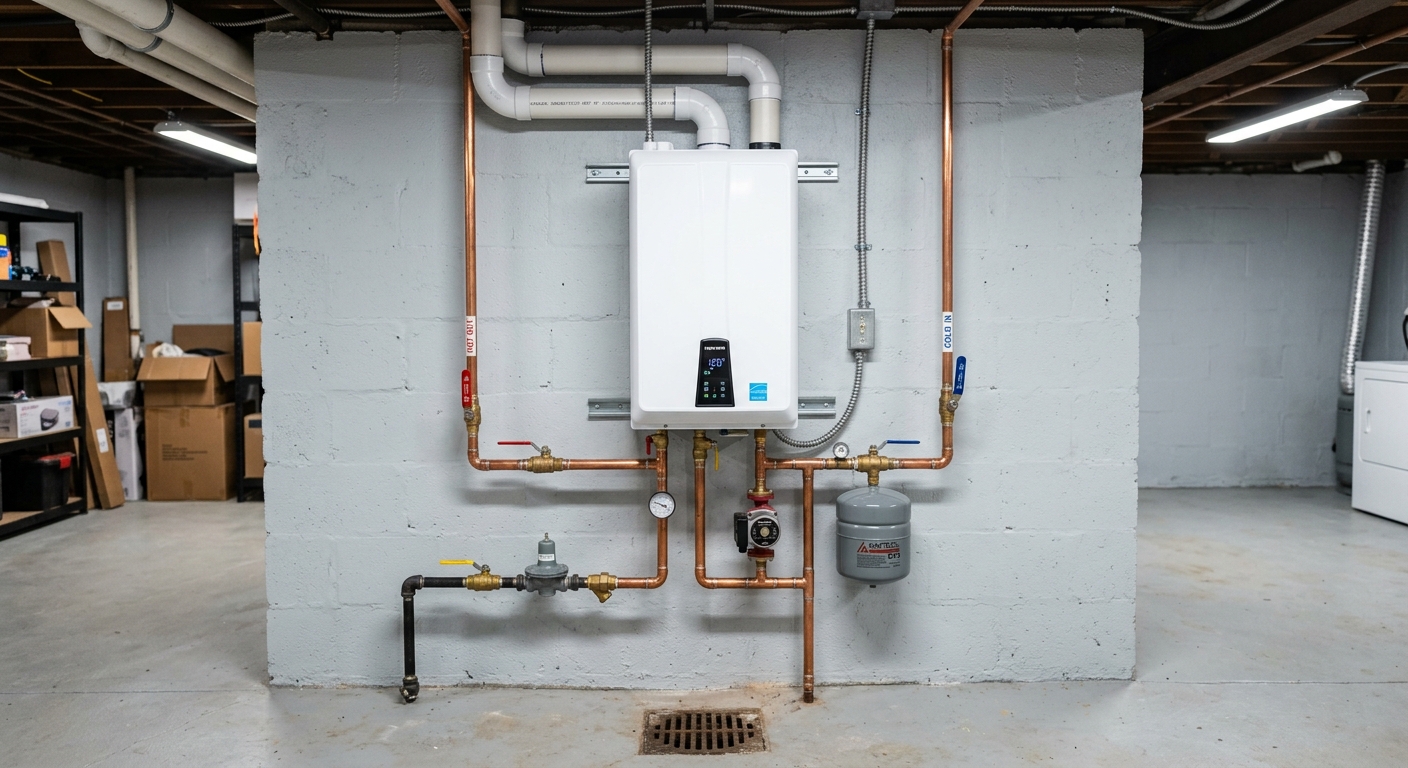
Standard tanks (gas or electric) are the least costly to install. Expect shorter service life—about 8 to 15 years, depending on type. They always keep water hot, so you’ll pay for standby losses even when you’re out. Tankless gas heaters bring endless hot water and a longer 18–25 year life, but installation surprises many people; they often need bigger gas lines and upgraded venting, adding serious dollars. If your home isn’t already set up for this, the cost-benefit might not pencil out.
Heat pump (hybrid) water heaters cost about as much as tankless, but operate on a fraction of the energy—important if Doylestown’s aging housing stock and rate structure push up your bills. The catch: they need space and warmth. Put one in a cold or finished basement, and you’ll get poor efficiency and a room that feels even chillier.
When sizing, look for first-hour ratings (how much hot water can be delivered in one hour of full use), not just tank size. Doylestown’s code enforcement expects expansion tanks and pans with drains if the heater sits above finished space. Nearly every replacement happens due to tank leakage, not a failed thermostat or control.
| Type |
Installed cost |
Service life |
Operating cost |
Best when |
| Gas tank, 40–50 gal |
$1,450–$3,400 |
8–12 yrs |
moderate |
gas available, space for venting |
| Electric tank, 40–50 gal |
$1,450–$2,300 |
10–15 yrs |
high |
no gas line, lower upfront budget |
| Gas tankless |
$2,300–$3,400 |
18–25 yrs |
low-moderate |
endless hot water, willing to pay for install |
| Heat pump water heater |
$2,300–$3,400 |
13–15 yrs |
lowest |
warm, unfinished space; high electric bills |
What urgency costs you
When a pipe bursts or a sewer backs up in Doylestown, the clock starts ticking—and so does the meter. An emergency plumbing call carries an added premium due to off-hours labor, overtime pay, fast dispatch, and the need to diagnose and stop damage under real pressure. That premium can add a few hundred dollars or more to a standard job.
For example, a burst pipe repair during an emergency will often run $700–$1,450, compared to $425–$1,450 if you can wait for normal business hours. You pay more because someone is stopping what they’re doing to respond, maybe bringing in a second worker, and competing with other urgent jobs for availability.
Some issues simply can’t wait:
- Active flooding (water pouring in or pooling fast)
- No water supply to the entire house
- Sewage backing up into tubs, toilets, or sinks
- Gas smell (leave the house and call 911!)
Other plumbing problems are stressful but can be scheduled without the emergency markup:
- Slow leaks with a drip pan in place
- Single slow drain (not every drain in the house)
- Running or stuck toilets
- Hot water heater with pilot out (no active leak)
Every Doylestown homeowner should know (and teach family) how to shut off the water at the main valve—usually found where the water line enters your home, often near the water meter. Fixtures like sinks and toilets have small shutoff valves directly below. Turning off water early can turn a crisis into a scheduled, less expensive repair.
Comparing plumbing estimates in Doylestown
When you receive a plumbing estimate in Doylestown, pay close attention to how it’s built. Most contractors use either a flat-rate (quoted price, no matter what) or a time-and-materials (hourly rate plus parts) model. Flat rates bring price certainty but include a safety margin for unknowns. Time-and-materials jobs risk higher costs on complex or hidden problems but can save you money on straightforward repairs. The main hazard is not knowing which you’ve agreed to—the terms must be clear up front.
Check whether you’re being charged a diagnostic fee and if it will be credited if you approve the work. Confirm what’s included: will they restore drywall and flooring, pull a permit, specify brands and models, and lay out the scope of work? Look for a clear warranty on labor (not just parts). If your job is quoted after hours, the rate should be disclosed and written in advance, not hinted at.
| Line item |
What to look for |
Red flag if… |
| Billing model |
flat rate or hourly, stated up front |
unstated |
| Diagnostic fee |
amount, and whether it credits |
vague |
| Scope |
what is opened, repaired and restored |
price with no scope |
| Restoration |
drywall and finish explicitly in or out |
silent |
| Permit |
included and priced |
'not needed' |
| Parts |
brand and model for fixtures |
'standard fixture' |
| Warranty |
labour period stated separately |
parts only |
Dating your plumbing by what it's made of
In Doylestown and much of Bucks County, what your pipes are made of usually comes down to the era your house was built. Levittown in Falls Township is dominated by post‑1950 mass‑built homes with aging undersized copper and galvanized plumbing needing frequent replacement, so knowing your pipe material is the best starting point for figuring out what can fail and when.
Here’s a quick way to identify: Galvanized steel is silver-gray and threaded at joints; a magnet sticks. Copper is brownish and joined by soldered fittings. Polybutylene is typically blue-gray and flexible, but its unreliable fittings expose it to sudden failure. PEX is usually red or blue and joined by crimp rings or push-fittings. Cast iron drainpipes are heavy black and flange-jointed, while clay tile is tan and found underground running to the street. PVC and ABS are white or black plastics with glued joints.
If your piping is galvanized, you may experience low water pressure long before leaks—internal rust narrows the bore. Copper lasts but can spring tiny pinholes, especially with aggressive water. Polybutylene is a liability for insurance purposes. PEX is currently used and shows few issues aside from UV and fitting failures. Older cast iron drains and clay sewers routinely fail after 50+ years; roots love clay pipe joints. Era and original material give you the rough runway left.
| Material |
Typical era |
Failure mode |
Service life |
| Galvanized steel supply |
pre-1960 |
internal corrosion, pressure loss |
40–60 yrs |
| Copper supply |
1950s–present |
pinhole leaks, joint failure |
50–70 yrs |
| Polybutylene supply |
late 1970s–1995 |
fitting failure, sudden bursts |
unreliable |
| PEX supply |
2000s–present |
fitting or UV degradation |
40–50 yrs |
| Cast iron drain |
pre-1975 |
corrosion, cracking, scale |
50–75 yrs |
| Clay tile sewer lateral |
pre-1980 |
root intrusion at joints, offset |
50–60 yrs |
| PVC / ABS drain |
1970s–present |
joint separation, crushing |
50+ yrs |
Hardness, treatment and fixture life in Doylestown
Public water in Doylestown is provided across much of Bucks County by Bucks County Water & Sewer Authority. These systems publish annual water quality reports, which you can request for a full detail on hardness, contaminants, and treatment. Hard water here typically leads to mineral scale inside water heaters and on fixtures, shortening their service life and making hot water systems less efficient. If you notice unusually frequent water heater replacements or build-up on shower heads, hardness could be the culprit.
Aggressive water—meaning water low in minerals—can also cause pinhole leaks in copper piping, something many older Doylestown homes see. If you have a recurring need to patch copper supply lines, a water chemistry check may be worth the modest cost.
Many salespeople will pitch water softeners and whole-house filters. Softeners reduce scale but don’t always pay for themselves unless you have notably hard water. Whole-house filters make sense for taste, odor, or specific contaminants, but for most Doylestown homes, a simple point-of-use filter under the kitchen sink is enough.
If you’re not on public water—especially in the northern Bucks County townships with private wells—you will need to arrange your own water testing, as no public system publishes that data.
Frequently asked questions — plumbing in Doylestown
What do I do if a pipe is frozen but not burst?
If you live in Doylestown, a frozen pipe on a winter morning is not unusual, especially in homes built before 1980 where pipes can run near poorly insulated exterior walls. First, shut off the main water valve—usually near your basement wall or crawlspace entry—to prevent a sudden flood if the pipe splits while thawing. Don’t use open flame or aggressive heat sources. Instead, gently warm the affected area with a hair dryer or an electric heating pad. Open faucets served by the frozen pipe so melting ice has somewhere to go. If you spot any bulging or split seams, call a plumber before restoring pressure. If a split pipe does thaw and starts flooding, emergency repair can run $700–$1,450. But if you prevent a rupture, you may only be facing an inspection or insulation fix later.
What counts as a plumbing emergency?
In Doylestown, real plumbing emergencies are situations where immediate action is needed to prevent significant property damage or safety risks. Examples include: active flooding from a burst pipe, no water supply to the entire house, sewage backing up into your drains or toilets, or the smell of gas—this last one means leave immediately and call for help. Less urgent: a slow drip caught in a pan, a single slow drain, or a running toilet. True emergencies will mean a higher bill (for example, burst pipe service can cost $700–$1,450) because of after-hours dispatch and labor. If you can safely turn off the water and wait, you’ll usually save hundreds by scheduling during business hours.
Repair or replace a leaking water heater?
For Doylestown homes, leaking water heaters almost always signal tank failure—which can’t be reliably fixed—especially in units over 8 years for gas and 10 years for electric. Minor leaks from fittings or the drain valve might be repaired, but a tank leak means it’s time to replace. Plan for a total cost of $1,450–$3,400 including removal of the old unit. If you catch the leak early and shut off the cold supply and power source, you might avoid water damage and schedule a standard replacement. In most cases, replacement is the only economic move; patching a tank is throwing money away. If your heater is new and leaking, call for warranty service instead.
Is a sewer line replacement covered by homeowner's insurance?
In Doylestown, standard homeowner's insurance policies typically do not cover the cost of replacing a failed sewer line itself. They may cover resulting damage inside your home from a backup but not the excavation or relining outside. Sewer spot repair costs can range from $2,400–$14,500, and full water service replacement runs higher. Some insurers offer separate endorsements or "service line" riders for an added premium. If your home is in an older Bucks County area with original clay or cast iron piping, consider asking your agent about these coverage options before a failure happens.
Is Doylestown on combined sewers or septic?
Doylestown Borough and Bensalem Township are on separated sanitary and storm sewer systems, not combined sewers. That means your household wastewater goes to the treatment plant, and rainwater runoff goes elsewhere. In the northern Bucks townships there are still pockets of individual septic systems, especially for homes outside the public utility area. If you’re on public sewers, you’ll pay usage fees and can schedule repairs or spot repairs (cost: $2,400–$14,500) through private contractors. Septic owners are responsible for their own system maintenance and repairs.
How do I verify a plumber's licence and insurance?
In Pennsylvania, plumbing is licensed municipally—meaning a plumber must hold credentials in the borough or township where you live, such as Doylestown Borough. Always ask: “Are you licensed for this municipality?” For work over $500, the plumber must also be registered with the Pennsylvania Office of Attorney General as a Home Improvement Contractor; you can verify registration at hic.attorneygeneral.gov. Workers’ compensation insurance is mandatory for all employers; check coverage at Pennsylvania’s WCAIS system (wcais.pa.gov), which keeps homeowner liability clear. Don’t hire based solely on word-of-mouth—ask to see copies of their local license (if applicable), insurance, and registration before work starts, especially for larger repairs like a repipe ($4,200–$10,000).
Why do plumbers charge a diagnostic fee?
In Doylestown, most reputable plumbers charge a diagnostic fee (sometimes called a trip or service fee) for the time and expertise it takes to assess your plumbing problem, especially when a repair isn’t obvious. This covers the wear and tear, fuel, and labor involved in visiting your home and, in many cases, will be credited back if you authorize the repair. For example, if a plumber investigates a leak and you go ahead with a burst pipe repair ($425–$1,450), the diagnostic charge may be rolled into the total bill. If you choose not to proceed, the fee compensates them for their time. Always ask up front if the diagnostic fee is credited on repair.
What does discoloured water on first draw mean?
If you notice discoloured water (yellow, brown, or rusty) when you first turn on the tap in Doylestown, it’s usually sediment or rust from aging galvanized steel or cast iron pipes, either inside your house or in the street main. In homes built before 1960, galvanized pipes corrode internally, releasing particles especially after stagnation. Run the water for a minute—if it clears, it’s sediment; if it stays, a pipe replacement may be on your horizon. The cost for whole-house repiping here runs $4,200–$10,000 for most homes. If your area is scheduled for municipal water main flushing, you may also see temporary discoloration.
What does drain cleaning cost in Doylestown?
Main line drain cleaning in Doylestown typically runs between $200–$500 for scheduled, business hour service, and $350–$800 in an emergency or after-hours. Most jobs involve snaking (augering) blockages, and in older houses with original cast iron or clay pipes, occasional camera inspection or hydro-jetting may be recommended. As with all plumbing work, accessibility and root infiltration can bump the price to the higher end. For minor slow drains, you may be able to wait a day or two and save by avoiding the emergency surcharge.