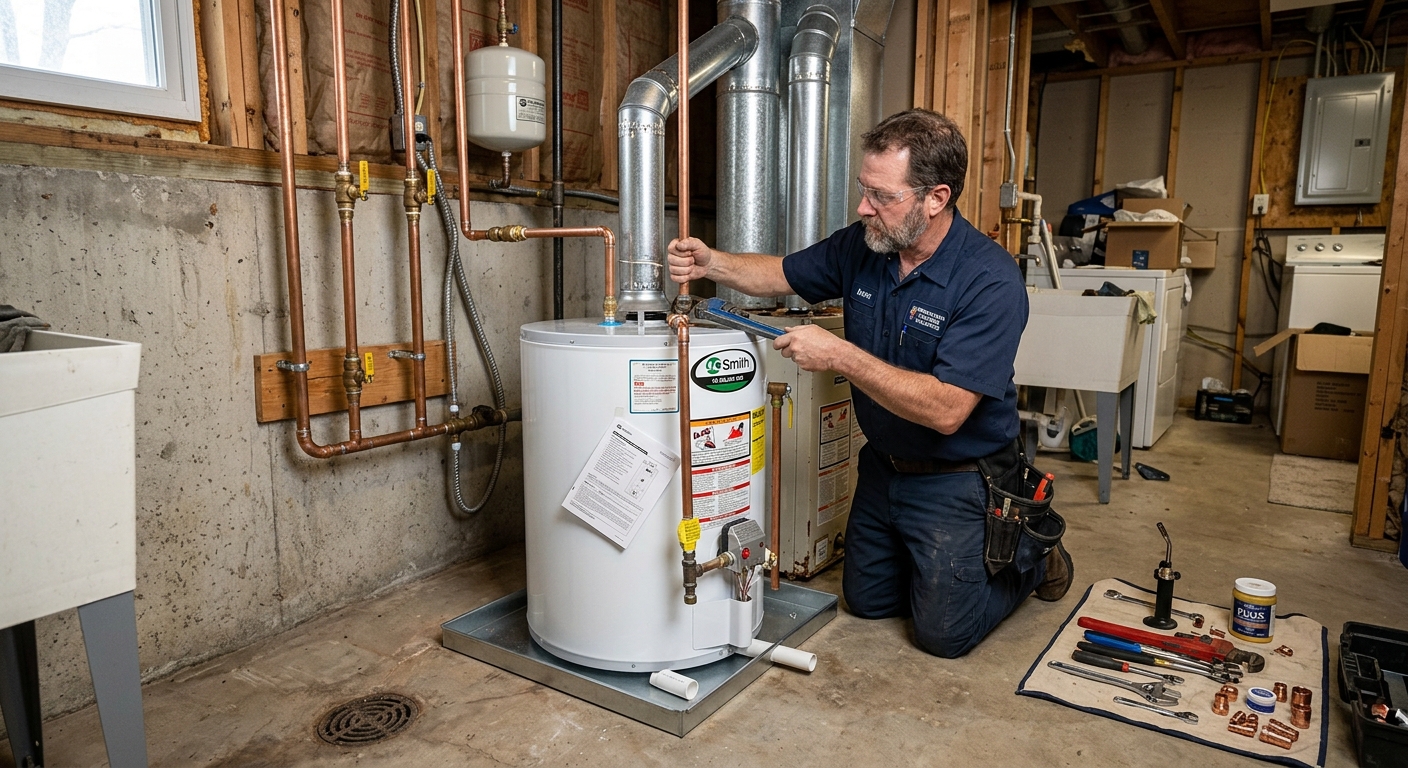
Hamilton plumbing prices by job type — 2026
In Hamilton, plumbing costs depend as much on the timing as the repair itself. Homeowners here, where 81.2% of homes are single-family and nearly half were built before 1980 (U.S. Census Bureau, ACS 2024), see different bills for the same job depending on whether it’s handled in an emergency. Given Franklin County’s wave of post-1970 suburban development along I-81, many homes have seen copper-to-PEX repiping and septic system repairs – changes that shape what breaks down and what the fix costs. Emergency plumbing calls bring not only after-hours labor but also the need to diagnose problems on the spot, which means higher rates up front.
Older houses often mean dealing with legacy pipe materials and the potential for hidden leaks or corrosion. In the past decade, the bulk of repiping jobs in the area have moved toward PEX because it stands up better to the pronounced freeze-thaw cycling seen in south-central Pennsylvania. The most accurate price for any plumbing work still comes down to access (tight crawlspaces or buried piping always add cost) and material—copper, PEX, cast iron, or PVC.
| Service |
Scope |
Emergency rate |
Standard rate |
| Emergency repair — burst pipe |
locate, open, repair section, restore service |
$650–$1,250 |
$375–$1,250 |
| Water heater replacement (gas, 40–50 gal) |
remove old, install, test, haul away |
$2,000–$2,900 |
$1,250–$2,900 |
| Drain cleaning — main line |
augering or hydro-jet, camera if needed |
$350–$800 |
$200–$500 |
| Sewer line spot repair |
excavate or reline a failed section |
$2,100–$12,500 |
$2,100–$12,500 |
| Whole-house repipe |
replace supply lines throughout, patch and finish |
— |
$3,700–$8,900 |
| Water service line replacement |
street to house, excavation and restoration |
— |
$5,700–$12,500 |
Estimates for a typical Hamilton home. Access difficulty and pipe material move these figures more than anything else.
Vetting a plumber in Franklin County
Choosing a plumber in Franklin County takes more than just checking for a business card. Since licensing for plumbing is handled municipally in this area, you must confirm the plumber holds credentials valid in your township—not just somewhere in Pennsylvania. In Chambersburg, for example, the plumbing license comes from the borough, whereas the surrounding townships require you to check with local code offices. Any reputable company will provide a current insurance certificate listing your property as the certificate holder. For work involving employees, state law demands valid workers’ compensation, checkable through WCAIS. If the job exceeds $500, make sure there’s a written contract, in line with the state’s Home Improvement Contractor requirements—verify at hic.attorneygeneral.gov.
Whether a plumber uses a regular crew or subs out work makes a difference when emergencies hit—find out who will show up. Finally, look closely at how emergency call pricing is explained. If a contractor cannot specify a range for after-hours work or hesitates to break down costs, keep looking.
- Confirm plumber is registered as a Home Improvement Contractor (hic.attorneygeneral.gov)
- Check that license is valid for your specific municipality (borough or township code office)
- Request insurance certificate listing your property as certificate holder
- Verify active workers’ compensation (wcais.pa.gov)
- Ask if all work is done by company employees or subcontractors
- Insist on written contracts for jobs over $500, as required
- Require a full breakdown of emergency trip and labor charges before scheduling
- Demand proof of permit where required (major plumbing changes in Chambersburg)
- Ask for camera footage and results if a sewer replacement or major repair is quoted
- Only accept a whole-house repiping quote after a pressure test or clear evidence
- If applicable, verify EPA Lead RRP certification for homes built pre-1978
- Get at least two references from recent, local jobs
In this thin rural market, red flags include vague pricing, refusal to supply documentation, pressure to sign during the first call, and anyone quoting major work like repiping or a sewer replacement without either a camera inspection or a pressure/leak test.
What urgency costs you
Plumbing emergencies in Hamilton—like a burst pipe or sewage backup—come with a premium for a reason. When you call off-hours, part of what you’re paying is after-hours labor, travel time from across a thinly covered rural market, and the fact that diagnosis is rushed. Standard business hours allow for a scheduled visit, which means lower rates and more options if walls or landscaping need to be opened up.
A burst pipe that gets handled during an evening or weekend will likely run you $650–$1,250, compared to a standard rate of $375–$1,250. That’s hundreds you can avoid spending if you can safely stop the water and wait until the next business day. If the leak is flooding your basement or you lose all water (or see sewage coming up drains), don’t hesitate—these are true emergencies. If there’s only a trickle under a sink, a slow drain, or a running toilet, you almost always save money by waiting.
Every Hamilton homeowner should know two shutoffs: main and fixture. The main usually sits just inside your basement foundation wall or near where the water service enters. Use a quarter-turn or gate valve to stop flow to the house. For fixture shutoffs (toilets, sinks), look for little chrome handles on the supply pipes.
- True plumbing emergency: Active flooding, water spraying uncontrollably, sudden complete loss of water, sewage backing up into fixtures, or smell of gas (leave and call 911/gas company for gas).
- Can wait for business hours: Slow leak under a fixture, one sink or toilet backed up with others working, water heater not making hot water but not leaking.
Learning where to shut off your water can be the difference between a regular bill and an emergency premium.
Verifying a Hamilton plumber's credentials
In Pennsylvania, there is no statewide plumbing license. Instead, licensing happens at the municipal level, which means a plumber licensed in Chambersburg is not automatically cleared to work in Hamilton Township or anywhere else in Franklin County. That detail matters when you’re hiring—always ask, "Are you licensed here, for my municipality?" Rely only on local code offices or, within Chambersburg Borough, their designated department for verification.
If your project is in Chambersburg and involves new or replacement water, sewer, or gas piping, you’ll need a permit from the borough’s codes department. For rural townships, fixture swaps like toilets or faucets typically don’t require a permit, but larger work should still be cleared with the township office. Inspection is handled locally—either by the municipality’s inspector or, in rare cases, by the PA Department of Labor & Industry in municipalities that opt out of their own enforcement.
For work exceeding $500, the Home Improvement Contractor registration is a must—lookup is at hic.attorneygeneral.gov. Always obtain proof of general liability insurance; the certificate needs to name your address as an additional insured for coverage on your job. For any company with employees, verify workers’ compensation status at wcais.pa.gov. The right paperwork plus insurance and municipal credentials are your best defense in a market where licensing is patchwork and enforcement varies from one township line to the next.
The leak you can hear but can't see
If you suspect a hidden plumbing leak in your Hamilton home, start with the free test: turn off every faucet and water-using appliance, then watch your water meter. If the dial or digital counter still moves, you’ve got a supply-side leak between the meter and your home’s plumbing.
For leaks you can’t isolate by shutting off appliances, a pro may use acoustic listening devices to pick up the high-frequency sounds of pressurized water escaping, which typically runs $375–$1,250 bundled with repair if pipe access is moderate. Thermal imaging cameras, used to detect colder (or warmer) zones behind drywall, can be called in especially for slab leaks or wall cavities. In rare cases—such as a leak under a slab or in radiant heat piping—tracer (inert) gas detection finds path-of-least-resistance escapes. Irrigation leaks often show up on the meter even when indoor use is shut off.
The biggest sign to walk away is a plumber proposing to cut open walls or flooring before using any non-destructive methods. In every case—slab, wall, buried line—location comes first, cutting second. Unless there’s water pouring from a ceiling or wall, demand a non-invasive location before signing on for repairs.
Freeze risk and what to do about it
South-central Pennsylvania’s winter design temperature drops to 12°F, and the frost depth reaches 30 inches, due to frequent freeze-thaw cycles and moderate snowfall. The most common freeze break isn’t the frozen part itself—it’s just downstream, where pressure has nowhere to go between the ice plug and a closed faucet. That’s why when thaw finally happens, water gushes out in a basement ceiling or crawlspace.
Vulnerable pipes in Hamilton include those along exterior walls, inside unheated garages or crawlspaces, in the attic (if unconditioned), and hose bibs exposed to outdoor temperatures. Prevention costs less than the mess: foam pipe insulation is inexpensive for accessible piping; heat tape (electric wrap) is an option for cold sections if properly installed; letting a faucet drip during severe cold keeps water moving and helps avoid a freeze; and opening under-sink cabinet doors against exterior walls lets room heat in during the coldest spells. Always shut off and drain outside spigots before the first real freeze.
If a pipe does freeze, use a space heater, heat gun, or even a hair dryer to gently warm the section—never a torch or open flame, which can burn down a house faster than it thaws a pipe.
If prevention fails, a burst pipe emergency in Hamilton will typically cost $650–$1,250 if handled after hours. Insulating exposed pipes and prepping hose bibs is a cheap investment when compared to that bill.
Water quality and what it does to your pipes
Most homes in Hamilton get water from a public system (the Borough of Chambersburg Water Department). You can ask the utility for their annual water quality report, which details things like hardness, chlorine, and contaminant levels.
Hard water—common throughout central Franklin County—causes scale buildup and shortens the life of water heaters and some fixtures. If you notice white crusty deposits or your appliances reduce in efficiency, scale is the culprit. Softening may make sense for homes with severe buildup, but if your water heater lasts at least 8–10 years and faucets aren’t clogging, most softeners don’t save more than they cost. Aggressive water (low pH or high acidity) causes pits in copper pipe; if you see blue-green stains or unexplained pinhole leaks, have your water tested and consider correction equipment only if tests recommend it.
For private wells in rural Franklin County, annual water testing (especially for bacteria and heavy metals) is your only protection—nobody publishes a report, so don’t assume it’s safe out of the tap. Be careful with whole-house filter and softener sellers; in my experience, much equipment is oversold or unnecessary in Hamilton homes on city water.
Frequently asked questions — plumbing in Hamilton
Are tree roots a common sewer problem in Hamilton?
Tree roots in sewer lines can be a significant issue in Hamilton, particularly in areas with mature trees and older clay or cast iron piping—common in homes built before 1980. As these pipes age, small cracks and loose joints develop, allowing roots to invade and eventually block the line. If your home has had slow drains, backups, or gurgling sounds from toilets, a camera inspection is the only way to know for certain if roots are the problem. Clearing a main line blocked by roots usually costs between $200–$500 with standard augering or hydro-jetting, but if roots have collapsed or destroyed part of the pipe, spot repair can rise to $2,100–$12,500. Always ask for real camera footage before approving sewer repair.
What does emergency plumbing cost in Hamilton?
Emergency plumbing in Hamilton—like a burst pipe on a weekend or a sudden sewer backup—commands a higher rate because it involves after-hours labor, rapid response, and immediate troubleshooting. For a typical burst pipe emergency call, expect to pay between $650–$1,250. This covers the trip, opening up to find the leak, repairing the section, and restoring service, even if it means removing wall or ceiling panels for access. Calling during business hours could drop your cost closer to $375–$1,250. Knowing where your shutoff valves are, you can often prevent urgent work from becoming a true emergency, saving hundreds.
What do I do if a pipe is frozen but not burst?
In Hamilton, where overnight lows can approach 12°F in winter, frozen pipes are a fact of life. If a pipe is frozen—not leaking—leave the affected faucet open and gently warm the pipe starting from the faucet back toward the freeze. Use a space heater, hair dryer, or heat gun—not a torch or open flame. Never close the faucet; open it lets pressure escape as ice melts. Don’t try to rush it—fast thawing can crack pipes. If you get water running again and there’s no leak, dry off the pipe and check the area for several days. If you do spot water damage, don’t delay—flooded rooms can mean bills of $650–$1,250 for emergency plumbing repairs. Prevention is always cheaper.
Is my water line lead?
Lead service lines are rarely found in Hamilton, though Chambersburg Borough has reported a small, actively replaced inventory so you can call the Borough of Chambersburg Water Department to ask about your specific address. For unincorporated Franklin County, data is unknown, and most post-1970 suburban homes in this area have copper or plastic (PEX or PVC) service lines instead. If your house predates 1980, especially before 1950, check the pipe at the main shutoff: lead pipes are dull gray, and a scraped surface turns shiny. Replacing a lead water service typically costs $5,700–$12,500, but only spend if verified—don't go by rumor alone.
Is a tankless water heater worth it in Hamilton?
Tankless water heaters can save on energy if you use comparatively little hot water at a time and have efficient natural gas service. However, installation is more complex in Hamilton homes, especially older ones with smaller gas lines or venting that doesn’t meet newer codes. Upfront, a quality tankless unit costs more than a traditional tank heater—often exceeding $2,900 installed. In nearly all Hamilton homes, a good 40–50 gallon tank model at $1,250–$2,900 is reliably cheaper installed, easier to maintain, and meets the hot water needs of most families, especially those with older plumbing lines or limited upgrade budgets.
Should I wait until business hours to call?
Unless you’re facing uncontrollable flooding, sewage backing into your home, total water loss, or a gas leak (which is a 911 call, not a plumber), waiting until business hours is almost always the best move in Hamilton. The premium for an after-hours visit can push the repair of a burst pipe from $375–$1,250 during the day into the range of $650–$1,250 at night or on weekends. If you can shut off water at the main, use buckets or towels to contain a minor leak, and keep the area safe, you’ll save money and have more contractors available for quotes.
Who owns the sewer lateral, me or the city?
In Hamilton and the rest of Franklin County, you—the homeowner—own and are responsible for the sewer lateral from your house to the point where it connects with the main line under the street or alley. The Borough of Chambersburg Codes Department will inspect any repair or replacement on your property. Any blockage, break, clogs, or root intrusion from your property to the main is yours to fix, which is why knowing that spot repairs commonly run $2,100–$12,500 is important. Always get a camera inspection before committing to a big dig.
Can I do my own plumbing work in Hamilton?
In most rural townships of Franklin County—including Hamilton—homeowners often do minor replacements like faucets and toilets themselves, as these usually don't require permits. However, if you’re changing out any water, sewer, or gas service piping, you’ll need to check local code requirements, especially if you live within Chambersburg Borough, which requires licensed plumbers and permits for most changes. DIY work without the right permit or inspection risks fines and voided insurance, particularly if a failure later causes property damage. If you do attempt it yourself, always have a qualified pro check your work—emergency repairs from DIY mistakes start at $375–$1,250.
How much does sewer line repair cost in Hamilton?
Sewer line repair in Hamilton varies with the job. Spot repairs—where only a section is excavated or relined—typically range from $2,100–$12,500. The wide spread covers everything from digging up and patching a four-foot section outside your foundation, to relining or replacing thirty feet of pipe under landscaping or driveway. Initial camera inspection and diagnosis are built into the repair cost by most reputable Franklin County plumbers. If a plumber ever recommends full replacement without showing you footage of the damage, push back and get a second opinion—especially given how quickly these costs add up in this market.