Titusville plumbing prices by job type — 2026
Titusville homeowners, especially those living in older homes, face a different plumbing reality than most of Pennsylvania. With 86.9% of the local housing stock built before 1980 (U.S. Census Bureau, ACS 2024), plumbing materials trend toward galvanized steel, cast iron, and the occasional relic service line. House age and pipe materials drive both what fails and how much it costs to fix. The core lesson: price for the same job splits in two, depending on whether you call for an emergency or book standard work. When a burst pipe wakes you at midnight, expect the upper end. Schedule in advance, and costs usually come down.
Old houses in Titusville and Meadville mean that galvanized-to-copper or PEX repiping is a frequent project, often after years of fighting pressure loss or leaks. With 1,336 owner-occupied homes in Titusville and plumbing repairs topping the local spending list, knowing realistic price bands is crucial for budgeting and fair comparison.
Below, you’ll find typical price ranges for the most common residential plumbing jobs in Titusville. Keep in mind: access and material—not just labor—move numbers more than anything else.
| Service |
Scope |
Emergency rate |
Standard rate |
| Emergency repair — burst pipe |
locate, open, repair section, restore service |
$500–$1,050 |
$300–$1,050 |
| Water heater replacement (gas, 40–50 gal) |
remove old, install, test, haul away |
$1,650–$2,400 |
$1,050–$2,400 |
| Drain cleaning — main line |
augering or hydro-jet, camera if needed |
$350–$800 |
$200–$500 |
| Sewer line spot repair |
excavate or reline a failed section |
$1,750–$10,500 |
$1,750–$10,500 |
| Whole-house repipe |
replace supply lines throughout, patch and finish |
— |
$3,000–$7,400 |
| Water service line replacement |
street to house, excavation and restoration |
— |
$4,800–$10,500 |
Estimates for a typical Titusville home. Access difficulty and pipe material move these figures more than anything else.
Verifying a Titusville plumber's credentials
Plumbing licensing in Pennsylvania is strictly local—not statewide. That means there is no state-issued plumbing license, so the question is never simply “Are you licensed?” but “Are you licensed here?” Meadville and Titusville each make their own rules. A plumber licensed in Meadville may not be recognized in Titusville or a nearby township. If a job requires a permit (like any water or drain piping work beyond a single fixture in Meadville), make sure the plumber is allowed to pull it in your municipality. If you’re outside either city, ask your township about permits—each office runs its own process.
The Pennsylvania Uniform Construction Code (UCC), based on the IRC, sets the base standard, and it’s enforced either by local governments or, for some opted-out areas, by the state Department of Labor & Industry. For jobs over $500, the contractor must be registered with the Pennsylvania Office of Attorney General under the Home Improvement Contractor (HIC) system, which you can verify at hic.attorneygeneral.gov. Always ask for proof of insurance naming your address and confirm workers' compensation status through WCAIS (wcais.pa.gov).
Every contract above $500 demands a written agreement under the Home Improvement Consumer Protection Act. You get a three-business-day right to cancel. By law, a plumber cannot offer to waive your homeowners insurance deductible. Always check whether the plumber can show you a valid HIC registration and the right permits before any work begins. For lead work on homes built before 1978, ask to see certification under the EPA Lead RRP Rule.
Sewer laterals: the pipe you own and can't see
If you own a home in Titusville or the surrounding area, you are likely responsible for the sewer lateral: the buried pipe running from your house to the city main, often under your yard or even the street. Most homeowners in Titusville and Meadville are surprised to learn the city doesn’t maintain or repair this line—that burden (and the bills) are yours if something goes wrong.
Watch for early warning symptoms: a single slow drain is usually a local clog, but if two or more drains are slow, you hear gurgling, or there’s a backup at the lowest (usually basement) fixture, the problem is likely in the main sewer line. The gold standard for diagnosis is a camera inspection—a plumber threads a scope through the pipe and shows you live footage, so you can see roots growing through clay joints or standing water in a belly. This should always come before considering any excavation or trenchless quote.
Common failure points in Titusville’s older homes include root intrusion at clay tile joints and shifting soil causing pipe offsets. Open-cut replacing the bad section is traditional but disrupts your yard or driveway; trenchless options can reline a bad pipe with less mess, but not every pipe is a good candidate.
In rural Crawford County townships, septic tanks and drainfields are common. Here, backups may signal a full tank or drainfield failure rather than a problem in the house or lateral. Tanks usually need pumping every 3–5 years, depending on use. Whatever the system, never accept a sewer repair or excavation quote without seeing the camera footage yourself.
Pipe materials in Titusville homes and how they fail
Titusville’s plumbing is a patchwork, reflecting a century of changing code and materials. Most houses here and in Meadville went up between 1900 and 1950, so galvanized steel and early copper are common for water lines, while cast iron or clay handles the drains. Galvanized steel pipes quietly close up from inside as they rust, cutting pressure before they leak. Copper rarely bursts but can develop pinholes if the water is overly “hot” (acidic or mineral-rich). Polybutylene cropped up in the 1980s and is now notorious for unpredictable failures at the fittings—insurers often refuse it.
PEX is today’s standard: flexible, quick for repipes, and the least likely to scale up or corrode if installed away from sunlight. Cast iron drains, meanwhile, corrode slowly and can crack with ground movement, while clay tile sewer pipes succumb to tree roots and shifting soil, causing misalignment. For later homes, PVC and ABS plastics dominate both supply and wastes.
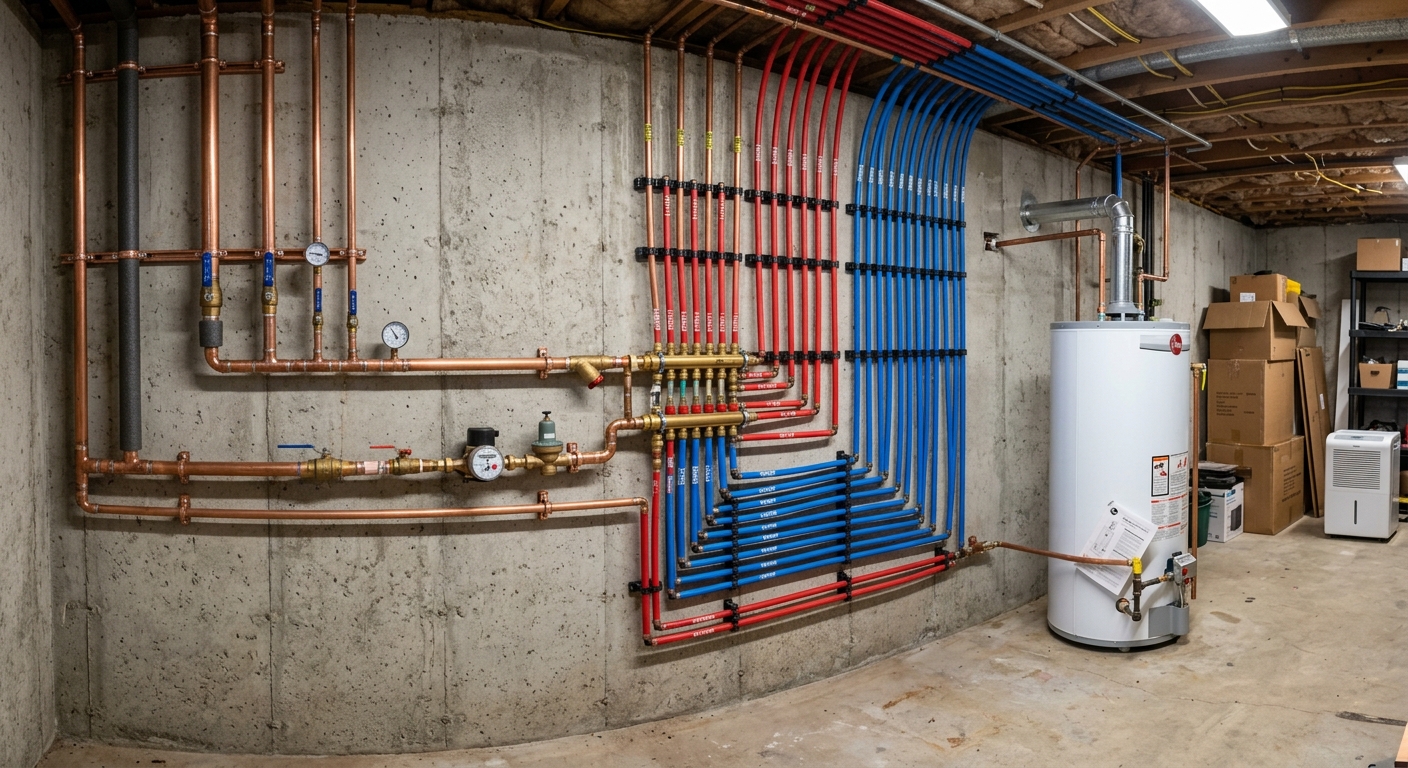
To spot what you have, check exposed pipe in the basement: galvanized is dull gray, magnetic, and threaded; copper is reddish-brown and soldered; PEX is colored flexible tubing. Scratch a spot—gray for galvanized, shiny copper or orange for copper. Cast iron is dark and thick-walled; clay is orangey and brittle. Era ties to risk: original steel or cast iron in a pre-1960 house is overdue for replacement if untouched. Polybutylene from the 1980s? Plan on a full repipe. Most copper from the 1950s onward fares well, but pinholes can pop up. PEX, properly installed, should last decades.
| Material |
Typical era |
Failure mode |
Service life |
| Galvanized steel supply |
pre-1960 |
internal corrosion, pressure loss |
40–60 yrs |
| Copper supply |
1950s–present |
pinhole leaks, joint failure |
50–70 yrs |
| Polybutylene supply |
late 1970s–1995 |
fitting failure, sudden bursts |
unreliable |
| PEX supply |
2000s–present |
fitting or UV degradation |
40–50 yrs |
| Cast iron drain |
pre-1975 |
corrosion, cracking, scale |
50–75 yrs |
| Clay tile sewer lateral |
pre-1980 |
root intrusion at joints, offset |
50–60 yrs |
| PVC / ABS drain |
1970s–present |
joint separation, crushing |
50+ yrs |
Water quality and what it does to your pipes
Titusville draws water from the Meadville Area Water Authority or other small systems, depending on your address. Every public water utility issues an annual water quality report, available by request, showing hardness, mineral content, and what treatment is in use. In older houses with copper or galvanized pipes, hard water is the main culprit behind scale buildup—shortening water heater life and slowing fixtures over time. Aggressive water (low pH) can create pinhole leaks in copper, eating it from the inside out.
Water softeners are common, but honest math says they don’t always pay for themselves unless your water is so hard it routinely scars showers and burns out water heaters. A softener does help appliances run longer and can spare your fixtures if you’re staying for years, but a quick resale often won’t recoup the cost. Whole-house filtration is usually oversold in Titusville unless you have a specific contaminant—point-of-use units (just under the kitchen sink) match most people’s actual needs.
If you’re on a private well in a township outside city limits, no one publishes water test results for you. You’ll need to test annually for bacteria and every few years for minerals or metals. Most plumbers here see more problems from lack of testing than bad test results. Don’t buy expensive filtration without clear evidence from a real test, not just a salesman’s pitch.
Plumbing systems in Titusville homes
Most Titusville homes—almost 87%—were built before 1980, and that shapes just about every major plumbing decision you’ll face. The supply lines are often original galvanized or early copper, and in many houses, you’ll find cast iron waste stacks and drains. Main sewer laterals in these homes are overwhelmingly clay tile if they haven’t been replaced, making root intrusion and joint offsets very common. Where service lines from the street date to the early 20th century, expect either lead or galvanized, which are both aging out now.
Water heaters are rarely original—most homes are on their second or third unit. If you’ve moved into an old Titusville property and see a tank that looks out of place, it’s probably near end of life, especially if the label is sun-faded or rust shows at the bottom seam. Plumbing patchwork is the norm here: expansions and partial repipe jobs mean it’s common to find copper tied to galvanized, or old iron joined to newer PVC or ABS drains.
The upside: nearly all problems in these legacy systems are well-documented and solvable, if occasionally messy. The downside: delayed maintenance quickly gets expensive, as failure in old pipes tends to cascade—one pinhole or clog today can mean a larger repipe or replacement tomorrow.
How to find a good plumber in Titusville
Finding the right plumber in Titusville means working through a thin rural market—and getting specifics right, since a contractor’s credentials and insurance must match your municipality. Plumbing is locally licensed in Pennsylvania, not statewide. Always confirm that the plumber can pull permits where your house sits. For jobs over $500, check the Home Improvement Contractor (HIC) registration at hic.attorneygeneral.gov. For workers' compensation, use the WCAIS system (wcais.pa.gov), and your insurance certificate should name your property directly.
Ask if the company sends its own crew or subs out work to others, and insist on a clear emergency pricing policy in writing—Crawford County’s rural geography means travel surcharges are common, but they should be disclosed up front.
- Does the plumber hold credentials valid in your specific municipality?
- Verify HIC registration for contracts over $500
- Check current insurance certificate naming your address
- Confirm workers' compensation coverage via WCAIS
- Ask who performs the work: in-house crew or subcontractors?
- Require written estimates—never “ballpark” over the phone
- Clarify emergency rates and travel charges before any dispatch
- Request references from recent Titusville jobs
- Insist on camera footage/diagnostics before large drain or sewer repairs
- Avoid anyone pushing filtration without testing
- Demand a written contract with your right of cancellation for jobs over $500
- Be wary of anyone unwilling to show permit history or job photos
Red flags: any plumber quoting a full repipe or sewer replacement with no camera footage, no pressure test, or unwillingness to show documentation should be your cue to get a second opinion. Many legitimate firms cover both Titusville and Meadville, but double-check permit and licensing rules for your exact location.
Frequently asked questions — plumbing in Titusville
What does emergency plumbing cost in Titusville?
Emergency plumbing rates in Titusville start at $500–$1,050 for a burst pipe or active leak, depending on access and pipe material. The same fix, scheduled under normal circumstances, can be as low as $300–$1,050. Because so much of Titusville’s housing stock was built before 1980, costs tend to run on the higher side where galvanized pipes or hard-to-access locations are involved. Many plumbers in the area apply emergency surcharges outside standard weekday hours due to travel time – a key cost driver in Crawford County’s rural setting. Always ask for a written quote, and if possible, wait until normal business hours unless the leak is actively damaging your home.
How do I find a hidden water leak?
For Titusville homeowners, finding a hidden leak usually starts with what you see or smell: unexplained wet spots, peeling paint, musty odors, or persistently running water meter even with all fixtures off. Plumbers may use moisture meters, infrared cameras, or even acoustic sensors to pinpoint a leak behind walls or under floors. In older Titusville homes with original galvanized pipes, pressure loss or brown water can be an early clue that a hidden section is slowly leaking. Diagnosing and repairing such a problem can range from a simple patch to a more expensive repipe—minor leak repairs often cost $300–$1,050. The older the plumbing, the more urgent it is to catch small leaks before they turn catastrophic, since corrosion can escalate quickly.
Should I repipe my Titusville home or keep repairing?
In Titusville, if your home still has original galvanized steel or polybutylene supply lines and you’ve had more than one repair in recent years, the honest answer is: consider a full repipe. Galvanized pipes—prevalent in houses built from 1900–1950—almost always fail from the inside out, and repairs become more frequent and less effective over time. The cost for a whole-house repipe here runs $3,000–$7,400 depending on access and chosen material (copper runs higher than PEX). If you’re only chasing the odd leak and your main lines are copper or PEX, targeted repairs can be the smarter, thriftier move. Many Titusville homes now have patchwork systems, so ask for a walkthrough and real inspection before deciding.
What do I do about a burst pipe right now?
If you have a burst pipe in Titusville, the first step is to shut off your home’s main water supply immediately—typically found in the basement near where the line enters from the street or well. Open a faucet on the lowest floor to help drain water pressure. Once the flow stops, set towels or buckets to control flooding and call a local plumber right away, letting them know it’s an active leak. Emergency repair costs here typically run $500–$1,050, with the upper end more likely if shut-off valves are inaccessible or outdated. If the burst happened during a cold snap—common with Titusville’s deep frost line and older pipes—ask about insulation or freeze protection when the immediate repair wraps.
Do older Titusville homes have galvanized pipes?
Yes—most older Titusville homes, especially those built before 1960, still have some galvanized steel plumbing, unless they’ve been fully repiped. These pipes corrode from the inside, shrinking water flow and eventually leaking or bursting. If your house is showing low pressure at several fixtures or you see brown water after shutoffs, chances are galvanized supply lines are the culprit. Replacing these lines with copper or PEX is a common investment in the area, with full repipe jobs costing $3,000–$7,400. The older and more piecemeal your system, the likelier it is you’ll need to address this at some point for both safety and insurance eligibility.
Does Pennsylvania license plumbers at the state level?
No—Pennsylvania does not issue a statewide plumbing license. Instead, plumbing is licensed locally by each municipality. This means a plumber licensed to work in Meadville might not be authorized in Titusville, and vice versa. Before hiring anyone for a significant job, check that they have the right credential for your town or township, and verify Home Improvement Contractor registration for contracts over $500. For lead work in pre-1978 homes, ask about EPA Lead RRP certification. Never take a blank assurance of "licensed and insured"—always ask for the details relevant to your locality.
Does insurance cover a burst pipe in Titusville?
Homeowners insurance in Titusville will usually cover the cost of sudden burst pipe repairs and resulting water damage, but not the cost to upgrade or replace outdated plumbing. Insurers may require documentation, and may not cover repeated slow leaks or damage caused by long-term neglect—something to keep in mind with Titusville’s older, maintenance-prone stock. By law, local plumbers cannot promise to waive your deductible. Emergency repairs for burst pipes commonly fall within $500–$1,050, which is often less than the cost to meet your insurance deductible unless there is extensive property damage.
What does drain cleaning cost in Titusville?
Main line drain cleaning services—think heavy augering or hydro-jetting—typically cost $200–$800 in Titusville, with emergency rates at the higher end. If camera inspection is necessary, some plumbers include it in the price; others may charge extra, but in old clay or cast iron systems it is usually well worth it to spot obstructions or root growth. Slower drains or recurring blockages often signal a deeper problem within the main or even the lateral, so invest in at least one professional cleaning before considering excavation. Regular drain clearing helps prevent the bigger, costlier sewer spot repairs—which in this area run from $1,750–$10,500.
Should I leave a faucet dripping in cold weather?
In Titusville, with a frost depth of 36 inches and frequent subzero snaps, it’s often wise to let a slow, steady drip run on the coldest nights—especially if your supply lines run through unheated areas like crawlspaces or exterior walls. This small flow helps prevent pressure buildup if water freezes, reducing the risk of a pipe burst that could cost between $500–$1,050 to repair in an emergency. Still, a better long-term fix is proper insulation and heating in vulnerable spaces. If your house has older pipes or a history of freeze-ups, take both approaches: pipe foam, heated tape, and, on the most bitter nights, that drip as a backup.