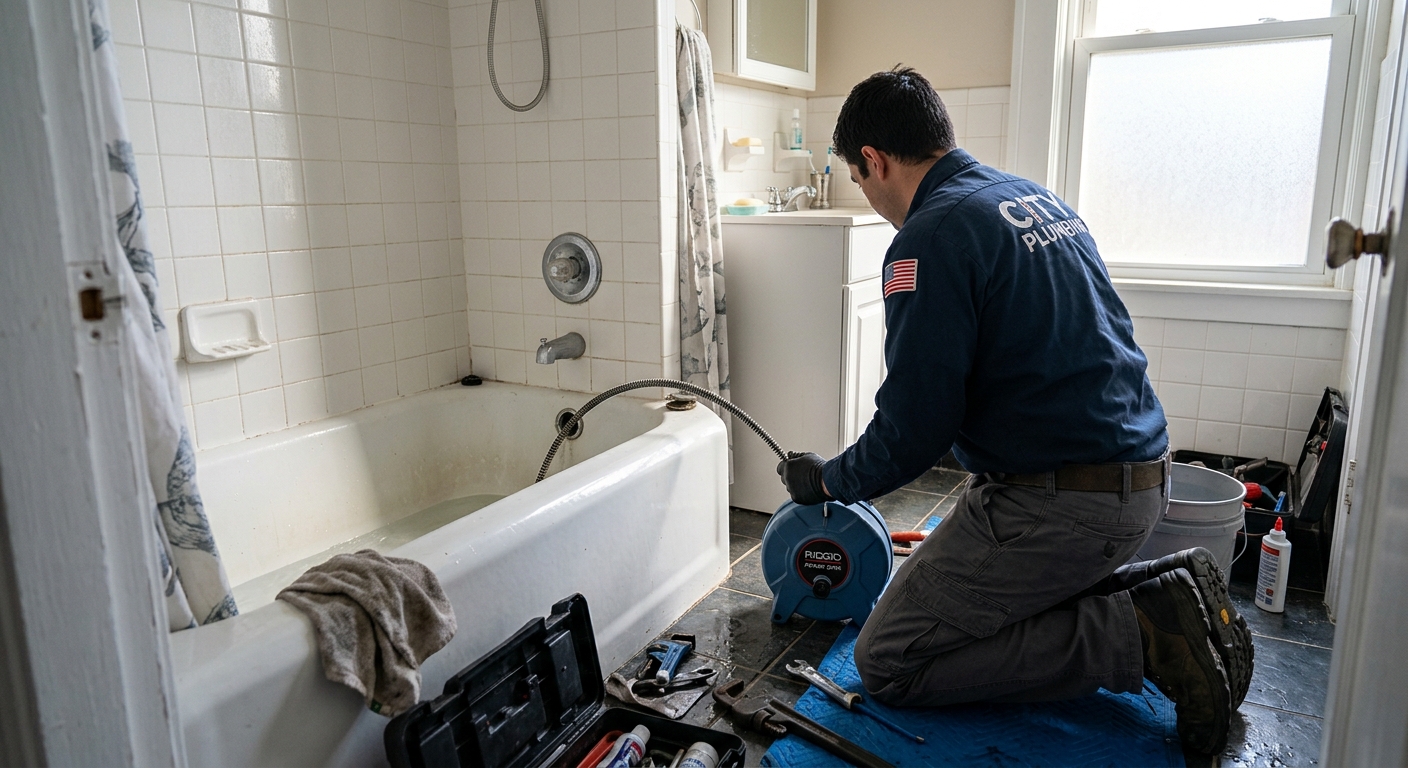
Plumbing costs in South Park — 2026
South Park homeowners see a wide swing in plumbing costs, and a lot of it boils down to this: emergency calls cost more, sometimes much more, than a job you can schedule. With a strong homeownership rate (79.9%) and most houses single-family (78.4%) (U.S. Census Bureau, ACS 2024), South Park reflects nearby Pittsburgh’s pattern: many homes built decades ago with galvanized or cast iron pipes. That older piping is why jobs take longer and sometimes throw curveballs — debris, tight access, or pipes that have “repaired” themselves with scale and now clog or fail in new spots.
If you wake up to a burst pipe, the number that matters is the emergency rate. For planned work, like water heater replacement or a repipe, costs drop and you have more room to compare quotes. Material and access are the biggest cost drivers: repairing a copper line in a finished basement is not the same as swapping a garden hose bib in a crawlspace. Major replacements (like sewer or water service lines) track the era of your home; South Park’s older housing means more cases where full pipe runs need to be replaced, not patched.
| Service |
Scope |
Emergency rate |
Standard rate |
| Emergency repair — burst pipe |
locate, open, repair section, restore service |
$650–$1,250 |
$375–$1,250 |
| Water heater replacement (gas, 40–50 gal) |
remove old, install, test, haul away |
$2,000–$2,900 |
$1,250–$2,900 |
| Drain cleaning — main line |
augering or hydro-jet, camera if needed |
$350–$800 |
$200–$500 |
| Sewer line spot repair |
excavate or reline a failed section |
$2,100–$12,500 |
$2,100–$12,500 |
| Whole-house repipe |
replace supply lines throughout, patch and finish |
|
$3,700–$8,900 |
| Water service line replacement |
street to house, excavation and restoration |
|
$5,800–$12,500 |
Estimates for a typical South Park home. Access difficulty and pipe material move these figures more than anything else.
Licensing and permits for plumbing work in South Park
Plumbing in Pennsylvania is not governed by a statewide license. Instead, municipalities can require their own licensing and most do. In Allegheny County, including South Park and Pittsburgh, the Allegheny County Health Department runs its own journeyman and master plumber licensing program, covering most plumbing work in the region. If your plumber is licensed for Pittsburgh, that credential is local—it does not automatically apply to South Park or nearby municipalities unless specifically recognized. Always ask, “Are you licensed to do plumbing here?” rather than just “Are you licensed?” That’s not splitting hairs; it protects you if there’s an issue with the job.
Permits are required for new or altered plumbing systems, including replumbing a bathroom or installing a new water heater. In practice, simple fixture swaps (like replacing a faucet) don’t trigger county permit requirements. More substantial work—like adding a bathroom or repiping—does. Plumbing permits are inspected by the Allegheny County Health Department. Make sure the permit is pulled and closed out; this is what protects you when you sell or refinance.
In Pennsylvania, plumbers doing jobs valued at over $500 must hold Home Improvement Contractor (HIC) registration through the Office of Attorney General. You can verify this yourself at hic.attorneygeneral.gov. Workers’ compensation insurance is mandatory for employers and can be checked via WCAIS (wcais.pa.gov). For jobs in homes built before 1978, lead-safe practices (federal EPA Lead RRP Rule) apply—verify certification at certifiedrenovatorsearch.epa.gov. Don’t hesitate to ask for proof.
Water heater replacement decisions
For South Park homeowners, water heater choice typically comes down to three types: gas tank, electric tank, and heat pump. Nearly every house here can use tank-style water heaters, which remain the cheapest up front and are simplest to swap into older homes. Their drawback is the shortest expected life, and they lose energy standing by—heat just leaks out. By contrast, tankless (on-demand) units promise endless hot water in a small package and last longer, but in this market, most existing gas lines are too small, and the venting requirements can run up your install cost. People are often caught off-guard by that.
Heat pump water heaters are the lowest to run, but they come with tradeoffs: they need space and warmth to work efficiently, they make noise, and they will cool the room they’re in (no fun if that’s your finished basement). If you have the space and an unfinished area, they can pay back over the years, especially with rising utility prices. South Park has a high proportion of older, single-family homes—fitting a heat pump or tankless model may mean extra carpentry or electrical work.
Sizing should match your first-hour hot water need, not just gallon size. Expansion tanks, a pan, and a proper floor drain are code and insurance “best practice” here. Most failures are tank ruptures, not control issues—another argument for a pan and drain.
| Type |
Installed cost |
Service life |
Operating cost |
Best when |
| Gas tank, 40–50 gal |
$1,250–$2,900 |
8–12 yrs |
moderate |
Easy direct swap with existing venting and gas |
| Electric tank, 40–50 gal |
$1,250–$2,000 |
10–15 yrs |
high |
No gas available, low install cost |
| Gas tankless |
$2,000–$2,900 |
18–25 yrs |
low-moderate |
Major remodels or new construction with upgraded gas line |
| Heat pump water heater |
$2,000–$2,900 |
13–15 yrs |
lowest |
Large unfinished basements, high utility rates |
Winter pipe failures in southwestern Pennsylvania
Southwestern Pennsylvania’s ground frost depth is 36 inches, and our winter design temperature drops to 8 °F. Those are real numbers that should influence how pipes are run and how you protect them. With heavy freeze-thaw cycles and plenty of older homes, it’s no surprise many South Park residents deal with pipe freezes. What surprises most is that a frozen pipe rarely bursts right at the ice plug; instead, pressure builds up between the frozen spot and a closed fixture further down the line, causing a split where the pipe doesn’t have any ice but can’t relieve the pressure.
The usual suspects for freeze risk are pipes in exterior walls, unheated crawlspaces, garages, unfinished basements, hose bibs, and any run left exposed in a vented attic. The cheapest fixes are often the most effective: foam pipe insulation, use of UL-listed heat tape, letting a trickle run during extreme cold, and opening cabinet doors on exterior walls to help room heat reach the plumbing. Outdoor spigots must be shut off and drained well before the first hard freeze—a big deal in older homes, where frost-proof fixtures may not have been added yet.
If a line does freeze, use a hairdryer or a dedicated pipe-thawing device—never a blowtorch. Open a faucet first so melting ice has somewhere to go. Professional repairs for a burst pipe cost $650–$1,250 if you need an emergency call, and more if finished flooring or walls are damaged. Spending a little on prevention beats that bill every time.
Sewer line problems in South Park
If your sewer backs up in South Park, you own the line from your house out to the main, including any section that runs under the sidewalk or even the street. That surprises a lot of people and makes a big financial difference when a repair is needed. The most common warning signs, from least to most serious: a single slow drain (usually just that branch), then multiple fixtures draining slowly, followed by odd gurgling noises, and finally backup at the lowest drain in the house—often a basement floor drain or tub.
A camera inspection is essential before anyone talks about digging up your yard. Older Allegheny County homes often have clay tile laterals, which are notorious for root intrusion and “bellies” where the pipe sags and collects waste. Offsets at joints let more roots in, and everything downstream slows down. If the sewer main backs up, all your lower-level fixtures will tell you before water ever comes to the surface.
You have two main repair options: open-cut replacement (digging up the bad section) or trenchless relining (if the existing pipe hasn’t collapsed). Both have a place here, but insist on seeing the camera footage before you sign a contract. In some South Park neighborhoods, septic systems are still present—those bring a different list of concerns, primarily tank pumping every 3–5 years and dealing with saturated drainfields if they start to slow.
What a plumbing quote should contain
When you’re handed a plumbing quote in South Park, check the billing model first. Some companies give a flat rate—one price for the whole job, which builds in their risk if things go sideways. Others run time-and-materials, which can be cheaper for a quick fix but open-ended if a job turns up hidden issues. There’s nothing wrong with either, but not knowing which you agreed to is how bills balloon.
A solid quote spells out whether the diagnostic fee is credited to the work, what is being opened or replaced, and whether drywall or finish repairs are included or excluded. Permitting should be clearly stated—and included for jobs that need them. Look for a warranty on labor separate from parts (many fixtures carry their own manufacturer warranty, but labor is always up to the plumber). After-hours rates for emergencies should be disclosed, not buried.
| Line item |
What to look for |
Red flag if… |
| Billing model |
flat rate or hourly, stated up front |
unstated |
| Diagnostic fee |
amount, and whether it credits |
vague |
| Scope |
what is opened, repaired and restored |
price with no scope |
| Restoration |
drywall and finish explicitly in or out |
silent |
| Permit |
included and priced |
'not needed' |
| Parts |
brand and model for fixtures |
'standard fixture' |
| Warranty |
labour period stated separately |
parts only |
The leak you can hear but can't see
If you suspect a hidden leak in your South Park home, you can confirm it yourself before calling anyone. Shut off every fixture and appliance that uses water, then check your water meter—if the small red dial (or the digital counter) is still turning, you have a leak on the supply side. This costs you nothing and gives you a starting point.
A plumber can go further using acoustic listening equipment to pinpoint pressurized leaks in walls or under floors, usually costing between $375–$1,250 if it turns into a typical emergency call. Other tools include thermal imaging (helpful for hot water leaks), tracer gas (for the most stubborn cases), and ground microphones for slab leaks. Slab leaks and irrigation line leaks can be found without tearing up floors or yards—no one should be opening walls or concrete until the leak is actually located.
For leaks inside wall cavities or beneath concrete, insist on professional leak detection before any demolition. A plumber who suggests “cut and check” before using these tools may be guessing at your expense, rather than solving the problem efficiently.
Frequently asked questions — plumbing in South Park
How deep do water lines need to be buried in South Park?
Water service lines in South Park should be buried to a depth of at least 36 inches. This is tied to the southwestern Pennsylvania frost depth—our region sees prolonged hard freezes and a winter design temperature of 8 °F. Burying water pipes below 36 inches protects them against freezing even when the ground is at its coldest. If your home predates modern codes, your line may be higher and at risk. If replacing a service line—and it’s a common job in South Park’s older neighborhoods—it’s also an opportunity to upgrade materials and insulation. Professional excavation, replacement, and restoration costs run from $5,800–$12,500 for a typical South Park property, depending on obstacles and distance from the main.
Do I need a permit for plumbing work in South Park?
For anything beyond basic fixture swaps such as replacing a faucet, a plumbing permit is required in South Park. This includes new water heaters, bathroom remodels, repipes, or moving supply and drain lines. Permits are issued and inspected by the Allegheny County Health Department—having them keeps your home within code, protects resale value, and ensures the work is up to standard. For jobs valued over $500, your contractor must also have Home Improvement Contractor (HIC) registration, which you can verify directly. The rule of thumb: when in doubt, ask your plumber to clarify if your job requires a permit. Most emergencies—like a burst pipe—mean quick repairs and documentation afterward, with typical emergency repair costs between $650–$1,250 if you need immediate service.
Are tree roots a common sewer problem in South Park?
Yes, tree roots are one of the top causes of sewer line issues in South Park’s older housing stock. Many of our homes date back to 1900–1950, when clay tile was commonly used for sewer laterals. Those clay joints let fine roots migrate in, which eventually become large enough to block flow or break the pipe. Root intrusion often shows up first as slow drains, then progresses to more frequent backups. Annual mechanical cleaning can keep roots at bay, but when the problem repeats, a camera inspection is the next step. If you need a sewer spot repair because of roots or other failure, the cost in South Park runs $2,100–$12,500 depending on whether digging or relining is possible. Always see the camera video before agreeing to excavation.
What does repiping a house cost in South Park?
Repiping a whole house in South Park, whether in copper or PEX, costs $3,700–$8,900 for a typical single-family home. The high side of this range generally means a larger home, lots of finished walls, or dealing with the quirks of a 1940s era plumbing layout—which many South Park homes have. Repiping is often only necessary if pipe corrosion, low water pressure, or repeated leaks have made repairs a losing battle. Most quote prices include basic patching but not full repaint, so clarify restoration; older homes with plaster or custom finishes may see additional costs. Before committing, verify your plumber’s registration and ask if a permit is needed, as these are big-ticket projects and consumer protections should apply.
Why do all my drains drain slowly at once?
If all the drains in your South Park home are draining slowly at the same time, this points to a main sewer issue, not just a problem with a single fixture. Older homes (and over 70% here predate 1980) often have older cast iron or clay main lines that deteriorate or get blocked with roots and debris. This is typically the signal for a professional drain cleaning or hydro-jetting to clear the main line, with typical costs between $200–$800 depending on access and severity. If the problem keeps returning, you’ll want a camera inspection to check for cracks, offsets, or root masses that could require a spot repair. Don’t let anyone bid sewer work without showing you video from their inspection.
Is trenchless sewer repair reliable?
Trenchless sewer repair is widely used and can be very reliable in South Park, especially with the large number of clay and cast iron laterals dating from 1900–1950. Techniques like cured-in-place piping (CIPP) allow lining of an existing pipe without a complete yard excavation, minimizing disruption and restoration costs. The reliability depends on the condition of the existing pipe—if it’s collapsed or severely offset, trenchless may not be an option. For eligible pipes, a proper install gives 50+ years of life. Always insist on a before-and-after camera inspection, and get at least a 10-year warranty. Trenchless spot repairs in South Park tend to fall within $2,100–$12,500, usually on the lower end unless extensive prep or heavy cleaning is needed first.
How do I shut off the water to my house?
In most South Park homes, your main water shutoff will be in the basement near where the supply pipe enters the house—usually within a few feet of the front wall. Turn the valve clockwise (right) to shut off. If you have an older “gate” valve and it won’t turn, don’t force it—a plumber can replace it with a modern ball valve as part of routine service or a water service line replacement (costs $5,800–$12,500 if it’s a street-to-house job). Always test your shutoff valve once a year, and make sure everyone in the house knows where it is. Fast shutoff during a leak or burst pipe can save thousands in water damage, especially during winter freezes.
How much does a water heater replacement cost in South Park?
A standard 40–50 gallon water heater replacement in South Park typically runs $1,250–$2,900, with most jobs landing around $2,000, including haul-away of the old unit, supply connections, and venting adjustments. This depends on the type (gas, electric, or heat pump), location, and whether you need upgrades to flue, gas line, or drainage. South Park’s older homes often present challenges; for instance, venting a new tankless heater or running a dedicated electric line for a heat pump may add to the cost. Always request an itemized quote showing model, accessories (like expansion tank and drain pan), warranty, and labor separate from the unit itself to compare apples to apples.
Who owns the sewer lateral, me or the city?
In South Park and throughout Allegheny County, the homeowner is responsible for the entire sewer lateral from the house to the main, even if part of that line runs under the sidewalk or street. The city or utility only maintains the public sewer main in the street. If there’s a blockage or failure, you—not the city—must repair any section on your property plus the run to the main. When you get sewer repair estimates, understand that a spot repair or trenchless lining can cost $2,100–$12,500. Always insist on video documentation of the problem before signing any contract, and check if your insurance policy covers lateral line repairs, as many do not without specific riders.