What plumbers charge in Plum
Plum’s plumbing costs are shaped by two big realities: a high owner-occupancy rate (81.8%) and an older, mostly single-family housing stock, with nearly 63% of homes built before 1980 (U.S. Census Bureau, ACS 2024). This matters because those pre-1980 homes often have aging galvanized or cast-iron plumbing, which is more failure-prone and more expensive to repair or replace—including full repipes, sewer spot repairs, or water service replacements. Much of Pittsburgh’s housing stock was built between 1900 and 1950, a fact that applies just as well here in Plum and predicts the kind of calls plumbers get: leaks from rusted pipes, main waste line clogs from root intrusion, and water heaters ending their service life sooner from scale buildup.
For any job, whether it’s a burst pipe or a scheduled heater replacement, the price jumps if you need service after hours or on a weekend. Emergency rates cover the overhead of “drop everything and drive,” while standard rates are for work you can schedule during normal business hours. This single choice between emergency and scheduled repair often makes a bigger difference than the company you hire or the product you pick.
| Service |
Scope |
Emergency rate |
Standard rate |
| Emergency repair — burst pipe |
locate, open, repair section, restore service |
$600–$1,250 |
$375–$1,250 |
| Water heater replacement (gas, 40–50 gal) |
remove old, install, test, haul away |
$2,000–$2,900 |
$1,250–$2,900 |
| Drain cleaning — main line |
augering or hydro-jet, camera if needed |
$350–$800 |
$200–$500 |
| Sewer line spot repair |
excavate or reline a failed section |
$2,100–$12,500 |
$2,100–$12,500 |
| Whole-house repipe |
replace supply lines throughout, patch and finish |
$3,600–$8,800 |
$3,600–$8,800 |
| Water service line replacement |
street to house, excavation and restoration |
$5,700–$12,500 |
$5,700–$12,500 |
Estimates for a typical Plum home. Access difficulty and pipe material move these figures more than anything else.
Sewer laterals: the pipe you own and can't see
Few Plum homeowners realize they are responsible for the buried sewer lateral all the way from the house out to where it meets the municipal main—often well into the yard or even the street. This is why sewer repairs are expensive and often come as a surprise, especially in older Plum neighborhoods where trees and clay pipes dominate.
Common symptoms start with a single slow drain. More serious: gurgling from other fixtures, two or more drains clogging at once, or sewage backing up at the lowest drain or floor. When these show up, a plumber should always recommend a video camera inspection before quoting any replacement or excavation. In homes built during the 20th century boom, many lines are clay tile, which readily cracks, lets in roots, and sags (“bellies”) that accumulate debris.
If you’re told your line needs replaced, trenchless technology (such as pipe relining) is sometimes an option, but not always: offset joints, collapsed sections, or severe root invasion may still require open-trench work. Expect to hear both options. If your Plum home is on septic, common in some outlying Allegheny County townships, slow drains can also result from an overdue tank pump (every 3–5 years) or a failed drainfield, which is a completely separate fix from a broken lateral.
Never accept a quote for sewer excavation or replacement without first seeing the camera footage—and understanding exactly where and why the repair is needed.
Tank, tankless or heat pump water heater?
For most Plum homes, a gas tank water heater is still the staple—install cost is lowest, they handle the region’s cold incoming water well, and most sellers keep them in stock. The tradeoff: they waste some energy keeping water hot 24/7, and the tank will eventually rust out, sometimes with no warning. Electric tanks are nearly as common, especially where no gas line runs to the appliance, but expect higher operating costs, especially on older units.
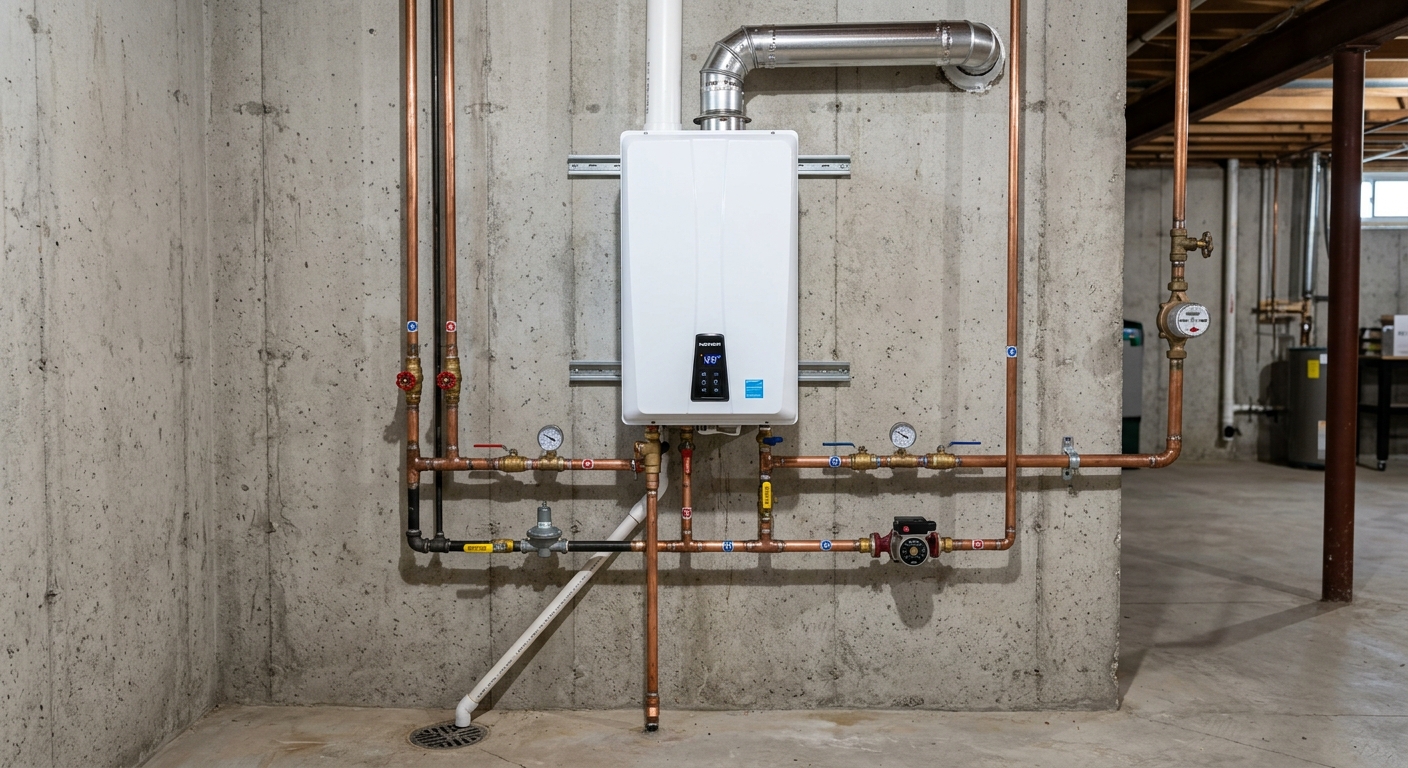
Tankless gas heaters sound appealing for their endless hot water. But most older homes in Plum were never piped with the gas supply or venting that modern tankless units require—so the install price often jumps, sometimes needing a new gas line or vent. Heat pump water heaters cost more up front but are cheapest to run. The catch: they pull heat from the basement air, leaving that space cooler and sometimes humid. They’re also too loud for a finished basement laundry.
No matter the type, sizing by first-hour rating (not just gallons) is crucial—especially for homes with multiple showers. Local code often requires a thermal expansion tank and a pan with a drain when replacing, particularly in finished basements. Most tank failures are leaks, not failed controls, and a 10–12 year average is about what to expect before leaks start in Plum’s tap water and older plumbing.
| Type |
Installed cost |
Service life |
Operating cost |
Best when |
| Gas tank, 40–50 gal |
$1,250–$2,900 |
8–12 yrs |
moderate |
gas available, middle-of-the-road install budget |
| Electric tank, 40–50 gal |
$1,250–$2,000 |
10–15 yrs |
high |
no gas line, lower upfront cost is needed |
| Gas tankless |
$2,000–$2,900 |
18–25 yrs |
low-moderate |
endless hot water matters, gas line/vent upgrades affordable |
| Heat pump water heater |
$2,000–$2,900 |
13–15 yrs |
lowest |
plenty of space; utility rates favor efficient units |
Choosing a plumbing contractor
In Plum, you need to go beyond asking “are you licensed?” Plumbing is not licensed statewide in Pennsylvania, but by the specific city or township. For jobs in this area, it’s critical the company holds any required credential where the work will actually be done—ask for documentation and verify with the municipality if you’re not sure. Contractors must have a Home Improvement Contractor (HIC) registration for any job over $500; look it up at hic.attorneygeneral.gov. Insurance must name your property, and if they have employees, workers' compensation must be verifiable through WCAIS (wcais.pa.gov). Ask if work is subcontracted or done by direct employees, and clarify emergency call rates up front—Pittsburgh metro is a crowded market, and not every company plays fair.
- Confirm HIC registration at hic.attorneygeneral.gov
- Verify local plumbing credential, not just “licensed”
- Require written contract for jobs over $500 (HICPA rule)
- Check workers' compensation via WCAIS
- See a current insurance certificate naming your property
- Ask if work crews are employees or subcontractors
- Insist on up-front, transparent pricing for diagnostics
- Get details on emergency charge policy and response window
- Request references from past jobs in Plum or Allegheny County
- Require camera footage before sewer or repipe quotes
- Ask if the contractor pulls all needed permits
- Insist on a pressure test, not just visual, after a repipe
Red flags: A company quoting a whole-house repipe or sewer replacement without camera proof, pressure testing or proper contract language. The local market is crowded enough that you can insist on accountability and still have options.
Water quality and what it does to your pipes
Plum homes on public supply get water from the Pittsburgh Water and Sewer Authority, which is required to publish an annual water quality report—request it directly if you’re curious about what’s in your tap water. Hardness here isn’t as severe as some Midwest areas but mineral scale does slowly collect in water heaters and on fixtures, especially for homes with decades-old pipes. This shortens the lifespan of tanks and any valve with moving parts.
Aggressive tap water—low pH or high chlorination—can cause pinhole leaks in copper. While whole-house water softeners can prolong appliance life and keep fixtures cleaner, they're not always worth it here. Between the upfront install and the years of salt or filter changes, most Plum homes don’t save enough on repairs or replacements to cover the cost unless you see visible scale or have diagnosed pinholes. Point-of-use filters (kitchen sinks, fridges) make sense if you just want better tasting or filtered drinking water at one tap.
If you're on a private well or septic in a township area—less common, but possible—no annual report will come in the mail. In that case, have the water tested for both bacteria and minerals every couple of years. Be skeptical about any contractor who tries to sell expensive treatment gear without lab results specific to your property.
Lead service lines in Plum
The Pittsburgh Water and Sewer Authority, which serves central Allegheny County including Plum, has identified and is actively replacing thousands of lead service lines. Homeowners own the portion of the line from the curb (the shut-off) to the house itself, while the utility is typically responsible from the main to the curb. Replacement programs often only cover the utility’s side, with the private portion still on the homeowner unless both sides are tackled together. Partial replacements have sometimes made short-term water quality worse by disturbing protective scale inside old pipes; true safety comes from fully replacing the whole run.
To check if you have lead, locate where the water line enters your basement. Scratch the pipe with a coin—lead is dull gray and easily scored, and is not attracted by a magnet. The utility should maintain a service line inventory you can check; ask Pittsburgh Water and Sewer Authority directly about available records and any cost-share for replacement, since program availability changes and details are not always posted online.
If you do need to replace your portion, expect to pay between $5,700–$12,500 for a water service line replacement, or $3,600–$8,800 if included as part of a full-house repipe. Because most of Plum’s homes are older, even houses built after 1950 may have had lead lines or connections originally—so checking is worthwhile, even if your neighbors haven’t needed work yet.
Who is allowed to do plumbing work in Pennsylvania
Pennsylvania does not license plumbers at the state level. Rather, licensing is handled by cities or municipalities. That means a plumber licensed in Pittsburgh may not have a credential to work in Plum or other townships in Allegheny County; always ask “are you licensed here?” For contract plumbing work over $500, a Home Improvement Contractor (HIC) registration from the Pennsylvania Office of Attorney General is mandatory—look it up at hic.attorneygeneral.gov. In Pittsburgh and surrounding municipalities, plumbing permits are administered by the Allegheny County Health Department Plumbing Program; a permit is needed for any new or altered system, but not for minor fixtures like faucet swaps.
If you hire a company with employees, verify active workers' compensation coverage through WCAIS (wcais.pa.gov). Any job over $500 requires a written contract, per the Home Improvement Consumer Protection Act. For work done in Plum or nearby municipalities, check with the local authority to see if a plumbing permit is required, especially for replacements involving concealed or underground pipes. Always see an insurance certificate making your address the named property, and do not accept just a general policy statement.
In short: the question in Pennsylvania isn’t “Do you have a state license?” but “Do you have the right credential in this township, and does your insurance and workers' comp check out for this job and address?”
Frequently asked questions — plumbing in Plum
Should I wait until business hours to call?
In Plum, deciding whether to wait until business hours depends on the severity of your plumbing issue. If you have an active leak, a burst pipe flooding your basement, or sewage backing up into your home, do not wait—these problems tend to get much worse quickly and repairs typically range from $600–$1,250 for an emergency call, but delays can double or triple your eventual repair and restoration costs. For less urgent problems (like a slow drain or a drippy faucet), waiting until morning or a weekday can save on service charges, as standard rates for similar repairs may start at $375. Bottom line: if water is actively causing damage or you’re without water/sewer service, call now. For nuisance issues, schedule during regular hours to keep your costs down.
Which utility supplies water to Plum?
Most Plum homes receive their water from the Pittsburgh Water and Sewer Authority, which serves central Allegheny County, including Plum. If you want to know specifics about your service line material (for example, whether it’s lead, copper, or galvanized), you can contact the utility directly or check their published inventory. Water service issues that affect your main supply—like needing a water service line replacement—generally cost $5,700–$12,500 in this area, much of which comes from restoring landscaping or pavement. Always verify with the utility itself if you have any doubt about supply, water quality, or replacement programs.
Does Pennsylvania license plumbers at the state level?
Pennsylvania does not issue plumbing licenses at the state level. Individual municipalities enforce their own rules. In Plum and throughout Allegheny County, plumbers may need a municipal or county license to perform certain work, especially new installations or changes to systems. Statewide, any contractor taking a job over $500 must have a Home Improvement Contractor (HIC) registration, checked at hic.attorneygeneral.gov. Always ask not just if they are “licensed,” but if their credential and insurance are valid specifically for work in Plum. If you’re quoted for a whole-house repipe—which can run $3,600–$8,800—make sure the company has the paperwork in order for this township.
Should I reline or replace my sewer line?
In Plum, many older sewer laterals are clay tile or cast iron, and both trenchless relining and open replacement are seen. Relining is less invasive (your lawn and driveway are less likely to be dug up) and works when the line is intact but leaking due to cracks or joints. However, if the line has collapsed, is heavily offset, or has severe root intrusions, open replacement is necessary. Camera inspection is non-negotiable before getting a quote. Relining typically falls on the lower end of the repair range, but a spot repair—even trenchless—can still run between $2,100–$12,500 depending on length and access. Make your decision based on video evidence and a clear written scope—not just a contractor’s word.
How do I prevent frozen pipes in Plum?
Plum’s winter lows routinely drop below 10°F, and older homes here were not always insulated for current code. To prevent pipes from freezing, focus on those in unconditioned spaces like garages, crawlspaces, and outside walls. Insulate exposed piping and keep areas heated where possible. On the coldest nights, opening cabinet doors under sinks and letting a trickle run from the faucet can help. If you do end up with a burst pipe, repair costs typically fall in the $600–$1,250 window for an emergency call. If your home is being renovated or repiped, make sure the piping is kept within the heated envelope—this alone can save headaches and money every winter.
How long should a water heater last in Plum?
In Plum, most standard tank water heaters last about 8–12 years. This is a bit shorter than advertised on some models, due in part to local water chemistry and scale buildup—both are common throughout aging Allegheny County home stock. Failures almost always occur as a leak from the bottom of the tank, not a failure of controls or electronics, so they’re tough to predict. Expect to pay $1,250–$2,900 for a full replacement, including removal of the old unit, installation, and disposal. If your heater is already over 10 years old or making rumbling noises, consider proactive replacement, especially if it’s located over finished space.
Does insurance cover a burst pipe in Plum?
In Plum, homeowner’s insurance will often cover sudden burst pipes—especially if they cause water damage to floors and walls. But there are big exclusions: if the insurer finds out the property was not properly heated, or plumbing was neglected, claims can be denied. Coverage rarely extends to repairs of old or worn-out systems; it’s mostly about cleanup and restoring finishes. Emergency burst pipe repairs typically cost $600–$1,250. Always fix leaks quickly and keep documentation; if you’re away for winter, shut off water and drain lines to avoid claim disputes.
Why do plumbers charge a diagnostic fee?
In Plum—and across Allegheny County—plumbers charge a diagnostic fee to cover the cost of travel, troubleshooting, and providing a professional opinion, especially when the real repair isn’t obvious at first glance. Rates for basic drain clearing or leak investigation usually fall between $200–$500 on a scheduled basis. These fees help offset the time and skill for identifying the issue, using video cameras or test equipment, and are usually credited to the job if you go forward with the repair. With a saturated Pittsburgh-area market, this upfront charge discourages folks from calling five different companies for free quotes without intending to hire anyone.
How much does a plumber cost in Plum?
Costs for plumbing work in Plum depend most on urgency and the specific nature of the repair. A scheduled visit to replace a water heater will typically run $1,250–$2,900. Main line drain cleaning is usually between $200–$500. The big-ticket items are underground work: a sewer spot repair or water service line replacement often costs several thousand dollars—$2,100–$12,500 is a realistic range depending on access and restoration. Emergency repairs—after hours or on weekends or holidays—always cost more, as much as double the standard minimum. Always insist on a clear written quote for your area and home before work starts.