Plumbing costs in Tunkhannock — 2026
In Tunkhannock, with almost all households owner-occupied (89.4%) and 92.3% of homes detached single-family (U.S. Census Bureau, ACS 2024), plumbing issues tend to be the homeowner’s responsibility from start to finish. The era of your home—commonly 1970s-2000s vacation and subdivision housing—typically tells you what kind of pipes you have and what repairs to expect. For instance, many Tunkhannock homes have seen one or more PEX retrofits, and township properties often tie into septic systems rather than municipal sewer.
Whether you pay the emergency or standard rate depends entirely on when you call. If water is pouring from your ceiling at 2 a.m., you’ll pay the emergency premium. If you spot a slow drip or plan a water heater changeout, you’ll pay the standard rate. The same job—replacing a burst pipe, swapping a water heater, or clearing a stubborn mainline clog—can cost half as much when scheduled for regular business hours.
| Service |
Scope |
Emergency rate |
Standard rate |
| Emergency repair — burst pipe |
locate, open, repair section, restore service |
$600–$1,150 |
$350–$1,150 |
| Water heater replacement (gas, 40–50 gal) |
remove old, install, test, haul away |
$1,850–$2,700 |
$1,150–$2,700 |
| Drain cleaning — main line |
augering or hydro-jet, camera if needed |
$350–$800 |
$200–$500 |
| Sewer line spot repair |
excavate or reline a failed section |
$1,950–$11,500 |
$1,950–$11,500 |
| Whole-house repipe |
replace supply lines throughout, patch and finish |
|
$3,400–$8,300 |
| Water service line replacement |
street to house, excavation and restoration |
|
$5,400–$11,500 |
Estimates for a typical Tunkhannock home. Access difficulty and pipe material move these figures more than anything else.
Sewer laterals: the pipe you own and can't see
The most misunderstood part of plumbing in Tunkhannock is this: you own the underground sewer lateral from your house to the main, sometimes extending all the way into the street. If a problem occurs anywhere on that run, you—not the municipality—are responsible for repairs. Most disputes start and end with that single fact. Signs of trouble start small—a single slow drain or gurgling from a fixture. When multiple fixtures back up simultaneously or waste appears at the lowest drain, the problem is almost always in the main house drain or the lateral outside.
Before anyone talks excavation or replacement, demand a camera inspection and see the real-time footage yourself. Sewer laterals here, especially in pre-1980 homes, may be original clay tile—which fails at joints where roots push through or with bellies (dips in the line) and offsets. Modern repairs may use open-cut trenching or trenchless relining. Beware: some firms will quote full dig-out jobs when a local patch or interior lining will do, so the only answer is “show me the video.”
If you're in a township home with a septic system (very common here), different logic applies. Problems could be as simple as the septic tank needing a pump-out—every 3–5 years is typical for most households—or as serious as a drainfield failure, which is unrelated to the house lateral. Recurring backups, especially after rain, usually indicate a saturated or failed drainfield, not a clogged pipe. Either way, camera inspection is your friend: it’s the only non-speculative way to know what needs fixing and where your money goes.
Galvanized, copper, PEX, cast iron
If you want to predict what will go wrong in a Tunkhannock home's plumbing, start by dating the house. Most here are 1970s-2000s vacation and subdivision builds—think copper, some remnants of galvanized, later-era polybutylene in stretch periods, and widespread PEX retrofits. Cast iron drain pipes stick around in older (pre-1980) houses, often outliving their intended lifespan. Clay tile predominated for older sewer laterals, replaced by PVC in later construction or during repair.
Here’s how you can identify your pipes: scratch galvanized steel and it shines silver and is threaded, but a magnet sticks. Copper is reddish and non-magnetic, usually with soldered joints. PEX is plastic—red, blue, or white, often stamped with markings. Polybutylene is gray-blue, flexible, and has plastic or metal crimp ring fittings. Cast iron is black and heavy; tap it, and it rings. Clay tile is usually only visible at exterior cleanouts and is brown or orange in color. PVC or ABS drain lines are white or black plastic, with glued joints.
If your house was built in the 1970s, your supply lines may be copper or even the late years of polybutylene—trouble if not upgraded. Cast iron drains can fail at 50+ years; clay laterals were common until the late 1970s and increasingly show root intrusion and shifting. If you’re newer (1990s-2000s), you likely have PEX supply and PVC drains; your main problem will be builder-grade fittings, not catastrophic aging. You can use this guide to guess how much runway your home’s plumbing has left before big-ticket work arrives.
| Material |
Typical era |
Failure mode |
Service life |
| Galvanized steel supply |
pre-1960 |
internal corrosion, pressure loss |
40–60 yrs |
| Copper supply |
1950s–present |
pinhole leaks, joint failure |
50–70 yrs |
| Polybutylene supply |
late 1970s–1995 |
fitting failure, sudden bursts |
unreliable |
| PEX supply |
2000s–present |
fitting or UV degradation |
40–50 yrs |
| Cast iron drain |
pre-1975 |
corrosion, cracking, scale |
50–75 yrs |
| Clay tile sewer lateral |
pre-1980 |
root intrusion at joints, offset |
50–60 yrs |
| PVC / ABS drain |
1970s–present |
joint separation, crushing |
50+ yrs |
Licensing and permits for plumbing work in Tunkhannock
There is no statewide plumbing license in Pennsylvania. Instead, municipal governments decide whether, and how, plumbers are licensed and registered. This means that if your plumber is licensed in a nearby city or township, that credential holds no automatic value in Tunkhannock unless issued or recognized by the relevant authority. Always ask a simple, direct question: “Are you authorized to work here?” instead of “Are you licensed?”
For most plumbing work touching pipe or drainage in a Tunkhannock home—especially anything beyond fixture swaps—you are subject to the Pennsylvania Uniform Construction Code (UCC), which is based on the International Residential Code. Most inspection and enforcement is handled by local municipalities or, if they opt out, by the Pennsylvania Department of Labor & Industry. Jobs over $500 require a written contract under the Home Improvement Consumer Protection Act, including a three-day right to cancel.
To protect yourself, only hire companies with Home Improvement Contractor (HIC) registration, verified at hic.attorneygeneral.gov, and if any worker other than the owner is on site, confirm they carry current Workers’ Compensation insurance with WCAIS (wcais.pa.gov). Never pay a contractor who offers to waive an insurance deductible—this is not permitted. For homes built before 1978, ask for EPA Lead RRP certification before any work that disturbs painted surfaces.
Tunkhannock's housing stock and its plumbing
With just 15.6% of homes built before 1980 in Tunkhannock, most properties fall into the newer side of Monroe County’s housing wave—primarily post-1970s vacation and subdivision builds, often with original or builder-grade plumbing systems. In these homes, copper or polybutylene supply lines are common for earlier houses, with a sharp shift to PEX in properties built or renovated in the 2000s and later. Expect the drains to be mostly PVC, but cast iron still surfaces in homes at the older end of the spectrum.
Service lines in this era are less likely to be lead, but some 1970s install periods saw galvanized or copper. Many water heaters in Tunkhannock are only now reaching the end of their first or second service life, with new installations typically shifting to higher-efficiency models. In homes that saw retrofits, you’ll spot sections of PEX replacing older pipes—especially where leaks forced the issue.
Septic tie-ins are common in the townships, which means more maintenance falls to the homeowner: regular septic pumping and awareness of drainfield health. In these newer subdivisions, plumbing issues are less about catastrophic rot and more about wear-and-tear. Burst pipe risk is higher in sections of unfinished basements or crawlspaces, and manufacturer defects or poor original installation (think polybutylene joints or builder-grade valves) drive most leaks and failures—not old age or corrosion, as you’d face in the oldest Pennsylvania housing stock.
Water heater replacement decisions
Choosing among water heater options in Tunkhannock isn’t just about price—layout and mechanicals matter just as much. Gas tank water heaters are the lowest up-front cost and offer a straightforward swap for most homes, especially those that started life in the 1970s-2000s wave. However, their 8–12 year lifespan means homeowners may already be facing their first or second replacement. Electric tanks last longer but cost more to run, especially in the cold months.
Tankless gas water heaters are popular for endless hot water and space savings, but expect a bigger installation bill if you need a new gas line run or a vent upgrade, which is often the case in older Tunkhannock basements. Heat pump water heaters are catching on thanks to lower operating costs, but only work well in a space that isn’t bitterly cold in winter and has room for the unit to breathe—it cools and dehumidifies the area, which can matter in a finished basement or utility room with limited airflow.
Sizing should be based on the first-hour rating, not tank gallons, to match family demand. Install an expansion tank on any closed-loop system, a pan for attic or finished-space installs, and a floor drain or pump as needed. Failures are almost always from tank corrosion, not electronics. If you go tankless or heat pump, calculate carefully—those higher install prices ($1,850–$2,700) may not pay back in energy savings unless you have high usage or high power rates.
| Type |
Installed cost |
Service life |
Operating cost |
Best when |
| Gas tank, 40–50 gal |
$1,150–$2,700 |
8–12 yrs |
moderate |
Gas on site, same-size swap, budget conscious |
| Electric tank, 40–50 gal |
$1,150–$1,850 |
10–15 yrs |
high |
No gas available, simple utility space |
| Gas tankless |
$1,850–$2,700 |
18–25 yrs |
low-moderate |
Endless hot water, space constrained, willing to pay up front |
| Heat pump water heater |
$1,850–$2,700 |
13–15 yrs |
lowest |
Room to install, moderate temperatures, high electric rates |
Detection methods and what they cost
If you suspect a hidden leak in your Tunkhannock home, there are a few steps to start before calling in help. Do the meter test: shut off every tap and appliance, then watch your water meter. If the low-flow indicator spins, you have a supply-side leak somewhere after the meter. That basic check costs nothing but your time.
For leaks that aren’t obvious, professionals have several methods. Acoustic listening uses sensitive microphones to “hear” pressurized leaks inside walls or under slabs—this runs about $350–$1,150 for the diagnosis if bundled with a repair. Thermal imaging can find warm or cool spots from leak migration, but is less precise for pinpointing. For slab leaks or irrigation lines, tracer gas (inert, safe) is injected and detected above ground. The most expensive is slab leak detection, which may include all of the above before cutting concrete.
In practice: a wall leak is best found with acoustic or thermal imaging; irrigation breaks are often pinpointed by tracer gas. No competent plumber in northeastern Pennsylvania starts by opening up drywall or concrete before running these tests—if someone insists otherwise in Tunkhannock, keep looking.
Frequently asked questions — plumbing in Tunkhannock
Is a tankless water heater worth it in Tunkhannock?
For many in Tunkhannock, a tankless water heater offers benefits—endless hot water and wall space savings are real—but whether it pays back depends on your usage, utility costs, and installation conditions. Installation in older homes often costs more, especially if your gas line or vent needs upgrading, pushing installed prices to $1,850–$2,700. If you use a lot of hot water at once (multiple showers, laundry, dishwasher), it can be worth it. However, for a typical household with modest hot water use, the up-front expense isn’t usually offset by energy savings alone. In homes with only electric service or limited gas capacity, a heat pump water heater may make more sense. Remember, the “worth it” factor comes down to lifestyle and budget as much as mechanicals.
Should I wait until business hours to call?
If you can stop the leak (shutoff valve works, water contained), always wait for business hours in Tunkhannock. Emergency dispatch costs are steeper—some repairs nearly double, such as pipe bursts going from $350–$1,150 standard to $600–$1,150 after-hours. Only call overnight if you cannot stop active water damage or restore service on your own. For non-emergencies like a slow-draining sink or a scheduled water heater change, you can save hundreds by letting it wait for a regular visit. Most contractors here will walk you over the phone through shutting off the main if you need immediate help. If you’re unsure, call and describe what’s happening before asking them to roll a truck.
What does emergency plumbing cost in Tunkhannock?
Emergency plumbing rates in Tunkhannock reflect the after-hours or immediate dispatch premium. A typical emergency repair—such as a burst pipe that needs to be located, opened, and patched—usually costs $600–$1,150, compared to $350–$1,150 for scheduled repairs. The extra cost covers rapid response, parts stocking, and the need to restore service right away, which can often mean overtime or two-person crews. Drain cleaning runs higher as well when called after hours. Your bill will also climb if the plumber faces extra hurdles, such as hard-to-access crawlspaces or dealing with subzero temperatures, which is common during Monroe County winters.
Who inspects plumbing work in Tunkhannock?
Plumbing inspection in Tunkhannock follows the Pennsylvania Uniform Construction Code, based on the IRC. Inspections are performed either by the local municipal authority, or by the Pennsylvania Department of Labor & Industry if the municipality has opted out. Always confirm with your contractor who will be contacting the inspector, as the responsibility typically falls to them. All permitted work—such as new water heaters, repipes, and major repairs—must be inspected before final payment. Homeowners should also ask to see the Home Improvement Contractor (HIC) registration, and verify active workers' compensation insurance with WCAIS, to ensure legal compliance for projects over $500. Never accept a job offer from anyone unwilling to put their credentials in writing.
Who pays to replace a lead service line in Tunkhannock?
In Tunkhannock, responsibility for the water service line—from the house to the curb (and sometimes into the street, depending on town rules)—falls squarely on the homeowner. If you have a lead service line or even a suspected lead section in older homes, replacement is not something the local government will typically pay for or arrange; it’s your out-of-pocket cost. Expect replacement to run $5,400–$11,500, depending on distance and access, in Monroe County. There may be occasional state loan or grant programs, but these are not guaranteed. Always confirm your line’s material before you commit—most homes built after 1970 use copper or plastic, minimizing the lead risk.
Do older Tunkhannock homes have galvanized pipes?
In Tunkhannock, properties built before 1960 sometimes contain galvanized steel supply lines, a material that’s reached or exceeded its expected service life of 40–60 years. Given that only 15.6% of local homes were built before 1980, most Tunkhannock properties will have copper or PEX by now. If your pressure is low or you find gray, threaded pipe at the meter or in the basement, it may be galvanized steel—susceptible to internal corrosion and reduced flow long before complete leak failure. Replacement can be limited to the trouble section at first, but if one part is failing, the rest is likely to follow in the next few years. A whole-house repipe is commonly $3,400–$8,300.
How do I prevent frozen pipes in Tunkhannock?
With winter design temperatures reaching 4 °F in Tunkhannock and a frost depth of 36 inches, frozen pipes are a genuine risk, especially in crawlspaces and unfinished basements. Prevention starts by insulating exposed pipes, especially those near exterior walls or in unheated areas. Letting faucets drip slowly during extreme cold, opening cabinet doors under sinks, and keeping the thermostat no lower than 55 °F overnight are classic standbys. For vacation homes—common in Monroe County’s 1970s-2000s wave—always shut off the main and drain down the system before leaving for weeks. Pipe freezes that burst can cost as much as $600–$1,150 in repairs if not caught early. If you have repeat problems, ask about heat tape or rerouting exposed lines.
What does drain cleaning cost in Tunkhannock?
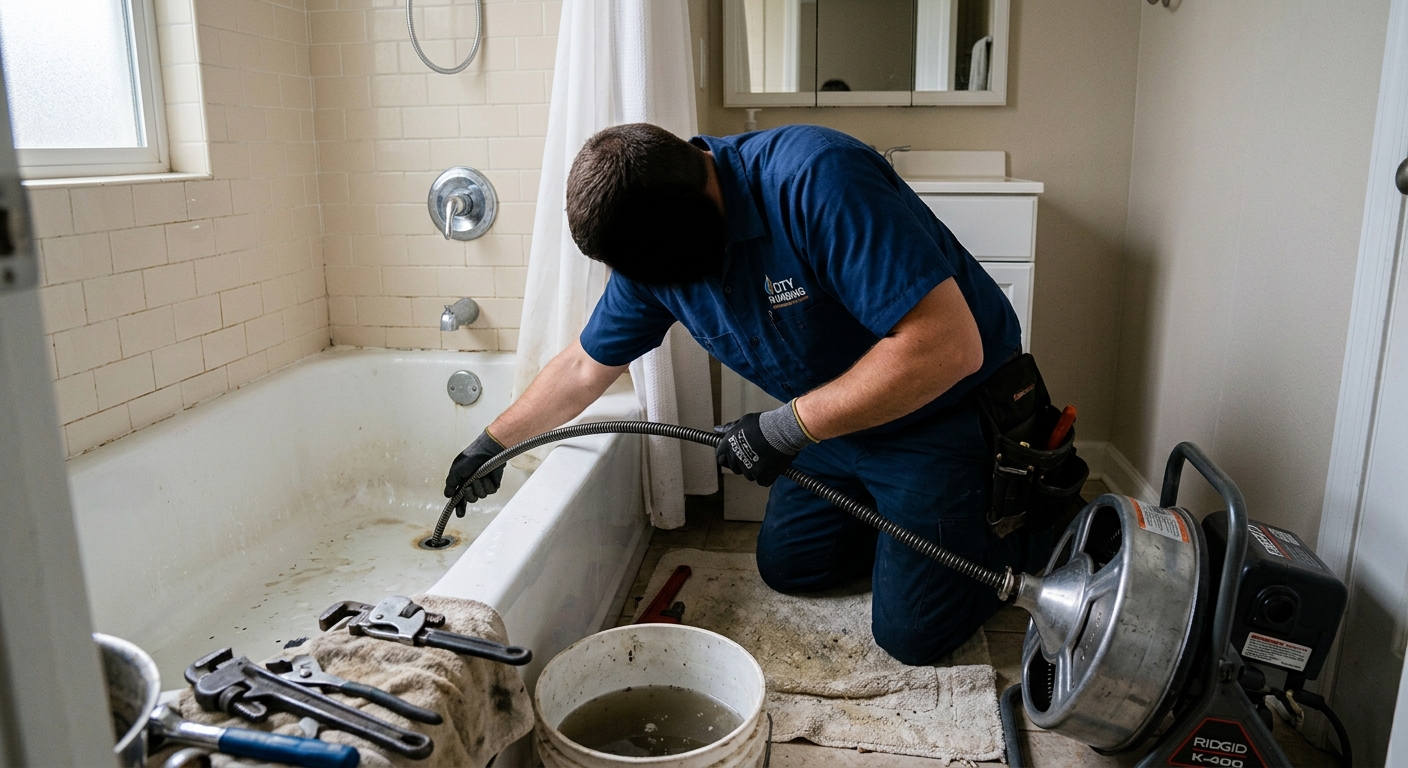
Drain cleaning costs in Tunkhannock depend on which line is clogged and how difficult it is to access. For mainline blockages—the kind that back up multiple fixtures or flood a basement—expect standard rates between $200–$500 for scheduled service, using auger or hydro-jet tools. Clogs inside single sinks or tubs fall on the lower end, unless removal or reassembly is needed. Emergency rates jump to $350–$800 if you call after hours. Most local plumbers will provide a fixed quote before work starts. Long-term, if you have a recurring problem, ask for a camera inspection; persistent blockages might point to pipe scale, root intrusion, or a partial collapse that costs much more to repair if ignored.
How do I find a hidden water leak?
In Tunkhannock, start by doing your own meter test—turn off all taps and check the water meter for movement. If it spins, you've got a leak on the supply side. For more elusive leaks, plumbers use acoustic listening devices, thermal imaging, and tracer gas. Costs for professional leak detection in our area run about $350–$1,150 if bundled with the first repair. The method depends on your house—if you have a slab foundation, tracer gas or listening devices are usually needed. Never let a contractor open walls or dig without first isolating the leak’s location with these tools. Systematic detection saves time, cuts wall repairs, and often leads to a smaller, faster fix compared to trial and error.