Plumbing costs in Warwick — 2026
If you own a home in Warwick, understanding local plumbing costs is crucial, especially when the unexpected happens. Warwick’s housing profile skews heavily to owner-occupied single-family homes (95.9% homeownership, per the U.S. Census Bureau, ACS 2024), and construction here largely postdates 1950 — but with nearly 16% of homes built before 1980. That split makes a difference: in neighborhoods like Levittown in Falls Township, mass-built copper and galvanized plumbing is reaching the end of its reliable life, which predicts more leak and repipe calls than in places with newer infrastructure.
With plumbing, the same repair will run two different prices — one for the middle of a freezing night, another for a planned fix when both you and the plumber have time to coordinate. Emergency calls always cost more, reflecting immediate response, after-hours labor, and often extra work to access or restore service. Standard rates assume you have the option to wait a day or two. With most Warwick homes being built to modern suburban layouts, access is generally straightforward unless you have an unheated crawlspace or original fixtures buried in finished basements.
| Service |
Scope |
Emergency rate |
Standard rate |
| Emergency repair — burst pipe |
locate, open, repair section, restore service |
$750–$1,500 |
$425–$1,500 |
| Water heater replacement (gas, 40–50 gal) |
remove old, install, test, haul away |
$2,300–$3,500 |
$1,500–$3,500 |
| Drain cleaning — main line |
augering or hydro-jet, camera if needed |
$350–$800 |
$200–$500 |
| Sewer line spot repair |
excavate or reline a failed section |
$2,500–$15,000 |
$2,500–$15,000 |
| Whole-house repipe |
replace supply lines throughout, patch and finish |
|
$4,300–$10,500 |
| Water service line replacement |
street to house, excavation and restoration |
|
$6,800–$15,000 |
Estimates for a typical Warwick home. Access difficulty and pipe material move these figures more than anything else.
Verifying a Warwick plumber's credentials
In Pennsylvania, plumbing licensing is not handled at the state level. There is no statewide plumbing board, license, or registry. Instead, each municipality sets its own licensing rules for plumbers. That means a plumber legally working in Bensalem Township or even Philadelphia may not have a valid credential to pull permits in Warwick. For homeowners, the right question isn’t “Are you licensed?” but “Are you authorized to work in this municipality?” If you’re unsure, ask for proof that your plumber is permitted by your township code office; in Bensalem, for example, the inspection and permitting process is run locally.
Projects that alter water or sewer piping layout or increase the fixture count generally require a plumbing permit. In Bensalem Township, nearly all substantive changes will. However, in places like Falls Township, minor like-for-like fixture swaps (such as faucets and showerheads inside existing rooms) can usually proceed without a new permit. The person who inspects your job will be from your township’s code office — not the state.
For contracts over $500, plumbers must have a Home Improvement Contractor (HIC) registration through the Pennsylvania Office of Attorney General. You can verify a contractor’s HIC registration at hic.attorneygeneral.gov. Any employer on your property is required to carry workers’ compensation insurance, verifiable at WCAIS (wcais.pa.gov). Never waive your right to a written contract on substantial work — state law (the Home Improvement Consumer Protection Act) requires it, and it gives you a 3-day cancellation right on jobs above $500.
Plumbing systems in Warwick homes
Most Warwick homes are suburban, single-family, and built well after World War II, matching the wider pattern in Bucks County — neighborhoods like Levittown set the tone, where mass construction after the 1950s means you’re likely to have original copper or, in some cases, galvanized steel supply lines. About 15.9% of homes pre-date 1980; these tend to show up with more plumbing issues, especially leaks and pressure problems, because galvanized pipe loses diameter as it corrodes.
The typical Warwick house will have copper or PEX supply pipes if it has been updated. Many older homes are on their second or even third water heater by now, since the average unit lasts around 10 years. Sewer lines are often original clay tile or cast iron in anything built before the late 1970s, while post-1980 homes should have more modern PVC drains and sewer laterals — less prone to root problems, but with their own aging issues.
In newer tract homes, “builder grade” fixtures dominate the bathrooms and kitchens; if these haven’t been replaced yet, expect failures in valves, shower diverters, and plastic supply lines. Warwick is not immune to the polybutylene supply pipe issue found in some early 1980s builds; these pipes are now considered unreliable. Even with newer construction, don’t assume trouble-free: original PEX or copper does eventually age out, and slab-on-grade layouts can complicate repairs if piping is buried. If you hear hammering, see blue-green stains, or have slow drains — your house is telling you it’s getting older, in plumbing terms.
Galvanized, copper, PEX, cast iron
Bucks County's post-1950 building boom brought a mix of plumbing materials, all with distinct life expectancies and quirks. In Levittown and similar developments, you’ll find aging copper and galvanized supply lines often undersized for today’s water demands. Galvanized steel was used pre-1960 and fails slowly as the inside rusts, closing off water flow and finally leaking at threaded joints. Copper, common from the 1950s on, is usually durable but can eventually develop pinhole leaks — especially if local water chemistry is aggressive.
If your home was built in the late ’70s to mid-’90s, watch for polybutylene. It looks gray or blue, uses crimp or clamp ring fittings, and is impossible to insure in many markets due to its record of sudden failures. Modern homes use PEX, which comes in red, blue, and white tubing and is usually clamped to brass fittings. For drain pipes, cast iron hangs on in homes built before 1975—black, heavy, non-magnetic—with typical failures appearing as rust blisters and cracks. If you find a heavy pipe with a bell-shaped joint in your basement, it’s probably original cast iron. Clay tile, used for sewer laterals up to 1980, shows up as sandy brown sections out in the yard and commonly lets roots inside at the joints. Newer drains are white or black PVC or ABS, joined at glued fittings.
The quick at-home test: scratch an exposed pipe lightly (ideally in the basement). Shiny silver is galvanized, copper is easy to spot, PEX and polybutylene are flexible plastics, and cast iron is dark and heavy. Estimating remaining service life gets easier once you identify what you have — because every material’s runway is predictable when you know the installation era.
| Material |
Typical era |
Failure mode |
Service life |
| Galvanized steel supply |
pre-1960 |
internal corrosion, pressure loss |
40–60 yrs |
| Copper supply |
1950s–present |
pinhole leaks, joint failure |
50–70 yrs |
| Polybutylene supply |
late 1970s–1995 |
fitting failure, sudden bursts |
unreliable |
| PEX supply |
2000s–present |
fitting or UV degradation |
40–50 yrs |
| Cast iron drain |
pre-1975 |
corrosion, cracking, scale |
50–75 yrs |
| Clay tile sewer lateral |
pre-1980 |
root intrusion at joints, offset |
50–60 yrs |
| PVC / ABS drain |
1970s–present |
joint separation, crushing |
50+ yrs |
Frozen pipes in Warwick: prevention and thaw
The southeastern Pennsylvania climate brings real risk of frozen pipes: our frost depth is 30 inches, and the winter design temperature drops to 14°F, with moderate freeze-thaw cycles and the occasional bitter spell. The way a pipe bursts isn’t always obvious — the freeze forms an ice plug, usually in a cold and exposed spot, but the rupture often happens between the frozen area and a closed faucet. Water trapped under pressure expands with nowhere to go, splitting the pipe, typically when it thaws out again.
Vulnerable spots in Warwick homes include pipes inside garage walls, crawlspaces, exterior hose bibs, and anywhere plumbing runs through an unheated attic. Even a short section of supply line run against a poorly insulated north wall can be a problem. The best prevention, ranked from least to most expensive: insulate any exposed pipes (foam sleeves or fiberglass wrap), seal up gaps near pipe penetrations, use heat tape for chronic trouble areas, let a trickle of water run during extreme cold snaps, and always shut off and drain outdoor spigots before the first hard freeze in fall. During unusual cold, opening bathroom or kitchen cabinet doors to let warm air circulate helps — especially on outside walls.
If a pipe does freeze, shut off the supply before attempting to thaw it. Use a hair dryer, space heater, or warm towels. Never, under any circumstances, use an open flame or a torch. The cost to repair a burst can run $425–$1,500 before any mold or drywall is addressed. Spending a few hours and a few dollars on pipe insulation will repay itself in the first hard winter.
Water quality and what it does to your pipes
Much of Warwick gets its water from the Bucks County Water & Sewer Authority, which means public water quality is monitored and reported annually — you can always call to request the latest water quality report. Public water is generally reliable, but the region usually sees moderate to hard water, which means calcium and magnesium deposits form inside water heaters and fixtures. Over years, this scale shortens the life of your tank and can reduce the flow at showerheads and faucets.
Aggressive, acidic water is less common on public systems here, but if present, it attacks copper pipes, causing pinhole leaks. A softener removes hardness, arguably extending appliance life, but be honest: these units come with electricity usage, salt purchases, and price tags that often run higher than occasional plumbing repairs. Whole-house filtration can be justified for taste, chlorine reduction, or sensitive skin, but for most Warwick homes, point-of-use filters (like under-sink reverse osmosis for drinking water) are a better payoff per dollar.
If you’re on a private well — more common in rural north Bucks County, but less so here — nobody else is testing your water. In that case, a well water test every year or two is good insurance. Beware installers recommending oversized or expensive systems; actual need almost never matches the sales pitch.
Choosing a water heater in Warwick
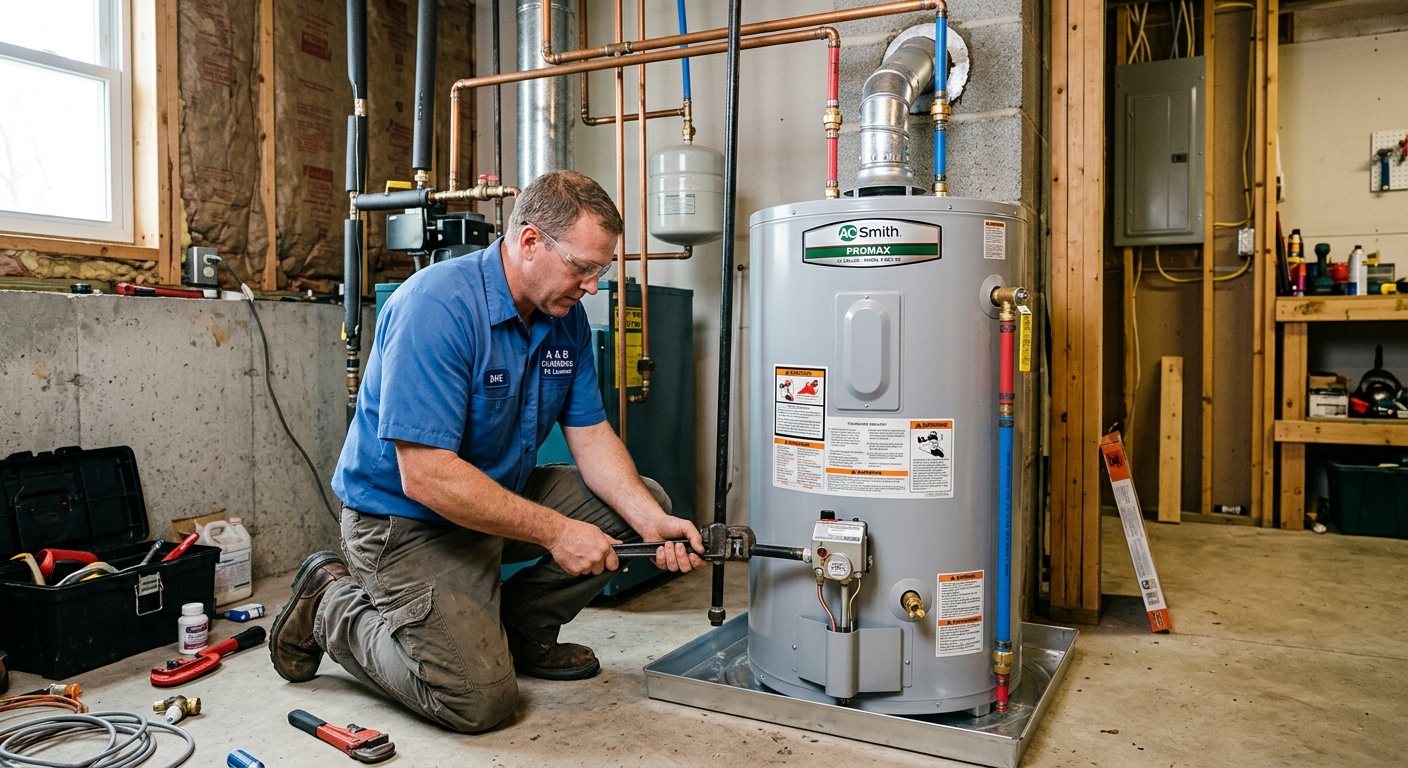
The three main types of water heaters each have their place in Warwick homes — but not everything makes sense for everyone. Gas tank-style heaters are the cheapest to install and most common in this market, where natural gas is typically available for most suburban properties. They last 8–12 years, fail by rusting out the tank bottom, and suffer from standby heat loss. Electric tanks are also common and last a bit longer (10–15 years), but cost more to run.
Gas tankless units are the “endless hot water” option, perfect for large or growing families, but the up-front cost covers not just the unit — you often need a bigger gas line and a new vent, which surprises some people. The life expectancy is longer (18–25 years), but expect higher maintenance and cleaning needs. Heat pump water heaters are the cheapest to run but are best placed in large, unfinished, and warm spaces. They’re louder, can cool the area they’re in (annoying in a finished basement), and sometimes struggle in tight mechanical rooms.
No matter what type, sizing should match the first-hour rating needed for your household — not just the tank’s gallon number. All new installs should include an expansion tank, a catch pan if installing over finished space, and (if possible) a drain to daylight or a sump. Most failures come as tank leaks, not electronic or thermostat problems.
| Type |
Installed cost |
Service life |
Operating cost |
Best when |
| Gas tank, 40–50 gal |
$1,500–$3,500 |
8–12 yrs |
moderate |
standard homes, gas available |
| Electric tank, 40–50 gal |
$1,500–$2,300 |
10–15 yrs |
high |
no gas service or smaller households |
| Gas tankless |
$2,300–$3,500 |
18–25 yrs |
low-moderate |
large families, space-constrained, new installations |
| Heat pump water heater |
$2,300–$3,500 |
13–15 yrs |
lowest |
warm, unfinished or mechanical rooms, electrified homes |
Frequently asked questions — plumbing in Warwick
What counts as a plumbing emergency?
Plumbing emergencies in Warwick are situations that require immediate attention to prevent property damage or health risks. Examples include an actively leaking or burst pipe where water can’t be shut off quickly, a sewer backup into your home, or a failed water heater flooding a finished basement. Other urgent situations are leaks near electrical panels, or when the only bathroom becomes unusable. Emergency calls typically command a higher rate due to the immediate response and after-hours labor required, and you can expect a repair band like $425–$1,500 for a burst pipe. Minor leaks under a sink or a dripping faucet do not rise to this level; unless water is uncontrollably escaping, you usually have time for a standard appointment. Remember, if turning a valve stops the flow and prevents damage, you can wait for regular hours and save money.
How much does sewer line repair cost in Warwick?
In Warwick and across Bucks County, sewer line spot repairs are among the biggest-ticket items for homeowners. The cost depends almost entirely on how deep the line lies, what’s above it (driveway, tree roots, lawn), and whether trenchless technology can be used. Typical rates for spot repairs here range from $2,500–$15,000. Older homes with clay tile laterals are most at risk for failures at joints, frequently due to root intrusion or line offset from shifting ground. Newer PVC laterals cost less to repair but failures are less common. If you experience repeated backups, especially during or after heavy rain, a camera inspection is the only way to know the extent of the problem and whether a localized spot repair or a full replacement is required.
Repair or replace a leaking water heater?
In nearly every Warwick home, a significant leak at the tank means it’s time to replace the unit. Tank water heaters fail from the inside, often spilling water suddenly. If you catch a minor leak at a copper fitting or a valve, repair might be possible, but for leaks coming from the tank body (especially at the base), replacement is the only safe and cost-effective answer. The installed price for a standard gas or electric heater is about $1,500–$3,500; tankless and heat pump models can run higher. Small repairs—like replacing pressure relief valves or thermostats—may buy time but don’t extend tank life. If your heater is over 10 years old and out of warranty, replacement is practically always the right call.
Do I need a permit for plumbing work in Warwick?
Most plumbing work that changes water or sewer piping layouts or alters fixture counts in Warwick’s surrounding boroughs and townships does require a permit from the local code office. For instance, adding a bathroom or relocating the kitchen triggers this requirement. In some municipalities, like Falls Township, routine swaps of existing faucets or showerheads in the same spot often don’t need a new permit. Always check with your township before work starts, and make sure the plumber has authorization to operate in your municipality. Permit costs are small compared to the risks of unpermitted work—especially if you’re planning to sell or refinance your home. Without proper paperwork, you could face delays or forced corrections.
Do I need to drain outdoor spigots in Warwick?
Yes—every Warwick homeowner with outdoor hose bibs or sillcocks should turn off the supply inside the house and drain them fully before winter’s first hard freeze. Bucks County’s frost depth reaches 30 inches, and a quick cold snap to 14°F can freeze standing water in unprotected pipes, causing bursts. Even “frost-free” hose bibs can split if hoses are left attached, so remove any attachments and ensure the line is empty. The cost of repairing a frozen and burst pipe starts at $425–$1,500, far more than the few minutes it takes to winterize outdoor faucets.
Is my water line lead?
Around Bucks County, especially in older neighborhoods, there are still about 2,000 known or suspected lead service lines pending replacement by the water utility. If your Warwick home was built before 1950, or if you have no record of a line replacement, there’s a real chance of lead pipe leading from the street to your meter. Lead is dull gray, soft, and scratches easily; use a screwdriver and magnet to check (lead is not magnetic). If you’re unsure, the most up-to-date information comes from Bucks County Water & Sewer Authority, and a plumber can confirm on site. Full replacement of a water service line typically runs $6,800–$15,000.
Am I responsible for the water line under the street?
In Warwick and most of Bucks County, homeowners are responsible for the water service line from the curb stop or property line to the house, not for the main in the street. Replacement from curb to house, including excavation and restoration, generally costs $6,800–$15,000. Responsibility for the section outside your property line varies by utility and municipality, so always verify the limit in your area with Bucks County Water & Sewer Authority before hiring. If an issue lies in the street itself, report it first—the utility is likely to handle that portion.
Are tree roots a common sewer problem in Warwick?
Yes, especially in homes built before 1980 where the original sewer lateral is likely clay tile. These lines are joined in short sections with cement, and tree roots readily intrude at the joints, eventually causing backups, slow drains, or even collapsed pipes. If you notice recurring blockages in multiple drains, particularly after rain, a camera inspection is the only way to know if roots are to blame. Removal starts with drain cleaning (typically $200–$500 during regular hours), but if the roots retaliate year after year, spot repair or full replacement becomes necessary. Newer homes with PVC sewer laterals aren’t immune to root issues, but they’re far less frequent.
What does drain cleaning cost in Warwick?
Drain cleaning for a main sewer line in Warwick typically costs $200–$500 in standard situations, and $350–$800 for emergency or after-hours calls. This service covers clearing blockages with an auger or hydro-jet, and sometimes includes a camera inspection to spot trouble spots or confirm the line is open. If the clog is due to root intrusion, the plumber might recommend a maintenance plan or camera follow-up to assess the likelihood of repeat issues. For simple sink or bathtub stoppages, cleaning costs are usually lower, but anything affecting the whole house should be checked from the cleanout to the street.