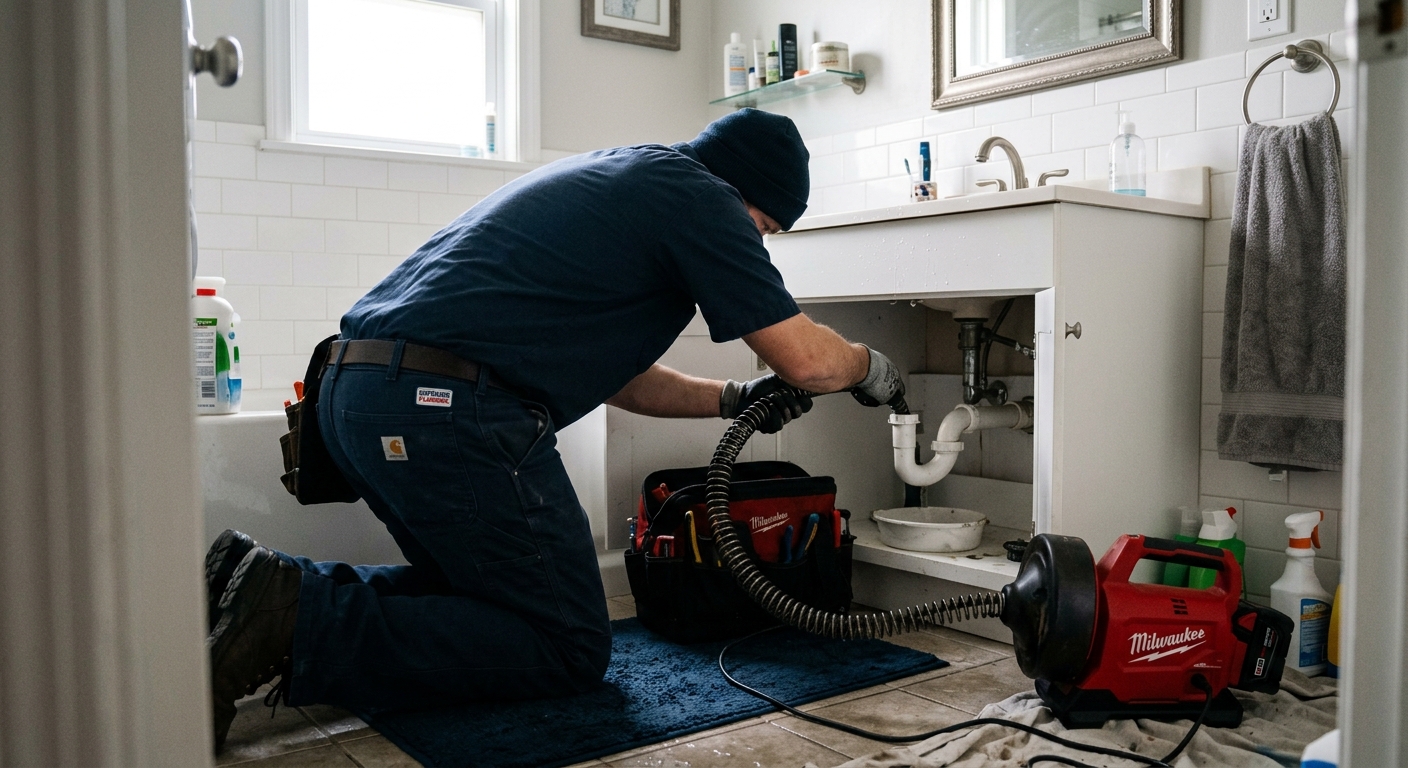
What plumbers charge in Castle Shannon
In Castle Shannon, where 82.8% of homes were built before 1980, most plumbing repairs and replacements tie back to pipe material and age. If your home is among the 2,178 owner-occupied properties (U.S. Census Bureau, ACS 2024), the odds are high you’re dealing with the original galvanized or cast-iron pipes. What this means for your wallet: older pipes are prone to leaks, corrosion, and blockages, so replacement work is significantly more common—and more expensive—than in newer suburbs.
For any plumbing job, there are two price points: emergency and standard. The difference? Emergency jobs—like repairing a burst pipe on a Saturday night—bring added charges for immediate response, after-hours labor, or complex cleanup. The same fix, if scheduled, costs less. With many Castle Shannon homes built before modern standards, jobs like whole-house repiping or water service line replacement can swing from a manageable planned project to urgent expense overnight.
| Service | Scope | Emergency rate | Standard rate |
| Emergency repair — burst pipe |
locate, open, repair section, restore service |
$550–$1,150 |
$325–$1,150 |
| Water heater replacement (gas, 40–50 gal) |
remove old, install, test, haul away |
$1,800–$2,700 |
$1,150–$2,700 |
| Drain cleaning — main line |
augering or hydro-jet, camera if needed |
$350–$800 |
$200–$500 |
| Sewer line spot repair |
excavate or reline a failed section |
$1,900–$11,500 |
$1,900–$11,500 |
| Whole-house repipe |
replace supply lines throughout, patch and finish |
|
$3,300–$8,100 |
| Water service line replacement |
street to house, excavation and restoration |
|
$5,200–$11,500 |
Estimates for a typical Castle Shannon home. Access difficulty and pipe material move these figures more than anything else.
Finding a hidden leak in Castle Shannon
The first leak detection step in Castle Shannon is free and simple: shut off all taps and appliances, then check your water meter. If the small dial or sweep hand is spinning, water is moving somewhere—likely through a hidden supply-side leak. For many old homes in Castle Shannon, this catches pinhole leaks in aging copper or steel faster than wandering around looking for damp spots.
When the meter shows a problem but you can’t find the source, plumbers use specialized methods. Acoustic listening devices (costing about a $200–$500 service fee) amplify the sound of water through pipe or concrete. Thermal cameras spot temperature differences on surfaces to pinpoint leaks behind walls or under floors at a similar price. Tracer gas—an advanced method only needed for elusive leaks—costs more, sometimes up to $800, but can locate breaks under a slab or foundation. For slab leaks, detection usually means combining all those approaches before breaking concrete.
Most leaks inside wall cavities can be found without opening anything; moisture meters and thermal imaging should tell you exactly where. For irrigation supply lines, acoustic and pressure testing isolate trouble below ground. If a plumber says they need to rip out walls first, get a second opinion—locating the leak comes before demolition.
What's in the water here
Castle Shannon receives its water from the Pittsburgh Water and Sewer Authority, which is required to publish an annual water quality report you can request directly. Most Castle Shannon homeowners deal with water that leans moderately hard, leading to calcium scale inside older galvanized and newer copper pipes alike. This chalky buildup shortens the life of water heaters and fixtures by slowly blocking flow and adding strain.
Aggressive (slightly acidic) water can cause copper pinhole leaks, especially in homes that still have sections of original piping from the 1900–1950 era. If you’re considering a softener, calculate honestly: unless you burn through appliances or absolutely hate scrubbing scale, the payback on a whole-house system rarely justifies the cost for the average household here. If you do need treatment, a point-of-use filter at the drinking tap handles most taste and safety complaints without expensive equipment or high maintenance.
For well owners in Allegheny County’s bordering townships, test your water yearly—no public report exists for private wells. Avoid spending on upsold filters if basic tests (hardness, lead, pH, bacteria) come back clean. For most Castle Shannon homes, annual heater and aerator maintenance matter more than new gadgets.
Licensing and permits for plumbing work in Castle Shannon
In Pennsylvania, plumbing isn’t licensed by the state. Instead, each municipality makes its own rules. In Castle Shannon and nearby Allegheny County communities, plumbing permits and licensing fall under the Allegheny County Health Department Plumbing Program. This means a plumber licensed in Pittsburgh, for example, isn’t automatically cleared to work in Castle Shannon unless they also meet county requirements. The important question is never just “are you licensed?”—it’s “are you licensed for this municipality?”
For new plumbing, major alterations, or anything more involved than a faucet swap, you need a plumbing permit from the Allegheny County Health Department. Simple fixture replacements (like toilets or faucets) usually do not require permits in this county, but adding or moving piping does. Inspections for permitted work are handled by the county health department, not the borough or a state agency.
Before you sign, check that any contractor holds a valid Pennsylvania Home Improvement Contractor registration (for jobs over $500). You can verify this directly at hic.attorneygeneral.gov. Employers must also have workers’ comp insurance, which you can confirm via the state’s WCAIS system (wcais.pa.gov). This protects you from liability if anyone gets hurt on your job. Always get the license and insurance details in writing before starting work.
Tank, tankless or heat pump water heater?
Choosing a water heater in Castle Shannon comes down to your home’s layout, your budget, and how much you value long-term operating cost over up-front price. Most homes here, especially those with space constraints and older mechanical setups, stick with traditional gas or electric tanks. These are cheapest to install, but their life expectancy is generally 8–15 years—shorter if your home’s water has a lot of scale.
Tankless water heaters are becoming popular for endless hot water and wall mounting, freeing up floor space. But in older Castle Shannon homes, upgrading to tankless nearly always means upsizing gas lines and adding expensive new vents. Those add-ons quickly drive installed costs toward the upper end of the $1,800–$2,700 range. You'll get 18–25 years of expected service life if you keep up with yearly maintenance, especially descaling.
Heat pump water heaters use much less energy but require a fair amount of space—think an open basement or utility area—and shift heat from the air into your water. They work best in warmer, unfinished basements. In a finished or already-cold basement common to Castle Shannon’s older builds, they’ll cool the room and can be annoyingly loud. Installed costs in this market match or exceed tankless options, but are offset by the lowest running cost long term.
No matter what you choose, sizing uses “first-hour rating” (how much hot water it can produce/hour) rather than tank size alone. Pennsylvania code requires an expansion tank if you’re on a pressure-reducing valve or backflow device. Use a drip pan and floor drain—almost every replacement I see here is needed because the tank failed and leaked, not because the controls died.
| Type | Installed cost | Service life | Operating cost | Best when |
| Gas tank, 40–50 gal |
$1,150–$2,700 |
8–12 yrs |
moderate |
existing gas, basic needs, budget install |
| Electric tank, 40–50 gal |
$1,150–$1,800 |
10–15 yrs |
high |
no gas available, small homes, simple swap |
| Gas tankless |
$1,800–$2,700 |
18–25 yrs |
low-moderate |
endless hot water, new gas line/vent OK |
| Heat pump water heater |
$1,800–$2,700 |
13–15 yrs |
lowest |
large unfinished basement, lower utility cost |
Lead service lines in Castle Shannon
Castle Shannon is served by the Pittsburgh Water and Sewer Authority, which actively identifies and replaces lead service lines in Allegheny County. If your home was built before 1950 and still has its original water line, there’s a real chance the supply is lead—not just from the public main to the curb (utility side), but also on your own property from the curb to the house (homeowner side). Utility-led replacement programs typically swap out only their portion; you’re responsible for the section on your land.
To check what you have, inspect the pipe where it enters your house, usually in the basement. Gently scratch the surface—lead will be a soft, dull gray. If a magnet doesn’t stick, that’s another sign it’s not steel or iron. PWSA’s service line inventory is public and well-maintained; Castle Shannon homeowners should request their home’s status directly or check on their website. Never assume your line’s been replaced just because neighbors have—it’s a house-by-house issue here.
If you need a replacement, expect to pay $5,200–$11,500 for a full water service line swap, or $3,300–$8,100 if you do a whole-house repipe with it. Be aware that a “partial” job—just replacing the public side—can spike lead levels for a few months by disturbing protective scale. If possible, coordinate both sides at once. Ask the utility about any cost-sharing before hiring anyone; if they don’t offer a program, it’s on you.
When to call now and when to wait until Monday
Emergency plumbing in Castle Shannon costs real money, driven by after-hours dispatch, a trip charge, overtime pay, and the fact that plumbers often work under time pressure with little time to plan or source parts. For the same repair—a small pipe leak, say—calling on a weeknight might cost $550–$1,150, while waiting until regular hours can bring it down to $325–$1,150.
True emergencies: active flooding from a burst pipe, sewage backing up into fixtures, total loss of water supply, or a gas odor should get immediate attention no matter the hour. Water pouring through a ceiling or a quickly spreading leak can destroy finishes and lead to mold inside of a day.
On the other hand, a slowly dripping pipe, a single slow drain, a toilet that runs but doesn’t overflow, or a stuck shutoff valve can almost always wait for a regular appointment. Waiting may save several hundred dollars if you can keep the situation stable.
To buy time, learn to shut off your main water: usually a round wheel or lever just inside where the line comes through your foundation wall. For toilets and sinks, look for small oval shutoff valves under or behind the fixture. Practice turning them off before you ever have to. If you can safely shut down the source, you often turn an after-hours emergency into a planned job.
Frequently asked questions — plumbing in Castle Shannon
Which utility supplies water to Castle Shannon?
The Pittsburgh Water and Sewer Authority is the primary utility supplying water to Castle Shannon homes. If you need to confirm your service or get answers about water quality or billing, contact them directly. Homeowners can also check their annual water quality report, which the utility is required to publish for all service areas. When considering repairs or replacement of service lines, always confirm utility programs directly—especially since a full water service line replacement can range between $5,200–$11,500 for a typical home in Castle Shannon.
What do I do if sewage is backing up?
If sewage backs up in your Castle Shannon home, stop using all drain fixtures immediately—no flushing, running sinks, or showers. Shut off the main water supply if possible, as this will prevent further waste from entering your drain lines. This situation counts as a true plumbing emergency because contaminated water can quickly damage floors, walls, and create a health hazard. Call a plumber for emergency drain clearing right away; expect to pay anywhere from $350–$800 to clear a main line, depending on the time and method used. Do not ignore this—delayed cleanup can mean bigger restoration costs and possible health risks.
How long should a water heater last in Castle Shannon?
In Castle Shannon, with our mix of harder water and homes that often date back to before 1980, standard tank water heaters generally last 8–15 years. Gas models trend toward the lower end and electric models can push longer if maintained. Higher mineral content means sediment builds up faster, shortening life if not flushed yearly. Tankless heaters last up to 25 years with maintenance; heat pump units usually 13–15 years. Replacement costs are typically between $1,150–$2,700 installed. If yours is over 10 years old and showing rust, leaks, or temperature swings, it’s often more cost-effective to replace than repair.
Should I leave a faucet dripping in cold weather?
In Castle Shannon’s freezing winters (local code frost depth is 36 inches and the design temp is 8°F), it’s sometimes wise to let a slow drip run overnight on extremely cold nights—especially in older homes with pipes close to outside walls or in unheated crawlspaces. The slight flow helps prevent water from sitting still and freezing, which can burst pipes. Still, if you’re relying on this trick every cold snap, it’s time for better insulation or relocating exposed pipes. Emergency frozen pipe repairs here start at $550–$1,150, so investing in permanent fixes pays off long term.
Repair or replace a leaking water heater?
If your water heater in Castle Shannon is leaking from the tank itself, replacement is almost always the right move—especially if it’s over eight years old. Tank leaks are not repairable, and patching rarely lasts, particularly given the scale buildup common to our water supply. If the leak is just at a pipe or fitting above the unit, a repair is usually quick and affordable. A new 40–50 gallon unit, including removal of the old, typically costs $1,150–$2,700 installed. For electric models, failure is less sudden but still not worth trying to fix the tank; go for replacement.
Is a sewer line replacement covered by homeowner's insurance?
In most cases, standard homeowner’s insurance in Pennsylvania does not cover the cost of normal wear or failure of a buried sewer line. Sudden physical damage caused by something like a tree root or collapse might be covered, but coverage varies by policy and most claim exclusions plug this gap. In Castle Shannon, spot repair or replacement of a failed sewer line runs between $1,900–$11,500, so it’s wise to check your policy and consider a sewer line endorsement or third-party “line warranty” if your home is older with original pipes.
Why do plumbers charge a diagnostic fee?
Plumbers in Castle Shannon nearly always charge a diagnostic or trip fee, especially for emergency or after-hours calls. This covers time spent traveling to your home, inspecting the problem, and providing a quote—even if you don’t end up moving forward. With a typical emergency repair running $550–$1,150, the diagnostic fee protects the contractor from losing time and money on no-shows or indecisive customers. This is standard practice across Allegheny County, reflecting the high demand and geographic challenges in the area. Many plumbers will apply the fee toward your final invoice if you proceed with the work.
What does emergency plumbing cost in Castle Shannon?
Emergency plumbing service in Castle Shannon—such as fixing a burst pipe or stopping a flood—usually runs between $550–$1,150 for common leaks, with after-hours rates covering same-day response, travel, and overtime pay. Deeper repairs like emergency drain clearing or water heater replacement after hours can cost more. The same repair during normal business hours generally falls to the lower end of the band ($325–$1,150). Castle Shannon’s older homes often mean tougher access, which can also raise rates. If you can safely turn off the main water and wait, you may save several hundred dollars.
Can I do my own plumbing work in Castle Shannon?
In Castle Shannon, minor repairs like replacing a faucet or toilet are typically fine for a homeowner to tackle—with no permit required, as commonly practiced in Allegheny County. But for larger jobs—new piping, moving fixtures, or anything involving the water service line—you must work with a plumber licensed through the Allegheny County Health Department and pull the correct permit. This makes sure the work meets Pennsylvania Uniform Construction Code and local health standards. Doing your own major piping work without a permit can bring fines or insurance headaches. For repairs over $500, written contracts are required under state law for consumer protection.