What plumbers charge in Hazleton
Hazleton’s older housing stock and variable access mean plumbing jobs here play out differently from what you might see in a newer suburb. With a homeownership rate of just 46.4% and more than 90% of homes built before 1980 (U.S. Census Bureau, ACS 2024), you’re likely dealing with pipes that predate modern materials—usually galvanized steel or even cast iron supply and drain lines in multifamily buildings. These aging pipes typically mean more complicated repairs and sometimes limited access, which raises costs. Multistory construction found widely in Hazleton and Wilkes-Barre means reaching and replacing pipes can involve cutting into walls and ceilings, often with old-plaster finishes that are expensive to repair.
One crucial factor in how much you’ll pay is whether you need emergency service. The same job—say, repairing a burst pipe at 2 p.m. or 2 a.m.—comes at dramatically different rates. After-hours emergency calls are not just pricier because of overtime, but because the breakdown itself may have caused more damage before you noticed or could respond. The table below shows what you can expect for common jobs in the Hazleton area. Notice the jump for emergency repairs and what drives up costs on big jobs like sewer and water service line replacement: digging, restoring, and dealing with crowded utilities under older streets.
| Service |
Scope |
Emergency rate |
Standard rate |
| Emergency repair — burst pipe |
Locate, open, repair section, restore service |
$500–$1,050 |
$300–$1,050 |
| Water heater replacement (gas, 40–50 gal) |
Remove old, install, test, haul away |
$1,650–$2,400 |
$1,050–$2,400 |
| Drain cleaning — main line |
Augering or hydro-jet, camera if needed |
$350–$800 |
$200–$500 |
| Sewer line spot repair |
Excavate or reline a failed section |
$1,750–$10,500 |
$1,750–$10,500 |
| Whole-house repipe |
Replace supply lines throughout, patch and finish |
|
$3,100–$7,400 |
| Water service line replacement |
Street to house, excavation and restoration |
|
$4,800–$10,500 |
Estimates for a typical Hazleton home. Access difficulty and pipe material move these figures more than anything else.
Sewer laterals: the pipe you own and can't see
Most Hazleton homeowners don’t realize they’re responsible for the buried sewer lateral running from the house all the way to the main line—even across public sidewalks and under streets. That point is the source of more “sudden” bills than any other plumbing issue in this area. The most common warning signs show up in a predictable order: it might start with a slow drain at the basement laundry, then progress to multiple slow drains or gurgling sounds, until finally you get a backup at the lowest fixture in the house.
Before anyone quotes digging up your yard or driveway, insist on a camera inspection. Dodging this step often leads to unnecessary excavation. In much of Luzerne County, the original laterals on older homes are clay tile, which typically fail at the joints and let in tree roots—those show up clearly on a camera. In others, you might find cast iron with “bellies” (sagging sections collecting waste) or offsets caused by settling over time.
Depending on the problem, trenchless pipe relining may spare you the cost and mess of open-cut excavation, but the decision should rest on visible proof from the camera: root intrusion in clay or a collapsed section calls for different repairs. In Wilkes-Barre’s city core, you’ll be dealing with city sewer mains and may need a permit for significant repairs. For many township homes, a septic system—not a public sewer—means a different routine altogether: regular tank pumping and drainfield maintenance, with problems showing up as soggy lawns or persistent drain clogs.
Bottom line, never accept any excavation quote until you have watched the camera footage yourself. In my experience, that’s the detail that protects Hazleton owners from the most expensive mistakes.
Choosing a water heater in Hazleton
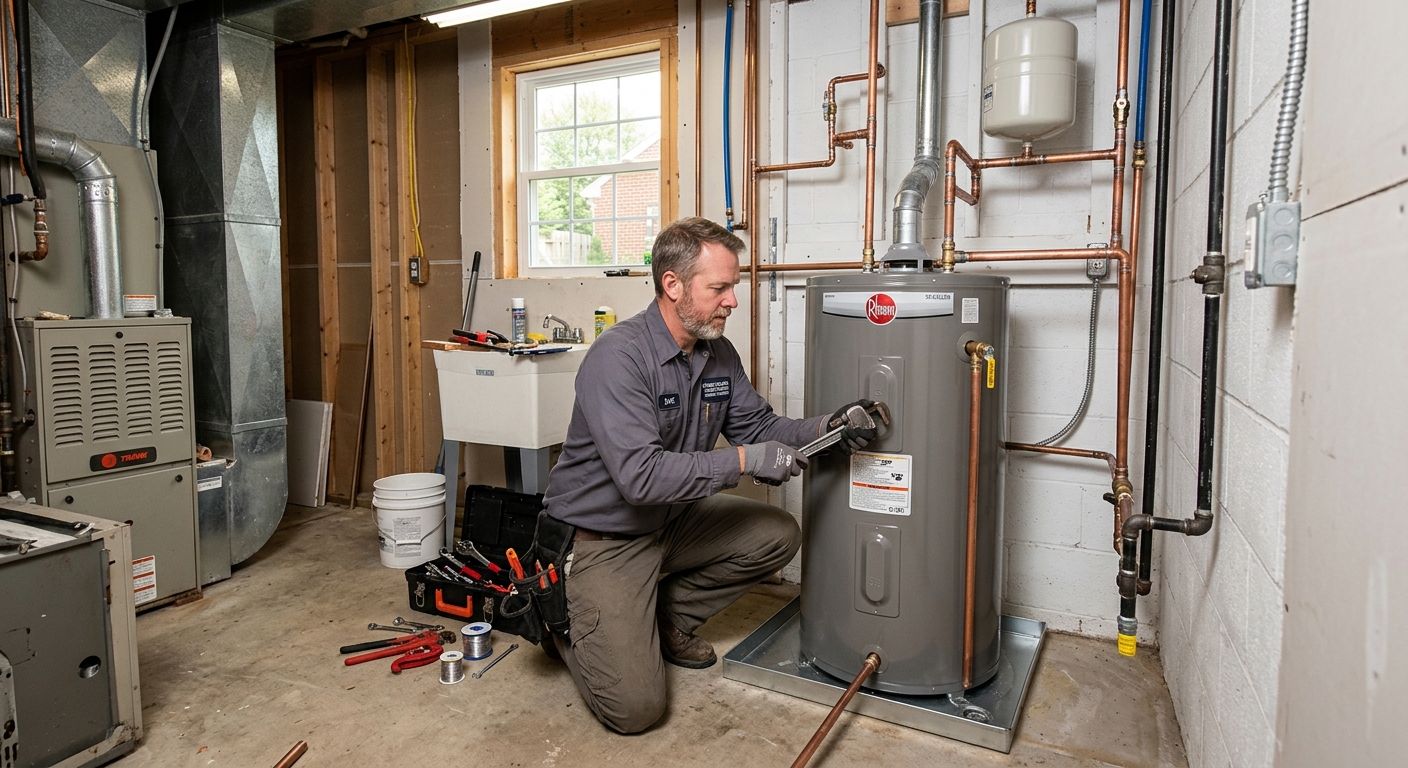
Replacing a water heater is usually a reactive job in Hazleton—you come home to a wet floor, not a warning light. Tank-style water heaters are the most common because they’re cheapest to put in, but they’re also the shortest lived and the least efficient, with “standby losses” meaning they keep heating water you’re not using. Gas-fired tanks are common where public gas is available, but in many Hazleton homes, access is limited or non-existent, shifting most electric replacements toward old-fashioned resistance tanks or, in recent years, heat pump water heaters.
Tankless heaters promise endless hot water and a longer life, but the price tag can surprise. Gas tankless units usually need a bigger gas line and new exhaust venting, driving install costs up higher than the sticker suggests. Heat pump water heaters—usually electric—cost the least to operate, but only if you have enough warm air volume (garage or unfinished basement), and they do cool the space where they sit. The fan can be noisy, which matters if you finish the space later.
Sizing isn’t about gallons but about first-hour rating—how much hot water you need between the first and last shower in the morning. In Luzerne County’s older homes, also plan for an expansion tank (required by code if you have a backflow preventer) and a drain pan piped to a floor drain if your heater sits above finished space. Most failures are tank ruptures from the inside out, causing leaks—controls rarely fail first—and replacement is usually the only cost-effective choice.
| Type |
Installed cost |
Service life |
Operating cost |
Best when |
| Gas tank, 40–50 gal |
$1,050–$2,400 |
8–12 yrs |
Moderate |
Existing gas service, basement install |
| Electric tank, 40–50 gal |
$1,050–$1,650 |
10–15 yrs |
High |
No gas, small or low-use home |
| Gas tankless |
$1,650–$2,400 |
18–25 yrs |
Low-Moderate |
Large family, space saving, gas supply |
| Heat pump water heater |
$1,650–$2,400 |
13–15 yrs |
Lowest |
Unfinished basement, moderate use, all-electric home |
Verifying a Hazleton plumber's credentials
In Pennsylvania, plumbing isn’t licensed at the state level—there’s no universal plumbing license, exam, or registry. Licensing is strictly municipal. This means a plumber legitimately licensed in Wilkes-Barre could be unlicensed a few miles away in Hazleton or in a rural Luzerne County township. Here, the practical test isn’t just “are you licensed?” but “are you licensed to do plumbing work in this municipality?” For Wilkes-Barre, your plumber needs a contractor license from that city’s Code Enforcement Office.
Permits are required for any plumbing work involving new or modified supply or drain lines—in Wilkes-Barre, that includes replacement and additions. The relevant authority inspects the work for code compliance, using the Pennsylvania Uniform Construction Code (UCC) as the standard. Every contract over $500 must be in writing under the Home Improvement Consumer Protection Act, and you have three business days to cancel. You can check Home Improvement Contractor registration through the state Attorney General’s online tool at hic.attorneygeneral.gov.
Ask for proof of current workers’ compensation. Verification can be checked via WCAIS (wcais.pa.gov). Don't let a contractor start major work without both registration and documented insurance—these are the basics that protect Hazleton homeowners from unnecessary risk.
When to repipe a Hazleton home
If you’ve had two or more leaks on the same line or in the same area within three years, you’re not unlucky—you’re overdue to consider a repipe. In Hazleton’s pre-1940 housing, galvanized supply and cast iron drains dominate. Once these materials fail, the pattern continues until you replace the offending sections. Telltale warning signs include falling water pressure throughout the house (not just at one fixture), brown or rust-colored water on first draw in the morning, visible rust or pitting at joints, or repeated pinhole leaks in copper. Any of these should prompt an inspection.
Copper remains the gold standard for repiping, but PEX is now common because it’s flexible (easier to fish through tight spots) and less likely to burst if it freezes. Partial repipes make sense if only one branch is failing and the rest is modern. Remember that drywall, plaster, and tile restoration drive up total costs—especially in older homes with thick plaster walls. Patchwork repairs only go so far on legacy piping, but a whole-house repipe is an investment that removes both the ongoing repair bills and the water quality headaches.
| Situation |
Recommendation |
Cost |
Reasoning |
| One leak, accessible, modern pipe |
Spot repair |
$300–$1,050 |
Cheapest fix; pipe type still sound |
| Two or more leaks in 3 years |
Partial repipe |
$3,100–$5,000 |
Pattern of failure, localized upgrade |
| Galvanized supply, pressure loss |
Full repipe |
$3,100–$7,400 |
Material is at end of life, wider issues |
| Polybutylene anywhere in the house |
Full repipe |
$3,100–$7,400 |
Uninsurable, liable to fail suddenly |
| Cast iron drain with root intrusion |
Camera, then reline or replace |
$1,750–$10,500 |
Spot failures in buried drains |
| Suspected lead service line |
Test, then replace the lateral |
$4,800–$10,500 |
Health hazard, legal liability |
Pipe materials in Hazleton homes and how they fail
Walk into a Hazleton basement and you’re likely to see a patchwork of decades-old pipes—each chosen in a different era with materials that age in their own ways. Many of the area’s pre-1940 multifamily homes still run on galvanized steel supply lines, which corrode from the inside. That’s why pressure drops before you see a leak. Copper supply, popular since the 1950s, lasts longer but can develop pinhole leaks if your water is acidic or high in dissolved minerals. Polybutylene, found in some homes renovated in the 1980s and 1990s, fails at its fittings—often suddenly and unpredictably.
Current repipe jobs use PEX: flexible, blue or red plastic, installed with crimp rings. It’s most reliable when kept away from UV light and protected from abrasion. On the drain side, cast iron—black, heavy, magnet sticks—shows up in almost every old Hazleton house, but it corrodes after 50 years and can crack from ground movement. Clay tile (brown/orange, brittle, with visible joints) marks the oldest sewer laterals, vulnerable to roots entering at the joints and offsets over time. PVC or ABS (white or black plastic) mark modern repairs or additions, more resistant to rot, but joints can be knocked apart if not buried and bedded properly.
To identify your own pipe, look for the joint: threaded (galvanized), soldered (copper), crimped ring (PEX), or glued socket (PVC/ABS). A metal pipe that scratches to bare steel is likely galvanized; a green tinge suggests old copper; plastic that’s gray and flexible could be polybutylene. Once a pipe’s expected lifespan is up, replacement is usually more cost-effective than patchwork repairs.
| Material |
Typical era |
Failure mode |
Service life |
| Galvanized steel supply |
pre-1960 |
Internal corrosion, pressure loss |
40–60 yrs |
| Copper supply |
1950s–present |
Pinhole leaks, joint failure |
50–70 yrs |
| Polybutylene supply |
late 1970s–1995 |
Fitting failure, sudden bursts |
Unreliable |
| PEX supply |
2000s–present |
Fitting or UV degradation |
40–50 yrs |
| Cast iron drain |
pre-1975 |
Corrosion, cracking, scale |
50–75 yrs |
| Clay tile sewer lateral |
pre-1980 |
Root intrusion at joints, offset |
50–60 yrs |
| PVC / ABS drain |
1970s–present |
Joint separation, crushing |
50+ yrs |
Freeze risk and what to do about it
Northeastern Pennsylvania’s ground frost runs to 36 inches, and the winter design temp sits at a frigid 4°F—meaning that subfreezing snaps happen every year, with high snow loads and severe ice-dam risks in the Hazleton and Poconos areas. Pipe freezes here aren’t rare. The science behind the damage is simple: when water freezes inside a pipe, it expands. But the burst typically occurs between the freeze and a closed faucet (not always at the ice plug) when pressure builds as more water tries to move through. The aftermath is a split pipe, often in finished space, and a water cleanup bill that dwarfs the cost of prevention.
Exterior walls with poor insulation, unheated crawlspaces, garages, hose bibs, and attics over old rowhomes are the main trouble spots. Prevention starts with pipe insulation (cheapest and best if it’s installed before cold weather), followed by electric heat tape for exposed pipes. On extreme cold nights, letting a faucet drip keeps water moving—a proven method in Hazleton’s coldest spells. Opening cabinet doors to let room heat reach pipes and shutting off and draining outdoor hose bibs before the first deep freeze can mean the difference between annoyance and disaster.
If you do face a frozen line, use a hair dryer, space heater, or a specialized heating cable on the pipe. Never use a torch or open flame: fires started this way cost more than the plumbing bill. The cost of an emergency burst repair here usually ranges from $500–$1,050, so a few dollars spent on insulation and some planning can easily pay for itself in Hazleton’s climate.
Frequently asked questions — plumbing in Hazleton
How hard is the water in Hazleton?
Hazleton’s water is moderately hard, with noticeable mineral content. Most homes on Pennsylvania American Water or other local borough supplies experience some limestone-origin hardness, which leads to scaling in water heaters and on plumbing fixtures, especially in older pre-1980 multifamily buildings. If you see white or chalky buildup around faucets or notice that soap doesn’t lather easily, that’s typical local water—not a plumbing failure. A basic in-home test kit can confirm hardness levels before you spend money on a softener. If scaling repeatedly shortens your water heater’s life, you might consider a heat pump or higher-end tankless unit, though both cost more up front—heat pump water heaters typically fall in the $1,650–$2,400 range including installation.
Does Pennsylvania license plumbers at the state level?
No, Pennsylvania does not license plumbers at the state level. Plumbing licenses are handled by the municipality: for instance, Wilkes-Barre has its own contractor licensing system through the city’s Code Enforcement Office, but that doesn’t transfer to Hazleton or other Luzerne County towns automatically. This is why the key question is “Are you licensed to work here?” not just “Are you licensed?” On larger plumbing jobs exceeding $500, a registered Home Improvement Contractor is required by state law, and every job should be backed by valid workers’ comp insurance, which you can check through WCAIS. Don’t hesitate to check these credentials before hiring.
How much does a plumber cost in Hazleton?
The cost swings widely based on the job and whether it’s an emergency call. In Hazleton, a standard service visit for minor repairs can start around $300, while emergency jobs—like fixing a burst pipe overnight—can run as high as $1,050. The complexity of working in pre-1940 housing with older galvanized or cast iron pipes means many plumbing jobs take longer or require extra repair to walls or ceilings. For water heater replacement, expect between $1,050–$2,400 depending on type and access. Always ask for a written quote and breakdown before the work begins.
How do I prevent frozen pipes in Hazleton?
Given Hazleton’s winter design temp of 4°F and common old basements and crawlspaces, frozen pipes are a real risk. Start by insulating pipes along exterior walls or in unheated areas—closed-cell foam is inexpensive. For exposed lines, especially under porches or in crawlspaces, heat tape provides extra protection. In extreme cold, open sink cabinets and allow a trickle at the highest-risk faucet to keep water moving. Before the first hard freeze, shut off and drain outdoor spigots. If you do have a freeze, never use an open flame to thaw pipes; a hair dryer or portable heater is both safer and usually effective. Compared to the cost of fixing a burst (often $500–$1,050), prevention is cheap and, in this climate, necessary.
Should I reline or replace my sewer line?
In Hazleton, the choice between trenchless relining and digging up your sewer lateral depends on the precise condition of the pipe and the material—often clay tile or cast iron in older homes. If the problem is limited to root intrusion at the joints or localized corrosion, trenchless relining can be less disruptive and usually costs on the lower end of $1,750–$10,500. However, collapsed pipes or significant bellies require excavation and full replacement. Always ask to see the camera inspection video before you decide; a legitimate contractor will provide this. In either case, repairs that reach under sidewalks or old driveways can raise the final bill, so honest visuals and a detailed proposal are crucial.
What does discoloured water on first draw mean?
If you notice brown or rusty water when you first turn on the tap in your Hazleton home, especially after the water’s been sitting overnight, it almost always traces back to internal corrosion in old galvanized steel supply piping—still common here due to the pre-1940 housing stock. This is sometimes harmless sediment, but persistent discoloration signals that your pipes are nearing the end of their life. Long term, repeated rusty water is a sign that a partial or full repipe might be needed. The cost for a whole-house repipe, depending on the material and finish work needed, ranges from $3,100–$7,400, but targeted repairs for small problems can cost much less if caught early.
Is a sewer line replacement covered by homeowner's insurance?
In most Hazleton policies, the answer is no: standard homeowner’s insurance does not cover normal wear or gradual deterioration of sewer laterals from the house to the main, even though you own that whole stretch. Some policies offer a “service line rider” as optional coverage, but it must be purchased in advance. If a backup causes interior water damage, that cleanup may be covered. Because a lateral replacement can run up to $10,500, it’s worth asking your agent about such coverage, especially with an older clay or cast iron line. No provision in Pennsylvania law requires insurance for these repairs, so do your homework before you need it.
What does emergency plumbing cost in Hazleton?
Emergency plumbing rates are always higher, reflecting both after-hours labor and the high odds of damage containment. In Hazleton, you should expect an emergency burst pipe repair to run between $500–$1,050, with more if extensive drywall, flooring, or ceiling repair follows. Emergency water heater replacement might tip into the $1,650–$2,400 range. If the work involves old construction or hard-to-access pipes—common here—the price leans higher. For non-urgent concerns, waiting for business hours can save you hundreds, but for active leaks or sewer backups, prompt response limits water damage and may reduce the overall repair bill despite the higher callout fee.
Should I wait until business hours to call?
If you have a manageable drip or a non-critical issue (like a slowly draining sink), it often makes sense to wait for regular business hours to avoid emergency premiums—standard rate jobs in Hazleton typically fall in the $300–$1,050 range rather than emergency rates. But if water is actively leaking from a pipe, a joint has burst, or you’re facing a sewer backup that could threaten finished spaces, don’t wait. The water damage (to walls, floors, and personal items) often exceeds any savings from deferring the repair. In Hazleton’s older multifamily and tight single-family homes, fast action can prevent a minor disaster from becoming a major cleanup.