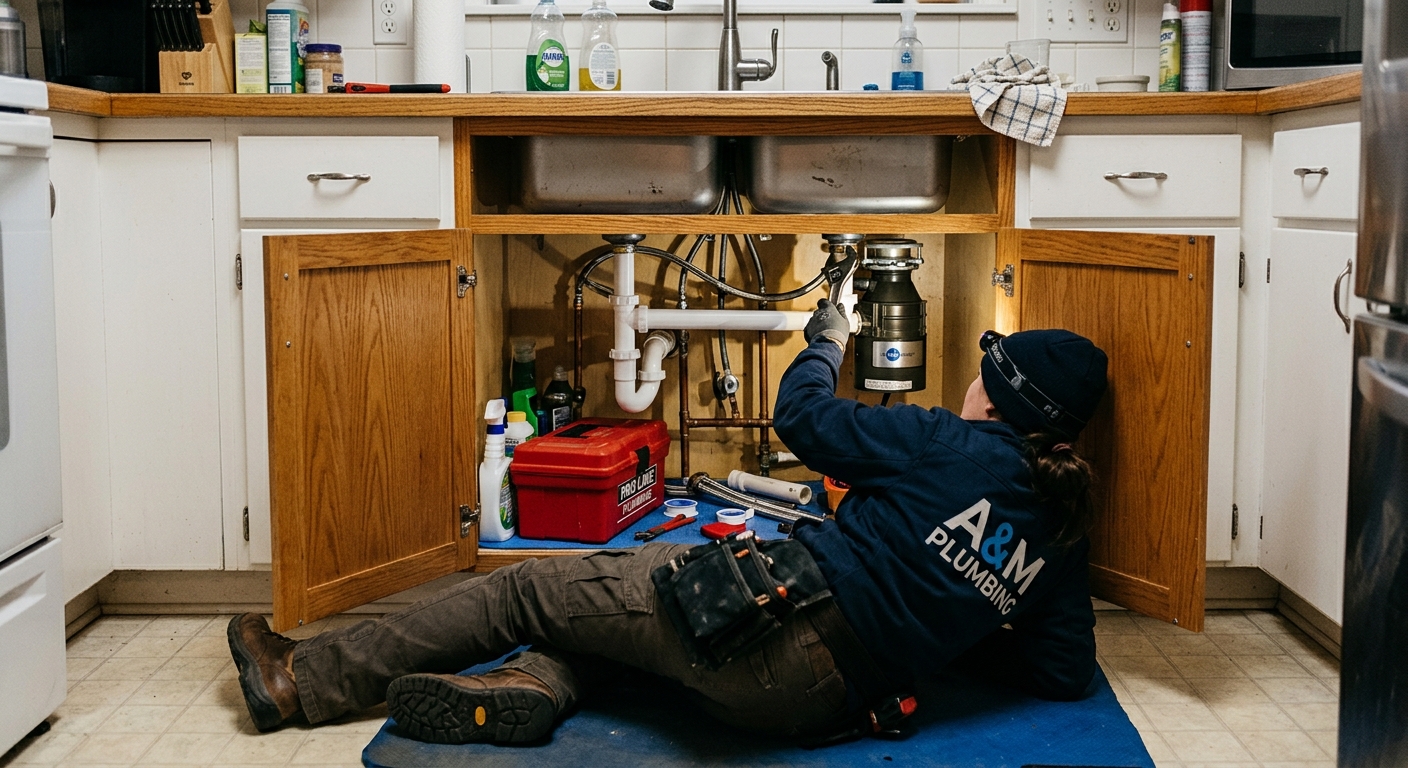
What plumbers charge in West Bradford
In West Bradford, plumbing costs are shaped by the era when most homes were built and by whether work is needed in an emergency. With a high homeownership rate (96.0%) and largely single-family housing (86.7%) (U.S. Census Bureau, ACS 2024), projects often involve well-lived-in systems and original builder materials. Clare stretches of Chester County—including West Bradford—saw substantial housing development between 1960 and 2000. That construction wave means many homes have copper or early PEX water lines and PVC or clay sewer laterals, each with their maintenance and replacement quirks. For example, copper-to-PEX repipes are common as older copper lines reach the end of their service life, and PVC sewer lines from that era can see joint failures or root intrusions.
One thing moves prices more than anything: whether the call is an emergency, like an active leak at night. Emergency rates—especially for burst pipes or failed water heaters—are always higher. Non-urgent replacements and planned upgrades can be scheduled at a standard rate. The size and layout of your home, as well as how walls and floors were finished when the neighborhood was built, can matter nearly as much as the problem itself.
| Service |
Scope |
Emergency rate |
Standard rate |
| Emergency repair — burst pipe |
locate, open, repair section, restore service |
$750–$1,500 |
$450–$1,500 |
| Water heater replacement (gas, 40–50 gal) |
remove old, install, test, haul away |
$2,400–$3,500 |
$1,500–$3,500 |
| Drain cleaning — main line |
augering or hydro-jet, camera if needed |
$350–$800 |
$200–$500 |
| Sewer line spot repair |
excavate or reline a failed section |
$2,500–$15,000 |
$2,500–$15,000 |
| Whole-house repipe |
replace supply lines throughout, patch and finish |
|
$4,400–$10,500 |
| Water service line replacement |
street to house, excavation and restoration |
|
$6,900–$15,000 |
Estimates for a typical West Bradford home. Access difficulty and pipe material move these figures more than anything else.
Is your water line lead? How to find out
Chester County’s water service is mainly provided by Aqua Pennsylvania’s southeast division and the West Chester Area Municipal Authority. According to Aqua Pennsylvania’s 2024 inventory, fewer than 1% of active service lines in Chester County are still lead. While that’s a very low share, the risk isn’t zero, especially in homes built before 1980 or those that have never replaced the original service line.
Your water service line has two parts: one side belongs to the utility (from the street to the curb stop), and one belongs to you (from the curb stop to your house). Replacement programs, if offered, often only cover the utility’s side—so verify with your provider before assuming anything is covered. In West Bradford, the homeowner side is almost always the one in question when you’re footing the bill.
To check if your home has a lead service line, look at where the pipe enters the basement or crawlspace. Scratch it with a key: lead will be soft, dull gray, and a magnet won’t stick. Copper is reddish and hard; galvanized steel is gray and magnetic. Be careful—partial replacement (changing just the utility or homeowner portion) will disturb mineral scale that may actually increase lead in water for a short time after work.
Aqua Pennsylvania’s online service line inventory will identify if your address has any known lead. If your line is lead and needs to be replaced, expect $6,900–$15,000 for full water service line replacement, depending on the length, depth, and how much landscaping is in the way. Spot repairs or partial replacements are not recommended due to the scale disturbance issue and can cost $2,500–$15,000, but they’re a last resort. Always call your utility to confirm programs or cost share—they change, and unless listed, assumptions can cost you.
Licensing and permits for plumbing work in West Bradford
Pennsylvania does not have statewide plumbing licensure. Instead, plumbing is licensed municipally, which means a plumber can be fully credentialed in one township but may hold nothing valid in the next. This matters in Chester County, where Westtown Township and other local municipalities run their own plumbing contractor registration in addition to anything recognized in Philadelphia. So, in West Bradford, don’t ask, “Are you licensed?”—ask, “Are you licensed to work here?”
In this region, all new or replacement plumbing connected to public water or sewer in West Goshen Township requires a township plumbing permit; other Chester County townships operate their own code offices with similar (though not always identical) requirements. That means work must be inspected by local code officials. The underlying code here is Pennsylvania’s Uniform Construction Code, which is based on the IRC and enforced by the municipality.
Any plumbing contract over $500 must use a contractor registered with the Pennsylvania Office of Attorney General as a Home Improvement Contractor (check hic.attorneygeneral.gov) and carry written contracts under the Home Improvement Consumer Protection Act. Workers’ compensation is required for all employers and can be verified through the WCAIS portal (wcais.pa.gov). Always ask for an insurance certificate showing both general liability and workers’ comp coverage—you want to be named on that certificate, not just a copy handed over.
Tank, tankless or heat pump water heater?
When replacing a water heater in West Bradford, homeowners face three choices: traditional tank, tankless, or heat pump models. Each has its place, and the most expensive option isn’t always the wisest for your typical Chester County home.
Tank heaters are the cheapest up front and offer reliable performance but waste energy through standby losses and often last only about a decade. Gas tankless models deliver endless hot water and use less energy, but usually need a larger gas line and a new vent—hidden costs for many homes. The long-term service life is a plus, but up-front costs are high. Heat pump water heaters have the lowest running costs, but they’re bulkier, need a lot of surrounding air, cool their space in summer, and make enough noise that you likely wouldn’t want one in a finished basement.
Sizing matters more than gallons—go by first-hour rating to match your household’s peak demand. Modern code and best practice require an expansion tank (protecting against pressure surges) and a pan with a drain if the heater’s in a finished area. Failures are usually from the tank rusting, not the controls—so any model with a steel tank is on the clock from the moment it’s filled.
| Type |
Installed cost |
Service life |
Operating cost |
Best when |
| Gas tank, 40–50 gal |
$1,500–$3,500 |
8–12 yrs |
moderate |
you need fast replacement, have gas, and space isn’t an issue |
| Electric tank, 40–50 gal |
$1,500–$2,400 |
10–15 yrs |
high |
no gas available, or emergency replacement needed |
| Gas tankless |
$2,400–$3,500 |
18–25 yrs |
low-moderate |
long hot showers, limited space, efficient use matters |
| Heat pump water heater |
$2,400–$3,500 |
13–15 yrs |
lowest |
unfinished basement, access to enough air volume, utility rebate offered |
Plumbing systems in West Bradford homes
West Bradford’s housing, much like the rest of Chester County, saw its biggest building booms between 1960 and 2000, with 38.1% built before 1980 (U.S. Census Bureau, ACS 2024). That means most homes aren’t dealing with the 1920s’ lead pipes and cast iron, but rather with copper supply lines, early PVC (and sometimes ABS) drains, and clay or PVC sewer laterals. Homes from the 1970s and 1980s may show signs of aging copper—thinning or corroded from decades of use—or still have their first builder-grade fixtures and valves.
Post-1980 homes are more likely to have PEX or copper water lines, though the very earliest PEX can be brittle or have issues at fittings. Some homes built in the late 1980s through mid-90s went up during the polybutylene era, and if you spot gray flexible tubing stamped with “PB2110,” it’s time for a full repipe. Sewer lines in this era are usually PVC, but joint leaks, gapping, or misalignment at the main are common as tree roots push in over time.
Water heaters in these homes may be on their second or third replacement cycle, since tank life is generally 8–15 years. Supply shutoffs, saddle valves, and old stop valves are signs the house could benefit from proactive updating. Newer homes aren’t free of plumbing headaches—they just bring a newer set of common failures.
Choosing a plumbing contractor
Choosing a plumber for your West Bradford home takes more than asking for a license number—they need to be properly registered both with the state as a Home Improvement Contractor and locally if your township has its own rules. Always confirm they are allowed to work in your specific municipality, because Chester County’s dense suburban market expects this and local enforcement is active.
Verify the contractor’s Home Improvement Contractor registration at hic.attorneygeneral.gov. Get an insurance certificate addressed to your property for both general liability and mandatory workers’ compensation (confirm this through WCAIS at wcais.pa.gov). Clarify if you’re dealing with company-employed crews or subcontractors, and demand up-front disclosure of emergency and after-hours rates, which are routine in this market. Inquire about permit handling and inspections—some townships require it, some don’t, and your plumber should steer you straight.
- Confirm municipal-specific plumbing registration, not just a general state number
- Home Improvement Contractor registration is active and matches business name
- Insurance certificate (general liability, your address as certificate holder)
- Workers’ compensation coverage through WCAIS
- Are crews employed or subcontracted?
- Contractor’s history and years local to Chester County
- References from recent local jobs (not generic or statewide)
- Clear written contract for any job over $500
- Emergency/after-hours rates provided in advance
- Will pull (and close) all required permits; willing to meet inspector
- Camera footage or pressure test supplied on major repairs and repiping
- No upfront payment required beyond materials deposit
Red flags in West Bradford’s competitive plumbing market: any repipe or sewer replacement quoted without first providing video or pressure test evidence, reluctance to address insurance or workers' comp, and evasive answers on permits. With as many established contractors as there are in Chester County, there’s no good reason to accept anything less.
Detection methods and what they cost
The simplest leak test costs nothing: turn off every faucet, and if your water meter’s dial is still spinning, there’s a supply-side leak somewhere. This catches anything leaking between the meter and your fixtures—including outside lines or slab pipes—without opening a single wall.
If you can’t isolate the leak yourself, plumbers in West Bradford use several professional methods—each suited to a different situation and each with its own cost. Acoustic listening detects leaks in pressurized supply lines by picking up the distinct “hiss” or “splash” noises made at a break, and generally costs in the lower hundreds. Thermal imaging spots temperature differences around leaks—useful for finding hot water leaks hidden in walls. Tracer gas (where an inert gas is pushed through the pipe and detected at the leak location) is highly accurate but pricier, best for under-slab or inaccessible leaks. Locating a slab leak usually runs from $450–$1,500 depending on depth and concrete thickness.
A reputable plumber should combine these methods before opening any wall or slab. For a mystery leak that isn’t gushing, insist on proper locating—breaking open walls first almost always means needless damage and cost, and in Chester County’s dense housing, access under floors is rarely impossible.
Frequently asked questions — plumbing in West Bradford
What does drain cleaning cost in West Bradford?
Drain cleaning for a main line in West Bradford typically runs between $200–$500 for a standard call using augering or hydro-jetting, and $350–$800 if you need it done in an emergency. Most homes here were built post-1960 and have PVC or cast iron mains, which are easier to clear than older, heavily-rooted clay lines but can still slow from buildup. If your main is backing up repeatedly, make sure your plumber includes a camera inspection in the quoted price—the source of frequent clogs could be an offset sewer joint, a crush point, or heavy grease deposits. Repeated fails without scope evidence are a sign to get a second opinion.
Should I leave a faucet dripping in cold weather?
In a cold Chester County snap, leaving one faucet open to drip overnight can prevent a frozen line, but in West Bradford’s post-1960 housing, most supply pipes are better insulated and buried below the frost line (30 inches, per code) than in prewar homes. If you have a sink or laundry line on an outside wall or unheated area, a slow drip can be cheap insurance—just don’t do it in every bathroom. If you do get a frozen pipe that bursts, you’re looking at an emergency repair costing $750–$1,500 after hours. More important: keep heat circulating, open cabinet doors under sinks, and insulate any pipes that have frozen in the past.
Is West Bradford on combined sewers or septic?
West Bradford, like most Chester County townships outside West Chester Borough, uses separated sanitary and storm sewer systems; many outlying areas retain private septic. If your home is outside of the main service corridors, you likely have an individual septic system, which carries its own maintenance needs—pump-outs, inspections, and watching what goes down the drain. For sewer line repairs on public systems, a spot repair runs from $2,500–$15,000 depending on access and whether relining or excavation is possible. If you’re on septic, avoid “flushable” products and chemical drain cleaners, as they’ll shorten your system’s lifespan.
Does insurance cover a burst pipe in West Bradford?
Most homeowners’ insurance policies in Pennsylvania, including West Bradford, do cover sudden accidental water damage from a burst pipe—provided you maintained reasonable heat. Insurers require you to take steps to limit damage as soon as a burst is discovered—such as shutting off the main water and getting an emergency plumber in. Typical costs for burst pipe emergency repairs here range from $750–$1,500. Note that gradual leaks, mold, or damage from neglect often aren’t covered, so keep records of all work and annual maintenance, especially in older homes likely to have aging copper or original PVC piping.
What do I do about a burst pipe right now?
If a pipe bursts in your West Bradford home, immediately shut off the main water supply—find it where the water line enters the basement, usually near the water meter. Open faucets to drain any remaining water and relieve pressure. Then, contact a plumber for an emergency repair, which here will usually run from $750–$1,500 depending on location, access, and after-hours timing. Remove any valuables from the affected area and, if safe, start mopping up to limit water damage. Your homeowners’ insurance is likely to cover sudden bursts but usually not long-standing leaks, so report it quickly and take pictures for documentation.
Is a water softener worth it in West Bradford?
Water in West Bradford—supplied by Aqua Pennsylvania’s southeast division—tends toward moderately hard, but not enough to force every homeowner into a softener. Still, if you see white buildup on fixtures or the inside of your kettle, or if your water heater struggles with sediment, you might benefit, especially with older copper inside and PVC outside mains. A basic softener install usually starts below the cost of an emergency pipe fix, and sometimes around $450–$1,500 installed. For many, periodic cleaning of aerators and simple water heater maintenance is enough—full-home equipment is rarely necessary unless the build-up is severe or you strongly dislike water spots.
How much does a water heater replacement cost in West Bradford?
The typical cost to replace a standard 40–50 gallon gas water heater in West Bradford runs between $1,500–$3,500, with most jobs landing around $2,400 if access is good and venting updates aren't needed. Upgrading to tankless or heat pump water heaters costs more up front—think $2,400–$3,500—but can pay off with energy savings, especially if you use a lot of hot water or have electric-only service. Always factor in code-required expansion tanks and pans in finished areas; skipping those is a costly mistake in case of failure.
Is my water line lead?
If your West Bradford home was built before 1980 and the water service line entering your basement is a dull gray pipe (not copper or plastic), it could be lead. Aqua Pennsylvania’s 2024 inventory says fewer than 1% of Chester County homes have active lead service lines, but that means it still exists. Check with a scratch and magnet: lead will be soft and non-magnetic. If you confirm it’s lead, replacement of the homeowner’s side typically costs $6,900–$15,000. Reach out to your water utility directly—don’t assume they’ll cover the cost unless you receive written confirmation.
Do I need a permit for plumbing work in West Bradford?
For any new or replacement plumbing tied to public water or sewer, a permit is generally required in Chester County townships such as West Goshen—and it’s best practice in West Bradford as well, since each township runs its own code office. Making changes without a permit can hold up real estate deals and void warranties or insurance. Your plumber should be able to tell you exactly what’s required and handle the paperwork and inspections. Expect to see permit fees built into any full repipe, major water heater replacement, or sewer work (costs for those projects: $4,400–$10,500 repipes, $1,500–$3,500 water heaters, etc.). Never skip permits—especially on jobs involving the supply main, which will be inspected on final.