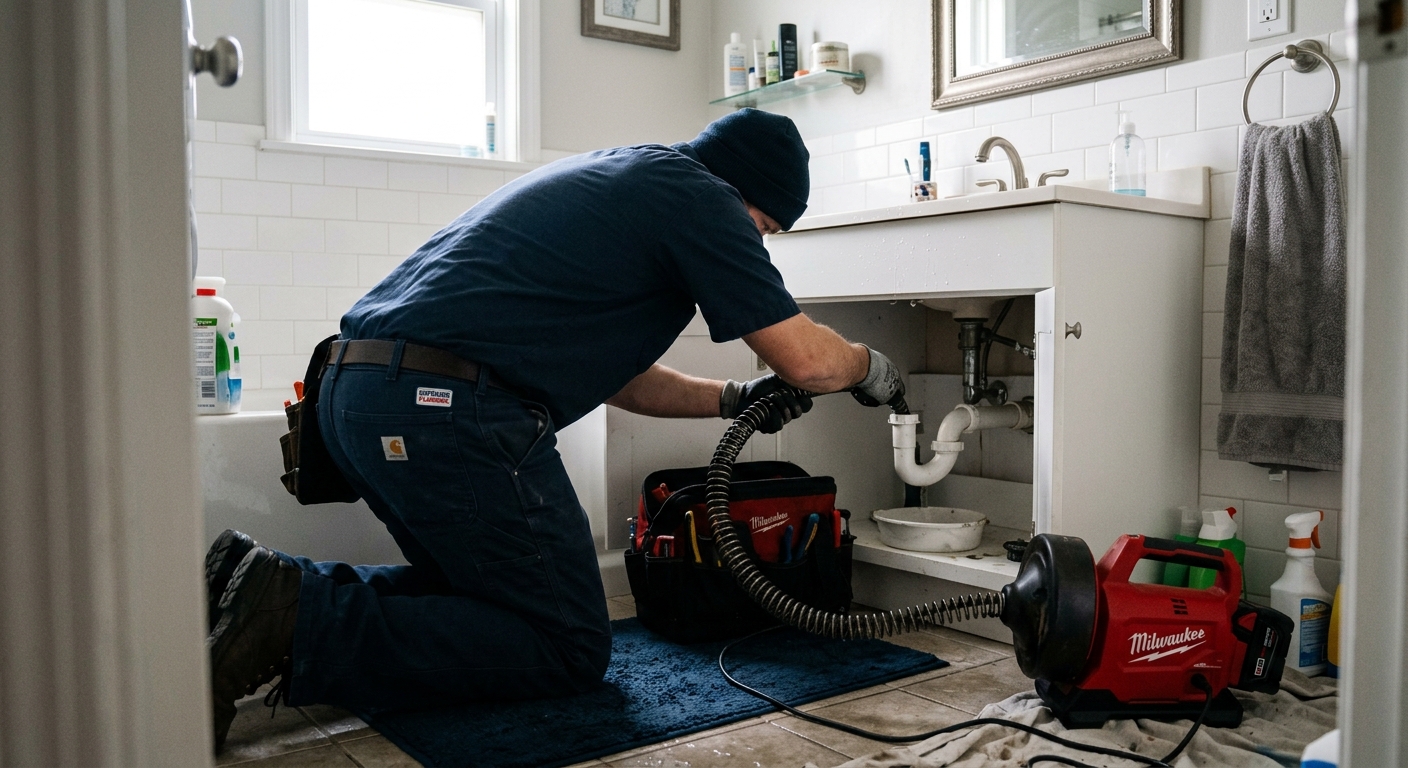
North Versailles plumbing prices by job type — 2026
In North Versailles, where 82.3% of homes were built before 1980 and nearly two-thirds are single-family (U.S. Census Bureau, ACS 2024), plumbing costs track directly to the age and material of your pipes. Much of the Pittsburgh region’s housing stock was built between 1900–1950, so galvanized steel and cast iron are still common, each with well-known failure patterns from leaks to complete blockage. The older the pipe, the more likely you are to see recurring problems—and the more restoration is needed after the fix.
Expect two prices for the same job: a premium if you need service right away (nights, weekends, or with water flooding), and a lower standard rate if you can schedule. The difference can run a few hundred dollars, which matters most on faster, labor-driven jobs like leak repairs or drain cleaning.
| Service |
Scope |
Emergency rate |
Standard rate |
| Emergency repair — burst pipe |
locate, open, repair section, restore service |
$550–$1,150 |
$325–$1,150 |
| Water heater replacement (gas, 40–50 gal) |
remove old, install, test, haul away |
$1,800–$2,600 |
$1,150–$2,600 |
| Drain cleaning — main line |
augering or hydro-jet, camera if needed |
$350–$800 |
$200–$500 |
| Sewer line spot repair |
excavate or reline a failed section |
$1,900–$11,500 |
$1,900–$11,500 |
| Whole-house repipe |
replace supply lines throughout, patch and finish |
|
$3,300–$8,000 |
| Water service line replacement |
street to house, excavation and restoration |
|
$5,200–$11,500 |
Estimates for a typical North Versailles home. Access difficulty and pipe material move these figures more than anything else.
Choosing a water heater in North Versailles
In North Versailles, most homes have gas or electric tank water heaters because they’re the least costly to install and fit the mechanical spaces you’ll find in typical 20th-century construction. Tank models are simple and work well, but their main weakness is energy loss—they keep reheating water around the clock, whether you’re using it or not. That’s “standby loss,” and it makes them less efficient, especially in our cold southwestern Pennsylvania winters.
Tankless gas units provide endless hot water on demand, but there’s a catch few mention up front: older homes with small gas lines often need an expensive upsizing and a new vent. That extra cost can surprise people. Heat pump water heaters are the cheapest to operate, but you need a fair amount of space (they draw heat from the surrounding air), and they blow cold air while running. If your mechanical room is finished or your basement is already cool, that’s a problem. They’re also noisier than most people expect.
North Versailles mostly has ready gas access, but in homes where gas is not available or the electric panel is undersized, heat pump or electric tanks are common. Size your water heater for your busiest hour, not just gallons—look for the “first-hour rating.” Expansion tanks, pans, and proper floor drains matter, so insist the installer does them. Most tank failures are the tank itself rusting out, not the controls, which is why life expectancy is limited by corrosion, not electronics.
| Type |
Installed cost |
Service life |
Operating cost |
Best when |
| Gas tank, 40–50 gal |
$1,150–$2,600 |
8–12 yrs |
moderate |
Existing gas line, standard basement utility area |
| Electric tank, 40–50 gal |
$1,150–$1,800 |
10–15 yrs |
high |
No gas; panel can handle load |
| Gas tankless |
$1,800–$2,600 |
18–25 yrs |
low-moderate |
Families with high demand; prepared for vent/gas upgrade |
| Heat pump water heater |
$1,800–$2,600 |
13–15 yrs |
lowest |
Large, unfinished basement; moderate temperatures |
Sewer line problems in North Versailles
In North Versailles and throughout Allegheny County, you own the sewer lateral from your house to the public main—even if it runs under the street. So, any repair or blockage is your responsibility, not the utility’s. Problems show up first as one slow drain, then multiple slow drains, gurgling, and water backing up at the lowest fixture (usually a basement floor drain or tub).
Because the area has both combined sewer systems and, in outlying townships, some homes still on septic, it’s important to know yours. For municipal sewers, the biggest repeat issues are tree root intrusion (in old clay tile), “bellies” (sagging areas that collect waste), and offset or disjointed pipe sections from shifting ground. If you’re on septic, slow drains can also mean your tank needs pumping (every 3–5 years) or you’re headed for a costly drainfield failure.
Always require a camera inspection before accepting a quote for excavation—honest contractors will show you the exact break, blockage, or root problem. This diagnostic is the only way to avoid unnecessary digging. Some repairs require open-cut trenching, while others can be relined without tearing up the yard, depending on pipe type and condition.
Don’t skip the camera footage. It protects both you and your contractor if there’s ever a dispute about what was fixed and why.
Is your water line lead? How to find out
Many North Versailles homes get water from the Pittsburgh Water and Sewer Authority, which is actively identifying and replacing thousands of lead service lines in Allegheny County. But here’s the catch: The service line is usually split—part utility-owned, part homeowner-owned. When the utility replaces their section, it may leave your portion untouched, and replacement programs often only cover their side.
To check your line, look at the pipe where it enters your basement. Scratch the surface with a coin (lead is dull gray; copper is reddish). A magnet will not stick to lead or copper, but will to older galvanized steel. If you find lead, it’s most urgent to replace the entire line at once, because partial replacement can shake loose the protective scale and actually boost lead in your water short-term.
The Pittsburgh Water and Sewer Authority publishes a service line inventory online. Search for your address, or call to confirm—never assume you’re in a replacement program. If your side isn’t scheduled, you’ll pay the homeowner portion. Replacement of a water service line in North Versailles typically falls between $5,200–$11,500. Full whole-house repiping costs $3,300–$8,000 if interior lead lines are found too.
Always ask the utility or your contractor what programs or cost sharing exist before starting work. Don’t count on automatic assistance.
What's in the water here
North Versailles is served by the Pittsburgh Water and Sewer Authority, which means your water is tested and reported annually—you can request the official water quality report for your property. Most local water is moderately hard, which means scale can build up in water heaters and faucets, reducing their lifespan. This is one reason older tank heaters here rarely make it more than 10–12 years before leaking.
Pittsburgh-area water isn’t usually aggressive enough to cause copper pinholes, but over decades some homes do see blue-green stains from copper leaching. Softening the water (with a softener) makes sense if scale is ruining appliances or fixtures, but for most households—unless you’re on a private well—the cost to install and maintain a softener isn’t recovered in savings. That’s why many plumbers in North Versailles don’t recommend one unless there’s a documented issue.
Whole-house filtration is mostly about taste and chlorine, not safety. If you’re concerned about lead or specific contaminants, install a point-of-use filter certified for that substance at the kitchen tap, rather than full-home filtration—which is oversold for our water supply. If you have a private well (less common), schedule periodic lab testing since no utility monitors your supply.
Licensing and permits for plumbing work in North Versailles
Plumbing in Pennsylvania is licensed not by the state, but municipally. This means a plumber working in Pittsburgh may not be licensed in North Versailles unless they’ve met local requirements. In Allegheny County, Pittsburgh and nearby municipalities use their own licensing system through the Allegheny County Health Department Plumbing Program, so always ask, “Are you licensed to work here?”
When it comes to permits, new or altered plumbing systems require an Allegheny County Health Department plumbing permit throughout Pittsburgh and surrounding areas. Basic fixture swaps (like faucets) can often be done without a permit. For anything bigger—a new bathroom, moving supply lines, or replacing a water heater—a permit and inspection are standard.
Under Pennsylvania law, any contract for plumbing work over $500 requires your contractor hold a Home Improvement Contractor (HIC) registration from the Pennsylvania Office of Attorney General (verify at hic.attorneygeneral.gov). Insurance and workers’ compensation are mandatory for all employers and must be verifiable using WCAIS (wcais.pa.gov). Never sign a contract without checking both, and never take an installer’s word for it—always look them up yourself.
When to repipe a North Versailles home
In North Versailles, if you’ve had two or more leaks in the same type of pipe within three years, it’s time to stop repairing and consider repiping. With so many homes built before 1980, recurring leaks are often a sign of pipe material reaching the end of its life—not just bad luck.
Other signals you can’t ignore: water pressure dropping at every fixture (not just one), brown or rusty water first thing in the morning, clearly corroded joints in exposed piping, or recurring small pinhole leaks. These are classic symptoms for old galvanized supply lines or failing copper, which are both common in this part of Allegheny County. For main drains, cast iron that’s cracked or root-bound also often justifies replacement over repeated snaking.
The big decision is copper versus PEX (plastic). Both are reliable; PEX is easier to route in older basements and less prone to freeze-burst, but some homeowners still prefer copper. Most forget that the real cost isn’t just replacing pipe, but also patching drywall and plaster—restoration can rival or even exceed plumbing labor in older homes with finished spaces.
| Situation |
Recommendation |
Cost |
Reasoning |
| One leak, accessible, modern pipe |
Spot repair |
$325–$1,150 |
Material/serviceable and not a pattern |
| Two or more leaks in 3 years |
Partial repipe |
$3,300–$5,400 |
Repeat failure — past service life |
| Galvanized supply, pressure loss |
Full repipe |
$3,300–$8,000 |
Obstructed, corroded throughout |
| Polybutylene anywhere in the house |
Full repipe |
$3,300–$8,000 |
High failure risk, no reliable repair |
| Cast iron drain with root intrusion |
Camera, then reline or replace |
$1,900–$11,500 |
Internal tree roots — repair is not enough |
| Suspected lead service line |
Test, then replace the lateral |
$5,200–$11,500 |
Health risk and code compliance |
Frequently asked questions — plumbing in North Versailles
Do I need to drain outdoor spigots in North Versailles?
In North Versailles, draining your outdoor spigots is a must before the first hard freeze. Our winter design temperature is 8 °F and frost depth goes 36 inches deep, so any water left in exterior lines can freeze and split the pipe behind your wall. Ideally, turn off the interior shut-off valve (common in older homes) and open the outdoor spigot fully to drain what's left. If your house is older—82.3% built before 1980 (U.S. Census Bureau, ACS 2024)—it's more likely your lines are rigid copper or even galvanized, both of which are highly vulnerable to freeze damage. A burst pipe repair starts around $325–$1,150, but the restoration from a hidden wall leak is usually far greater. Five minutes in the fall saves hundreds in the spring.
What does emergency plumbing cost in North Versailles?
Emergency plumbing rates in North Versailles start at $550–$1,150 for a burst pipe or active leak. Nights, weekends, or holidays always cost more because plumbers have to re-route other work and pay after-hours premium to their techs. Compared to scheduled repairs, you’ll pay a significant upcharge, especially for fast dispatch or when property damage is at risk. Drain cleaning or leaks inside finished basements may run higher if urgent restoration is needed. Emergency response is for active water loss or sewage backup—if your issue can wait, you’ll always save by scheduling for regular business hours. But when water is spraying or the lowest drain is backing up, don’t wait.
Is North Versailles on combined sewers or septic?
North Versailles is within Allegheny County, where most homes connected to the Pittsburgh Water and Sewer Authority use combined public sewers. In surrounding townships, some areas still use septic tanks—especially for homes not directly on public streets. If your sewer backs up or multiple drains are running slow, always confirm whether you’re on public sewer or a septic system, because solutions differ. For sewer line spot repairs, costs typically range from $1,900–$11,500 depending on depth and access. If you’re on septic, pumping your tank every few years prevents system failure—and that’s affordable compared to a full drainfield replacement.
Should I repipe my North Versailles home or keep repairing?
If your North Versailles house has needed two or more supply leaks fixed in three years, especially in galvanized or copper from the 1900–1950 era, you’re in repipe territory—not just a streak of bad luck. Whole-house repiping costs $3,300–$8,000 but ends the cycle of patchwork repairs, low pressure, and rust stains. If you’re only having isolated, modern pipe leaks (like PEX or newer copper), a spot repair at $325–$1,150 makes more sense. The threshold is repeated failures of the same aged material—when that pattern appears, replacement is smarter than continued patching.
Should I wait until business hours to call?
Unless you have water actively flowing where it shouldn't—like a burst pipe spraying or a main sewer backup—waiting until business hours can save you a significant premium. After-hours emergency rates start at $550–$1,150, but can be higher if multiple techs or immediate restoration are needed. In North Versailles, same-day service during regular hours can often be arranged for much less. If you can safely turn off the water or isolate the problem, that's almost always worth the wait. But if delaying risks property damage or health (sewage, flooding), pay for the urgent visit and prevent far greater repair costs after the fact.
Am I responsible for the water line under the street?
In most of Allegheny County, including North Versailles, you as the homeowner are responsible for the water service line from your house to the connection at the main, even if it runs under the public sidewalk or street. If your line needs replaced—especially for lead or recurring leaks—costs typically run $5,200–$11,500. The Pittsburgh Water and Sewer Authority may cover their portion up to the curb during replacement programs, but your stretch (often the most expensive, under pavement) is your responsibility. Always clarify scope, and ask the utility what portion, if any, they will handle. Never assume full coverage without checking in writing.
Who inspects plumbing work in North Versailles?
For homes in North Versailles (Allegheny County), the Allegheny County Health Department Plumbing Program is responsible for all permits and inspections of new or altered plumbing systems. This applies to bathroom remodels, water heater replacements, and full repipes—anything beyond minor fixture swaps. The plumbing code enforced is the Pennsylvania Uniform Construction Code, based on the IRC. If you’re signing a contract over $500, verify the plumber has active HIC registration at hic.attorneygeneral.gov and worker’s compensation via WCAIS. New work will not pass final without a municipal or county inspection, and inspection is included in permitted job costs (for example, $3,300–$8,000 for a repipe includes required sign-offs).
How long should a water heater last in North Versailles?
In North Versailles, with our moderately hard water and aging housing stock, most tank water heaters last 8–12 years before rusting out. Electric tanks sometimes make it 12–15, especially in households with water softeners. Poor water quality or lack of annual flushing can shorten life. Tankless gas heaters, if properly maintained, can stretch to 18–25 years. Heat pump water heaters usually last 13–15 years but require more clearance and can’t be jammed into a small closet. Replacement cost for a typical 40–50 gallon tank is $1,150–$2,600, installed. If your plumber is promising 20 years from a tank-type heater, be skeptical.
What does repiping a house cost in North Versailles?
For a whole-house repipe in North Versailles, expect to pay between $3,300–$8,000 depending on house size, pipe accessibility, and whether you choose copper or PEX. This range includes the labor to access and replace all supply lines, but not always full patching and paint—wall restoration in an older plaster home can double the cost if you want everything looking like new. Homes built before 1950, which make up a large share in this area, often cost more because pipes are tucked behind thick walls and odd framing. If you’re pricing a repipe, ask for an itemized bid that includes all cosmetic work, not just plumbing. That gives you the real budget.