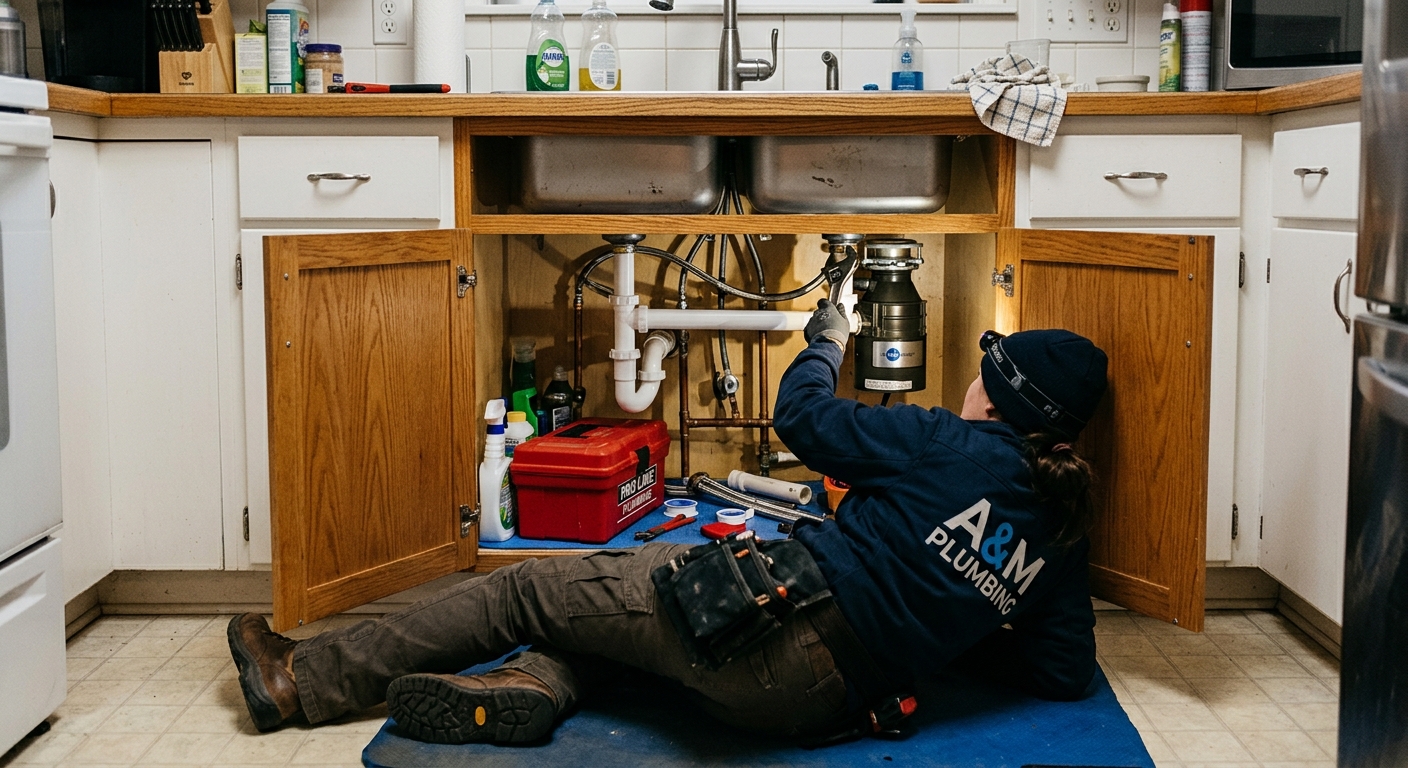
Montgomery plumbing prices by job type — 2026
In Montgomery, the cost of plumbing work depends heavily on whether your job is an emergency (like a burst pipe at 2 a.m.) or scheduled during business hours. Emergency calls mean faster response, overtime labor, and sometimes damage control — so rates can climb quickly compared to the same job done with time to plan. With over one-fifth of all homes built before 1980 (U.S. Census Bureau, ACS 2024) and mostly suburban houses from the 1950s to 1970s, this area sees frequent needs for pipe replacement, new fixtures, and water heater swaps. Here, era predicts pipe material — copper, galvanized, and some early plastics were all common — which then drives both what fails and what the repair costs.
For most households (owner occupancy is above 90%), you’ll see some typical scenarios: stopgap repairs for leaks in older lines, full repiping projects, and fixture updates. Service rates for the same repair vary: an after-hours leak repair will bill higher, while planned jobs like water heater replacement or sewer repair can land on the low end if there’s easy access.
| Service |
Scope |
Emergency rate |
Standard rate |
| Emergency repair — burst pipe |
locate, open, repair section, restore service |
$700–$1,350 |
$400–$1,350 |
| Water heater replacement (gas, 40–50 gal) |
remove old, install, test, haul away |
$2,200–$3,200 |
$1,350–$3,200 |
| Drain cleaning — main line |
augering or hydro-jet, camera if needed |
$350–$800 |
$200–$500 |
| Sewer line spot repair |
excavate or reline a failed section |
$2,300–$13,500 |
$2,300–$13,500 |
| Whole-house repipe |
replace supply lines throughout, patch and finish |
$4,000–$9,700 |
$4,000–$9,700 |
| Water service line replacement |
street to house, excavation and restoration |
$6,300–$13,500 |
$6,300–$13,500 |
Estimates for a typical Montgomery home. Access difficulty and pipe material move these figures more than anything else.
Tank, tankless or heat pump water heater?
In Montgomery, most homes are either on their first or second water heater, and the choice is shaped by installation space, how much hot water you need, and what you expect to spend — both up front and every month. The classic tank water heater is lowest in price, but it loses heat even when nobody’s using hot water (“standby” losses), and a tank failure is almost never gradual; it’s usually a rust-through leak or sudden burst. A gas tankless model gives you endless hot water and big space savings, but plan for extra cost: most installs between 1950 and 1980 assumed small gas lines and minimal venting, so you’ll often need a gas line upgrade and a new vent for code — two line items homeowners don’t see coming.
Heat pump water heaters are rising in popularity for efficiency, especially as electric rates climb. They’re cheapest to run but need a large volume of warm, unfinished space (like a utility room, not a finished basement), and they’ll cool and dehumidify the area they’re in. They’re also noisier.
Sizing is about first-hour rating, not just tank size. If your family does three showers and a load of laundry back-to-back, you need enough recovery — check manufacturer specs. Every replacement should include an expansion tank (required by code in pressure-regulated systems), and a pan and drain in a finished area. Expect to replace the whole unit at the end of its life; the tank usually fails first, not the controls.
| Type |
Installed cost |
Service life |
Operating cost |
Best when |
| Gas tank, 40–50 gal |
$1,350–$3,200 |
8–12 yrs |
moderate |
Existing vent, gas line sized; moderate demand |
| Electric tank, 40–50 gal |
$1,350–$2,200 |
10–15 yrs |
high |
No gas, low upfront budget |
| Gas tankless |
$2,200–$3,200 |
18–25 yrs |
low-moderate |
Small household, endless hot water needed |
| Heat pump water heater |
$2,200–$3,200 |
13–15 yrs |
lowest |
No gas, conditioned basement, lower bills matter |
Frozen pipes in Montgomery: prevention and thaw
Montgomery winters bring moderate freeze-thaw cycles with a winter design temperature of 14 °F and a frost depth of 30 inches, so every year brings phone calls about frozen pipes. The burst doesn’t usually occur at the frozen spot: ice forms, blocks water flow, then pressure between that plug and a closed tap builds until the pipe splits downstream. Common trouble spots are pipes on exterior walls, in unheated crawlspaces, above garages, in an unconditioned attic, or feeding hose bibs.
Prevention starts with pipe insulation and heat tape for exposed lines, especially those fed from an exterior wall or running through a garage. Before the first hard freeze, always shut off and drain outdoor spigots from their interior valve (a must here). In a bad cold snap, a slow trickle at a faucet and opening lower cabinet doors can save you hundreds. Never use an open flame — not a torch, not a lighter; use a hair dryer or warm towels to thaw pipes slowly, starting at the faucet and working back toward the blockage.
Getting caught by a freeze can mean an urgent repair — often running $700–$1,350 if you call in a plumber to clean up or repair a split pipe. Spending a few hours on pipe wraps, insulation, and draining hose bibs can keep that money in your pocket.
Who is allowed to do plumbing work in Pennsylvania
Pennsylvania handles plumbing licensing at the municipal level, not statewide. That means a plumber registered or even “licensed” in Norristown has to meet that specific municipality’s requirements, and those credentials may not transfer to a neighboring township. If you’re hiring for plumbing work, the right question is “Are you licensed and permitted for this address?” not simply, “Are you licensed?”
Any plumbing work that alters the system — including repiping, water heater swaps, or new/changed water, sewer, or vent systems — needs a permit in Norristown and in most surrounding Montgomery municipalities. Like-for-like fixture replacement without altering pipes generally does not. Inspectors are municipal employees; if Norristown, that’s the Code Enforcement Department — otherwise check with your own township office.
For contractor legitimacy, ask for Home Improvement Contractor (HIC) registration from the Pennsylvania Office of Attorney General (verify at hic.attorneygeneral.gov), and check workers’ compensation coverage for every contractor who employs others (verify via WCAIS at wcais.pa.gov). If you’re in a pre-1978 home, federal EPA Lead RRP certification applies to any work that could disturb paint — always ask for proof.
Detection methods and what they cost
If you suspect a leak in your Montgomery home, start with a free meter test: turn off every fixture, then watch your supply meter. If the dial still turns, there’s a leak somewhere between your meter and the last shutoff — usually on your side of the property line.
Professional leak detection starts at about $200–$500 depending on method and access. Acoustic listening picks up the sound of water escaping under pressure — good for hidden indoor leaks and slab leaks. Thermal imaging (infrared) finds temperature differences caused by cold water behind walls or in floors. Tracer gas (a harmless mix like hydrogen and nitrogen) can sniff out pinpoint leaks, especially through slabs. For a concrete floor (slab) leak, detection and location before cutting is essential, often billed as a flat fee.
Don’t let anyone start opening walls without a clear detection step — that is old-school and gets expensive fast. A skilled plumber will locate a leak before any demo, especially for non-obvious locations like an irrigation line under a walk, or a branch line hidden in a finished wall.
Sewer laterals: the pipe you own and can't see
In Montgomery County, homeowners are responsible for the sewer lateral from the house out to where it meets the municipal main, frequently under the street itself. Most confusion starts here: a sewer problem in the street is usually yours to fix, not the utility’s.
Symptoms start small — a single slow drain, then gurgling or slowdowns in multiple fixtures, then a backup at the lowest drain (often the basement or first-floor tub). If you notice these, get a camera inspection before any quote; this is the only way to see if the problem is roots in old clay tile (common in mid-century homes), a sag (“belly”), an offset joint, or collapse. Don’t let anyone quote excavation or relining until you’ve viewed the camera footage yourself.
Sewer spot repairs in Montgomery run from $2,300–$13,500 depending on depth, access, and how much pipe needs replacing. Trenchless relining is an option for many homes, and can save major disruption — but requires careful inspection first.
Most homes in Norristown are on the municipal sewer; septic exists only in some outlying townships. If you are one of the few using septic, your main worry is tank pumping (every 3–5 years) and keeping the drainfield clear; backups here are a different beast.
Montgomery's housing stock and its plumbing
Montgomery’s homes are largely mid-century suburban, with 21.3% built before 1980 (U.S. Census Bureau, ACS 2024). In these houses, you’ll often find copper or, in a few cases, early plastic supply lines inside and cast iron or clay tile drains under the slab or yard. Service lines to the street might be older copper, sometimes even lead on the oldest blocks. For many homes, the main water heater is on round two or three, matching a typical 10–15 year replacement cycle.
In the newer stock (1970s onward), builder-grade fixtures abound. Polybutylene and the earliest versions of PEX showed up in some homes, leading to later whole-house repipes. Even houses just hitting 40-50 years old can have water heaters, angle stops, and supply lines all reaching end-of-life together. “Newer” doesn’t mean you’re off the hook — it just means you’re likely tackling fixture upgrades, water heater swaps, and the first full-scale repipe instead of a patch or two on copper or iron.
Frequently asked questions — plumbing in Montgomery
Which utility supplies water to Montgomery?
In the Montgomery area, Aqua Pennsylvania is the primary water utility supplying the majority of single-family homes, including the boroughs and many surrounding townships. They’re responsible for maintaining the mains and setting the standards for water quality up to your property line. Everything after the meter — including the water service line and all interior pipes — is yours to maintain and repair as a homeowner. That means if you have a break in your water service line, you’ll be calling a local plumber, not Aqua, and a typical water service line replacement runs $6,300–$13,500 depending on distance and access. Always call 8-1-1 before any digging to have all utilities marked; your plumber or the utility will coordinate this for you.
Do I need a permit for plumbing work in Montgomery?
Yes, most plumbing jobs in Montgomery and Norristown require a permit if you’re altering the water, sewer, vent systems, or installing a new water heater. Even if you’re just moving a fixture more than a few feet, you’ll usually need municipal approval and final inspection. Minor like-for-like fixture swaps — such as replacing a faucet without changing piping — don’t need a permit. Permit fees run from a few dozen to several hundred dollars depending on job scope. If there’s any doubt, call your local code office to check. For a permitted water heater replacement, for instance, total install and permit costs typically fall in the $1,350–$3,200 band for a 40–50 gallon gas unit.
What does drain cleaning cost in Montgomery?
Drain cleaning in Montgomery depends on whether it’s an emergency or a planned job. During normal business hours, the cost to clean a main line (snaking or hydro-jetting, plus a basic camera inspection) typically ranges from $200–$500. If you call after-hours or on a weekend, that same job might run $350–$800. If a plumber finds a bigger issue, like a broken sewer line or heavy root infiltration, expect a more extensive (and expensive) solution, but for a straightforward clog or slow drain, these are your expected numbers.
How much does a plumber cost in Montgomery?
For emergency repairs — like a burst pipe with active leaking — expect to pay between $700–$1,350 in Montgomery. That reflects travel, specialty parts stocked, and off-hour labor. For scheduled work like fixture installation or planned repairs (replacing a valve or updating a water heater), you’ll generally see quotes in the $400–$1,350 range for small jobs, scaling upwards with complexity. Always get a detailed estimate, and don’t trust anyone quoting “flat fee for any job” — that’s often a bait-and-switch, especially in a market as competitive and regulated as suburban Philadelphia.
Should I wait until business hours to call?
If you have an active leak threatening to damage walls, ceilings, or flooring in your Montgomery home, do not wait; shutting the water off is your first move, followed by a call to a local plumber for an urgent visit. The cost for emergency service is higher — typically $700–$1,350 — but water damage spreads quickly and can end up costing much more in repairs and insurance claims. For minor issues (a slow drain, a faucet drip), it’s usually best (and cheapest) to schedule the work during business hours. Most plumbers reserve after-hours for true emergencies, and you’re likely to save several hundred dollars by waiting if waiting is safe.
Do I need to drain outdoor spigots in Montgomery?
Yes, draining and shutting off your outdoor spigots every fall is essential in Montgomery. Suburban homes here routinely face hard freezes, and the frost depth reaches 30 inches. If you don’t drain or shut off outdoor lines, water left in the pipe will freeze, expand, and often split copper or PEX, leading to leaks hidden inside finished basement ceilings or exterior walls. Emergency repairs for this type of split often cost $700–$1,350. Always turn off the interior shutoff (usually in the basement or utility room), open the outside valve to drain, and leave it open over winter. Installing a frost-free bib can help, but only if the pipe is sloped and drains when the valve is open.
Does insurance cover a burst pipe in Montgomery?
Most standard homeowners insurance policies in Montgomery do cover sudden water damage from a burst pipe — provided you were maintaining the system and not ignoring likely freeze risks (like uninsulated pipes or spigots left connected). Coverage usually does not extend to “wear and tear” repairs, only the actual water damage. That means you’ll pay the plumber’s repair fee (typical burst pipe: $700–$1,350), and the insurance may reimburse you for drywall, floor repairs, and personal property — minus your deductible. Important: Pennsylvania law prohibits a contractor (or anyone else) from waiving your deductible. Always document the loss with photos and repair receipts for your claim.
Repair or replace a leaking water heater?
In Montgomery, it comes down to where it’s leaking. If the tank itself leaks — water from the base or seam — the only realistic move is replacement, as repairs are not possible. A leaking valve or fitting above the tank can usually be fixed for a service call ($400–$1,350). Water heaters here, especially in homes built before 1980, are often on their second or third cycle; tanks last 8–15 years depending on model and water quality. Swapping out an old gas unit for a new 40–50 gallon tank runs $1,350–$3,200 and requires a permit. Don’t wait too long — tank failures often turn sudden, bringing water damage risks especially in finished basements.
How do I tell what my pipes are made of?
In Montgomery’s dominant 1950s–1970s housing, you’re most likely to find copper or galvanized steel supply pipes, with cast iron or clay tile drains under your slab or yard. Check wherever pipes are visible: a bright or green-tinged metal pipe is copper, a gray and heavy one is galvanized steel, and white/gray plastic is PEX or PVC. Your water service line, found near the meter, could be lead, copper, or even early plastics in some cases; an inspection by a plumber is best for confirmation, especially if you’re considering a whole-house repipe ($4,000–$9,700). Identifying pipe material helps you plan for upgrades before leaks or failures, which get far costlier if left to emergency repairs.