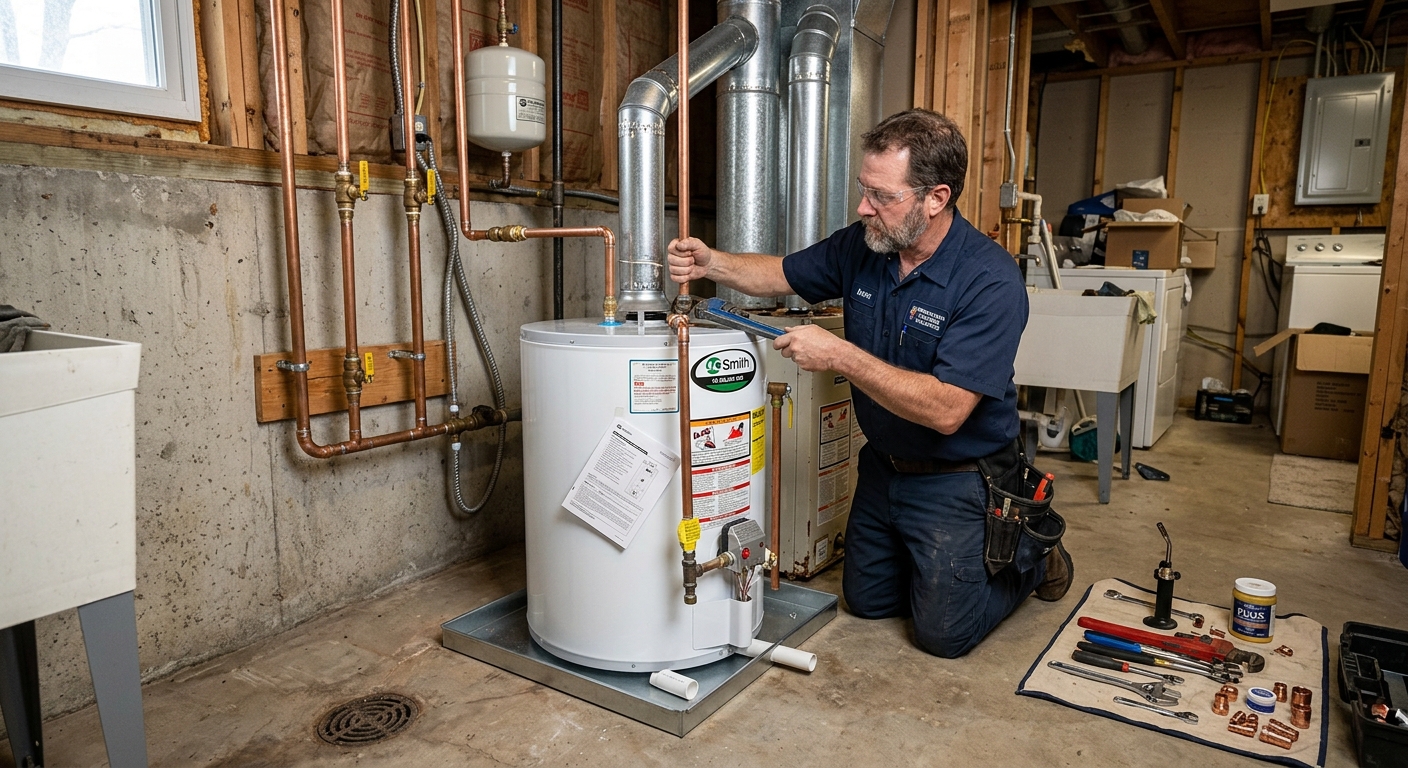
Plumbing costs in Hamilton — 2026
Hamilton’s plumbing costs reflect both the age and style of its housing. With 75.8% of homes being single-family and nearly half built before 1980 (U.S. Census Bureau, ACS 2024), most plumbing jobs here involve either maintaining older galvanized or copper lines, or working with PEX that’s already seen one retrofit. In the classic vacation or subdivision home built in the 1970s through 2000s, expect to see PEX piping for supply and either municipal sewer tie-ins or an aging septic system. That background shapes what often goes wrong — and what it costs to fix. Pipe material is the big cost driver: PEX is easier and cheaper to repair or replace; old galvanized, polybutylene, or copper can ratchet costs up fast depending on access and finish work.
In Hamilton, as everywhere in Monroe County, the price for any plumbing job splits into two tracks: emergency and scheduled. Pay a premium for after-hours calls, rapid response, and rush parts — or pay less if you can wait and schedule the work. An active leak that floods your basement at 2am is one price. The same repair, found and fixed during business hours, costs less. That split is the single biggest pricing driver, more than home size or location. Here’s what to expect for typical jobs in our area, including a mix of emergency and planned rates:
| Service |
Scope |
Emergency rate |
Standard rate |
| Emergency repair — burst pipe |
locate, open, repair section, restore service |
$600–$1,150 |
$350–$1,150 |
| Water heater replacement (gas, 40–50 gal) |
remove old, install, test, haul away |
$1,850–$2,700 |
$1,150–$2,700 |
| Drain cleaning — main line |
augering or hydro-jet, camera if needed |
$350–$800 |
$200–$500 |
| Sewer line spot repair |
excavate or reline a failed section |
$1,950–$11,500 |
$1,950–$11,500 |
| Whole-house repipe |
replace supply lines throughout, patch and finish |
$3,400–$8,300 |
$3,400–$8,300 |
| Water service line replacement |
street to house, excavation and restoration |
$5,300–$11,500 |
$5,300–$11,500 |
Estimates for a typical Hamilton home. Access difficulty and pipe material move these figures more than anything else.
What a plumbing quote should contain
When you get a plumbing quote in Hamilton, you’ll see two billing models: flat rate and time-and-materials. Flat rate means you pay one set price, no matter how long it takes to finish the job. You know your cost up front, but a simple fix can seem expensive because the price includes the contractor’s risk of the job running long. Time-and-materials (T&M) means you pay for hours worked and materials used; it can be cheaper on a straightforward job, but open-ended if surprises crop up behind your walls. Neither approach is wrong — the only real red flag is when you don’t know which you’ve agreed to.
Your quote should spell out if there’s a diagnostic fee (and whether it’s applied toward the repair), clearly state what gets opened, fixed, and patched, and whether wall or floor restoration is part of the price. For larger jobs, permit fees should be included. Make sure warranty terms are separated into labor and parts, since manufacturers’ part warranties often outlast labor coverage. If the work is outside normal business hours, the after-hours rate should be disclosed before you commit.
| Line item |
What to look for |
Red flag if… |
| Billing model |
flat rate or hourly, stated up front |
unstated |
| Diagnostic fee |
amount, and whether it credits |
vague |
| Scope |
what is opened, repaired and restored |
price with no scope |
| Restoration |
drywall and finish explicitly in or out |
silent |
| Permit |
included and priced |
'not needed' |
| Parts |
brand and model for fixtures |
'standard fixture' |
| Warranty |
labour period stated separately |
parts only |
Emergency rates versus scheduled work in Hamilton
Every plumbing job in Hamilton splits into two price tracks: emergency and scheduled. Emergency service costs more because it’s built from several layers: after-hours or weekend dispatch, a trip charge for getting a tech to your door fast, overtime labor rates due to night or holiday work, and the fact that the plumber has to diagnose and stop damage under serious time pressure. All of this stacks up quickly and shows up in your final bill.
Here’s how to triage what needs an emergency plumber, and what can safely wait:
- True emergencies (acts now, pay the premium): active flooding (burst pipe), sewage backing up into the house, no water service at all, any natural gas or propane smell.
- Can usually wait for business hours (save money): a slow drip under a sink, one slow drain when the rest of the house is fine, a running or stuck toilet, hot water out but no sign of leaking or flooding.
The difference can be $300–$800 or more. For example, an after-hours burst pipe call runs
$600–$1,150 versus
$350–$1,150 if you can safely hold for a morning appointment.
If you’re able to shut off the water at the main or the fixture, you turn most “emergencies” into scheduled work — and cut hundreds from the bill. In a Monroe County home, look for the main shutoff where the water line comes through the basement wall, usually near the front foundation or in a utility closet. At individual fixtures (toilets, sinks), turn the oval handles clockwise to close. Never force; if it won’t budge by hand, leave it and close the house main instead.
Water heater replacement decisions
Hamilton’s home styles mean you’re likely replacing a tank water heater — but deciding what to go with next is a mix of up-front cost, operating cost, space constraints, and venting. Here’s the honest breakdown:
Tank water heaters (gas or electric): cheapest to install, and fit most closets or mechanical rooms. They lose some heat (standby loss) just sitting there, last 8–15 years, and when they fail, it’s usually the tank that gives out, not the controls.
Tankless (on-demand) gas water heaters: endless hot water, better efficiency, and wall-mounted, but the install costs more, and in Monroe County homes, it’s common to need a new gas line or vent pipe to meet code — which can surprise you at installation time. For most Hamilton homes with average hot water demand, tankless saves on energy, but the upgrade rarely pays for itself before the next replacement.
Heat pump water heaters: lowest operating cost, and worth it if you have a large, unfinished basement. They use the air around them for heat, so they need lots of space and can cool down (and noisily dry out) a finished basement, which isn’t ideal for every family.
Regardless of type, sizing should be by first-hour rating (how much hot water it delivers in an hour), not just tank size. Always ask for a pan and a drain connection, and budget for a new expansion tank if your old one is more than five years old.
| Type |
Installed cost |
Service life |
Operating cost |
Best when |
| Gas tank, 40–50 gal |
$1,150–$2,700 |
8–12 yrs |
moderate |
existing gas, typical demand |
| Electric tank, 40–50 gal |
$1,150–$1,850 |
10–15 yrs |
high |
no gas line, modest usage |
| Gas tankless |
$1,850–$2,700 |
18–25 yrs |
low-moderate |
endless hot water, space saver |
| Heat pump water heater |
$1,850–$2,700 |
13–15 yrs |
lowest |
large, unconditioned space, electric only |
Licensing and permits for plumbing work in Hamilton
Pennsylvania does not license plumbers at the state level. Plumbing licensing is municipal, meaning every locality writes its own rules. In practical terms, a plumber with permission to work in one Monroe County township might not hold any credentials in another. When you’re hiring in Hamilton, the question is, “Are you approved to pull a permit and do this work here?” — not just “Are you licensed?”
All residential construction, including plumbing, follows the Pennsylvania Uniform Construction Code (UCC), as enforced by the local municipal authority, often through the East Stroudsburg Borough Code Enforcement office in much of Monroe County. Large projects like new water heaters, repiping, sewer tie-ins, or water service replacements require a permit, which includes inspection for code compliance. Always ask to see the permit included in your quote.
Every contractor on a job over $500 must have Home Improvement Contractor (HIC) registration from the Pennsylvania Office of Attorney General. You can verify this at hic.attorneygeneral.gov. Insurance — especially workers’ compensation if there is a crew — is mandatory for all employers. Verify coverage directly through WCAIS (wcais.pa.gov). For properties built before 1978, contractors must also comply with the federal EPA Lead RRP Rule: you can check status at certifiedrenovatorsearch.epa.gov.
When to repipe a Hamilton home
Don’t repipe just because of one pinhole or leak — but if you’ve had two or more leaks in the same pipe material within three years, that’s a pattern. Other warning signs: low pressure across the whole house (not just one faucet), brown or yellow water on first draw, visible corrosion or minerals at joints or valves, and especially repeated pinholes. In the vacation and subdivision homes built from the 1970s to 2000s around Hamilton, you’ll see early PEX retrofits and a handful of older copper, galvanized, or even risky polybutylene pipes left over from the first build or an early renovation.
Copper is more expensive and harder to install but lasts longer; PEX is cheaper, flexible, and a good fit for most Hamilton homes’ crawlspace and basement runs. Whole-house repipes cut future headaches but cost more, and the missing cost line in most estimates is drywall or plaster repair — which can double your final bill in homes with finished or plaster walls.
| Situation |
Recommendation |
Cost |
Reasoning |
| One leak, accessible, modern pipe |
Spot repair |
$350–$1,150 |
Cheapest fix, no sign of wider failure |
| Two or more leaks in 3 years |
Partial repipe |
$3,400–$5,500 |
Pattern means more failures are coming |
| Galvanized supply, pressure loss |
Full repipe |
$3,400–$8,300 |
Corrosion internally, can't flush or patch |
| Polybutylene anywhere in the house |
Full repipe |
$3,400–$8,300 |
Material fails unpredictably, insurance risk |
| Cast iron drain with root intrusion |
Camera, then reline or replace |
$1,950–$11,500 |
Spot repairs won't last, need to scope first |
| Suspected lead service line |
Test, then replace the lateral |
$5,300–$11,500 |
Health risk, regulatory pressure to replace |
Frozen pipes in Hamilton: prevention and thaw
Hamilton’s winter means planning for pipes in a ground frost depth of 36 inches and temperatures as low as 4°F, with harsh ice dam exposure typical in the Poconos. Pipes freeze because they’re above this frost line—most at risk are in exterior walls, crawlspaces, unheated garages, or anywhere above an unconditioned basement or attic. The burst usually isn’t at the frozen spot — it’s between the ice plug and a closed fixture, where pressure climbs until a weak point splits.
The best defenses, from cheapest up: add pipe insulation on any exposed runs in crawlspaces or garages, install heat tape on key sections, crack faucets to a trickle on frigid nights, open cabinet doors under sinks, and always shut off and drain outdoor hose bibs before the first hard freeze. If a pipe does freeze, thaw gently with a hair dryer or heat lamp moved along the pipe — never use an open flame (torch or lighter), as it’s the number one way to start a house fire during a freeze event.
The cost of a burst pipe in Hamilton runs $600–$1,150 for a typical after-hours call, not counting water damage remediation. A little prevention, done before December, is always cheaper than the thaw-and-repair after a January snap.
Frequently asked questions — plumbing in Hamilton
What do I do if a pipe is frozen but not burst?
If you discover a frozen pipe in your Hamilton home but it hasn’t burst, act fast but don’t panic. First, open the faucet the pipe serves — this relieves pressure and gives thawed water somewhere to go. Then use a hair dryer, heat lamp, or a warm towel to gradually thaw the pipe starting near the faucet end and working back. Do not use any open flame, such as a torch, since that is a major fire hazard and can cause the pipe to burst or nearby combustibles to ignite. If you can’t reach the frozen section or if it’s inside a wall, turning up the heat in that part of the house and giving it time may help. If the pipe is inaccessible or you see any sign of a bulge or split, call a plumber rather than risk a flood. Catching it early is key — if the pipe does burst, Hamilton emergency repair rates run between $600–$1,150.
How hard is the water in Hamilton?
Most homes in Hamilton and the surrounding Poconos have moderately hard water, typical for northeastern Pennsylvania. If you’re on municipal water in East Stroudsburg, expect visible mineral buildup in fixtures and appliances over time. On a private well, you could see higher or lower hardness depending on your aquifer. Hard water isn’t bad for your health, but it can shorten the life of water heaters (especially tank models) and lead to scale in plumbing. For an older home already due for a water heater replacement, budget $1,150–$2,700 and consider adding a scale filter if you see frequent buildup. If your dishwasher or faucets show white deposits, a softener may help but isn’t always necessary unless you’re bothered by the effect.
What does repiping a house cost in Hamilton?
Repiping a home in Hamilton is an investment — but sometimes, with repeated leaks or old galvanized pipes, it’s the only way to avoid ongoing water damage. For a typical home, a whole-house repipe runs $3,400–$8,300. The cost depends on the type of pipe (PEX is cheaper than copper), accessibility (open basement ceilings are easier and cheaper), and how much drywall or plaster needs patching after. In some older vacation homes with finished basements or tricky wall finishes, restoration can rival the plumbing cost. Most repipes use PEX in this region due to ease and freeze resistance. If you’ve had two or more leaks in three years, or your water pressure is dropping house-wide, it’s usually time to get a repipe bid.
Does Pennsylvania license plumbers at the state level?
No. In Pennsylvania, plumbing is licensed at the municipal level, not by the state. Every town or township can set requirements, so a plumber working legally in one Monroe County community may have no credentials a few miles away. In Hamilton, what matters is whether your contractor can pull permits and pass code inspections for your specific project. Don’t settle for a generic “licensed and insured” statement — specifically ask, “Are you registered and approved for work here?” For larger jobs (over $500), your contractor should also be registered with the state as a Home Improvement Contractor (HIC). You can check this at hic.attorneygeneral.gov. And with a new water heater or repipe costing anywhere from $1,150–$8,300, it’s worth making the call before work starts.
How do I shut off the water to my house?
In almost every Hamilton home, the main water shutoff is either in the basement (near where the water line enters through the foundation) or in a mechanical closet if you’re on a slab. Turn the wheel or lever clockwise (right) to close — don’t force it if it’s corroded or stuck. For leaks at a single fixture, you’ll also find small shutoff valves under sinks and behind toilets; turn these right to close. Knowing how to do this can turn a plumbing disaster into a simple repair job — for example, a burst pipe after midnight becomes an affordable fix in the morning, dropping the bill from $600–$1,150 to as low as $350 if you schedule the repair after the emergency is over.
Why do plumbers charge a diagnostic fee?
Diagnostic fees in Hamilton exist because it takes time and expertise to find the source of a plumbing issue — especially in homes built before 1980 with multiple renovations and patchwork done over decades. A clear diagnostic process, which can run from $200–$500 for drain issues, pays for camera inspections, trip time, and expertise, not just the fix. In many cases, the fee is credited toward the actual repair if you go forward with the work. Be sure the terms are stated up front and ask if the charge is applied to the final bill. If your plumber won’t say or seems unwilling to discuss the fee, that’s a red flag — clear, written scope is key under Pennsylvania’s Home Improvement Consumer Protection Act.
Repair or replace a leaking water heater?
In Hamilton, if your water heater is under 8 years old and the leak is from a fitting, valve, or the temperature-pressure relief, it’s often repairable. If, however, the tank itself is leaking from the bottom or showing signs of rust and corrosion, replacement is the only safe option. The average cost for replacing a gas tank heater is $1,150–$2,700, but that includes haul-away and proper venting for local code. Remember, tank leaks can quickly turn into emergency calls if not addressed, running those bills higher. If yours is more than a decade old and showing any sign of corrosion at the base, expect that replacement is the best use of your money. Newer water heaters also run more efficiently, which can help with Hamilton’s moderately high utility costs.
Is my water line lead?
Some Hamilton homes, especially those built before 1980, may still have lead service lines from the street or well to the house. If your supply line at the basement wall is a dull gray, scratches shiny, and attracts a magnet (or not), you might have lead. To be sure, have it professionally tested — don’t guess. Replacement runs $5,300–$11,500 but is a smart investment for health and for resale value, especially as regulations tighten. If you’re planning a major plumbing upgrade or already opening up your yard, combine work for the best value. Aging galvanized pipes are less common, but can still lead to lead-solder concerns; those are best addressed with a repipe for overall safety and peace of mind.
Who owns the sewer lateral, me or the city?
In Hamilton and across Monroe County, the homeowner is responsible for the sewer lateral — the section of pipe that runs from your house to the main in the street or to your septic tank. The utility or municipality (like East Stroudsburg) handles the main line only. This means any clogs, collapses, or root intrusions happening between your foundation and the curb are yours to fix, with spot repairs running $1,950–$11,500 depending on access and scope. For homes on septic systems, you’re also responsible for the tank and drain field. Always get your lateral inspected with a camera before you buy or sell. Problems in this “no man’s land” are expensive, but an early camera test can save a fortune in missed damage or emergency repairs.